To atone for the sins he committed serving his country, ex-covert government agent Paul Janson is determined to save the world: one person, one mission, one redemption at a time.
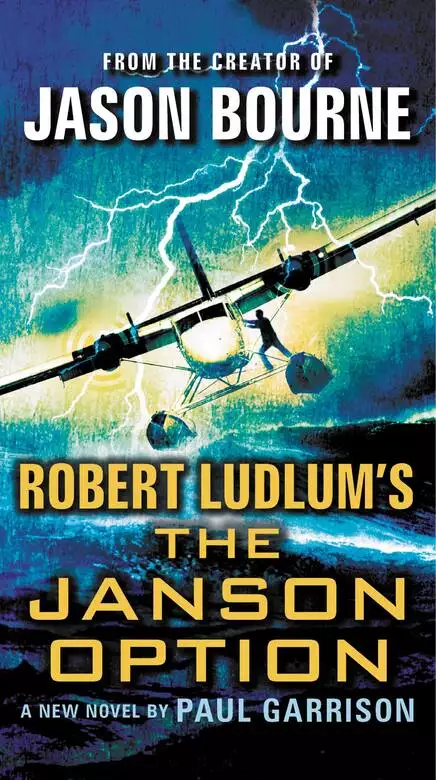
The Janson Option
Paul Janson – a former Consular Ops legend known as "The Machine" for his deadly speed and accuracy – has a new mission. Sickened by the "sanctioned serial killings" ordered by the state department, Janson has left covert operations and is now a private security consultant. In partnership with deadly sharpshooter Jessica Kincaid, he only takes assignments that he believes will lead to the greater good.
When American Synergy Corporation oil executive Kingsman Helms begs Janson to rescue his wife, Allegra, from Somali pirates, Janson and Kincaid view it as the perfect opportunity to infiltrate ASC and disrupt the company's scheme to subvert independent oil-rich African countries into wholly-owned ASC subsidiaries.
Once on the ground, Janson and Kincaid discover that the pirates may be the least lethal threat in the violent chaos of anarchic Somalia. Is Allegra's kidnapping for real? Or is she merely a pawn in her husband's machinations for control of the country? Janson and Kincaid quickly find themselves embroiled in a bewildering storm of plots and counterplots, and their fight to survive threatens to disrupt the entire region, and beyond...
A Hachette Audio production.
Release date:
March 18, 2014
Publisher:
Grand Central Publishing
Print pages:
450
* BingeBooks earns revenue from qualifying purchases as an Amazon Associate as well as from other retail partners.
Now, One Year Later5° S, 52°50' EIndian Ocean, 700 Miles off the East African CoastEn Route: Mahé, Seychelles Islands, to Mombasa, Kenya
The superyacht Tarantula was making eighteen knots between the Seychelles Islands and Mombasa. Built on a Kortenaer-class frigate’s hull, she had a warship’s profile—a high bow, a clean sweep to a low stern—and a strikingly graceful superstructure by Parisian designer Jacques Thomas, famous for resurrecting the fluid curves of the Art Nouveau in bent glass and carbon-fiber-reinforced epoxy. She was pointing west, burnished bright and shining by the sunset. Seen from a low-slung skiff racing flat out on a course to intercept, Tarantula appeared to skim the surface of the Indian Ocean like a fiery dragonfly.
A crew of twenty men and women attended the fully automated ship, her middle-aged owner, Allen Adler, and Adler’s guests. She carried two helicopters—each painted gold with Adler’s initials emblazoned red on its tail boom—a ten-place Sikorsky S-76D on a pad amidships and a light-turbine five-place Bell Ranger on the foredeck. Two twenty-passenger high-speed tenders were cradled at the stern in a well deck, which was a bay that could be flooded in order to launch the boats. Also sharing the well deck was a fifty-three-foot blue-water sloop, an ocean-passage Nautor Swan that would make a millionaire proud.
Night was falling quickly, as it did so near the equator. Five of Adler’s guests—a former fashion model, a retired United Nations diplomat and his wife, and a New York real estate agent and her husband—gathered for cocktails to watch the sun set from a forward lounge under the steering bridge.
The sixth, Allegra Helms, a thirty-year-old Italian countess with pale blue eyes and long blond hair, joined their host on the bridge itself—a spacious, glass-enclosed aerie with views in four directions of the darkening sea. Adler was trying to impress her by driving the yacht. To demolish his expectations of a hookup, she had packed an outfit that her mother would have bought from Valentino’s resort collection—monastically simple high-waisted white linen yachting slacks with a boat-neck blouse—and an Hermès scarf, screen-printed with her family device in a pattern so minute that only a cousin or an ancient enemy would recognize it.
A round German stewardess in a short, tight skirt brought a tray of marinated shrimp and sea scallops. She returned with a Champagne bucket, opened a bottle of Cristal with quiet efficiency, and poured two glasses.
“That’s all,” Adler said patting her behind. “Outta here. You too, Captain Billy,” he told the officer watching the instrument cluster that surrounded the auto-helm.
Allegra Helms was kicking herself for accepting a last-minute invitation from a man she had known only through a mutual acquaintance. Now she was trapped in the middle of the ocean on a boat full of boring strangers. She could dodge the other guests, but there was no escaping their host, who just would not shut up about his money and his fucking yacht.
“Biggest in the world—460 feet, 3,550 tons—and I had her teched-up so I can drive her with a smart-phone app.” Adler swigged Champagne, indicating with a nod that Allegra should help herself, and resumed his monologue with a joke she had heard twice at dinner the night they sailed. “I don’t know what I’m paying the captain for.”
An alarm sounded a staccato chirp. Allegra saw the captain’s eyes shoot to the radar monitor, and she noticed an orange dot flare briefly. Adler brushed past him and flipped a switch to mute the noise that was interrupting his delivery.
“I can run this baby from the middle of Kansas. Captain Billy, what am I paying you for?”
Allegra glanced at the captain, a sun-polished symphony of curly chestnut hair and Viking cheekbones—speaking of hookups, if she were considering one, which she was not. Not with her husband meeting her in Mombasa. And never, ever, when trapped on a boat.
“You could run her from the middle of Kansas,” Billy Titus answered with an affable smile as he fiddled the radar’s controls. “You pay me so you don’t have to.”
Allegra laughed.
Adler glared. “Fact is I pay him a bonus to save on fuel, and I fine him when he wastes it. Isn’t that right, Captain Billy?”
“Yes, sir.”
“Go grab a bite. The countess and I will run the ship.”
“Keep an eye on the radar.”
“Get out of here.”
“I mean it, sir. If you see pirates before they get too close, we can cut in the turbines and get the heck away.”
“I guarantee you that no pirates will bother me. Go get something to eat and leave us alone. I’ll call you back when I need you.”
“The hunting season just started, Mr. Adler. The monsoon’s over, and the water is calm enough for small boats.”
“Go, goddammit! Now!”
Captain Titus took his time checking the radar once again, before he turned on his heel and left the bridge.
Alone with Allegra, Adler said, “My captain is a regular comedian.”
“Che buona figura.”
“What does that mean?”
“It means… He has a great image—handsome—and you could also count on him to do the right thing.”
“I don’t get it.”
“It would be hard for you to understand. It means he’s a gentleman.”
Adler heard the challenge and threw it back at her. “You saw me grab that girl’s ass. You think there’s something wrong with that?”
She turned her back on him and studied the radar screen, which showed an empty sea in every direction. Adler was more alert than she had thought, and she wondered idly whether he used his crudeness to confuse business rivals into underestimating him.
Adler said, “She’d be disappointed if I didn’t grab her ass. She’d think I was mad at her.”
When Allegra still remained silent, Adler demanded, “What do you think?”
She was thinking about her husband, who was currently rooting around East Africa like a truffle pig on his incessant hunt for oil and gas concessions. It would be nice to have him around if Adler became any more of a pain.
“I think you remind me of my father.”
Adler’s face hardened. “I’m not old enough to be your father. I’m forty-eight.”
He was fifty-eight, she knew for a fact—though remarkably fit and still handsome, with looks that would age well. She said, “My father gropes the servants too.”
“Oh yeah? What does your mother think of that?”
“We’ve never discussed it.”
Adler blinked. Then he switched tactics, though not his manner. “How much money does your husband make running American Synergy?”
“He doesn’t run all of ASC. He’s president of the Petroleum Division.”
“The Petroleum Division is their number-one profit center. What do they pay him to run it?”
“I haven’t the vaguest idea.”
That stopped him again, though only a moment. “You don’t care?”
“I’d rather feel young than rich.”
Adler winced, as she hoped he would. But it didn’t shut him up. “How long do you think that will last?” he shot back.
“How can you guarantee that pirates won’t attack us?”
“I cut a deal with Bashir Mohamed. Bashir’s ‘king’ of Somalia’s pirates. He gave me a pass for protection. No one will attack my yacht.”
“How can he guarantee other pirates won’t attack?”
“They’re afraid of him. He’s organized them. Anyone gets independent, he turns them over to the UN’s African Union Army, or the Combined Maritime Force. They include the Chinese and Russians, who play a lot rougher than the US and EU. Or he pays somebody to kill them. Piracy is the same as any business: you make money by controlling the market, and you control the market by clearing out independents.”
“What did you offer Bashir Mohamed in return?”
“You wouldn’t believe me if I told you.”
At last, she thought, Adler was becoming interesting. Allegra smiled a smile that warmed her pale eyes. She ran her fingers through her hair. “You must tell me,” she said. A beguiling hint of an Italian accent lent music to her fluent English. “You’ve made an interesting story.”
“Do you know anything about New York?”
“I was sent to school there, as a girl.”
“Where?”
“Nightingale-Bamford.”
“OK. That explains a few things.”
“Like what?”
“You act less like a countess than a New York rich kid.”
“So what did you offer Bashir Mohamed?”
“I sit on the boards of private schools like Nightingale. Not theirs, but others. In exchange for Tarantula’s safe passage, Bashir Mohamed’s firstborn son has a spot guaranteed in preschool. I swear that’s the truth. That’s all it took. He’s dreaming preschool to prep school to Harvard.”
Allegra Helms laughed. “Well done, Mr. Adler.”
“I keep telling you, call me Allen.”
“Whatever you say, Allen.”
“Now you tell me something. Why’d you accept my invite to come on this cruise?”
“As I told you. I just finished a job in the Seychelles. I was ready to leave.”
“Appraising antiques?”
Tiring of his attitude, Allegra Helms answered with a dismissive gesture that reduced his lavish yacht to a commodity. “Men who’ve made money recently need to be assured that a copy of a Holbein portrait was painted by the master’s protégé instead of a master forger.”
“Maybe I should hire you to vet my paintings.”
Allegra shrugged. In the tight-knit world of high art, it was known that Adler was advised by yes-women who spent baskets of his money on nothing particularly interesting. Surprise, surprise. “When you invited me, I thought my husband might join me in Mombasa for a little get-together. We’ve both been traveling, for a while.”
Adler laughed.
“What’s funny?”
“I have never seen a ‘trial separation’ that didn’t work.”
Stung, and annoyed with herself that she had revealed too much to Adler, Allegra Helms said, “It wasn’t exactly a separation—No, that’s not true. It is a trial separation, and it is working very well. I am very much looking forward to reuniting with my husband in Mombasa.” She could hardly believe her ears, but there, she had said it. Out loud and in front of a witness.
“You look surprised,” Adler said.
“I am,” she said with a smile and a shiver of happiness she had not felt in a long time. “But I shouldn’t be surprised, should I? He is still the man I wanted ten years ago. He is handsome. He is decisive. And I like that he is self-made. It gives him a sureness that is deep because he earned it.”
“A macher, like me,” Adler cracked. “I earned mine, too.”
It struck Allegra that in one way Adler was like Kingsman—a man convinced that he deserved whatever he wanted because he wanted it. That was a reminder not to go overboard hoping for more for their marriage than could happen on a short visit in Mombasa. But wasn’t it still worth a try? And still worth hoping?
Adler said, “Why don’t I pinch-hit for him till we get to Mombasa?”
“Why don’t you try Monique,” she replied, pulling away. The striking Monique—a favorite Galliano model before Galliano wrecked his career—was an anxious brunette in her forties, nearly hysterical on the subject of her age, and in the market for a wealthy boyfriend if not a husband, Allegra had learned in the briefest of conversations the first night.
“I prefer countesses to fashion models,” Adler said, moving closer. “I checked out your family, you’re the real deal.”
“Quite clearly,” said Allegra Helms, “you invited Monique along in case it didn’t work out with me. It didn’t and it never will. I am married. I’m going down below now. I’ll send Monique up here.”
“You are a piece of work.” Adler’s laughter was cut off by the astonishingly loud noise of a sustained burst of gunfire. The firing went on and on, the sound of the shots blurring like a jackhammer tearing up a street.
* * *
GREED MAKES MEN BRAVE, thought Maxammed, the pirates’ captain.
Triple pay for the first to board the yacht: an immediate three million Somali shillings—one hundred American dollars—plus the promise of a Toyota 4Runner after the ransom was paid, sparked a vicious struggle between two clan brothers vying to climb the ladder they had propped against the low stern of the moving ship.
“Keep going!” Maxammed shouted. He was a tall, wiry Somali of thirty-five, with a high and broad forehead, strong white teeth, and light brown skin, and he leaped with practiced grace on the foredeck of a fiberglass skiff that was bouncing violently in Tarantula’s wake. He wore a flak vest, the only pirate so protected, and a bandolier of machine-gun bullets. The bandolier was for the shock effect. His weapon was a magazine-fed SAR 80 assault rifle with the stock chopped so he could wave it in one hand like a pistol.
“Go! Go! Go!”
Inshallah, they wouldn’t shoot each other. He was undermanned already, with only twelve fighters and one of the first-time boys so seasick that he lay paralyzed in the bottom of the skiff, too exhausted to even retch the nonexistent contents of a stomach emptied days ago.
Maxammed saw a shotgun poke over the stern. “Gun!”
The pirate who had made it to the top of the ladder first froze. The sailor from the yacht who was pointing the shotgun, a Christian Filipino wearing a silver Jesus cross around his neck, froze also, too gentle to shoot his fellow man even when his life was in danger.
Maxammed triggered his SAR. The sailor tumbled off the boat. Maxammed led the rest of his crew up the ladder onto the yacht and sprinted forward to seize the steering bridge and disable satellite phones, radios, and emergency tracking beacons.
His heavy vest and bandolier slowed him down. It had been a year since he had actually boarded a ship. He had advanced from lowly “action man” to managing from the shore, where the real profits lay in collecting the ransom. But this yacht was a special case.
His men—boys half his age and fired up on dreams of riches they could barely comprehend—raced ahead of him, up a stairway to the bridge. One of them let loose with a deafening burst of his AK-47.
Maxammed tore after them before they accidentally killed valuable hostages, or damaged equipment vital to running the yacht. Taking her was only a start. His battle to keep her had just begun.
The shooting stopped.
He heard women scream.
Bounding up the stairs past a window, he saw one of his men covering rich Europeans in a fancy lounge. He continued up a final flight to the bridge, swaggered into the sharp cold of the air conditioning, and drank in the huge, glassed-in command center. He could see out over the ocean in every direction and forward and back the full length of the yacht. There was a helicopter in front, and a bigger one in the middle—a magnificent Sikorsky—and a swimming pool sparkling like a blue gem.
Farole, his cadaverous second in command, was pointing his weapon at a middle-aged man and a striking blond woman. Maxammed had been shown their photographs, and he recognized his two most valuable hostages: the American who owned the yacht, and the rich Italian countess. Somali women were famous for their extraordinary beauty. There were truly none in Africa—none in the world—more beautiful. But this countess woman would give them a run for their money, even wide-eyed, pale, and trembling.
Maxammed gestured for Farole to move the hostages out of his way and strode over to the ship’s instrument panels to shut down the GPS, radios, radar—any instrument that would send out signals that naval patrols could track. He knew what he was looking for, and it took only moments to unplug the ship from the world it came from. Then he put the engines on manual control and throttled them back so they could haul their skiff aboard.
The middle-aged American took Maxammed for the pirates’ leader and turned on him, red-faced with anger. “Do you have any idea who you’re fucking with?”
Having grown up in cities, Maxammed spoke several languages: Somali, Italian, and English; and originally from the coast, he could converse in Swahili when he had to deal with Arabs or East African mercenaries. English was his favorite, being riddled with puns and multiple meanings that were tailor-made for Somali wordplay. But he had the least occasion to speak it, so it took a moment for the meaning of the angry American’s “who you’re fucking with” to sink in. When it did, Maxammed grinned with pleasure.
“I am fucking with you. You are flirting. With death.”
“You’re the one flirting with death!” the American shouted back. “I paid your pirate king for safe passage.”
“Meet the new king,” said Maxammed. “Bashir retired.”
“I spoke to him yesterday.”
“But not today.”
“I’ll get him on the phone right now.” Adler pawed a satellite phone from its clip on his belt.
Maxammed leveled his SAR at the patch of skin between the American’s eyebrows. “Not today.”
“You going to shoot your richest hostage?” the American shouted.
“I do not need all of you,” Maxammed replied. “If your insurance pays only ten percent of the price of your yacht, I will be the richest man in Somalia.”
The American raised his hands.
Maxammed shouted orders.
Two of his men herded the rich people he had seen below up to the bridge.
Maxammed looked them over carefully. There were two couples and a single woman. She was tall and dark-haired with arms and legs as thin as sticks. She was the French model. One of the couples was very old, the man frail, the woman hard-faced and haughty. They were the United Nations employees who had retired long ago—not rich, but related by marriage to the rich owner. The other couple was younger, in their fifties, and clutching hands. The woman’s arms clanked with bracelets. A band of white skin on the man’s suntanned wrist showed where his watch had been; a bulge in his trouser pocket indicated, Maxammed guessed, a hastily hidden gold Rolex.
All of them looked fearful. None would resist.
The rest of his men brought the crew at gunpoint.
Maxammed counted six guests and nineteen crew: chief engineer, first mate, bosun, cook and helpers, deckhands, stewardesses, and helicopter pilot.
“Where is the captain?”
No one spoke.
Maxammed searched their faces and selected the youngest crew member, a yellow-haired girl wearing a white stewardess costume with a short skirt that exposed her thighs. He pressed his gun to her forehead.
“Where is the captain?”
The girl began to weep. Tears streaked her blue eye makeup.
A middle-aged Chinese in a stained cook’s uniform spoke for her. “Captain locked in safe room.”
“Where?”
“By engine room.”
“Does he have a satellite phone?”
The cook hesitated.
Maxammed said, “You have one second to save this girl’s life.”
“Yes, he has a phone.”
Maxammed ordered Farole and two men below. “Tell the captain that I will shoot the stewardess if he does not come out. Hurry!”
They waited in silence, the crew exchanging glances, the guests staring at the deck as if afraid to meet one another’s eyes. The blond beauty, Maxammed noticed, had withdrawn into herself, either frozen with fear or simply resigned. His men returned with the yacht’s vigorous-looking American captain and handed Maxammed the sat phone.
“Who did you call?”
“Who do you think?”
“Tell him, for chrissakes!” shouted the owner. “You’ll get us all killed.”
“I called the United States Navy.”
“Did you give them our position?”
“What do you think?” the captain asked sullenly.
“I think you put a lot of innocent people’s lives at risk,” said Maxammed. He turned to Farole and ordered in Somali, “Load the captain and his crew into a tender. Take the boat’s radios and wreck the motor.”
“You’re letting them go?”
“We’ll keep the rich people.”
“But the rest of them?”
“Too many to guard and feed. Plus, we’ll look good on CNN.”
Farole grinned. “Humanitarians.”
“Besides, who would pay big money for crew?” Maxammed grinned back. The practical reasons were true, but there was more that he did not confide to Farole. This rich prize of a ship and wealthy hostages would make him a potent warlord in his strife-torn nation, more than just a pirate. A pirate who freed innocent workers and held on to the rich was a cut above—a Robin Hood, a man of consequence.
“Give them plenty of food and water, but don’t forget to wreck the motors. By the time they’re picked up, we’ll be safe in Eyl.”
* * *
ALLEN ADLER WAITED to make his move until the pirates got distracted launching the tender. Putting the tender in the water involved slowing Tarantula to three knots, and opening the sea cocks to flood the well deck, then opening the stern port so the tender could drift out. It could all be done from the bridge, where the release controls were stationed by the big back window, if you knew what you were doing. To his surprise, they did. Sailors were sailors, he supposed, even stinking pirates. They turned on the work lamps, bathing the stern in light, and went at it as neatly as if Captain Billy were running the operation.
Adler edged toward the stairs.
What the pirates didn’t know, what no one else on his ship knew, not even the captain, was that Tarantula had in the bottom of her hull a one-man escape raft that could be launched under the ship in total secrecy and inflated on the surface. The raft carried food and water for a week, as well as a radio, GPS, and a sat phone. The reason no one knew was that there was no point in having a secret escape hatch if it wasn’t a secret; otherwise the crew would be fighting to get inside it. He had rehearsed this move numerous times, sometimes for real, sometimes in his head. It was vital not to panic and to remember to lock doors and hatches behind him as he ran.
All the pirates and all his guests were watching the release of the tender in the work lights. The stern port opened. The boat started sliding out the back and into the water behind the ship. Adler ran.
Maxammed and Farole saw him reflected in the glass, whirled as one, striking on instinct as cats would claw at motion. Maxammed fired two shots before he realized the fool had nowhere to go. It was too late. Shatteringly loud in the confined space, they knocked Adler’s legs out from under him. He skidded across the teak deck and crashed into the railing that surrounded the stairs.
“I hope you didn’t kill him,” Maxammed said to Farole.
“We both shot him.”
“No, I pulled my gun up. Only you shot him.”
Farole shook his head, knowing that was not true. He changed the argument, saying, “But you said you didn’t need him.”
“To frighten him, you idiot. He’s the richest of all.”
“We still have the ship.”
“If the ship is worth half a billion dollars,” Maxammed asked scornfully, “how much is its owner worth? Pray you didn’t kill him.”
Adler clutched the back of his thigh in both hands and tried to sit up. His face was slack with shock. He looked around the bridge, cast a disbelieving look at the pirates and hostages grouped at the aft windows. Then he sank back on the deck, still holding his leg.
Maxammed watched the rich people gather around him, the women holding hands to their mouths, the men staring wide-eyed. “Oh my God,” whispered one. “Look at the blood.”
There was so much blood on the deck that Adler appeared to be floating on it. He looked, Allegra Helms thought, like a swimmer doing the backstroke in a red pool. The New York woman whispered, “We have to stop the bleeding. It severed an artery. See how it’s pumping?”
It was spurting rhythmically, the pulsing against his trousers as if a mouse trapped in the linen were trying to batter its way out.
“Tourniquet,” said the white-haired diplomat. “He needs a tourniquet.”
Maxammed shouldered them aside and knelt in the blood. He unbuckled Adler’s belt, yanked it out of the loops, dragged his trousers down to his knees, shoved one end of his belt under his leg, pulled it above the ragged wound the bullet had furrowed in his flesh, slipped the tongue through the buckle, and pulled it tight.
The blood kept spurting. He couldn’t hold the belt tightly enough.
“Use this,” said Allegra, handing over her scarf. Maxammed tied it around Alder’s thigh and thrust his SAR in the loop and turned it like a lever, drawing the cloth so tightly that it bit into the flesh. At last the blood stopped spurting.
“Hold this here,” he told her.
She knelt beside him in the blood and held the gun in both hands. She fancied that she could feel Adler’s heart beating through the steel. It felt very weak, and she was struck by her ignorance. She knew not even the most basic first aid, and she was helpless to save his life.
He opened his eyes and they locked on hers. She felt the beating slow. He tried to speak, and she leaned closer to hear. “Hey, Countess? Don’t hate your father for groping the servants.”
In a moment of insight as sharp as it was unexpected, Allegra Helms realized it was probably the gentlest thing the man had ever said, and she whispered as intimately as pillow talk, “I don’t hate him. He’s just not my favorite relation.”
“Who’s your favorite?”
“Cousin Adolfo. Since we were children.”
“Kissing cous—?” Adler’s body convulsed. Allegra lost her grip on the tourniquet. She tried desperately to tighten it again. Then she saw that it didn’t matter. Where his blood had spurted, it now just dripped.
“Oh my. . .
We hope you are enjoying the book so far. To continue reading...

 Please log in to recommend or discuss...
