
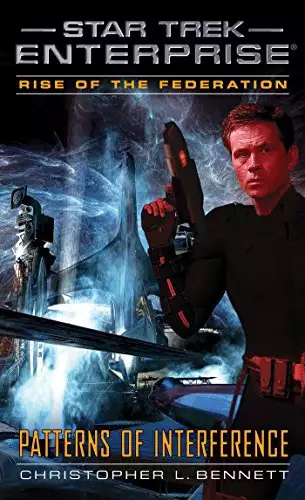
Rise of the Federation: Patterns of Interference
- eBook
- Paperback
- Book info
- Sample
- Media
- Author updates
- Lists
Synopsis
The saga of the Star Trek: Enterprise TV series continues with this thrilling original novel! The time has come to act. Following the destructive consequences of the Ware crisis, Admiral Jonathan Archer and Section 31 agent Trip Tucker both attempt to change their institutions to prevent further such tragedies. Archer pushes for a Starfleet directive of non-interference, but he faces opposition from allies within the fleet and unwelcome support from adversaries who wish to drive the Federation into complete isolationism. Meanwhile, Tucker plays a dangerous game against the corrupt leaders of Section 31, hoping to bring down their conspiracy once and for all. But is he willing to jeopardize Archer’s efforts—and perhaps the fate of an entire world—in order to win? ™, ®, & © 2016 CBS Studios, Inc. Star Trek and related marks are trademarks of CBS Studios, Inc. All Rights Reserved.
Release date: August 29, 2017
Publisher: Pocket Books
Print pages: 368
* BingeBooks earns revenue from qualifying purchases as an Amazon Associate as well as from other retail partners.
Reader buzz
 Please log in to recommend or discuss...
Author updates
Rise of the Federation: Patterns of Interference
Christopher L. Bennett
January 4, 2166
U.S.S. Pioneer
CAROLINE PARIS craned her neck upward to gaze through the pair of portholes on the curving hull above. “Amazing,” she said. “I’ve never seen a Bussard collector this close when I wasn’t in an inspection pod.” The reddish-brown cabochon dome at the fore of Pioneer’s starboard warp nacelle loomed darkly outside the port, powered down but still impressive to see looming just a few meters above her head.
“It is striking,” Malcolm Reed said. “And with the improved cooling and vibration damping Commander Tizahr has promised, it should remain relatively comfortable in here even during warp operations.” The room in question was a small common area and observation bay on C deck, overlooking the starboard cargo bay.
“I’m not sure why they even put viewports here,” Paris remarked. “There’s nothing to see but the nacelle cap.”
“I admit, the Intrepid class is a bit of a kludge,” Reed confessed. “It was an offshoot of the NX class, putting its pieces together more compactly for more efficient warp dynamics, in case the warp-five engine didn’t perform as hoped.”
“Never apologize for your ship, Captain,” Paris said. “Compared to the antique I’ve been serving on for the past five years, this is a regular hot rod.”
Reed chuckled. “It occurs to me that much of our conversation would be incomprehensible to people who aren’t fans of old movies.”
She patted his cheek, leaning in for a conspiratorial whisper. “So much the better. Helps us keep our secrets.”
Paris had never expected her dalliance with Malcolm Reed to last more than a few nights. He wasn’t her usual type; if anything, his formal, stiff-upper-lip English manner, facial hair, and military bearing reminded her of Captain Shumar, which should have been the opposite of a turn-on. But then, “usual” had gone out the window since her close call on Delta IV last April. It was only recently that she had felt ready to explore that side of herself again, and perhaps she had turned to Malcolm Reed because he seemed safe. Though he was clearly attracted to her, he had his own natural reserve—and some sort of inner hesitancy toward intimacy that reminded Paris of her own. They had not spoken of it, but perhaps their mutual recognition of each other’s restraint had let them both feel that they could pursue a casual involvement without feeling pressured to go further.
Yet, as they had spent their time watching movies and playing tennis and talking about their careers, Paris had discovered that there were other things she and Reed had in common. They both loved classic cinema, though Paris had been unable to get Reed to understand her fondness for ancient, youth-oriented adventure serials like Flash Gordon and Captain Proton. They had a similar love of antiques, though Paris’s fancy was vintage toys and games while Reed’s was military hardware and weaponry. They both came from service families with a strong sense of legacy and tradition—though Malcolm had defied his family custom to serve in Starfleet rather than the Royal Navy, while Paris had readily followed the starfaring example of her mother, Argonne, a United Earth Space Probe Agency veteran who had become one of the UE Starfleet’s first flag officers upon its founding in the 2130s, and her older brother, James, who had commanded one of the old Marshall-class ships in the Earth-Romulan War.
Not that there weren’t plenty of differences between them as well. Paris had always been the class clown, the little sister who’d acted out in defiance of her family’s pressure to perform—and who had maintained her irreverent manner even after embracing her aptitude for the family business, as a way of announcing that it was something she did to please herself instead of anyone else. Reed’s reserved, disciplined style couldn’t have been more different, at least on the surface. But as she got to know him better—particularly today, as she saw him interact with the members of Pioneer’s crew who were on duty during the refits—she realized that he wasn’t as much like Bryce Shumar as she’d initially believed. Shumar could be arrogant, prideful, and judgmental. He was a perfectionist who demanded no less than perfection from those around him. Paris had only earned the license to be informal on the bridge by proving to him that it did nothing to diminish her exemplary performance. But Reed’s perfectionism was more self-directed. She got the sense that it came from a deep insecurity, a need to prove his worth to himself and to others. And so he was slow to judge others, as though he did not feel entitled to do so. He ran a looser ship than she expected and gave his crew plenty of rein—as Paris saw when Reed’s tour led her to main engineering, their next stop after the nacelle cap.
“No, no, no!” a woman was shouting as they came into the engine room through the heavy forward hatch. “You have to polarize the magnetic field in parallel with the crystal impurities to reduce the unspent reactants! Calibrate each chamber individually, like this.” The speaker, standing on the raised control platform before the warp reactor, elbowed a fellow engineer aside to enter the settings herself. She was a Jelna Rigelian, craggy-faced and parchment-skinned—an exofemale, if Paris remembered their four-gendered system correctly—but her streaked gray-white hair was cut short and lacked the elaborate beads commonly worn by her people. She wore a red-brown tunic with lieutenant commander’s stripes and a Pioneer mission patch on the shoulder. Paris was still getting used to seeing those two-piece uniforms on Pioneer’s crew. They had been in use fleetwide for several years now, the Class A uniforms meant to stand for the entire Federation fleet—but the member fleets’ individual uniforms had not been entirely phased out, and Shumar was one of a number of human captains who preferred his crew to wear the one-piece gray uniforms of the Earth division, as Paris did now. No doubt Reed favored the fleetwide uniform due to the greater species diversity of his crew.
Completing the recalibration, the Rigelian engineer ordered the ensign next to her to run a simulation of core performance. She frowned at the result. “No, didn’t I say you need to adjust the injector pressure to compensate? Here, like this!” She clambered down off the platform and headed for the port injector frame, where the crewman tending to the injectors hastily stood aside to make room for her. “There. See?” she asked a few moments later. “Now try it.”
“Commander Tizahr,” Reed spoke up, drawing the exofemale’s attention. “A word, if you please.”
“Captain, I’m sure you think you have something important to contribute, but just let me get through with this—”
“Now, Commander.” Tensing at the steel in his voice, Tizahr relented and came over to them, though her lean body practically trembled with impatience. Paris realized that, despite the impression created by her pale coloring and craggy features, she was unusually young for an officer of her rank.
“Lieutenant Commander Kivei Tizahr,” Reed continued, “this is my guest, Commander Caroline Paris, first officer of Essex. Caroline, Commander Tizahr is Pioneer’s new chief engineer.”
Paris extended a hand. “Pleased to meet you.”
Tizahr took her hand with a wry smirk. “Which means that either you already know my work, or you know nothing about me personally. Stick around, you’ll probably get less pleased by the moment. Now, Captain, is there anything of actual relevance you have to say? I’m trying to squeeze what efficiency I can out of these cobbled-together engines of yours, and explaining my techniques to your crew is only slowing me down. They’ve gotten slack, working under civilian temporary chiefs for so long.”
“My engineers know how to do their jobs, Commander.”
“They know how it used to be done, and if that were adequate, you wouldn’t have called on me. Your Doctor Dax did come up with some effective workarounds for reconciling different species’ technologies, but you’re novices at that compared to the Rigelians.”
“No doubt you do have the edge on technique, Kivei. But these people all have their own abilities and strengths, which you’ll never discern if you keep doing all their work for them. Perhaps if you let them show you what they can do, it will help you better understand how to utilize them in achieving what you want them to do.”
To her credit, Tizahr took only a couple of seconds to say, “You’re right, Captain. If I’m to turn this crew into a smoothly functioning machine, I need to know the full specs and tolerances of its components. If I may, sir?”
“Go right ahead.”
“All right, people, stop everything you’re doing!” Tizahr shouted, clapping her hands over her head. “Time for some emergency drills! Show me what you’ve got!”
Reed and Paris wisely retreated before the chaos began. “She seems . . . intense,” Caroline said once they were back in the corridor.
“She’s very driven. She was one of Grennex Aerospace’s top warp engineers by the equivalent age of twenty-two. The Rigelian Trade Commission made her a better offer at twenty-eight, so she became a chief engineer for their defense fleet, which means she got folded into Starfleet when Rigel joined. She’s the best—but the best aren’t always easy to like.”
“Still, I’m impressed with how you handled her, Malcolm. Captain Shumar would’ve probably butted heads with her and loudly reminded her who was in charge, and I would’ve had to come in later as the good cop and finesse her into cooperating. But you had all the finesse you needed—even though you and Bryce come from similar backgrounds.”
“All I know about finesse, I learned under Jonathan Archer. He understood that most Starfleet personnel are more scientists than soldiers. I had trouble understanding that for years, but I like to think I’ve gotten the hang of it.”
“I’d say you have. You mesh well with your crew. And you’ve probably helped Tizahr mesh with them too.”
He lowered his head. “I’m gratified to hear you say that. When I took this command, I was distant from them at first. I relied on Travis—Mister Mayweather—to be my bridge to them. But we’ve grown close . . . largely through sharing adversity.”
Paris hesitated a few moments. “Speaking of growing close, Malcolm . . . when are we going to get to the most important part of the tour?”
“What would that be?”
She moved in closer—much closer. “Your quarters.”
Reed flushed, surprised but far from unhappy. “You mean . . . you want to . . .”
“I want to.”
“Are you sure?” he asked. “I mean—not that I don’t want to, of course. But you’ve kept a certain distance . . .”
“Which has nothing to do with you. I just . . .” She sighed. “Can we discuss this in private? In your quarters?”
At once thrilled and confused, Reed led her there. Once they were alone, Paris paced the small room and gathered her thoughts. “About nine months ago, I led an Essex landing party making the first official Federation contact with the planet Delta IV.”
Reed’s eyes widened. “The Deltans. I’ve heard the stories about them from Travis—it was his family’s ship that made the original contact.”
“I know. Small galaxy.”
“And I heard that there were some . . . difficulties . . . with Essex’s visit. That their sexual proclivities were more potent—more dangerous—than even the spacers’ tales. Like the pheromones of Orion females.” He gazed at her solicitously. “Did they . . . do something to you?”
“No, nothing like that. The Deltans are a remarkable, open, compassionate people. That’s just the problem. The connections they form with their empathic powers are so deep, so profound . . . It’s easy for a human to get lost in them. The Deltan man I had sex with . . . what he offered was a casual, friendly gesture among his people, and I was—” She laughed. “Well, I was just being a good diplomat and accepting the natives’ hospitality. But . . .” She sobered quickly. “I almost lost my sense of myself as an individual. The other member of my crew who slept with them—with several of them at once—he’s still in a catatonic state. He’s not expected to recover, ever. I got lucky.” She needed a moment before she could continue. “But it was a struggle. It’s taken me months to get past the yearning for more, the depression, the withdrawal. I’ve been afraid to attempt normal human sex . . . though I’m not sure if it’s because I’m afraid of losing myself again or if I’m afraid I’d just find it inadequate next to the memory of . . . that.”
Reed cleared his throat. “No pressure, then.”
She laughed. “No, it’s all right. Because it’s not just about the physical. What was so overpowering was the emotional connection. The way it made me feel like being part of another person. Maybe nothing human can match that intensity.
“But it doesn’t need to. I feel really close to you, Malcolm. I let you in because you didn’t push, because you respected my boundaries and gave us a chance to get to know each other first. So I know that the connection I feel for you isn’t just some ghost of what I experienced on Delta. It’s grown organically within us. And I think that wherever that leads us is somewhere I’m ready to go.”
She pulled his head toward hers—slightly up toward hers, for she had three centimeters on him in height—and kissed him deeply. When it finally ended, she took a deep breath of satisfaction. “That said . . . there are some things I picked up on Delta that I’d be happy to teach you.” Laughing, she pulled him toward the bed.
January 5, 2166
Oakland, California
“Your move.”
“I’m thinking, I’m thinking.”
Val Williams tried not to fidget while Sam Kirk studied the chessboard in her father’s living room, stroking his chin as he contemplated his options. Normally she was more patient with his deliberations, but Captain Marcus Williams was watching over her shoulder, his burly arms crossed in a way indicating that Sam was not making as good an impression as Val had hoped.
For her own part, Val was playing an aggressive, risky game in the style her father had taught her, deliberately exposing her king to danger in order to lure Kirk into a trap. But he wasn’t taking the bait; instead, he was playing it safe, passing up opportunities to capture her pieces and instead positioning his own with a longer strategy in mind. He was now a move away from checking her black king with his white king’s pawn—a move she’d almost missed because it was so unassuming. But if she let it happen, she could then move her king into a position that would lure out the white queen. She had moved her queen’s bishop to the second rank to position it for that strategy.
That was the situation Sam was now contemplating, and the senior Williams was growing more impatient as the time dragged on. “Maybe you should be using the timer,” he suggested.
“It’s just a friendly game, Dad,” Val reminded him.
“Well, okay. I guess some people need a handicap.”
Val glared up at her father, but fortunately, Sam was too immersed in contemplation to notice the dig. Finally, he went ahead with an unexpected maneuver, putting his king’s knight one move away from checking her king again, from either of two black squares. As soon as she realized this, she moved a pawn to force him to choose the one that would let her move her king to threaten the knight in return.
“This is ridiculous,” her father said while Sam considered his response. “Eight moves in and not one piece has been captured yet.”
“But he’s had me in check three times, Dad.”
“Only because you’re giving him too much time to think.”
“I’m not as good at thinking on my feet as your daughter, Captain,” Sam said to him. “And I don’t want to make any mistakes, so if you don’t mind . . .”
At another glare from Val, her father subsided. Sam eventually moved a pawn, leaving a clear path for his queen’s bishop to protect his knight. “Okay,” Val muttered, seeing where things were headed and how bad it looked for her king. She tried to distract his attention using a feint with her queen’s knight, but he didn’t fall for it. With careful consideration, he began to spring his trap, a series of moves that checked her king and left her only one response leading immediately to another check, three times in a row. Yet each time, he pondered and bided his time before making the obvious move.
Captain Williams could no longer keep his silence. “You’re closing in! Don’t you know what you want to do?”
“Just making sure, sir. Ah, yes.” Moving his knight to e6 not only exposed her king to his other bishop, it put the knight one move away from capturing Val’s queen.
But the only move she could make was to counter the check with the one available pawn, which would inevitably be captured to end the game. Instead, Val tipped over her king. “I resign. Well played, Sam!”
“I don’t believe it,” the captain said. “A whole game without one piece captured!”
“He would’ve taken my pawn for mate, Dad.”
The elder Williams puffed air through his lips. “One measly pawn.”
“Don’t underestimate them. Sam checked me with a pawn three different times.”
Kirk shrugged. “The triumph of the little guy.”
“I’ll say,” Val replied. “You really had my king on the run there. Half my moves were of the king, most of them to get him out of check. I never even got to move my queen.”
“I only moved mine once.”
“Yeah, but you made her the anchor for the formation you assembled around my king.” She shook her head as she examined the board. “Look at that. We only moved seven distinct pieces each. And you mated me in thirteen moves.” She smirked. “In case you’re wondering, Dad, his mating usually takes a lot longer than that.”
Sam blushed, and her father winced. “More than I needed to know, hon.”
“It’s just a matter of focusing on the long-term goal instead of instant opportunities,” Sam said—and then blushed harder. “In, in the game, I mean. The chess game.”
Val was laughing now. “Among other things.”
Her father cleared his throat. “I understand strategy,” he said, trying to get back to a more comfortable topic. Predictably, the former wide receiver followed up with a sports metaphor. “There’s no game without a game plan. But you can’t always win by playing it safe. I mean, not only did you shy away from sacrificing your own pieces, you didn’t even take any of hers!”
“I didn’t see the need, sir. My real target was the king. And luckily, I was able to work around the other pieces this time. Taking hers would’ve cost me mine and reduced my options.”
“And leaving her strength completely intact didn’t bother you?”
Sam smiled, meeting Val’s eyes. “Her strength is what I love about her, sir. And playing the long game until she gave me an opening has worked for me before.”
Her father seemed unimpressed. Later, when he went out to the rear patio to heat up the barbecue for dinner, Val managed to get him alone while Sam chopped vegetables in the kitchen. “You don’t approve of him, do you?” she asked bluntly.
Captain Williams was just as blunt, as had always been their way with each other. “He’s sure not the kind of guy I ever thought I’d see you fall for. So timid and intellectual. No toughness in him.”
“Why do I need someone tough? Don’t you think I’m tough enough for two?”
Her father’s eyes widened. “Of course you are, hon! But if we’re talking . . . well, if you think this is serious . . . I’m your dad, Val. I can’t help thinking about what my grandkids are gonna be like.”
She rolled her eyes. “Oh, for—I’m not trying to pick out a stud horse here. And if and when I’m ready to think about that, it’s my decision, not yours.”
He held up his hands placatingly, though one still held a large pair of tongs. “That’s not what I meant. I just don’t think he’ll be able to keep up with you in the long run, and I think you’ll get tired of waiting for him.”
“That’s what I thought at first. That’s why it took me so long to realize what he had to offer. But I was wrong. He’s taught me the value of patience and quiet.” She gently touched her father’s muscular arm. “Which is why I believe he’ll win you over too, if you just keep an open mind.”
He lowered his head. “I’ll try, hon. For you.” But his tone was grudging.
Val could tell she would need patience. This was going to be a long game.
January 8, 2166
Smithsonian Orbital Annex, Enterprise XCV-330 exhibit
“This seems to be my week for giving tours,” Malcolm Reed said as he led T’Pol through the enviropod of the first UESPA ship named Enterprise. The cylindrical pod was the approximate size and shape of a midsized passenger shuttle, though with a cramped, submarine-like interior. Luckily, this was a private tour after the museum had closed for the evening, a perk of the captains’ combined clout, so they did not have to contend with crowds of tourists squeezing their way through the cramped hatches. The pod sat at the front of a long, narrow boom, almost like the kind used in Klingon ship designs—but at the rear of the boom was a single vertical vane connecting it to a pair of wide, flat rings instead of the more familiar cylindrical nacelles. “You’ve really never been to see this exhibit before? I’d have thought it would be the sort of thing to interest you.”
“Not particularly,” the Vulcan captain answered. “Humans were not the first protégés of the Vulcans to attempt to emulate the annular warp drives of Vulcan starships. And the Experimental Coleopteric Vehicle program was discontinued twenty years before I came to Earth, in favor of Henry Archer’s Warp Five Project. As you are aware,” she went on as they entered the navigation and briefing area just aft of the bridge, “the latter was of much greater concern to then-Ambassador Soval when I was assigned to his staff.”
“He sure made me plenty aware of it back then,” came a new voice from the bridge. One of its acceleration seats rotated to reveal Charles Tucker III smiling back at them. As usual, their secret-agent friend had managed to slip into the vessel without being observed until he wanted to be. Reed had done his share of intelligence work, but he’d never mastered that particular trick. “But we’ve all come a long way since then, haven’t we?”
The other two descended the short flight of steps to the deck of the bridge, which occupied the top half of the foremost section of the enviropod, giving it somewhat more headroom than the three decks of quarters and crew facilities farther back. At the front of the bridge was the upper half of the transparent aluminum dome that formed the nose of the pod, affording a view of the Orbital Annex hangar beyond. A portion of NX-01, the subsequent Enterprise on which Reed, T’Pol, and Tucker had once served, was visible beyond, giving Reed a rush of nostalgia.
The warmth with which T’Pol greeted the former engineer was subtle, recognizable to Reed only because of his fifteen years of friendship with them. “It is good to see you safely returned from your recent travels, Trip. We have been understandably concerned for your welfare.”
“Oh, don’t worry,” Tucker assured her. “Phil Collier of Abramson Industries may be one of Starfleet’s most wanted right now, but the Section did its usual thorough job of severing any data trails that could tie that identity back to me.” He rubbed his clean-shaven chin. “And as you can see, their cosmetic surgeons put my lovable mug back to rights, or as close as it gets these days.”
“I’m just surprised you went back to that nose,” Reed teased. But it was said with fondness and relief. He and Tucker had been given a rare chance to renew their friendship during the lengthy Ware mission. They had seen each other infrequently over the preceding years since the former engineer of Enterprise (the one visible outside, not this abandoned prototype) had faked his death to become an operative of the secretive, extralegal intelligence cabal informally known as Section 31, after the clause in the Starfleet charter whose ambiguous wording about extraordinary measures in times of great crisis was regarded by its leaders as the authorization for its existence. Reed had only himself to blame for that separation, for it had been he who had proposed the idea, seeing it as a way to infiltrate the Romulan Star Empire and undermine their impending war plans. Reed believed that Tucker had done important work during the war, even playing a key role in preventing a Romulan victory.
Yet Tucker had remained dead in the eyes of the galaxy even after the need for that deception had passed, carrying on as an anonymous intelligence operative. Reed had come to fear that Tucker had gotten too deep into the spy game and begun to lose himself in the process.
The discovery of the widespread threat posed by the Ware, a technology that the two men had encountered and bested once before aboard NX-01, had allowed Reed to offer Tucker a chance to become an engineer again, even if it was under an assumed identity as the civilian consultant Philip Collier. It had worked out well, with Tucker’s team discovering a means to deactivate the Ware and liberate its captives—and later, on behalf of the Partnership, attempting to develop a bioneural surrogate that would enable the Ware to be used safely without drawing on the brains of imprisoned sophonts. Things had gone wrong when their research had accidentally created a program that triggered the Ware to tear itself apart in an autoimmune reaction—an ideal weapon for its destruction, yet potentially devastating for the Partnership races that depended on it. Tucker and his colleagues had continued their search for a better option . . . but Section 31 had used another infiltrator to leak the destruct protocol to the Klingons as part of a secret deal to head off their invasion of the Federation. The Section had then arranged for “Collier” to be implicated as the source of the leak—both to tie off loose ends and to compel Tucker to abandon that identity and return to the shadows.
But they had not counted on Tucker’s conscience. Saving the Federation from Klingon invasion had meant condemning the Partnership to the same fate and wiping a unique civilization from the galaxy. That had been the last straw for Tucker, and his former Enterprise crewmates had agreed to assist him in doing something about it. Something decisive—and hopefully survivable.
“In any case,” T’Pol told Tucker, “your propensity for secret meetings aboard museum vessels named Enterprise is growing predictable. It might be best to choose a different type of venue in the future.”
“She’s right,” Reed said. “If you’re serious about bringing Section Thirty-One down from the inside, we’ll need rendezvous prot
We hope you are enjoying the book so far. To continue reading...
