
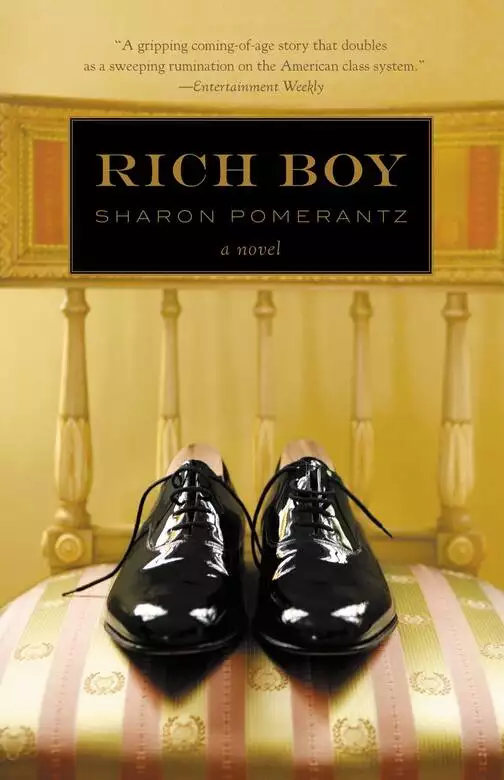
Rich Boy
- eBook
- Paperback
- Hardcover
- Book info
- Sample
- Media
- Author updates
- Lists
Synopsis
Robert Vishniak is the favored son of Oxford Circle, a working-class Jewish neighborhood in 1970s Philadelphia. Handsome and clever, Robert glides into the cloistered universities of New England, where scions of unimaginable wealth and influence stand shoulder to shoulder with scholarship paupers like himself who wash dishes for book money. The doors that open there lead Robert to the highest circles of Manhattan society during the heart of the Reagan boom where everything Robert has learned about women, through seduction and heartbreak, pays off. For a brief moment, he has it all-but the world in which he finds himself is not the world from which he comes, and a chance encounter with a beautiful girl from the old neighborhood-and the forgotten life she reawakens-threatens to unravel his carefully constructed new identity.
Release date: July 17, 2010
Publisher: Twelve
Print pages: 520
* BingeBooks earns revenue from qualifying purchases as an Amazon Associate as well as from other retail partners.
Reader buzz
 Please log in to recommend or discuss...
Author updates
Rich Boy
Sharon Pomerantz
A Booklist Top Ten First Novel of the Year
Winner of the National Jewish Book Awardfor Debut Fiction
“Compulsively readable… There’s nothing quite as classically American as the myth of the self-made man… RICH BOY is told with
such page-turning skill that its pleasures feel rich indeed.”
—Entertainment Weekly
“A smooth read, rich in observations… a literary delight… This debut novel complements Philip Roth’s Pulitzer Prize–winning
American Pastoral… Which novel did I prefer? RICH BOY.”
—Providence Journal
“A noteworthy addition to that long and distinguished line of American fiction about money, stretching from The Great Gatsby to The Bonfire of the Vanities.”
—Peter Ho Davies, author of The Welsh Girl
“We dare you to put down this big, fat, old-fashioned drama about a poor boy who makes good—but feels bad about it.”
—O, The Oprah Magazine
“Delightful… Pomerantz has wowed me to the nth degree… just masterful!”
—Naples Daily News (FL)
“Pomerantz digs deep into notions of class and wealth… an easy-reading saga with an intriguing, complicated hero.”
—Publishers Weekly
“RICH BOY is a compelling American story of desire and grace. Robert Vishniak is irresistible and true. I started reading
the novel and could not stop.”
—Min Jin Lee, author of Free Food for Millionaires
“A great read… superior… completely engrossing… a not-to-be-put-down book… I didn’t want it to end.”
—Hamptons.com
“This debut novel does something quite rare. It manages to be both detailed and general—to tell a single story and make of
it a parable, to chart the rise and fall of a representative figure in ‘the American century’… Her character of Robert Vishniak
is the poor RICH BOY writ large.”
—Nicholas Delbanco, author of What Remains and The Vagabonds
“Involving… richly drawn… a really good tale.”
—Long Island Press
“Engaging… compelling… a page-turning novel.”
—Forward
“Terrifically intricate… an excellent summer novel, one that offers a rip-roaringly good historical saga, a compelling character
study, an emotional mix of tragedy and romance, and tantalizing details of luxury and wealth.”
—BookReporter.com
“This vivid morality tale is also a Magical Mystery Tour of the ’60s, ’70s, and ’80s, in which Robert wins all the prizes
but pays a price.”
—More magazine
“I’ve written about a lot of beach books coming out this year—fantastic reads that I’d recommend again. But they’ve all been
trumped by RICH BOY, which I’m naming my top beach read of the summer… an excellent read.”
—BookaWeekwithJen.blogspot.com
“An impressive, engrossing, sprawling picaresque… a meaty, juicy read.”
—AARP The Magazine
“Very rarely, a writer comes along who understands the very rich, and those who are determined to become very rich. Think
Fitzgerald and Gatsby, Bellow and Augie March, Wolfe and The Bonfire of the Vanities. And now here comes Sharon Pomerantz, bringing to life in an utterly compelling and convincing way Manhattan in the 1970s
and 1980s… If you want to understand what made Bernie Madoff possible, I can think of no more serious, sensitive, and intelligent
novel to read than RICH BOY.”
—Eileen Pollack, author of In the Mouth,The Rabbi in the Attic, and Paradise, New York
For as far as the eye could see were miles and miles of Jews, families of four, five, and more packed into long, solid-brick
rows—so many ’Steins and ’Vitzes, Silvers and Golds—each house with its own narrow scroll of front lawn and a cement patio
big enough for exactly two folding chairs. On Robert Vishniak’s block, the 2100 block of Disston Street in Northeast Philadelphia,
an Italian family lived three houses down from him. “Italian from Italy,” his mother liked to say, born over there, unfamiliar
with the lay of the land, and so no one told them until it was too late that they were buying on the wrong side of the Roosevelt
Boulevard, a highway that might as well have been a river; Jews stayed west of it and Catholics east.
The area was known by residents as simply “the Northeast,” and Robert’s neighborhood was called Oxford Circle, named after
a traffic circle that drivers had trouble navigating their way out of. Most of the fathers in Oxford Circle worked at government
jobs or in factories, did physical labor, or owned small shops. The mothers stayed home with the children and were house proud.
They hung their wet clothes on miles of line that stretched from house to house in the endless shared back driveway—the heavy canvas work shirts were spotless and the white bedsheets gleamed, as did the
kitchen and bathroom floors that the women scrubbed, on their hands and knees, as if in worship.
The Vishniak family moved here in 1953. Before that, they’d lived with Robert’s grandparents, Cece and Saul Kupferberg, in
a three-story row house in Southwest Philadelphia. Robert made the fourth generation to reside in that overcrowded house,
yet the adults greeted the arrival of the first grandchild as if he warranted his own national holiday. Saul—who worked long
hours at the tannery and came home so tired that his dinner was often served to him in bed—asked that the baby be brought
to him after his last glass of tea so that he might hold him for a few minutes before bed. More than once he was found with
his arms locked around the infant, both of them fast asleep. When Robert’s young uncle Frank, just a year out of high school,
returned each day from his job at the supermarket, he lifted the boy into the air, parading him around the living room high
above them all, where they believed he belonged. As Robert grew, his grandmother indulged him with endless homemade desserts,
and his aunt Lolly, who lived just down the block and did not yet have children of her own, came over every afternoon to hold
him on her lap and smother him with kisses while declaring Robert the most beautiful child she’d ever seen.
She was not completely biased in her assessment. He had a full face, with olive skin like his mother’s and straight black
bangs that skimmed large brown-black eyes. On his chin and on the right but not the left cheek was a dimple that, when it
chose to appear, seemed to be awarding a prize. Mostly, the boy smirked rather than smiled, as if possessing a secret that
might at any moment corrupt him. Women particularly responded to his charms. When walking the child in the stroller, Stacia
and Cece were often stopped by strangers who wanted to smile at him and, in Stacia’s words, “make fools of themselves.” A
neighbor once took a picture, hoping to enter him in a local contest for adorable toddlers, but his mother would not hear of it—there was no cash involved, so what, Stacia
asked, was the point? She was the only one who didn’t slobber over her son; for that matter, she didn’t hug or kiss most people,
be they child or adult. But affection is affection, no matter where it comes from, and in Cece and Saul’s house Robert grew
drunk on it.
Though Stacia worried that Robert would be spoiled, she could not deny that so many babysitters, cooks, and assistants made
her life much easier. She would have been happy to live in her parents’ house forever, paying no rent and letting others fuss
over her firstborn, but then, when Robert was five, Stacia had another child, Barry. The second son brought none of the novelty
of a first grandchild and was a loud, colicky baby who kept the house up all night. The adults were five years older, five
years more crowded and tired. Cece’s father, now age ninety-five and referred to by all as “the old man,” was still occupying
the attic and showed no sign of going anywhere. Frank was as yet unmarried and remained at home. Instead of happily making
room for the new baby, the family wondered where on earth they’d put him. It was not that they were unloving, or neglectful,
but they went about their duties this time with significantly less enthusiasm. Then Saul got sick, and it dawned on his wife
that Stacia, her husband, and their growing family might stay forever, and Saul would never be able to retire. So she kicked
them out.
Stacia argued with her mother and then, for the first and only time in her life, she begged—“We haven’t saved enough for our
own place; we’ll pay more into the household expenses; I’ll keep the baby quiet, I promise”—but Cece’s mind was made up. She
folded her arms over her significant chest, told Stacia to get a mortgage like everyone else, and declared the decision final.
They bought the house in Oxford Circle for $6,300 with 30 percent down. Even at six years old, Robert knew those figures because
Stacia Vishniak believed that hearing what things cost was good for children, like castor oil. There was a mortgage to pay
now, and Vishniak, who worked at the post office during the day, began moonlighting nights and weekends as a security guard. After
Barry went off to first grade, Stacia took the school crossing guard job so that she could still keep an eye on her sons after
school. Mornings and afternoons she ferried the children from Solis-Cohen Elementary School safely across Bustleton Avenue.
It was a strange vocation for a woman who hated automobiles, considering them wasteful and dirty. But no crossing guard was
more diligent, keeping her charges in line with only a look, and holding drivers to the school-crossing speed limit, memorizing
quickly the license number of anyone who infringed. Robert’s mother not only shopped for and prepared their meals and did
the cleaning, washing, and general housework, but she also did all her own home repairs, fixing plumbing and unclogging drains,
plastering and painting hallways and replacing light fixtures. Every other Sunday morning Stacia mowed the small front lawn
with a rusty hand mower. She paid all the bills, too, squeezing twenty dollars out of each nickel. If the neighbors sometimes
gossiped about her standoffishness, her plain appearance, she ignored them. No one’s opinion mattered to her but her own.
Eventually Saul died, followed by the old man. Cece sold her house and moved to an apartment near Stacia. Then the rest of
the family trailed after her to Oxford Circle, so by 1960 the Vishniaks and Kupferbergs—cousins and grandparents, great-aunts
and great-uncles—were once again within blocks of each other. And for a long time that was all Robert knew—the embrace of
family, blocks and blocks of people who if they were not related to him, might as well have been. But he was older now, did
not need them as he had in childhood. No matter, they still crowded around, wanting to be close. On the streets, he heard
his name called out too many times, noticed too many familiar, familial, faces always watching him. As he grew to adolescence,
preparing for the ceremony that would declare him a man, he could get away with exactly nothing and he began to yearn, more
and more each year, to be a stranger.
WITH SO MANY COUSINS, Cousins Club was an event to be dreaded but not ignored. Every few months his mother and her two siblings
and most of their many cousins, and sometimes all the elderly parents as well, got together at someone’s house. The system
that determined who hosted was part economics and part caprice—some had it twice within a short time; others were overlooked
completely. Eventually, though, when Robert was thirteen and Barry eight, the wheel stopped on Stacia and Vishniak.
His mother made the announcement at the dinner table that February. “The Cousins Club is here next month,” she said. “Even
the rich cousins, back from their fancy winter vacations, are coming to look us over.”
“When was the last time we had it?” Robert asked. He could only remember his parents leaving for other people’s houses dressed
in their best clothes. They returned late at night, often waking up Robert with their fights; the evenings were not without
controversy.
“We’ve never had the club,” Stacia said. “When we lived with Cece we didn’t have to. Now we have our own place and we can’t
escape. It’s a family obligation.”
“Jesus!” Robert’s father said, suddenly pounding his hand on the table. The boys and their mother started in their seats and
then looked at him, waiting for some additional verbiage, but he went back to his mashed potatoes.
“What does the club do, Ma?” Barry asked, hoping for special passwords, or time spent in a tree house.
“They play cards for money,” Stacia said. “Too much money.”
“They eat like pigs,” his father added. “Like termites.” He paused. “They eat like the Russians are at Camden Bridge.”
“Great!” Barry said.
“It’s not great,” Robert replied, five years older and more in touch with the general sentiment. But he was desperately curious
to meet the mysterious rich cousins—two of his grandmother’s nephews who’d been in the junk business, barely making ends meet, when
the Second World War broke out, bringing with it the incessant demand for scrap metal. What would prosperity look like on
the face of a Kupferberg? How, he wondered, were these cousins made?
By now Robert knew that the children of Cece and Saul Kupferberg, while intelligent, did not have heads for business. At one
time or another, all had tried their hand at entrepreneurship and failed. The Vishniak side of his family was no better—his
father’s father had a brief period of entrepreneurial success as a bootlegger during Prohibition, but then his basement still
caught fire, forcing the family to make a narrow escape as the house burned almost to the ground. Stacia and Vishniak’s story,
while less dangerous, was no more optimistic. Just after the war they owned a candy store in South Philadelphia. A lover of
sweets, Vishniak ordered too much merchandise and gave away endless samples, carried away by his own enthusiasm, insisting
that generosity brought in business. Stacia, who operated the cash register, mostly stood up front, arms folded, glowering
at the freeloaders. Vishniak hired his brothers to work for him, and often one or the other sat in the back reading books
for their night school classes. After three years the store went belly-up, and all Robert’s father had to show for his efforts
was a bad case of diabetes and a garage full of stale Goldenberg’s Peanut Chews.
Were these rich cousins somehow constituted differently than the rest of the family? Or was it, as his mother claimed, merely
luck? The rich cousins lived in the far Northeast, meaning farther north on the Roosevelt Boulevard. Even that was a mysterious
place to Robert, a distant neighborhood where, he’d been told, brave settlers carved aluminum-sided single homes and a shopping
mall out of a virtual wilderness.
During the month leading up to their hosting of the club, Stacia was in a terrible mood. Theirs was a loud house with two
boys, but in the weeks before the cousins arrived, even Barry did not dare set anything on fire, pass wind at the dinner table, or slide down the carpeted steps on his stomach yelling, “When the hell are
we finally going to buy a used car?”
Generally his mother could always be counted on to cheer up when his father returned from work with new treasure—a broken
but serviceable umbrella, a man’s watch with a cracked face that still ran, a pair of barely used pantyhose, or a lady’s scarf,
sometimes monogrammed, often still smelling of its owner’s perfume—all left behind by passengers on the bus or elevated train.
His parents kept these collectibles in the drawers of the china cabinet in the dining room, where most people would keep their
good silverware and cloth napkins. In the week before Cousins Club, Robert noticed Vishniak making a particular effort, but
even when one of that week’s scarves turned out to be silk, Stacia said barely a word, her eyes scanning the living room in
search of excess dust.
Stacia cleaned and vacuumed, not to please her sister or brother or mother, or even the various cousins who lived blocks away
and were seen with regularity; her worry focused utterly and completely on the two rich cousins, their wives, and a third
man, a brother-in-law, who was also a distant relation. In their family, out of either habit or tradition, cousins often married
cousins.
The much-anticipated Saturday night arrived, and despite the constant shortage of parking on the block, the rich cousins somehow
found spots in front of the house. Robert looked out the window and saw three Cadillacs in a row: pale blue, silver, and pink.
His parents and aunts and uncles waited in the living room, assembled near the bay window, peering as if at a passing parade.
He heard whispers of “those earrings” and “that coat” and “with all his money you’d think he could buy a better rug.”
The rich cousins burst through the door, the men first, wearing leather jackets and jingling the change in their pockets.
The wives had blond hair the color of yellow corn before boiling; all three wore long furs of varying colors and patterns.
They shook hands and smiled and kissed the air like movie stars as the crowd gathered around them. Barry and Robert stood by to take their
coats.
After exchanging fast greetings, the men went downstairs to play poker and the women remained in the living room, sitting
around a spread of food on snack tables—chopped liver and herring, creamed cheese stuffed inside olives, knishes and kishke
and pumpernickel and all kinds of fruit. This was only the hors d’oeuvres. The real food came out after the men finished their
game and joined them. It was a basic rule of all family functions that no one skimped on food, his mother and grandmother
least of all, even if for the next six months they all ate leftovers and bought dented cans from the discount bin.
All night, Barry and Robert made trips up and down the stairs with sweaters and overcoats, but the long furs and leather jackets
of the rich cousins weighed as much as all the other coats combined and needed two trips. The silk linings of the three minks
smelled of cigarettes and heavy perfume. Robert put them on top of the stuff on his parents’ bed in a heap, a mountain of
coats.
In the master bedroom, Barry tried to entertain Robert with his skill as a mimic. His newest impression was of an old man
who lived down the block, an epileptic who a few months earlier had had a fit while walking his dog on Disston Street. The
drama of the event—the barking, his wife rushing out of the house with a butter knife to put under his tongue—had been the
talk of the neighborhood for weeks. At recess, Barry now fell to the ground regularly, wriggling, groaning, and foaming at
the mouth to great applause from his peers; he repeated the performance for Robert that night, having achieved a kind of studied
perfection through practice, but Robert was already bored with his brother’s small repertoire.
“Try someone else already! What about your gym teacher, the one who’s always got his hand down his pants? Or the cashier at
Shop N’ Bag, with the lisp, who hates when Ma comes with all her coupons?”
But Barry would please only himself and fell onto the coats, cookie spit erupting from his mouth as he kicked out one leg
in a series of scissorlike motions and almost tumbled off the bed.
Robert left his brother and went out into the hall, sat on the landing where no one could see anything but his feet, and listened
to the hum of female chatter down below and the high-pitched exclamations of delight. Fake, he thought, all fake. With the arrival of the rich cousins, the other women, when they bothered to say anything at all, spoke in high, strangled
voices. His mother was talking about how well Robert did in school, that his teacher had suggested he apply to Central, the
city’s academic magnet high school. How strange to hear her talking of him this way—she never did, never called him smart
or praised him in any way.
One of the rich cousins talked about a trip she’d taken to Florida and plans she and her husband had to visit South America,
where gambling was legal. All the rich cousins were big gamblers, his father had told him. Was that not a lesson in itself?
Robert walked carefully down the steps to where the women sat. Aunt Lolly winked at him and spread her arms wide. When he
got close to her, she smothered him against her enormous bosom. Cece took his face in her hands and kissed him wetly, and
Uncle Frank’s wife pecked his cheek. Then one of the rich cousins put her hand on his arm, a small hand with long fingers,
nails painted red.
“So handsooome,” she purred, clamping her fingers around his wrist, “he looks just like Monty Clift.” Finally she released
him and he walked into the dining room.
“What good will his looks do him?” Stacia asked. “They won’t help him earn a living. As it is the girls run after him. Only
thirteen years old and they call the house. Call the house!”
The other women laughed, though Stacia had not meant to be funny.
Robert mulled over their comments as he walked through the kitchen, stopping to pour himself a glass of orange juice. At school
he’d heard his English teacher, Mrs. Markowitz, tell his history teacher, Miss Taft, that one day Robert Vishniak would be
a lady-killer, a term that rang in his ears like a threat. When boys and girls had to pair up to learn square dancing in music
class, four or five girls would rush to his side, so that he had to make none of the effort of the other sweating, red-faced
males. Those same girls sometimes wanted him to walk them back from school, and twice he’d made out with Margie Cohen behind
a tree in the school yard, and he’d liked kissing her but was uncertain what to do from there. Miss Taft, the youngest of
all the teachers and the prettiest, would sometimes brush the bangs off his face and, smiling sweetly, tell him to get a haircut,
even when he’d gotten one the week before. The sensation of her fingers on his forehead, and the light scratching of her fingernails,
gave him a pleasurable chill. Other female teachers seemed to like to put their hands on his shoulders, giving them a momentary
squeeze. Yes, women liked to touch him, but what his part was, how far he might go in response to their caresses, remained
unclear.
While thinking of the mysteries of women, he descended slowly into the dark basement, the realm of men, and his feet made
a hollow clomping sound on the stairs. The room was filled with cigar smoke and, as if inside a cloud, the men around the
table hunched over their cards, shoulders stooped in concentration. In front of Robert’s father were only four chips. Uncle
Frank had a few more chips than Vishniak, and Uncle Fred was doing the best of the three, but nothing compared to the chips
in front of the three guests on the other side of the table. Robert stood behind his father, looking over his shoulder at
his hand: two of hearts, two of diamonds, four of clubs, eight of spades, and a king of spades. What could Vishniak do with
such a hand? From the glass next to him, Vishniak took a few sips of cherry brandy, sweet as syrup, which Robert knew he was
not supposed to do, on account of his sugar. His father’s face was red, his forehead sweaty. Unlike the women, the men were
mostly silent—a grunt here, a cough, a random obscenity mumbled.
Barry came down moments later eating a mandelbrot cookie, the crumbs clinging to his sweatshirt. They stood together and watched their father ask for three cards, which improved
his hand only slightly, then silently throw a chip into the pot in the center of the card table. “Is he winning anything?”
Barry whispered. “He’s not winning anything, is he?”
“Shut up,” Robert replied. For the first time in his life, he saw nobility in his father, who was mostly a shadow presence
in his life, a sweaty mumbler of greetings who came in from work as his sons were leaving for school, was asleep by the time
they did their homework and ate dinner, and left for a second job as they were going to bed. But suddenly Robert saw how his
father could be strong, losing money without speech or expression, swallowing his shame.
And he wanted to help him. He stared at the cousin who was winning, at his big, shiny face, his cigar, the calm of his expression,
the confidence as he upped the ante, then stopped to mop his brow with a handkerchief. Because the basement was cold—only
a curtain divided this room from the garage—Stacia had felt the need to spring for two space heaters, which were surprisingly
effective, and the cousin who was winning took off his sport jacket and put it over the back of his chair. Robert stared at
the jacket—navy blue with a pink-and-white-striped silk lining. He’d never seen anything quite like it before. One side sagged
with weight, a lump created by something in the inside pocket. A wallet, Robert thought. He keeps his wallet in his jacket, not in his pants. He can’t sit on his money because there’s too much of it.
Barry, bored with it all, had wandered over to the other end of the room, to the table where unopened bottles of liquor, the
accumulation of ten years of Christmas gifts from Vishniak’s various supervisors at the U.S. Postal Service, sat on a table.
Barry tried unsuccessfully to reach an open bottle but was too short. He signaled to Robert, but Robert, lost in his own thoughts,
didn’t see his brother, so Barry crossed the room.
“Throw a fit,” Robert whispered.
“Now?”
“Yeah, a big one. Lots of spit. Throw your leg around like you did upstairs.”
“Whadda I get?” Barry asked. “I’m not doing it for nothing.”
“This is for Pop,” Robert said, motioning toward the game. “Think about someone else for a change.”
Vishniak had only two chips left now. He took another sip of his brandy, then pulled a handkerchief out of his pocket and
mopped his brow.
“I want a drink first. The gold-colored stuff in the fancy bottle.” He pointed at the makeshift bar.
Robert went to the bar—the men oblivious, grunting and scratching, a few moans as they lay down their hands—and filled about
a third of the cup with black cherry soda, Barry’s favorite. Then, as Uncle Frank dealt a new hand, Robert picked up the bottle
of Crown Royal and quickly poured to the top of the cup, then replaced the cap and brought it back to Barry.
His brother tilted his head back, gulping down as much as he could, then gagged softly, and burped.
“All right, hurry up,” Robert whispered, and pushed his brother closer to the men. Barry took a deep breath, as if plunging
into water, and fell to the ground, groaning and convulsing, his foot catching on a metal folding chair that hit the floor
with a loud clatter. There was some commotion, a few cousins got up, but Uncle Frank and Vishniak glanced at each other with
a certain understanding, and Frank shook his head, smiling to himself. The rich cousins did not even leave the table, and
Robert feared his plan would not work; how could he get at the jacket if everyone refused to be distracted?
Then Barry, taking his performance to a level beyond the Method, rolled over and groaned, crawling to the poker table on all
fours. When he got close, he grasped at a chair and began to pull himself to his feet. He opened his mouth, about to say something,
and cherry-red vomit spewed out in a great arc, some of it raining down on the table and its inhabitants, some of it traveling all the way to the distant curtain. As if under fire, the men
ran for cover in the garage. Vishniak spotted the cup of mud-colored liquid by his son. As Frank ran upstairs to get towels,
We hope you are enjoying the book so far. To continue reading...
