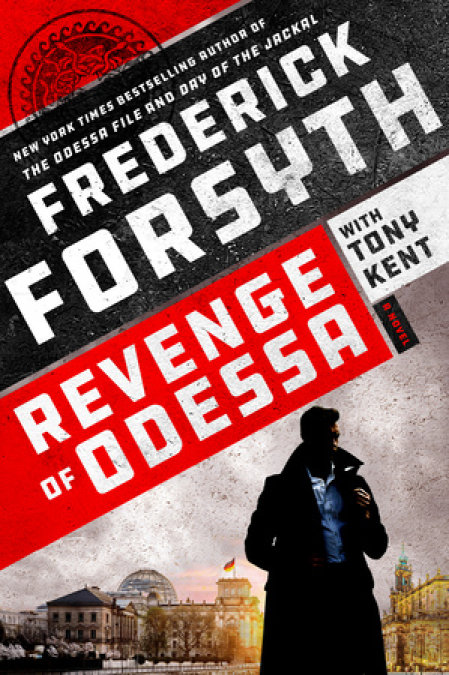
At last, the long-awaited sequel to the New York Times bestselling thriller classic, The Odessa File.
Fifty years after revealing the secrets of Odessa, an underground organization of former Nazis angling to regain power, Peter Miller is a retired legend in the journalism community. He's spent the last decade caring for his grandson Georg, after the death of his son and daughter in law in a tragic cara accident.
Always suspecting that his own long list of enemies might have been behind his son’s death, Peter pulled back from his career to keep Georg safe. But he could do nothing to stop the young man from following in his footsteps, Georg's reputation and renown for fearless journalism growing fast in a digital world.
But Georg Miller is not the only aspect of Peter’s past that has thrived. By 2025 Odessa has been replace by Medusa which has reached a level of secret power greater than Odessa ever achieved, its every long-term plan nearing fruition. The subtle rise of the far-right in German politics; the dozens of seemingly unconnected ‘patriotic’ parties growing across Germany’s constituent states and districts; the spike in violence and terrorism against Germany’s immigrant population; and the angry reaction of her citizens. All are symptoms of a man-made, hidden danger, fuel for a planned inferno that must be stopped at all costs.
All while, elsewhere, the children of Odessa play for the highest power of all--a seat in the West Wing.
Release date:
November 18, 2025
Publisher:
G.P. Putnam's Sons
Print pages:
448
* BingeBooks earns revenue from qualifying purchases as an Amazon Associate as well as from other retail partners.
Karl Weber leaped into the air before the ball had hit the back of the net, his frenzied cheers as indecipherable as the thousands that surrounded him. The entire Cannstatter Kurve had come alive at a moment of individual brilliance from VfB Stuttgart's iconic number 10, Bobby Wright, his forty-meter run ending with a rocket of a shot from the corner of the penalty area.
The wonder goal had put the result beyond doubt. VfB were 4-0 ahead with only fifteen minutes to go, making a comeback near impossible for TSG Hoffenheim. It was the kind of scoreline that demanded celebration, especially when it was achieved against one of the club's biggest rivals. And Weber-like so many around him-was going to do exactly that.
He wiped what seemed like a bucketful of beer from his eyes and through his hair as he continued to cheer through the ongoing shower of lager, grabbing and hugging and mostly screaming at those closest to him. He was not the only one. Wright's strike had set off an explosion of uncontrolled euphoria in VfB's most infamous stand, filled with the club's most fanatical fans. Anywhere else and Weber's reaction might have seemed over the top. Here he was a single drop in an ocean of manic excitement.
No attention was paid to the pitch as the madness engulfed the stand. No one watched as the ball was retrieved from the goal or reset in the center circle, ready for the final stretch of the match to begin. Instead the cheering continued as minutes passed, with fans congratulating one another as if they had scored the four goals themselves.
This was why the Cannstatter Kurve fans were the very last to see death's arrival at the MHP Arena.
Weber barely registered the first of the gunshots. They came when his head was buried deep into the shoulder of his much taller friend, Philipp Rüdiger. Weber and Rüdiger had been coming to VfB together-along with their pal Florian Aber-for close to thirty years. None of the three men noticed the sudden change in atmosphere.
The second shots came seconds later. This time Weber noticed the noise, but his mind was still too distracted to even wonder what the cause might be. That changed in a moment with a third, fourth and fifth burst, those ones almost simultaneous.
Weber looked around in confusion. His first thought was firecrackers, but something inside him was saying "no." Perhaps it was the volume. Too loud for stadium fireworks. Or perhaps it was the inherent violence that seemed to accompany the sound. Whatever it was, his instinct was proved correct by a sixth, seventh and eighth burst and the realization that what he had thought were cheers of joy had become screams of terror.
He turned toward Aber to his right, intending to shout an instruction. His friend beat him to it.
"RUN!!"
Aber pushed Weber forward as he screamed, his words drowned out by the noise around them and then eclipsed completely by another round of shots, this one much closer. The entire Cannstatter Kurve had registered the threat and a whole section of the stand seemed to move as one, sweeping a terrified Weber, Aber and Rüdiger in its wake.
The shots continued to ring out as they moved. Some sounded distant. Some sounded close. Wherever they were coming from, Weber had no way to see them and no way to control if he was moving toward or away from them. It was all he could do to stay upright in the crushing embrace of the crowd, his breathing strained as bodies pressed in from all sides.
Weber tried to struggle free. He was desperate for a better view of where the human wave was taking him and desperate to catch a glimpse of his two friends, now lost to him somewhere in the throng. It was an impossible task. Thousands of people had merged into a single, irresistible and mindless entity that was driven by just one thing: the urge to escape.
Against that, one man could do nothing.
More shots. More screams.
The crowd seemed to tighten in response. As if those on the outside were trying to fight their way in. It worsened the already unbearable constriction, with bodies on all sides pushing deep into Weber's chest, shoulders and back. In that moment it was impossible to breathe at all: his lungs and his rib cage could do nothing to overcome the pressure that now surrounded him.
He fought for breath. For space. But he knew that he was failing. That he could not survive this.
Relief came with another round of fire. The sound alone told Weber that these were the closest yet. A mix of blood and other bodily matter confirmed that instinct, hitting his face as it was expelled from some unseen victim.
The close proximity of the gunman had somehow dispersed a portion of the crowd, as if they had decided to take their chances in another direction. It eased the pressure on Weber, allowing him to breathe for what felt like the first time in minutes. It also cleared a line of sight.
For the first time he could see a gunman.
He registered the features in the blink of an eye. The man was Arabic. He was dressed in a brown, military-style one-piece that resembled a flight suit. And he was carrying an assault rifle, which in that moment he turned away from Weber's direction and toward a small group that had broken from the crowd.
A group, Weber now saw, that included several small boys.
"NO!!"
His scream did nothing, leaving Weber to watch in horror as the gunman opened fire, the multi-round burst accompanied by a shout of his own:
"ALLAHU AKBAR!"
It was the worst sight of Weber's life. The most horrific act he had ever witnessed. It left him physically stunned. Unable to move, he watched as the same gunman fired two more bursts into the fleeing crowds, both times with the same celebratory shout to his god. The same paralysis remained even as the man noticed him, and so Weber remained frozen as the gun was turned toward him.
Had the man had a chance to shoot, Weber would be dead. And yet he felt no relief when, instead of opening fire, the gunman was riddled with bullets from an unseen source, slamming him hard onto the ground.
Weber registered none of this. Not his own survival. Not the death of the terrorists who had killed so many. Not even the fact that his nightmare was ending. Instead his eyes remained rooted on the bodies that were meters ahead of him.
The bodies of three VfB fans, no younger or older than he and his two friends had been when they'd attended their first game. Three boys who had no doubt been celebrating that same goal only minutes earlier.
Three boys who would never see another sunrise.
Two
The intense heat of the Stuttgart night seems an apt backdrop for the hell wrought here today."
Georg Miller read the words back to himself four times. Three in his head, then once aloud. They passed the silent examination: they were fine on paper. But they fell at the final hurdle.
You can write this shit, Georg, he told himself, but you sure as hell can't say it.
Using his cheap black biro, he put a line through his own try-hard prose. Then he closed his battered leather notebook and stuffed it into his satchel case. The words weren't coming, and nor would they. Not yet.
Not while he felt like this.
He looked outside, through the wide doors of the main hospital entrance. What he wanted most right now was a cigarette, but the sight of the smoking area made him hesitate. It was full to uncomfortable capacity with reporters, all with nothing to do but smoke and vape as they waited for an announcement from inside.
It was a lazy approach to the job, Georg always thought. Waiting for the bare bones of a story to be handed to them on a plate. But it was not just his disdain for his peers that was keeping Georg inside the building and away from the still-oppressive evening heat. It was also his certainty that a nicotine hit, as welcome as it might be, would do nothing to calm him. Not after the horrors he had seen tonight.
It's going to take something a lot stronger and a lot less legal to touch the sides after this one.
He turned his gaze back toward the deeper interior of the hospital.
From here he could see the overcrowded reception area. Five percent of that number were press, he estimated. The rest were patients and medics. Those numbers alone suggested a busy night, but the terrible reality was hidden from his view. What Georg had witnessed in the wards and corridors beyond reception was like nothing he had ever experienced. Not up close.
The images would be seared into his memory for as long as he lived. A high price that removed any need for him to look again in order to describe them.
And yet still he had no choice but to go back in. To go past reception and into the hell beyond. Because that was where the answers were. The answers to the questions he was burning to ask.
To the questions he was paid to ask.
Because a newsman doesn't run at the first sight of blood.
He repeated the words in his mind as he pushed his back from the wall and took a deep breath, steeling himself for what was to come. Those same words, driven into him by his grandfather for longer than he could remember, had fueled Georg his whole career: a mantra etched into his soul. By now he was unaware he was even thinking them. Unaware how much he owed to the ethos behind them. His grandfather's ultimate lesson, the difference between him and everyone in that smoking area.
He headed back inside.
It had taken Georg almost two hours to travel from the Hamburg office of the Komet news magazine to Stuttgart airport, then thirty minutes more to reach the Marienhospital, where most of the wounded and the dying had been brought in a desperate effort to save their lives. By the time he arrived a clear three hours had passed, yet still the medics had not seen half of the wounded.
That was the scale of the horror that had brought him and so many other reporters here.
Even now the details remained sparse.
The police had said very little to the public or to the press, and Georg had been unable to get much sense from anyone inside the hospital. The medics were too busy, the victims mostly in no condition to talk, and the sight of so many dead and dying had left Georg too shaken to formulate any kind of insightful inquiry.
Three hours since the first word of the atrocity had reached him and still all he knew were the same scant details as had been shared with the rest of the world: over thirty football supporters dead and who knew how many more wounded, with all the gunmen themselves killed by GSG-9, the elite special forces unit of the Bundespolizei.
In the early days those facts would have been enough for Georg. At least at this stage of the story. But the world had changed in the decade since he had printed his first byline, and nowhere was that truer than in Germany. Back then he could have expected a moderate, logical reaction to even the worst terrorist outrage. Now he could guarantee the opposite. Germany was a tinderbox, primed to explode in a direction Georg found unthinkable. And his country's politicians, once among the most liberal in the western world, could no longer be relied upon to calm that storm.
An attack like this one, and like all of those that had preceded it, was an escalation in scale and horror great enough that its manipulation and use against an already frightened population was inevitable.
He had watched it happen before. So-called respectable politicians using tragedy to rally the panicked masses to a cause those same masses would otherwise question. Again and again it had happened, across three heart-wrenching years of terror and violence and death.
But not this time. This time Georg would stop it.
To do that, he needed to know more.
Three
He walked slowly as he moved back inside, fearful of the sights about to greet him.
One of the largest hospitals in Stuttgart and boasting by far the city's biggest emergency center, the Marienhospital was still unfit for the purpose to which it was now being put.
Georg kept his eyes fixed straight ahead and tried to ignore what was happening around him, but it was impossible to miss the huge numbers of bloody and barely covered corpses left on abandoned trolleys in the hospital corridor, dumped there by staff too busy fighting for the living to worry about the dignity of the dead.
Thirty dead is an underestimate, he told himself as he moved ever forward. It's way more than that.
And yet somehow those bodies were not the worst of it. Instead it was the sights and the sounds of the living that haunted him more. There were scores of them, left and right. Some were still awaiting medical attention. Others looked as if the medics had done all they could.
He could only shake his head in dismay as he moved onward, fighting back tears of despair. This, he recognized, was the real-world result of pure evil: the massive blood loss, the agonized cries and the desperation on the faces of doctors and nurses still battling to save these poor people.
Many of them wouldn't make it. Georg needed no medical qualification to know that. And those who would survive? They were dotted around the emergency center and beyond, into the many surrounding departmental areas seconded to the task.
Georg didn't know it, but he had been breathing deeply as he moved. A subconscious attempt to strengthen him for what was to come, itself a symptom of his determination to get through this. His determination to do his job. But those breaths stopped now as he glanced to his left, his attention caught by the nearest trolley and by the small, child-size figure its sheet was covering.
For a moment he could not move. That last sight-that lost child-was almost too much. An innocent kid, probably excited about a day at the football with their papa, their joy replaced in an instant by a terror they could never understand. Their life ripped away from them by those . . .
We hope you are enjoying the book so far. To continue reading...

 Please log in to recommend or discuss...
