Chapter 1
Al-Taqaddum Air Base
Just Outside Fallujah, Iraq
2006
Another blistering day had settled over Iraq, and Captain Hap Stoner and Major Jonathan Simmons sweated inside the ready tent, waiting out their fifteen-minute alert.
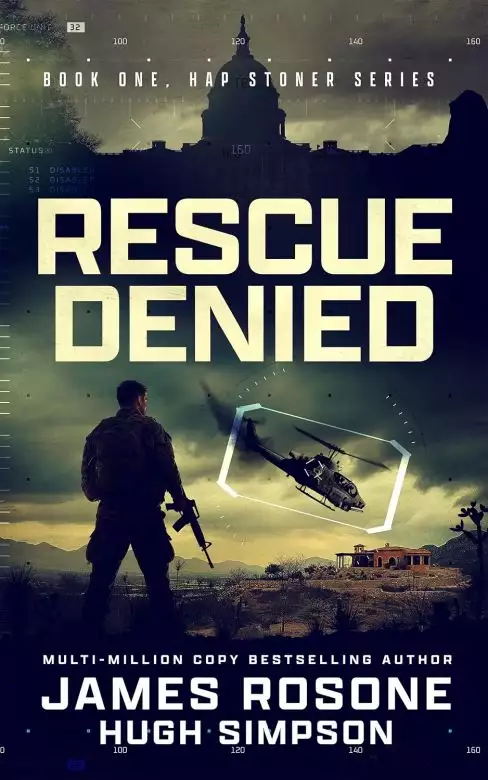
With all four walls of the tent rolled up, two fully armed AH-1W Super Cobras sat in full view, shimmering in the heat, fueled and ready for war.
Nearby, Hap’s wingman, Captain John Hancock, and his gunner gathered their flight vests and sidearms. Thirty minutes remained in a twelve-hour shift, and everyone in the tent had begun watching the clock.
Simmons sat hunched behind a small green field desk, working his way through an eight-hundred-page biography of Napoleon nestled between four empty water bottles. Beside the book sat an old hand-cranked field telephone connected directly to the Direct Air Support Center at Camp Fallujah.
Hap sat on the edge of his cot, reviewing intelligence reports on the fighting inside Fallujah.
For three weeks, Marines and US Army troops had been fighting house to house through the city, clearing insurgents from a city they had claimed as their own.
The phone rang.
Five minutes later, both pilots reviewed Simmons’s scribbles as the massive rotors slowly began to turn overhead.
“Still fighting for that same old building,” Hap said.
“Appears to be the situation,” Simmons replied. “Bastards are tough. The DASC did say the grunts fighting for the building specifically asked for us.”
Hap, call sign Kang Cobra, had to chuckle. He knew Jethro, call sign Simmons, and knew he had a reputation for getting the job done. He also knew the Iraqi resistance had a bounty for both their scalps…dead or alive.
“Dash two is ready.”
“Jethro copies,” Simmons replied over the radio as Hap waved the ordnance crew forward to arm both aircraft.
Starting with their Cobra, the ordnance men armed four TOW missiles, four Hellfires, fourteen 2.75 rockets, and six hundred rounds of 20mm ammunition for the cannon.
*******
“I got the smoke,” Hap said.
Grunts from the 8th Marines had marked the target building.
The radio crackled to life as the forward air controller came up on the flight frequency. He immediately gave the flight a nine-line brief.
Hap repeated the brief back to the FAC.
“What’s our target?” Simmons said.
“We are to take out the northeast window on the second floor,” Hap replied.
“Cleared hot, Jethro,” the FAC said.
“Jethro copies,” Simmons answered. “Cleared hot.”
“Hollywood is lazing.”
“Got it,” Simmons transmitted.
Bang, bang, thump. Three rounds ran across the starboard side of the aft cockpit; one round punched through the cockpit. The aircraft jerked to the right.
“I have the controls, Jethro?” Fearing the worst, Hap wrestled Simmons for control of the aircraft.
Simmons gurgled over the ICS as he released the controls. “You have the aircraft. Stay in the fight.” Shot through the neck, those would be the last words he would speak in this life.
Hap selected a TOW and settled the sight’s crosshairs over the second-floor window.
Something was wrong. Deathly wrong.
He squeezed the trigger.
The missile leapt from the starboard rail and streaked toward the building as Hap kept the crosshairs centered on the window, guiding it all the way in.
“Jethro?”
The TOW disappeared through the opening.
Still nothing.
Jethro hadn’t said a word.
Hap stayed in the fight as Hollywood sent another missile into the building.
“Target destroyed,” the FAC called. “Mission complete.”
Hap pulled max power and whipped the Cobra around, racing toward the field hospital at Camp Fallujah.
The instant the skids settled onto the steel matting, medical personnel sprinted toward the aircraft. Hap pointed over his shoulder toward the rear cockpit, then popped the front canopy and waited impatiently as the ordnance crew rushed in to safe the weapons.
He shut down both engines and engaged the rotor brake.
By the time Hap climbed out and rounded the Cobra’s nose, Jethro was already strapped to a stretcher. As the gurney rolled toward the ambulance, Hap caught one last look at his mentor. Blood soaked through the sheets, one arm hanging unnaturally over the side, fingers dragging inches above the matting.
For a split second, Hap thought Jethro’s eyes found his before the ambulance doors swallowed him.
One of the medics caught Hap by the vest as ordnance personnel gathered around them.
The medic slowly shook his head.
Major Harold Simmons, United States Marine Corps, was dead.
Chapter 2
Richardson, Texas
Seven Years Later
Hap Stoner smacked the hand-carved gavel against a small block of Hill Country cedar and closed his first board meeting as the chair of Vector Data Communications Corp. With the resignation of the former chairman, Will Kellogg, two months earlier, Hap was already the organization’s CEO and president.
John Hancock, the company’s chief legal officer, gave Hap a single nod—respectable meeting. As they reached the elevator and shook hands, Hap’s blue eyes bounced between the six board members. At six foot three, his presence was much larger. He kept his goodbyes short, knowing the directors were anxious to catch the waiting limos for DFW International Airport and Love Field.
Back in the executive conference room, Hap stuffed documents into his leather portfolio, the polished mahogany table reflecting Richardson’s skyline behind him.
Tucked inside an inner sleeve was a pocket Bible and a grainy black-and-white photograph with curled edges from years of handling. His mother stood in front of a modest Gulf Coast residence with refinery stacks in the background. He smiled, thinking of his memories of growing up deep in the rock-hard foundation in a refining city on the Texas Gulf Coast.
Hap traced the faint crease across her face. Along with the Bible, the photo had ridden through both his combat tours. The expression on her face wasn’t soft or pleading—Momma Stoner was defiant. Her dark eyes locked straight into the camera as if she’d known years before he was born—her son would test himself against distant wars.
The Bible gave him promise. Her face was a mandate to come home.
He slid the photograph into the sleeve and closed the portfolio, the clasps snapping shut with quiet resolve.
“You about ready, Hap?”
John Hancock’s voice brought Hap back to the boardroom. He looked over and nodded. “Just about.”
During their years in the US Marine Corps, both active and reserve, he and Hancock, call sign Hollywood, had flown attack helicopters together. Flying in combat creates a special bond, forged through shared hardships, fears, and accomplishments. Later, Hap had introduced Hancock and his Houston law firm to Will Kellogg, Vector Data’s cofounder and Hap’s partner.
The introduction turned out to be a godsend for the company. As Vector Data grew, so did the demands to bring more in-house counsel on board. Will had wanted to recruit one of his Vegas buddies, a corporate attorney, but Hap had intervened on the side of Hancock, who understood the company and could navigate the rocky regulatory environment.
Hap and Will had met at a local pub to deliberate seriously who would become VDC’s in-house counsel. After three toddies each, Hap proposed an arm-wrestling challenge. Never one to run from a contest, Kellogg accepted. Inches shorter and years older than Hap, Kellogg went back and forth until the back of his hand smacked the table. The next day, Hancock formally became in-house counsel for Vector Data Communications.
Now, as he trailed Hollywood out of the boardroom, Hap felt good about the financial results for the quarter, but he remained deeply concerned about industry regulations. Having passed on several purchase offers, Vector Data walked a tightrope over a hostile regulatory landscape. One particular attorney general from New York worked behind the scenes for certain telephone companies while lining his pockets for a run at a governorship. The quid pro quo was to make life miserable for the smaller carriers like Vector Data, who were deploying cutting-edge technologies.
The AG used i-commerce and payments for services as impetus to ask the Federal Bureau of Investigation for help. The feds put constant pressure on the fledgling carriers and their entrepreneurial young owners. Enter John Hancock. Vector Data’s chief counsel became the tip of the spear, working the halls of Congress and the FCC and meeting with state regulatory authorities to ensure Vector Data’s three hundred and fifty jobs were secure.
“See you later,” Hollywood said as the two men reached his office.
Hap nodded, already turning toward his office located down the hallway. “I’ll get my updated schedule from Peg and let you know when we can take off for California.”
They were anxious to join their squadron mates of HMLA 767, who were closing out the remaining two weeks of another JTF-6 mission. Hap enjoyed the dual roles: a reserve Marine Aviator and a member of corporate America. What a life. Wearing fitted, suspendered suits in the morning, but before noon, he and Hancock would have wheels in the well, taking the corporate jet to El Centro, California.
Both would be in the cockpit of an AH-1Z Viper attack helicopter the same evening. The Viper was sleeker than the old Whiskey Cobras Hap had flown in his first active-duty combat deployment—the same deployment in which Major Jonathan Simmons lost his life.
Hap deployed for months at a time to fight the War on Terror and then returned stateside to his civilian life. In between combat tours, the Marine Corps offered real-time training. The push and pull shaped him, giving Hap a balance he rarely admitted he needed.
*******
Peggy Smith looked up from a pile of messages neatly organized on her desk. As always, she greeted Hap with a wide smile spread across her narrow face and a cheery “Good morning, Mr. Stoner.”
“Morning, Peg,” Hap replied, displaying an ear-to-ear grin.
She was the proverbial breath of fresh air no matter how bad the day. Her smile and blue eyes parted rain clouds. Not a day went by when she wasn’t dressed to the nines, her shiny brown hair bouncing off her shoulders. Hap had hired her in the early days of Vector Data. It hadn’t taken long to realize he couldn’t get through a workday without her.
On more than one occasion, Carla, Hap’s live-in girlfriend of two years and a high-powered attorney in a large legal firm, had joked, “If I’m ever hit by a bus, Hap, you’ll fall for the Mrs. Stoner in waiting.”
Carla was as strong-willed as Hap, and the two balanced each other out. When Hap charged ahead on instinct, Carla had a way of slowing him down just enough to see what he might have missed. And when she dug in her heels, Hap was usually the only man alive who could make her reconsider.
“How was your meeting?” Peggy asked.
“It’s over, Peg, so it’s a good meeting.”
She nodded her head toward his office door. “Your CO at the squadron called. It sounded urgent.”
Hap stepped inside his door, leaning back far enough to give her “the look,” eyeball-to-eyeball, indicating that he would return the call to his immediate report in the Marine Corps.
Settling in behind his desk, he set the portfolio to the side and punched the speed dial button on his console. The small display lit up instantly: Tuna Man. As the phone rang, Hap noticed the empty place on his desk where his squadron cup—with a camel wearing sunglasses and smoking a cigarette—normally sat.
As he puzzled over the disappearance, Peg’s voice startled him.
“Not so fast,” she said as she handed him the cup, filled to the brim with steaming French vanilla. Closing the door, she retreated from the office without saying a word.
We hope you are enjoying the book so far. To continue reading...
Copyright © 2026 All Rights Reserved

 Please log in to recommend or discuss...
