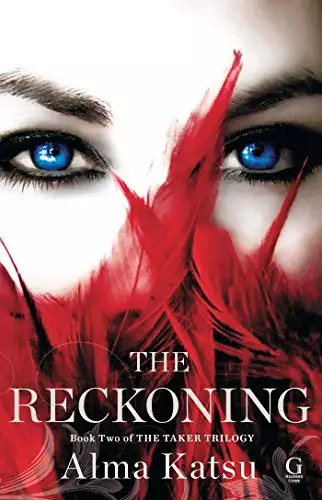
SECOND IN ALMA KATSU’S GRIPPING SUPERNATURAL TRILOGY THAT BEGAN WITH THE TAKER Lanore McIlvrae is the kind of woman who will do anything for love. Including imprisoning the man who loves her behind a wall of brick and stone. She had no choice but to entomb Adair, her nemesis, to save Jonathan, the boy she grew up with in a remote Maine town in the early 1800s and the man she thought she would be with forever. But Adair had other plans for her. He used his mysterious, otherworldly powers to give her eternal life, but Lanore learned too late that there was a price for this gift: to spend eternity with him. And though he is handsome and charming, behind Adair’s seductive façade is the stuff of nightmares. He is a monster in the flesh, and he wants Lanore to love him for all of time. Now, two hundred years after imprisoning Adair, Lanore is trying to atone for her sins. She has given away the treasures she’s collected over her many lifetimes in order to purge her past and clear the way for a future with her new lover, Luke Findley. But, while viewing these items at an exhibit at the Victoria and Albert Museum in London, Lanore suddenly is aware that the thing she’s been dreading for two hundred years has caught up to her: Adair has escaped from his prison. He’s free— and he will come looking for her. And she has no idea how she will save herself. With the stunningly imaginative storytelling and rich characterizations that fascinated readers worldwide and made The Taker a singular and memorable literary debut and an international sensation, Alma Katsu once again delivers “a powerful evocation of the dark side of romantic love” ( Publishers Weekly) in her breathtaking new novel.
Release date:
June 19, 2012
Publisher:
Gallery Books
Print pages:
352
* BingeBooks earns revenue from qualifying purchases as an Amazon Associate as well as from other retail partners.
We were nearly at the Victoria and Albert Museum when we saw the crowds spilling out of the entrance and across Cromwell Street, forcing our taxi to stop in the middle of the road. The driver turned to shrug at me and Luke as though to say we could go no farther as hundreds of people streamed toward the arched entry in a blur of color and movement like a school of fish. All there to see my exhibit.
I stepped from the cab, unable to wait a second more, and my eye was drawn immediately to the tall banner hanging overhead. Lost Treasures of the Nineteenth Century, it read, the dark print striking against the shimmering orange background. Beneath the words was an image of a lady’s fan, extended to show the white satin stretched over whalebone ribs, its leash made of silk cord with a tassel curved upward like a tiger’s tail. More treasured than the painted lilies and golden roses on the front of the fan were these words scrawled by hand on its lining:
Man’s love is of man’s life a thing apart, ’tis woman’s whole existence.
—Byron
The museum had singled out this rather small and intimate object as the crown jewel of the collection and featured it on the banner and in advertisements, bypassing works by master craftsmen and artists, and rare ethnic antiques from the Silk Road. I could well imagine the excitement of the museum worker who found the words and signature of George Gordon Noel, Lord Byron on the back of this obscure little fan.
The fan was precious to me, and I’d never meant to part with it. But when we were packing up boxes to send anonymously to the V&A (shipped through my lawyer to make them untraceable back to me), I’d set it aside to return to its place on the mantel, and Luke boxed it up, thinking it a straggler from the dusty stacks of hoarded mementos to be cleared out. I wanted to get it back, but it was too late: we couldn’t think of a way to ask the museum to return it without opening the door to questions.
That fan was one of the few gifts that Jonathan, my love of a lifetime, had ever given to me. After fleeing Boston, we wound up in Pisa. It was so hot that summer that Jonathan, tired of hearing me complain about the heat in our airless room at the inn, bought me the fan to cool myself. It was very fancy, meant for formal occasions, and not really suitable for my humble circumstances. But he had no idea about ladies’ fashions and no experience courting, as he’d always been the one who was pursued, and so I treasured his gift all the more for being proof that he really did love me, for he had tried to please me.
As for the inscription on the back, Byron had written these words as secret solace to me, for the many times I had to hide behind my fan and say nothing as Italian ladies threw themselves at Jonathan right before my eyes. But that was in 1822, a long time ago. He was gone now and had been for three months.
I was still looking up at the banner when Luke finished paying and stepped from the cab. “Ready to go, Lanny?” he asked, sliding a hand confidently to the small of my back to steer me through the crowd. His eyes were glazed with excitement. “It’s an amazing turnout. Who would’ve thought so many people would be interested in the stuff from your living room?” he joked, for he knew full well what marvels I’d kept to myself for so long.
We maneuvered our way through the crowd toward the first gallery, the hall reverberating with the buzz of many conversations. I wasn’t entirely surprised that the exhibit, nicknamed “the mystery exhibit” by the press, was popular; there had been excitement in the city since the anonymous gift was announced in the papers. The Victoria and Albert wasn’t the only museum to receive mysterious donations—museums in France, Italy, Russia, Turkey, Egypt, Morocco, and China also received shipments of mystery treasure—but the British institution had received the most, over three hundred pieces in all. The story, splashed on news programs around the world, had generated so much curiosity that the directors at the V&A decided to quickly assemble a small show to meet public demand.
Never before on public display, read the banner to our left as the queue shuffled forward. That was true: these items had spent the past century stockpiled in storage, having come into my possession as gifts or tributes or stolen outright in the case of pieces that were particularly tempting, the ones I hadn’t been able to resist.
The entire divestment had come about due to Luke, really, because through him I saw my house with new eyes and realized that it had become a graveyard of keepsakes from my former lives, rooms filled to bursting with things that I’d been unable to let go. I’d accumulated and held on to these things with an irrational passion, but told myself that’s what collectors did. I see now that I lied to myself to avoid the truth, which was that I collected madly to make up for the one thing I wanted and couldn’t have: Jonathan.
We turned the corner into the exhibition hall, and the very first item on display, set on its own in a box on a pedestal, was the fan. It seemed to glow in the intense spotlight shining down on it, luminous as a ghost. People crowded around the pedestal, gently buffeting me as I stared at the once familiar object.
“Did Lord Byron really write that?” Luke asked me, forgetting for a moment that the people surrounding us did not know my secret.
I lifted my eyebrows. “Apparently. At least, that’s what the description here says.”
We were trapped in the crush of people shuffling through the gallery, forcing me to share a long, silent moment with each piece. It almost seemed as though the objects were reproaching me for upending our private life and casting them out into the world. I even felt guilt at the sight of some pieces, the most intimate ones, for having let them go like this. Mostly what I felt was panic, however, at seeing my life—a life spent entirely in secrecy—put on public display. Nothing good can come of this betrayal, the pieces seemed to warn me.
First was the urn that used to hold umbrellas in the entry hall of my Paris house, which my friend Savva had won from a pair of British explorers in a card game and turned out to be an Egyptian funerary urn they’d stolen from an archaeological site. Next was an Empire chair that occupied a spot on the third-floor landing: it had come from a little apartment in Helsinki where, for a brief time, I had been kept by a British officer as his mistress. As I gazed on each piece I recalled its provenance, and I should’ve been content with memories of my rich life, but I was not. I could not stop thinking about Jonathan. It was as though he were here beside me and not insensate and cold, buried in an unmarked grave in a faraway cemetery.
Jonathan had been absent from my life before, but this time was different, and I felt it to the marrow. Before, I had known he was out in the world somewhere, alive but happier without me, his choice for whatever hurtful reasons he felt were justified. Now his absence was permanent. I’d loved Jonathan my entire life, all 220-odd years of it. And I was just coming to terms with the immutable fact that I would never see him again.
When Jonathan returned to me, briefly, at the end, I saw that he had changed in ways I’d never have guessed. He’d stopped being the self-absorbed adolescent I had known and had gone to work in aid camps, tending to the sick and displaced, whereas I, if I were to be honest, hadn’t changed much at all. There was a part of me that believed I deserved my incurable immortal condition, a punishment meted out to me by an unspeakably cruel man. Adair had seen the bad in me, too, and known that I deserved punishment. I could only hope that I had been redeemed when I gave Jonathan oblivion, as he wished. I suspected, however, that whatever had attracted Adair had not been completely exorcised and was still inside me. I needed no more evidence than the fact that at the hospital I’d preyed on Luke, a man who’d been recently devastated by loss, to help me escape.
And, of course, there was the pain of being the one who took Jonathan’s life, even if he had asked for it. That pain, I knew, would never go away. I shook my head to drive out the thought; today was about saying good-bye to the past and embracing the present.
“Are you okay?” Luke asked suddenly, snapping me out of my thoughts.
“I am. It’s just . . .”
“Overwhelming. I understand.” He touched my cheek; perhaps I looked flushed. “Maybe it wasn’t a good idea to come. . . . Do you want to leave?”
“No, not yet.” I squeezed his hand. He squeezed back.
We continued to inch along, and while Luke focused on the exhibit, I studied his features in profile. He was oblivious to my eyes on him, fixated instead on the pieces in the display cases. Luke didn’t think of himself as good-looking, particularly in comparison to the perfect physical specimen that was Jonathan, whom Luke had seen for himself in the morgue. I tried to make him understand that he had his own kind of appeal.
We made a handsome couple, Luke and I, if lopsided in age. In public, he was likely taken for the father figure while I was cast as the infatuated girl. No one who saw us would suspect it was the other way around—that I was his senior by an impossibly wide margin. The truth was I was comfortable with a man at this stage of his life. So what if gray hairs had begun to mingle with the sandy-brown ones: young men were tiresome. I didn’t want to endure the fits of impatience, jealousy, rage. I’d borne witness to a young man’s maturation enough times to know that they’d resist any guidance from the women in their lives. No, I preferred Luke’s steadiness, his good judgment.
Not only that, but I owed him. By helping me to escape, he had spared me the difficulty of standing trial for murder. A lesser man would’ve blinked when confronted with the impossible, would’ve pretended not to see the proof I’d given him that I could not die, would’ve handed me over to the sheriff and not thought twice. But Luke smuggled me out of Maine and across the border into Canada and wound up leaving his life behind and coming all the way to Paris, and now London, with me. How could I not love him, given everything he’d done for me?
It wasn’t just the courage he’d shown that day that drew me to him. I needed Luke. He was my solace and support; he kept me from turning completely inward, crushed by the weight of what I had done. For the first time in a long while, I was with someone who took care of me, who cherished and protected me. It was incredibly appealing to be the object of his affection, to be foremost in his thoughts, and to be so desired that he couldn’t keep his hands off me. His strong touch made me feel safe, and there was something about his manner—perhaps it was his physician’s confidence—that made me feel capable of getting on with my life. Without him, I might have solidified into a pillar of grief.
Luke nudged me to point out a brick-red and gold silk carpet in the Hereke style, as supple as a handkerchief, acquired during a trip through Constantinople. I had been told it was a magical flying carpet (a time-honored Turkish sales pitch), although it never flew: its beauty was its own reward. “Wait—was I supposed to ship that to Turkey?” he whispered in my ear.
“No, it was meant to come here,” I reassured him. In truth, it didn’t matter which museum it ended up in. All that mattered was that the past was swept away and I was ready to move forward with my life.
Just then I noticed Luke’s gaze fall on two little girls in line, staring at the tiny hands held in larger ones, their glowing faces tilted up at their father. Luke’s expression grew wistful. He missed his daughters as surely as I missed Jonathan. His ex-wife, Tricia, had been unnerved to learn that her former husband had not only helped me escape but was living with me; she suspected that he’d lost not only his sense of judgment but quite possibly his mind. I hated that I was the reason he couldn’t see his daughters. It was only after he’d exchanged a series of emails with Tricia that he was permitted to speak to them on the phone.
“Here,” I said, positioning Luke so that he stood in front of one of the signs. I took his picture with my cell phone. “You can send it to the girls.”
He squinted, not unkindly. “Is that a good idea? Tricia’s still angry that I took off without a word. She says the sheriff in St. Andrew keeps calling to ask if she’s heard from me. It might just piss her off to see a picture of me on vacation while she’s dealing with my mess.”
“Maybe. But at least the girls will know that no matter what you do or where you go, you’re thinking of them—that you’re always thinking of them.”
Luke nodded and squeezed my arm as we continued to pick our way through the exhibit. Eventually, the crush of the crowd became too much for me. I tugged Luke’s sleeve and said, “I have to get out of here,” and without questioning he took my hand and we slipped out of the gallery.
Time to let go of the past.
We went up to the third floor and entered the long, darkened hall that held paintings of the nineteenth century, British and American, where the atmosphere was hushed, as if time held its breath. The rest of the museum was emptier than usual because of the opening of the special exhibit, and our footsteps cut through the silence and echoed through the hall like spirits rapping on the walls.
This hall, its walls crowded with oil paintings, had always beckoned to me, and I’d visited it on every trip to London without fail. I’d always loved the luminous Rossettis and Millaises, the rich paintings made even more beautiful by their melancholy. From the walls, the Burne-Joneses looked down on us, the Blakes, the Reynoldses. Lily-white women with long curled hair, faces heavy with maudlin expressions of love, clutching a bouquet of weeping roses, incongruously dressed as though in a classical Greek play. I think it was the models’ air of sobriety that appealed to me: the sense that they knew love was fleeting and, at best, imperfect, but even so, its pursuit was no less worthy. They were doomed to try, and try again. Maybe I was drawn to this gallery because this was where I belonged, in a glass display case, kept with other things that were out of place in time. I would be a curiosity, like a mechanical fortune-teller or extinct bird, the oddities Victorians were so mad about, only I’d be a living artifact people could talk to and question.
I was squinting at a painting through the dimness—this hall was always so dark—when I felt a hum in the back of my head. At first, I thought it was only a headache from the excitement of the day, or from the claustrophobia of being swallowed up by a crowd (which I avoided whenever possible), or the dissonance of seeing my things in a strange setting . . . except that I never got headaches, just as I couldn’t catch a cold or suffer a broken bone. The hum rattled, weak but not unfamiliar, at the base of the skull where it joined with the spinal column, and sent shivers chattering down my back like an old engine with a forgotten purpose being started up after a long time dormant. The hum was more than a sound: it seemed to convey emotion, the way a whiff of scent can carry memory. The hum was all these things. Once I was aware of it, it was all I could think about.
It was only then I understood that it was a signal, like the electric current that switches on a machine. I had been contacted, and a dread I’d carried for two centuries bloomed inside me, firing through every cell of my body. I could try to run from the past, but it seemed the past was not done with me yet.
I turned to Luke and reached for him; fear broke my vision into a pixelated landscape. My blood felt as though it had seized up in my veins.
“Lanny, what is it?” Luke asked, his voice filled with concern.
I clutched his lapel desperately. “It’s Adair. He’s free.”
We hope you are enjoying the book so far. To continue reading...

 Please log in to recommend or discuss...

