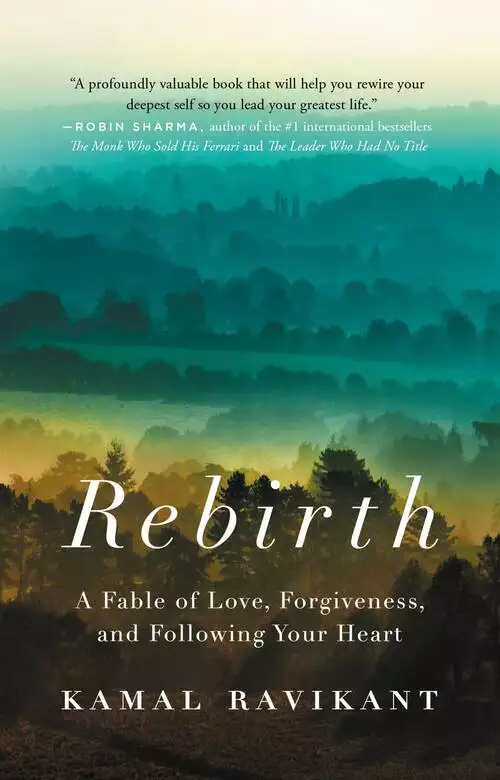
From the author of the bestsellers Love Yourself Like Your Life Depends on It and Live Your Truth comes Rebirth, an inspiring novel about the magic that happens when you learn to follow your heart.
After the death of his estranged father, Amit takes his parent's ashes to the Ganges to fulfill a deathbed promise. Instead of returning home, he wanders, his pain and grief leaving him confused about his future. Almost broke, unsure about his direction in life, and running from memories, he is led by fate to the Camino de Santiago, an ancient 550-mile pilgrimage route across northern Spain.
Amit meets a variety of travelers on his journey. Some are lost and searching for answers. Others are doing their best to leave the past behind. And there are a few who walk to celebrate life. All have stories and lessons to share.
Once a reluctant pilgrim, Amit realizes he cannot stop until he completes the journey. As a traveler tells him, "Once you start walking the Camino, the Camino becomes a part of you." With each step Amit is challenged to confront his fear of following in the footsteps of his father, the loss of a woman he may love after all, and the reality of an uncertain future.
His month-long pilgrimage forces Amit to face life's big questions, and causes him to grow and embrace a new sense of purpose and being.
Based on the author's experience of walking the legendary Camino de Santiago, and told in the tradition of Paulo Coelho and Mitch Albom, Rebirth is a beautiful fable about forgiveness, synchronicity, and the unexpected adventures that reveal who we are.
A Hachette Audio production.
Release date:
January 3, 2017
Publisher:
Hachette Books
Print pages:
256
* BingeBooks earns revenue from qualifying purchases as an Amazon Associate as well as from other retail partners.
The bus to the monastery leaves in the afternoon. I sit behind the rear door and gaze out the window as the road curves through hills covered with beech forests. Schoolchildren get off at each stop and run into houses with white walls, sloping red-tiled roofs, and black wrought-iron balconies crammed with flowerpots. Soon, the villages grow sparse and the bus is almost empty.
I try writing in my journal but can’t concentrate. I pull out a map, spread it open on my lap, and trace the pilgrim route with a pen. The line starts in Roncesvalles, at a monastery near the French-Spanish border along the Pyrenees, then runs west for long stretches through open country dotted with small towns and occasionally through cities with names like Pamplona, Estella, Logroño, Burgos, León, and finally, Santiago de Compostela. It’s about 780 kilometers long. Over five hundred miles. Much longer than my Italian friend’s guess.
Am I crazy? I try remembering the last three months but the images blur: mountains, rivers, ashes. I’m not sure it meant anything at all. Now an eleventh-century pilgrim route in Spain.
“A pilgrimage?” I say, shaking my head. I almost want to laugh.
It is based on the story of Saint James, one of Christ’s apostles, known in Spanish as Santiago, who was beheaded by King Herod and buried by his disciples in northwest Spain. The tomb was forgotten for centuries until a hermit shepherd followed a star in the night sky and discovered it. The place became known as Compostela, “field of stars.”
The bus hits a bump, jolting me against the window. The sun is hidden by the hills, and past the initial line of trees, the woods are dark. The road climbs. The breeze, whistling through an open window up front, grows cooler.
When the Moors overran Spain, Christians needed a figure to rally around. There were reports of Santiago appearing all over Spain on a white horse, killing the invaders. The legend grew. A cathedral was built over his tomb and pilgrims arrived from all over Europe. The journey was called El Camino de Santiago, the road to Santiago.
For almost a thousand years, millions of pilgrims walked to the cathedral. But that was centuries ago. For all I know, the tradition has faded, and I might be one of a few on a long-forgotten journey.
“Pardon,” a man says. Strong French accent.
Outside, the trunks of the trees are white, their bottoms hidden by ferns, and branches arc out over the bus.
The man again. “You are a pilgrim?”
That gets my attention. He sits in the long rear seat. Late fifties, lean and handsome with graying hair, dark bushy eyebrows, and white stubble on his tanned face. He sticks his hands into the pockets of his faded hiking shorts and grins.
“Where is your stop?”
“Last one,” I say. “The monastery in Roncesvalles.”
He leans forward, shakes my hand. A strong, relaxed grip.
“We are both pilgrims. I’m Loïc.”
“Amit,” I say. “I don’t think I qualify, though.”
This makes him laugh. “It is not such a serious matter. If you are on the Camino, you are a pilgrim.”
The bus slows, then stops outside a house. Vines cover the walls and the gate to the garden is red. A man gets off and we are the only passengers left. The bus starts again.
“How is your Spanish?” Loïc asks.
“Pobre,” I say. One class in college forever ago.
“Another not serious matter,” he says. “Your French?”
“Nonexistent.”
A mischievous grin. “That, I assure you, is a very serious matter.”
Despite myself, I chuckle. He reaches into a white shopping bag and pulls out chorizo, jamón serrano, cheese, and bread, spreading them on the seat. My stomach rumbles. He fills two paper plates with food and passes one over.
“Eat,” he says. “Unless you prefer to be an ascetic.”
I thank him, then eat quietly. The bus passes no more villages, just shadows of trees on the road, shifting slightly in the wind. Sometimes, through the trees, I catch glimpses of pastures with grazing cattle, and, once, a field of rows and rows of sunflowers.
My mother loves sunflowers. I called her from the bus station in Barcelona, gave an edited version of my plans.
“I’m taking a group tour,” I said. Much easier than explaining a pilgrimage I barely understood.
“Amit, you hate groups.”
“Only one more week, Mom.”
She sighed. “But you will do what you do. You are like me.”
I think she might be getting used to my antics. She’s had enough practice. Case in point, halfway through freshman year in college, I called her up.
“Mom, I’m thinking about joining the Army.”
A long pause. “Be careful.”
Two days later, another call.
“Mom. Guess what? I joined the Army.”
The times when she does complain, I remind her of my history of off-the-cuff decisions.
“I am your mother,” she reminds me in turn. “It’s my job to worry.”
According to my aunt, I’ve kept my poor mother working overtime.
“Be careful, okay?” she said when it was time to hang up. “Promise me. And return home soon.”
I promised her the first. The second, I kept mum.
The shadow of the bus arches over a field, rises and falls over wheat stalks, then the trees close in again. For a moment, I’m struck by a strong desire to get off at the next stop, sprint to the nearest phone booth, and call my girlfriend. “It’s beautiful, Sue,” I want to tell her. “You’d love it.” I want to share what I’m seeing. But the prospect of the conversation going where it went last time is enough to kill the urge. She couldn’t understand that I didn’t know when I’d be returning. The resulting argument was no fun. Simpler to just not call.
The bus passes a stone cross, about three feet high, at the entrance to a gravel path. The sides of the cross are blackened, as if by fire. Loïc taps my shoulder, handing me a plastic cup of red wine. As we drink, he fills me in on the Camino. The route we’re headed for, the Camino Francés, is the most popular pilgrimage to Santiago de Compostela. But there are others, one from southern Spain, another from Portugal. Most important, he tells me that plenty of people come from all over the world to do this walk. Whether I like it or not, I won’t be alone.
By our second cup, I already have a brief synopsis of his life. He comes from a long line of sailors in Brittany. He’d been a captain in the merchant marine, a professor of maritime studies, holds a doctorate in psychology, and now investigates maritime accidents for the European Union. “I work for Brussels,” he says, shaking his head sadly whenever he mentions the EU. He loves Paris, jazz, and, more than anything, time on his sailboat.
“I bought my boat from an English naval officer. He told me that a sailor must choose between his boat and his wife.” He smiles wistfully. “It appears that I chose the boat.”
By the third cup, the scenery is sliding by the windows and we’re liking each other pretty fine. I join him on the rear seat.
“Are you religious?” he asks.
“Far from it.”
“Me also,” he says. “I’m far too old for such matters. But look.” He fishes a small paperback out of his cargo pocket, thumbs through it, and reads out loud. “If you bring forth what is within you, what you bring forth will save you. If you do not bring forth what is within you, what you do not bring forth will destroy you.”
I let it sink in. If I do not bring forth what is within me, it will destroy me?
“Gospel of Thomas,” he says.
“Can you tell me that again?”
No grin. Just a soft smile. He reads slowly. After he’s finished, I am silent for a while.
“I’ve made the study of many things in my life,” he says. “I have lived the lessons even less. The tragedy of life is not living what you know to be true.” He raises a slight toast. “This is why I will walk the Camino. A start to a life of living the lessons. What is within me.”
“That’s beautiful,” I say. “Really.”
“And you?”
“An Italian told me that everyone who walks this finds themselves. So here I am.”
He grins, reaches over and claps my shoulder.
“Mon ami, we will be good friends.”
The bus downshifts loudly. We come up a steep hill, and as we crest, the spires and the gray stone buildings of the monastery appear. They have slanted metal roofs. Behind them, the hills grow higher and fold into the Pyrenees.
The driver pulls up in front of the largest building. Loïc goes out the rear door, and there is a bang against the side of the bus, then a creak. The driver opens the baggage hold. Loïc says something and the driver laughs. The Pyrenees remind me of the Himalayas behind the monk, what he’d said. I step out.
Loïc hands me my blue Lowe Alpine backpack. “Look at that,” he says, pointing to his pack. It looks like a cleaner version of mine. “We have the same.”
“Sort of.” I put it on and adjust the straps. “Mine’s a fake.”
“Sorry, what?”
“It’s an imitation.”
His dark eyebrows tighten and he looks like he’s about to speak.
“My pack fell apart in India,” I add. “On my way out, I bought this for very little money.”
While he slips his arms through the thick, padded straps, I study his pack with its double-stitched, water-resistant lining. Mine has no lining and the straps are thin. I hope it lasts the week. The straps are already cutting into my shoulders and I don’t want to think about how they will feel after an entire day.
Suited up, I follow him across the lawn to the far end of the building where a group of men and women wait outside a closed door. Most have backpacks. The others hold bicycles with satchels slung over the rear wheels.
There are nineteen of us, eleven men and eight women, ages ranging from twenties to sixties, everyone wearing different-colored versions of Gore-Tex. Except for me. I have on an imitation Patagonia fleece pullover I bought in India. Real cheap.
While he makes small talk with the others, I remove my pack and sit on it. Instead of joining the conversations, I am content to listen, maybe pick up more information. German, English, Spanish, Portuguese, French, and a few languages I can’t place are spoken. There is one clear thing they have in common, though: their excitement.
The driver starts the bus up, turns it around slowly, and drives away. Soon it’s gone and there is only the sound of pilgrims talking and the breeze through the trees lining the other side of the road. Seven days of this, then home. To Sue. To no clue what to do next.
A latch behind the door clicks and it swings open from inside. A line forms, me in the far back. We snake through the door, down a narrow hallway, and to an office, carrying our backpacks in our hands like suitcases. Past the heads, there is a woman with thick arms, her gray hair pulled up in a bun, sitting behind an oak desk. She smiles and waves us in. Bookcases line the walls and a framed print of the Virgin Mary hangs behind her.
The woman takes each person’s name, writes it down in a ledger, and stamps a booklet they hold out. Her fingers are covered with streaks of blue ink.
“What’s that?” I ask an Englishman in front of me.
“Credencial,” the man says, “pilgrim passport. You must get it stamped in the refuges.”
“What’s a refuge?” I ask.
He watches me for a moment, scratches his ear.
“Where were you planning on sleeping?”
“Youth hostels, cheap hotels. Maybe camp a few nights.”
The line moves forward. I hear the hard thunk of the stamp on the desk. The woman stamps several booklets quickly. Thunk thunk thunk.
“No need for that,” he says. “There’s accommodations for pilgrims on the Camino. Refugios. Refuges. Some are rather nice, I hear. Then they’ve got your basic four-walls-and-a-roof types.”
“Are they expensive?”
“Not if you’ve got a credencial.”
The line moves again. Two thunks and he’s gone.
Standing there, waiting my turn, I start to feel foolish. I really had no idea what this involved. The Englishman’s boots, no scuffs, the laces still clean. Mine look like someone dragged them through the sewers of India. This helps me feel a little better. When I was in the Infantry, they didn’t call us “legs” for nothing. I may not know the details of this pilgrimage, but I know how to walk.
The woman sells me a credencial. It’s a long piece of cardstock folded several times like a map, each side divided into blank squares. She stamps the first square with a blue-inked image of the Virgin of Roncesvalles. I am now an official pilgrim.
Finished, she buttons up her brown sweater and motions for us to follow. We go out the door, through a stone courtyard, and inside another building. We walk up a winding stairway, the air growing colder, backpacks scraping the narrow walls, boots scuffling against stone steps.
The refuge is on the third floor. We claim bunks and a line forms for the single shower in the bathroom. I grab my journal, skip down the stairs past freshly arriving pilgrims, and head outside.
It’s a cool evening. I do push-ups on the front grounds. Then, leaning on my elbows, I run my hands through the lush grass. The breeze ruffles my hair. Loïc joins me and we watch the sun dip low.
He pats my arm. “I like this very much.”
Me too. No matter where in the world, you never tire of sunsets.
“You are a quiet fellow,” he says. “Tell me, what is your profession?”
“Profession?” I noodle it over. “Unemployed, actually.”
“A rather agreeable hobby,” he says. “But in France, it is a rather serious matter, I can assure you. Everybody will be full of commiseration, speaking with the kind of voice you adopt when you shake hands with the widow after burying her husband.”
I laugh, still nice and tipsy from the wine on our bus ride. “In the US, your friends give you high fives if you get more than two weeks’ severance.”
He looks at me closely, curious. “Tell me, your profession before this illustrious one?”
“Student,” I say. “Somewhere right after graduating college, I decided I wanted to be a doctor, so I’ve been going part-time, taking all my pre-med courses and working as an aide in the emergency room.”
“My ex-wife was a doctor,” he says. “One needs remarkable dedication for such studies. I am impressed.”
“Naah,” I say. “I lost my job while wandering around, and honestly, I don’t think I want to be a doctor anymore.”
What I don’t mention is the reason. Conversations are fine, sometimes even questions. Answers can always be tailored.
“Perhaps that is why you are on the Camino.”
“I don’t know. It’s not like I have hard-and-fast reasons.”
Biggest smile I’ve seen on his face so far. The man practically glows.
“Good,” he says loudly. “Good. The heart, it does not listen to reason. It leads you into a fog. You do not know if you will fall off a cliff or it shall part and you are standing at the open gates to Shangri-La. But when you follow your heart, you are alive.”
A thin gray cloud moves across the sun, cutting it in half, like a reflection in the water. We both fall quiet and watch the two halves slowly disappear behind the hills. When I blink, I see orange spots where the sun had been.
He waves an arm around. Then, quietly, “Reason did not bring you to this.”
“True that,” I say.
“Reason keeps you safe. This, this is not safe.”
“Ah, how not safe?”
He waves it off. “Your heart brought you here. Would you like to know where it will take you?”
“Very much.”
“Magic. That is the promise of the heart.”
Not a word that’s o. . .
We hope you are enjoying the book so far. To continue reading...

 Please log in to recommend or discuss...
