An unforgettable coming-of-age story from a stunning new voice in Australian fiction, for those who love Mark Brandi, Favel Parrett and Tim Winton.
I was six, turning seven, and all I really remember is the loneliness, and the lumpy feeling that I was somehow doing everything wrong. And then I met Rat.
Jimmy Quinn is only a boy when he meets Rat Daniels down by the creek. Until that moment, Rat wasn't called Rat, and Jimmy didn't have a best friend. That day at Edens Ridge is the beginning of everything.
Mercurial, wild and rebellious, Rat is thrillingly far from Jimmy's tidy world. But there is a dangerous current in Rat that scares Jimmy sometimes. So do the things that happen in Rat's house: the yelling, the violence and, most of all, Rat's hatred for a man named Davey Callaghan.
As they get older, Rat slips toward the darker elements of the Ridge. Ziplock bags and wadded-up foil balls - there's money to be made, and Rat has a plan that needs money. For the two friends, allegiances will be stretched and intentions questioned. Some days, Jimmy's not sure if he even likes Rat anymore.
Then a devastating fire on the Callaghan farm forces Jimmy to wrestle with his conscience and his memories. People are dead. The police are investigating. Jimmy will have to decide how far his loyalty will go, and just who his friend really is.
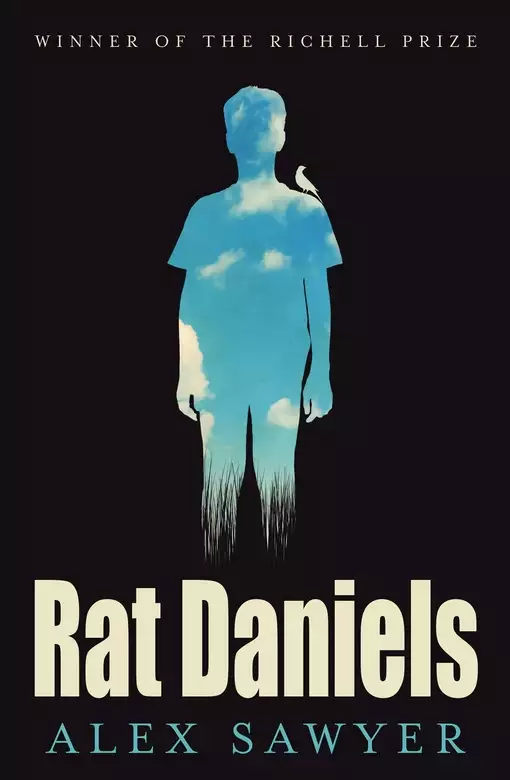
Rat Daniels is a luminous and deeply evocative debut novel from the 2023 Richell Prize winner, Alex Sawyer.
Release date:
July 7, 2026
Publisher:
Hachette Australia
Print pages:
400
* BingeBooks earns revenue from qualifying purchases as an Amazon Associate as well as from other retail partners.
Mum and Lisa dress me for the police interview. Mum pays for the suit, the first one I’ve ever owned. I can’t decide between two equally uninspiring options, so Mum picks for me – charcoal grey. The shoulders are too tight and there’s an inch or so of hairy leg showing between sock and hem when I sit, but there’s no time for adjustments. On the morning of the interview, I go round to Lisa’s and she cuts my hair herself. Short back and sides, a little bit of product. Standard private school haircut; Rat wouldn’t approve.
I can’t ever look in a mirror and like what I see, but I can appreciate Lisa’s work. She dreams of being a beautician, although we both know she’s going to be a lawyer. I straighten my shoulders and thrust out my chest. Fuss with the part. Lisa says there’s a right and a wrong way to comb hair to the side – Clark Kent versus Superman – and I always have to remind myself that the image in the mirror is a distortion of how it really looks. I’m dressed like I’m going to a funeral.
Mum messages to remind me that the detectives will be at their place in an hour. The cops must think I’m a loser, having my mum coordinate the interview for me. Lisa draws the tie up tight under my chin while I pull faces. I was tying my own school tie for a decade before she came along, but she claims I never learned how to do it right.
‘I look like an idiot.’
‘Don’t be a child,’ she says. ‘You look hot.’
I look at myself in the mirror and wonder when I’m going to stop being a child. I can legally drink and legally drive. I can vote. I could fight in a war if I wanted to; I’m pretty sure we’ve still got one going.
The suit is unnecessary. Even if it would convince the cops of something, I don’t have anything to prove. I’m an innocent bystander. My reasons for being on the scene are understandable, if embarrassing, my escape fortunate bordering on miraculous, my behaviour completely normal under the circumstances. I don’t need to dress myself up as a respectable member of society. Rat’s the one who’d need to wear a suit, not me.
This interview is a formality, I’ve been told. An opportunity to get my statement on the record. There is a thick fist of guilt punched deep in my stomach, but the police aren’t after me. Being a shit bloke isn’t a crime. The courts aren’t going to care about my shame. Maybe they should. Maybe I should take this opportunity to confess my part in things. And then Davey Callaghan can chime in and confess his, and Robbie Gunn and Wayne Pope and all the other ghosts and bastards. And we could go all the way back in history, trace down every last tangled strand to a beginning. ‘Here’s where it all got fucked, Your Honour.’
And then the judge would look at Rat and say, ‘Well there’s no denying you’ve done a bad thing here, lad, but given everything that’s happened, I understand why we are where we are.’ And we’d all be able to go home. Put this behind us.
Except two people are dead, in the most horrific way I can imagine. And I can’t understand it.
Maybe Rat’s innocent. He says he is. What kind of friend am I if I don’t believe him?
I don’t have whatever compass other people have in them that makes them certain of what they believe. I sit with things, I watch everything. I try to work out what’s right, but eventually I end up doing whatever seems easiest. I’ve been called stubborn my whole life, but the way I see it, I’m just waiting to be told what to do.
Rat had it. Whatever happened to him when he was younger left him an exposed wire, always sparking. Always live. He channelled the hidden currents of the world in a way I haven’t seen any other person do. It made him honest, not in the sense that he always told people the truth, but he never bullshitted and he never hid from some imagined version of himself like I sometimes think I’ve spent my whole life doing. He never ducked under doorways that weren’t there. It made him sensitive and it made him vulnerable.
Lisa drops me off at Mum and Dad’s but doesn’t wait around. I walk up the old driveway, feet crunching the gravel. Mum waits on the verandah . I don’t meet her eyes.
I try to go over it all in my mind, get my story straight for the interview, but the thoughts keep blurring on me, distorted by the static of anxiety and stabs of urgent fear. Rat is in prison. And what if something I’m about to say keeps him there?
And what if he’s guilty? a traitorous voice asks quietly. What if he’s right where he belongs? What kind of man am I if I can’t do the right thing here?
‘Hullo love.’ Mum hugs me around the midsection, as high as she can reach. ‘They’re already here waiting.’
They’ve come in an unmarked car, unremarkable clothes, casual attitude. I feel like an idiot in the suit. A man and a woman: he looks to be in his thirties, she’s about Mum’s age. We sit at the kitchen table. Neither wants a cuppa; Mum makes herself scarce. One of the cops asks if I’m missing the footy for this. I tell him I’m into basketball. He says he’s a Lakers fan, has been since Kobe. I almost don’t realise when the actual interview starts.
‘Alright, why don’t you just tell us everything that happened from your perspective?’
And I laugh then, a sort of swallowed hiccup of a laugh. Because where do you start?
‘I’m gonna kill him one day,’ Rat had said. That was ten years ago now. Do the words of an eight-year-old even matter? And if they do, then doesn’t everything matter, every single part of the story? Isn’t that what the cops want to know? The whole truth? Nothing but.
But these detectives don’t want to know everything. They’ve got their suspect in custody, they just want to find out whatever will help them keep Rat locked up. They don’t need to understand the whole story.
So, I hesitate. I’m always slow to react, unless I’m on a basketball court, and I get interrupted a lot by people who think I didn’t understand the question. After a moment, one of the cops says, ‘How about you start with what brought you to the Callaghan property that day?’
That’s safer territory. I answer their questions honestly and methodically, and slowly we work through events to construct the story that they want to hear.
And I can keep Rat’s secrets, our secrets, a little longer.
I lived in three different towns before I was six, but I can’t recall a single thing about any of them. So definitively do my memories start with Edens Ridge, in the Mount Lofty Ranges, where the hills bounce and roll a border along the edge of Adelaide like a great, green tidal wave, that it feels like a choice I must have made somewhere along the way.
Dad would have liked to live in the city, but Edens Ridge was as close as we could afford, on a half-acre block of solid clay, good only for growing weeds and big spindly-limbed eucalypts. Dad didn’t mind. He’d escaped the family farm, hating anything that smacked of agricultural work, even down to growing veggies.
My parents had done well to afford the house we had, with neither of them having finished high school. Dad had scored a position in the city, managing a large industrial cleaning service. He was handy on the tools, but even handier with people. He had a gift for making you feel important, or interesting. Depending on how he wanted other people to feel, he could puff up like a rooster or slip right inside his shell without ever seeming like a fake. It was a magic he didn’t pass down to me.
Mum was a baker, but she did kitchen lines too, or any catering and cafe work that called to her. She never stayed at the same place for long. Always, the change was sold to the family as a symbol of freedom, but it only ever came after weeks of stewing discontent – the hours too long, the owners too stupid.
Both of them made a big deal out of education, and despite the enormous cost, they enrolled all three of us kids at an Adelaide private school, St Luke’s, where the uniform for me was a sky-blue blazer, grey shorts and knee-high woollen socks.
‘Why do I have to wear this?’ I asked when confronted with the costume of elite education.
‘Because it’s a nice school,’ Mum explained patiently, ‘and you have to wear nice clothes.’
I was afraid of St Luke’s, although I couldn’t tell you now exactly what about it frightened me. The same thick oil of terror leached through me every time we drove past the wrought-iron gates. It was a childhood fear, uncertain and unnamed.
The simplest answer was that I felt like an outsider. St Luke’s wasn’t an easy place for a six-year-old from the country. There were more rules than I could keep in my head; rules for when to sit and when to stand, where to walk, how to speak, who to listen to and when. I learned that there were things I was supposed to know by age six that I didn’t, and couldn’t, despite my best efforts. Like which way the letter ‘b’ was supposed to go compared to the letter ‘d’. There were no major consequences for not knowing, just an indignant squawk from whichever teacher caught my mistake or, more often, an exasperated sigh.
That’s how all my early memories of St Luke’s run together. A long series of exasperated sighs, and a slow-building anger that I couldn’t do the things other kids found easy.
I found my classmates to be gently indifferent to the new boy who kept forgetting the rules. On my first day I was told there was already a James in the class, and that there couldn’t be two. I didn’t like being Jimmy, but I didn’t seem to have a choice in it. Soon, I made everyone in my family stop calling me James. I was Jimmy now; I couldn’t be two people.
When my birthday came near, Mum asked me to pick my three best friends to invite to a party. I asked if I could have four, so that her, Dad and my sisters, Milly and Maya, could all come. I saw the look on Mum’s face when I said it, and I cried that night, although I couldn’t say why.
Maybe it wasn’t so bad. Probably there were more good days than bad, but it’s the bad that stays with you. The harmless days of even a few years ago have washed out like the tide, leaving rock pools of only the worst, weakest moments.
I was six, turning seven, and all I really remember is the loneliness, and the lumpy feeling that I was somehow doing everything wrong.
And then I met Rat.
For my seventh birthday, Mum and Dad bought me a Razor scooter. I hadn’t asked for it, not because I didn’t want one, but just because it didn’t seem in the realm of possibility for a Quinn family birthday. A board game, maybe, or a bit of Lego, but not a whole scooter.
I suppose they were feeling guilty. I was spending my weekends in the back seat while Milly and Maya got driven to sports matches and friends’ houses. I had no sport, no friends and I was too young to be left at home alone. But I could ride my scooter around the rec centre car park while Dad watched Milly’s basketball. And once they trusted me with that, the scooter became my ticket out.
‘Can I take the scooter down the hill, Mum?’
‘Only if your dad goes with you.’
‘Dad says he’s busy.’
‘Just straight down and back up then. Quickly.’
Well, I was quick on the way down. Piggery Hill was steep and long. ‘A pig of a hill’ the locals called it, because the road followed natural contours, throwing off unwary drivers with its sharp turns and sudden, swooping dips. The scooter’s plastic wheels rattled across the cracked, uneven pavement, vibrating through your whole body. Brakes wouldn’t slow you. Once you’d started downhill you were committed to the whole ride, wind whipping, wrists jarring with every clatter and bounce, all the way down. If you ever fell, that’d be the end of you. Total wipeout.
I loved every second of it.
At first, when I reached the bottom, I would immediately turn around, dragging the scooter back uphill while my body still hummed with adrenaline. But over time, I realised that I could push my return out longer, that Mum wouldn’t even notice if I was gone for an hour, maybe more. So, I would ride along the creek for a while, each time going a little further.
The cheapest houses in Edens Ridge were built along the line of the creek, cramped together in the cool of the valley, contending with the noise and exhaust from the road. But despite the fence lines and the rumble of irregular traffic only metres away, the creek always felt like its own world.
It was hidden from the road by a thick row of willows, bottlebrush and red gums. They stretched out over the banks and cast shadows across the water, which rose and fell with the seasons – a bare trickle in summer, a great, frothing surge after the winter storms. Most of the time it flowed sedately, smelling sweet and earthy. Egrets picked their way along the banks and grass birds called from the reeds. Ducks drifted downstream, sometimes hopping out to navigate the small rocky waterfalls by foot. Tadpoles skimmed through the still patches. There were fish too, occasionally, although you had to be patient, and lucky, to catch one. Brown snakes were always a possibility in the summer; magpies swooped in spring.
A dirt track ran along the banks, just firm enough to ride on. A lot of folks would walk their dogs along that track, or take a stroll when the weather was good. But when the wind bit and the clouds hung low and grey in the sky, you might not see a single person.
It was on a day like that, when I expected to have the creek to myself, that I encountered a boy about my age, standing on the path and holding a stick. It was a good stick, about two thirds his height, firm and straight but supple-looking too. You could tell that if you swung that stick through the air it would make a satisfying swishing sound.
He wasn’t paying any attention to me, but he was in my way. I put the brakes on. He looked up from the pile of grass he’d been studying.
I have a clear memory of his appearance on this particular day, but it comes from a photo of the two of us, taken months later. I’ve superimposed it over this moment. In the photo, he has a squashed sort of face, like he’s dissatisfied with something. His eyes are squinted tight so that you can’t tell how crystal blue they are. He’s staring directly at the camera, and I’m next to him, watching him with half-lidded worship. We’re both shirtless – I don’t remember why – and flexing our pipe-cleaner arms like strongmen. His hair is dirty blond and recently cut, but long at the sides. You can’t see it but looking at the boy in the picture, you’re not surprised to learn he’s cultivating a small rat’s tail in his bushy mullet.
A lot of people used to think that was why everyone called him Rat. But it wasn’t. It was this moment.
‘Hi, I’m Jimmy,’ I said in the practised way I’d been taught to announce myself to other children. He looked at me a moment and then flicked his eyes back to the pile of grass. Then back to me. Considering.
‘What’s your name?’ I asked.
‘Rats,’ he said, or maybe, ‘Rats?’, like it was an invitation. But I didn’t take its meaning at the time. I just stared at him, processing his strange name.
He eased his stick into the grass clippings. It was tall and the grass was long, recently cut by the council and dumped into one large pile. The rains had clumped it together into a thick green mass. When he levered his stick into it, a whole section of congealed grass lifted like a lid.
He looked at me significantly and then gestured to the pile with a turn of his head.
I stepped off my scooter and leaned over. In the pile of grass, which gave off a surprising heat, lay half a dozen little pink thumbs, huddled together and writhing. Peering closer, I could make out tiny limbs, ears, blind eyes and weakly lifting snouts. A bundle of little lives, exposed.
‘What are they?’
He smiled proudly. ‘Rat babies.’
I marvelled at his discovery, and the fact that this boy named Rats had coincidentally also been able to show me a pile of rats. What were the odds? Or did his name confer on him some special power, some sixth sense for the presence of his namesake in any hidden place?
I stared at the writhing, blind mass of tiny bodies.
‘That’s so gross,’ I breathed.
‘I know,’ he said, with deep satisfaction. He eased the lid back down on them. ‘I don’t know where the mum is. I like your scooter. You live near here?’
‘Up the hill.’
‘Piggery?’
I nodded.
‘You know how to fish?’
I shrugged. Lying nearby, on the grass of the bank, was a lamb chop tied with string and a piece of dark stocking, like my sisters had to wear to school, wrapped around a coat hanger. ‘Hold that. I reckon there’s a burrow down here.’
I held the coat hanger, peering in the brown murk of the creek while he dangled the lamb in the water, occasionally bobbing it enticingly. We stayed silent, side by side, while the minutes stretched out before us.
A yabby emerged, tramped over on stick legs and assertively attacked the lamb chop with thick, blue claws.
‘Git ’im!’ Rat hissed, and I brought my makeshift net down, scooped it low, dragged it through the mud, threw up a cloud of silt. I lifted the net, unsure what I’d got. It was heavy, but was that just mud? A rock? I shook it out, and the irate yabby tumbled onto the grass, claws jabbing, punch-drunk. We whooped with excitement, dancing around our catch.
I was hesitant to get too close. On its back, legs prodding weakly at the sky, it looked like a spider or a cockroach, something not to be touched. But Rat picked it right up and lifted it triumphantly.
‘You little beauty! What a catch!’ Even at the time, they sounded like adult words, words he’d heard another person say once and had been saving for this moment.
‘What are you going to do with it? Eat it?’
‘Nah.’ Rat shook his head. He held the yabby close, inspecting it. ‘Give him back to the water. Just wanted to say hello.’ He wriggled a finger at the yabby, which snapped a claw at him. ‘Hello matey.’
We dropped the yabby back into the creek and watched it stomp off into the dark beneath the rocks.
‘You wanna come back tomorrow and see if the rat babies are still here?’
I nodded silently, hoping it conveyed my enthusiasm.
‘Same time then.’ As if either of us knew what time it was. ‘Seeya Jimmy.’
‘Seeya Rats,’ I said, still innocent of my mistake.
I worked it out of course, but by then he was Rats, and just Rat soon after. Rat fit him better. He was alert and smart and people always underestimated him. Everyone ended up calling him Rat, for good or bad, and if he ever disliked it, he never once said so. He had countless opportunities to duck the name, but he never did.
I’ve always wondered at the magic of that, and whether that moment at the creek meant what followed was inevitable. Rat Daniels was christened Damien, but I gave him his real name.
That was the beginning of it.
If I wanted to see Rat on a weekend, I’d head down to the creek at around the same time after lunch. Most weekends he’d be there, or somewhere nearby. It wasn’t long before he found out where I lived and he’d pace at the end of the driveway, restless, but not crossing the threshold.
‘What’s that boy doing out there?’ Mum asked when he first appeared. I joined her over at the kitchen window and felt a thrill of excitement. He’d come looking for me.
I didn’t question how he’d found our house. Rat was part of Edens Ridge in a way that I wasn’t, I could tell that already. No surprise that he knew where everything lay.
‘Well, invite him in,’ Mum said. But Rat didn’t want to come in. He sent me back to ask permission to come out and play.
‘Old-school,’ Dad said approvingly. ‘Just down to the creek, yeah?’
But in truth, we roamed all over the great crest of hills that made up Edens Ridge. We searched for old skulls in the sheep paddocks at the top of Murdoch’s Hill, and fished for redfins in the reservoir. If it was in Edens Ridge, it was ours to explore, from the peak of Piggery Hill to the train line at the top of Hawkins. In the south there was the Pines (which Rat swore was full of homeless teenagers who smoked and ‘did it’), and to the north there was the Bakers Road intersection, with its cluster of shops: the doctor, the chemist, the old deli and newsagent, the run-down sex shop with the fading plywood Playboy bunny, her breasts slowly peeling off in strips.
We roamed far and wide, finding old drainage tunnels and homestead ruins. One day Rat showed me the great scar on a red gum tree where he said the locals had cut out whole pieces of bark to make canoes. We spent the afternoon planning how we’d build our own canoes before I noticed the setting sun and had to race home.
Mostly though, we looked for animals. And it was here that Rat taught me to see the world in a completely different light.
‘I can’t believe how much you like them,’ I said to him once. He looked at me, confusion in his frost-blue eyes.
‘Everyone likes animals.’
‘Not like you do.’
And it was true. Rat was interested in every animal, in how the whole web of the living world was woven. If he took an interest in an animal, he wanted to see the world through its senses, to smell and taste and see as it smelled and tasted and saw. He wanted to creep at the level of ants and climb trees to stare down like a kingfisher at the creek. If he saw a magpie, he’d want to learn its warble, then fossick through the grass for the bugs it ate, then follow a bug back to its nest to run his hands through the sap-sticky leaves that the bug was eating. Then his head would dart up suddenly at a sound, eyes wide and searching, and he’d say, ‘Wind’s changed,’ and he’d be right. And we’d be off and exploring something new, because his focus changed with the wind.
Rat was the only kid I’ve ever met who noticed when the wind was changing. He was alert to everything.
So I said to him that day, ‘No-one cares about animals like you do, Rat.’ And he grinned.
‘You do.’
And that was true too, when I was with him.
He was an antenna for everything that was happening around him. You could watch his head turn toward a sound you’d only half been aware of: the call of a cockatoo, or the choky engine of a tractor turning on. If he heard a car backfiring two hills away, his whole body would freeze, stretched erect like a meerkat, wiry little muscles bulging as he clenched his fists, head on a swivel, scanning the horizon.
Nowadays I think differently about that hair-trigger reaction, and the breathless, sweating tension that came over him at times. But even when relaxed, there was a watchfulness to Rat. One time, while we were standing around talking, he pointed at the brush next to us and casually said, ‘Blue-tongue.’ It was like a magic-eye picture; this fat lizard lazing by my foot suddenly cleared into view. I would never have seen it without him.
There’s something else that stands out to me in those memories, beyond my wonder at his keen senses. I realise now that always beneath that raw, naked sensitivity to the world was something that scared me. Just a little. A hunger for more. Rat was always pushing just a little further than I wanted to go, never satisfied. Roving. Ravenous.
That first spring of our friendship we found the falcon. Spring in Edens Ridge meant unpredictable squalls and hayfever for the whole family. It meant weeds spread like a green plague across the hills and dead babies everywhere you looked. Baby birds beneath trees, baby possums on the asphalt, fox cubs hit by cars, ducklings hit by foxes, leaving nothing but a violent scattering of feathers and blood stains. Spring was carnage.
But Rat knew where to find the other babies, the hidden ones. He could pick out birds’ nests at the tops of trees, find the hollows that held goggle-eyed cockatoo chicks, spot the subtly swollen bellies of koalas with growing joeys in their pouches. Most of us only saw spring in the ones who hadn’t made it. Rat knew where the survivors were.
Naturally, Rat saw the falcon first. His attention was drawn by the sounds of crows calling. Not their normal disaffected croak; these were angry and eager. We spotted them in the grass at the bottom of a ridge. Dark, dancing bodies, feathers flying.
Rat broke into a run. I followed.
Among it all we could pick out another call, a panicked, throaty kak, kak, kak, picking up speed and volume. One of the crows jumped and swooped, and the kak, kak turned into a pained, indignant wail.
Crows are pretty bold, in my experience, but they’re not stupid. If you run at them, they’ll scatter. Sometimes they might dance away and try to stay near, but usually they’ll fly.
Rat was ahead of me, full sprint. He dropped to the ground, scooped up a rock and threw it with incredible force at one of the crows. I’d never seen anything like it, and never did again – not from Rat, not from anyone. We threw rocks at signposts, across lakes, into buckets and troughs. We were good shots. But to throw a rock at a bird? And what’s more, to hit it? Dead-eyed, at a run.
The crow dropped soundlessly; the others called in alarm and took to the sky, leaving behind a bird about the size of a pigeon, but clearly with growing still to do. Its feathers were mottled brown and white, puffed up and fluffy. Its eyes were dark, cartoonishly wide, but its beak was sharp and curved, its body upright like a predator’s. As it saw us, it bobbed its head and continued its plaintive call.
‘What is it?’
‘Falcon,’ Rat grunted, tugging off his t-shirt and dropping to one knee. The bird eyed him, wary but exhausted. Feathers were strewn about it, and one wing was outstretched in an awkward fashion. ‘Baby falcon. Must’ve fallen from somewhere.’
I peered up. We were at a rocky part of the Hawkins farm, where the hill devolved into high crags and dense thicket. . .
We hope you are enjoying the book so far. To continue reading...

 Please log in to recommend or discuss...
