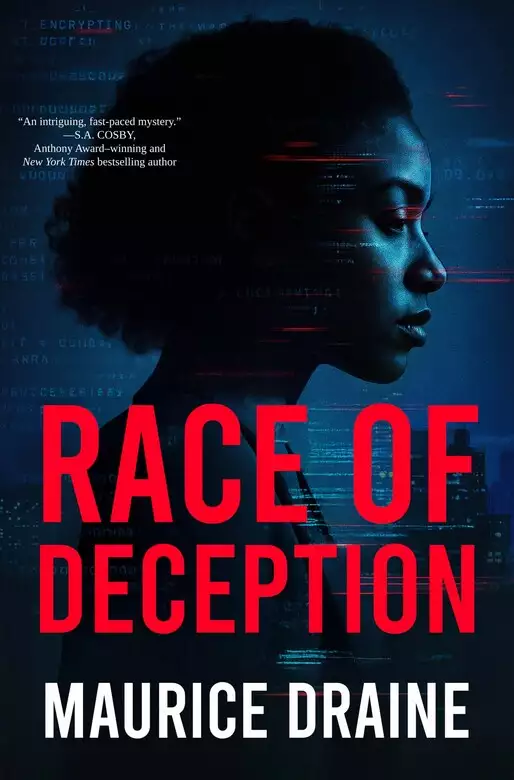
“An intriguing, fast-paced mystery." ¾S.A. Cosby, Anthony Award-winning and New York Times bestselling author
When investigative journalist Imani Cole uncovers a series of disturbing deepfake videos implicating high-profile politicians, she believes she’s found her next career-making exposé. But the closer she gets to uncovering the source, the more she realizes that someone—or something—is rewriting reality itself.
What starts as a routine investigation spirals into a labyrinth of corrupt politics, AI manipulation, and buried family secrets. Each lead draws Imani deeper into a conspiracy controlled by a tech company with global reach and limitless resources, forcing her to confront the possibility that her own past may be the key to the entire deception.
As digital truth and human morality collide, Imani must decide whether exposing the system will save the world’s last shred of truth . . . or destroy everything she loves.
Release date:
August 25, 2026
Publisher:
Black Odyssey Media
Print pages:
288
* BingeBooks earns revenue from qualifying purchases as an Amazon Associate as well as from other retail partners.
An unmarked white envelope landed on the cluttered desk of the buzzing Minneapolis Channel 4 News TV station’s mailroom. Its logo—a black, partially clenched fist—leered back at the mail clerk, promising to reveal a secret that would set the whole damn city on fire.
Claire, the observant new contractor, was the first to notice it. She wasn’t privy to the inner workings of the newsroom, as this was only her first week on the job. Nor did she possess the authority to decide what should be done with unclaimed mail, but she knew she needed to get the envelope to someone who did. Her eyes scanned the room like a laser beam, setting her sights on the office door of the editor-in-chief, Mr. Gene Washington.
Claire and Mr. Washington hadn’t had many face-to-face interactions, as she only answered the phones and their desks were on opposite sides of the station. Mr. Washington already had an intern named Alex, who—against company policy—he used as his personal assistant to perform many tasks he needed help with. She cautiously approached his office with the cold-to-the-touch envelope tightly gripped in her hand, almost wrinkling the hell out of it. She tapped softly on the slightly ajar door, reluctantly announcing her presence with nervous energy.
“Hello, Mr. Washington?” Claire said.
“Yes, please come in,” he said. “It’s Catalina, right?”
“Claire.”
“Apologies.”
Claire half-smiled so Mr. Washington wouldn’t feel so bad about butchering her name. “Oh, no worries, Mr. Washington. I’ve been called much worse than that before.”
“What brings you to my office this morning?”
“I found an unaddressed envelope left in the mail clerk’s area. It seemed odd once I actually took the time to look at it, so I thought I should give it to you.”
Gene Washington was a fifty-five-year-old Black man—short, roly-poly, with a small Afro and a wickedly patchy bald spot. The top of his head looked like a goddamn world map. He’d worked at the TV station since he graduated from Grambling State University almost twenty-five years ago. Now, the news station’s editor-in-chief, with a keen eye for detail, he regarded Claire with interest.
“Thank you, Claire. Leave it on my desk, if you will, and I’ll have a look as soon as I can. Thanks.”
He turned his attention back to his computer screen, absorbed in his important work.
Over the next few hours, the unopened envelope sat undisturbed on Mr. Washington’s desk, its contents still a mystery waiting to be revealed. It wasn’t until Alex—Mr. Washington’s de facto assistant—was assigned his mail duties that day, and he discovered it and took action. Alex picked up the envelope and examined it. Like Claire, he immediately noticed the sender’s information was missing and sensed intriguing content within.
Alex took it upon himself to open the envelope, only to find a flash drive with a futuristic design he’d never seen before, not even at Robbinsdale Cooper, his high school, or at Kansas State University, where he majored in broadcast journalism and mass communication. A yellow sticky note was beside it, with the words “Play Me” scribbled in colored pencil. The cryptic nature of the note sent Alex’s curiosity into overdrive. Without permission, he inserted the flash drive into Mr. Washington’s unattended computer while he was in the bathroom “taking his morning shit,” as he was fond of saying to anyone who’d listen. Alex took a deep breath and pressed Play.
As the video began, Alex’s expression shifted from innocent curiosity to utter confusion, shock, and, eventually, sheer horror. The events unfolded in a disturbing sequence, leaving the young intern shaken to his core. He glanced down at his athletic watch and noticed his heart rate had surged to 115 BPM, even though he wasn’t moving. He knew he had to share this video with someone in a position of authority. Alex had to think fast, given that Mr. Washington still wasn’t back from the bathroom. Trembling, he hurried to the office of the assistant chief editor, Mrs. Rosa Ramirez.
“Mrs. Ramirez, you need to see this,” Alex said insistently, handing her the futuristic flash drive.
Mrs. Ramirez, a forty-five-year-old Latina from the East Coast, who moved to Minneapolis twenty years ago for better career opportunities, was a woman of strong convictions. She couldn’t help but notice Alex’s body language and saw how shaken the young man was. This was no damn game.
“What is it, Alex? Are you okay? You look like you’ve seen a ghost.”
“No, Mrs. Ramirez, I’m not okay. I just found this video file inside a letter on Mr. Washington’s desk. You have to sit down and watch it. Like, right now. It’s shocking.”
Mrs. Ramirez snatched the weird-looking flash drive from Alex’s hand, jammed it into the USB port on her laptop, and pressed Play.
The video showed a quiet street in an upscale residential area during the middle of the day. Everything appeared ordinary, and the weather was favorable—rare for Minnesota. A young Black man dressed in athletic clothes appeared in the frame, walking down the sidewalk, minding his own business. Four white Minneapolis police officers suddenly appeared on foot behind him. They seemed to speak among themselves and cast glances at the man as he strolled. Unaware of the events unfolding behind him, the man continued walking with the hood of his workout shirt raised over his head, concealing his identity. Suddenly, the police moved faster to stay closer to the man. The officers stalked him like a tiger tracking its prey deep in the jungle, even though this was the whitest of the white suburbs, with a notably low crime rate.
The tension in Mrs. Ramirez’s office grew as she and Alex continued to watch on, their eyes fixed on her laptop screen. The man finally noticed the four white, burly officers. He shuffled a little faster, and his unease was apparent. The officers matched his pace, their eyes never leaving his sight. The man entered a convenience store. People walking the streets witnessed an argument between the man and the clerk. The man pointed to the back exit, and the clerk shook his head vigorously.
Not the answer the man wanted to hear, he rushed to the back exit and tried to force his way out into the alley behind the shop. But the clerk overpowered him and kicked the man out of his store. For whatever reason, the police officers didn’t go inside. They lingered outside it, exchanging words and pointing toward the store. They seemed to be waiting for something, their hands resting on their belts. A moment later, the officers witnessed the man being thrown out. They scrutinized his every move.
The man looked over at the officers and caught their piercing gazes penetrating his body from across the street. He looked over at them. They looked over at him. Knowing he’d committed no crime—maybe just a questionable argument with a store clerk—the man broke his gaze from the officers and strode away in the direction he was already heading. The officers jogged over from across the street and surrounded him in a calculated manner.
Knots formed in Mrs. Ramirez’s stomach, as she’d seen this movie—versions of it, anyway—far too many times before in the city of Minneapolis and realized what was about to happen next. She and Alex were totally powerless as they watched.
The man’s face was a mixture of confusion and fear as he tried to understand what the hell was going on, and why in the fuck the cops had stopped him. The officers asked the man questions, their tone aggressive and accusatory. The questions were intentionally absurd, as if they were trying to provoke him to “give them a reason” to put their hands on him.
“What are you doing over here in this neighborhood, boy?” one officer asked, a malevolent smile on his face. “Let me see some ID.”
The man hesitated, his eyes darting between the four officers now on all sides of him.
“Can I ask why you need to see my ID, Officer? Do you suspect me of having committed a crime?” the man asked, knowing his rights. In response, another officer grabbed the man’s wrist and twisted it behind his back in an unnatural direction.
“Oh, we got ourselves a smart nigger here, I see.”
“Okay, okay,” the man protested, trying to pacify them. “I . . . I just need to grab my wallet. May I grab my wallet, please, Officers?”
“Absolutely,” one officer said with a grin.
Mrs. Ramirez’s mouse made a slight cracking sound as her grip on it tightened, the tension in the room mirroring that of the video. She paused the video briefly, needing to catch her breath. She’d been holding it since they’d started watching it.
“Shit, Alex, Mr. Washington really should be here to see this. Where is he?”
“I’m guessing he’s on the toilet reading the New York Times on his cell. I don’t know when he’ll be back.”
Mrs. Ramirez reluctantly resumed the video.
They witnessed the man cautiously reaching for his wallet, a movement allowed by the officers. But as soon as he retrieved it, everything changed in a flash.
Without warning, the officers drew their guns the second the man reached his hand into his pocket to retrieve his ID. They aimed their guns at his face. That seemed to be their plan from the beginning. In the office, a stunned Mrs. Ramirez forgot to turn down the volume on her computer. Other reporters and assistant editors standing near her door heard the loud disturbance from her office and trickled in unannounced. Ten other coworkers from different parts of the newsroom also heard the commotion from the office and let themselves in. As the video continued to play, everyone in Mrs. Ramirez’s office quickly caught wind of what was going on in the video and held their collective breath, unable to tear their eyes away from the unfolding train wreck that seemed horribly inevitable.
“Get your goddamn hands out of your pockets, motherfucker!” one officer shouted, his voice reverberating through the laptop speakers. The man’s eyes widened, and his body froze with fear. His confusion was unmistakable as he tried to comprehend the sudden escalation.
“I-You told me I could get my wallet, Officers,” he stuttered.
But the officers weren’t listening. They repeated their demand, louder and more aggressively each time.
“Get your motherfucking hands out of your pockets now, nigger, or I’ll blow your fucking head off!”
Mrs. Ramirez’s heart pounded as the situation spiraled out of control.
The man’s voice became desperate as he tried to reason with them. “They’re out now! They’re out now! You guys told me I could get my ID!” he pleaded.
But the officers didn’t seem to care. They continued to yell more racial slurs at him, their guns trained on the man’s quivering form.
“Get on the ground now, monkey!” yelled another officer. “We’re not going to ask you again.”
It was at that very moment that the man knew his life was truly in danger, and that he might not make it home to his wife and kids tonight. The man complied. As he eased himself down, the officers holstered their guns, swapped them for batons, and quickly advanced on their helpless prey.
Gasps filled the newsroom as the brutal scene unfolded right in front of them.
The man did not lower himself to the ground fast enough out of fear and confusion. In response, and with little warning, the four officers mercilessly rained down violent baton strikes on his body. Strike after strike, blow after blow, the beating seemed to go on and on. Through the air, the man’s piercing screams echoed. The officers beat him until parts of his body looked like ground beef. The street beneath him turned as red as a fire truck with his blood. As a natural human reaction, the man put his hands up to block as many bone-crushing blows as he could.
“Stop resisting!” one officer shouted, his voice loud and commanding.
The man’s voice trembled with pain as he replied, “I’m not resisting, please! I’m not resisting! Stop! Stop, please!”
But his pleas fell on deaf ears. The beating persisted while the man fought to hold his hand up in a futile attempt to block as many strikes as he could. Seconds later, the digits from the man’s hand lost a hand-to-head battle against the titanium baton, as the snapping sounds of fingers rang out.
“Mama!” cried the man.
It’s never a good sign when a grown man screams out for his long-deceased mother.
The cry echoed in the newsroom, a stark reminder of the injustice and police brutality that so often went unchecked. Mrs. Ramirez’s eyes welled up, and tears streamed down her face. The video was a stark representation of the harsh realities faced by many people of color, the abuse of power, and the racial biases ingrained in society. The raw video footage now showed the bloody aftermath of the beaten, broken man.
She knew that what they had in their hands was a weapon against oppression, a tool to expose the truth and demand change across the nation, maybe even the world, just like the video of George Floyd’s murder had been.
The gruesome video finally ended, leaving a horrified room in utter silence. Mrs. Ramirez wiped her face and leaned back in her chair. She scanned her office, taking in her crowd of coworkers who had also witnessed the video, and her thoughts raced.
“We need to show this to Mr. Washington right now,” she said. “We need to let the world see what’s really happening out here in our community.”
She reached for her phone to call Mr. Washington’s office, and more tears rolled down her face as the weight of responsibility settled on her shoulders. As the phone rang, she stood up and looked out her twentieth-floor window onto the downtown Minneapolis streets. She watched the outside world continue to spin, unaware of the storm about to knock them all down like bowling pins.
After a few rings, Mr. Washington’s gentle but authoritarian voice came through the line. “Mrs. Ramirez, what can I do for you?”
“Chief, there’s something you need to see right now,” she said. “It’s a video from that white envelope with the black, half-clenched hand on it that was in your office. Alex brought it to me, and we played it. It involves an incident between four white Minneapolis police officers and an innocent Black man.”
Mr. Washington’s tone shifted from casual to attentive. “All right, send it over immediately.”
Mrs. Ramirez hung up the phone, attached the video file to an email, and pressed send. The fate of the video now rested in Mr. Washington’s hands. The newsroom went back to business as usual, with hundreds of other unaware employees on the floor, oblivious to the bombshell about to drop. Mrs. Ramirez’s thoughts raced in a frenzy as she waited for Mr. Washington’s response.
After what felt like an eternity, her phone finally rang. She picked it up, her heart pounding as she tried to speak without her voice cracking.
“Come to my office immediately,” Mr. Washington shouted.
Though her heart was still heavy from watching the video for the first time, Mrs. Ramirez wasted no time in running toward the chief’s office. His door was open, a rare sight. When she entered, she looked at his screen and saw he was finishing the last few frames of the horrific video. His expression grew graver by the second. The footage concluded. He clenched his fists, and his dark brown knuckles turned as white as snow. When it ended, he sat back in his chair with his eyes locked on a now blank laptop screen for a moment longer before speaking.
She didn’t dare utter a word until he was ready to talk. With his voice barely above a whisper, he finally said, “This . . . This changes everything. We must get this out to the community. We have to get our best reporters on this, and get them on the streets to dig up anything else.”
Mrs. Ramirez jotted down everything he said.
“We need some answers from the Minneapolis Police Department too. Call the police chief and see if he wants to give a statement. I’m sure he wants to get in front of this. He has an election coming up. Also, we have to find the man who was beaten and get his name—maybe even get an exclusive interview with him. If we have to pay him for his story, so be it. That’s if he’s even alive. Mrs. Ramirez, I want Mya Mosby on this as the lead investigative reporter. She’s our most experienced reporter. Isn’t she finishing up on the discriminatory facial recognition case?”
“No, I haven’t assigned her that one yet,” said Mrs. Ramirez. “She and I still need to talk about that some more. She’s currently working on obituaries and other community feel-good stories.”
“Get her off those fluff pieces now, because we’ve got a hard-core assignment for her. Just like she’s used to from her last job.”
“Yes, sir,” Mrs. Ramirez nodded, her own resolve strengthening. “She’s on PTO today, but I’ll contact her right now and get her up to speed so she can hit the ground running on Monday. We can make a difference with this incident, sir. We’ll shine a light on the truth and force change.”
He met her gaze with a mixture of confidence and sadness in his eyes.
“You’re right. We have a responsibility to tell this story to the community we serve. To expose what’s been hidden for too long.”
They knew the journey ahead would be challenging. Minneapolis Channel 4 News was about to set off a racially charged atomic bomb that would rock the foundation of the Twin Cities. But they possessed something even more powerful—the truth—unfiltered and unapologetic.
Chapter Two
Mya Mosby, a sharp-edged investigative TV news reporter, twenty-five, sat in her small uptown apartment. In a trancelike state, she reread newspaper clippings from twenty years ago. The headline—TV reporter killed in car wreck; child only survivor—caused tears to spill all over again, just like the first time she read it.
The cluttered space formed a fortress around her—a sanctuary made of paper. File folders as fat as Thanksgiving turkeys, filled with deep research, and a large whiteboard covered in interconnected red strings of information from old and current stories stared right back at her. Mya was supposed to be on PTO, enjoying a relaxing day at the picturesque Lake Bde Maka Ska, one of Minnesota’s ten thousand lakes. However, since she could never leave well enough alone, she abandoned her day off and instead locked herself in her apartment, immersing herself back into the car crash that claimed her mother’s life when she was five years old.
Mya’s fingers danced across the keyboard like Sammy Davis Jr. She meticulously pieced together old facts, trying to make solid connections with the evidence she had that could one day, maybe, help her make logical sense of her mother’s death. And give her and her father some much-needed closure. Well, mostly her these days.
Mya glanced away from her data, fixing her big brown eyes on her mother’s identical eyes from a picture on the wall. The loving memory of Mary Mosby still lingered in her heart and mind. Even after two decades, the tragic loss remained a vivid scar on her soul. Mya often reflected on how life would be if her mother were still alive. She didn’t know if things would be really all that different, but one thing was clear—if her mother were here, Mya never would’ve made all the mistakes in her career thus far. Her mother had been a wealth of knowledge and would’ve guided Mya whenever she needed direction in her life and career.
The police report was heartbreaking, to say the least. It said Mary was driving erratically at high speeds, lost control of her SUV, and crashed into oncoming traffic. That crash claimed five lives that day—her mother, and a family of four. Mya was in the car that day too. Mary and Robert, Mya’s father, got into a huge argument that night when Mary read a text message on Robert’s phone from another woman. This caused her to take Mya and storm out of the house. In the end, Mya was the only survivor, and the police had t. . .
We hope you are enjoying the book so far. To continue reading...

 Please log in to recommend or discuss...
