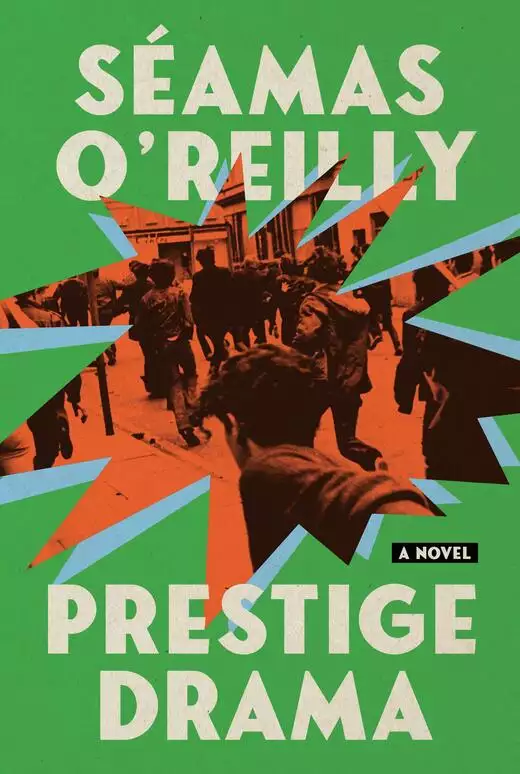
A dazzling debut about a community where an upcoming film production brings their past into sharp focus—and nobody’s version is the same
In Derry, the locals are already in a twist about the arrival of Hollywood actress Monica Logue to research her role for a show about the Troubles—and then she goes missing.
Everyone has a story to tell—about Monica’s possible whereabouts, and about the historic events that brought her here in the first place: the show’s screenwriter, desperate for this last shot at success; the grieving mother whose story he’s adapting; the ex-IRA member who knows the price of survival; the local psychic who’s seen too much... Prestige Drama brings to life a chorus of characters as they locate themselves in Monica's disappearance, and in the truth about their own history.
From the author of the acclaimed memoir Did Ye Hear Mammy Died?, Prestige Drama is heartbreaking, hilarious, and profound, an indelible portrait of a community both obsessed with its past, and desperate to forget it.
Release date:
May 5, 2026
Publisher:
Grand Central Publishing
Print pages:
256
* BingeBooks earns revenue from qualifying purchases as an Amazon Associate as well as from other retail partners.
I remember Jamie Devenney’s head blown half open, and the blood on the spot on the gravel where his body fell, not red like films but black like petrol, and the smell of pennies so strong you could taste it in your neck. We kids, a dozen years younger than him even though he was still a child himself, any time we saw a wee scab of chewing gum anywhere near that bit of pavement for years we’d tell each other they were bits of brain, and what you’d do was bounce a ball off it and say there’s Jamie’s brain on that ball, and everyone would say get it away from me, for Jesus’s sake, get it away. I remember cousin Phelim over in England, years gone, training to be an electrician said Auntie Pat dead loud if I ever asked, after she’d been smoking in our kitchen with Mammy all hushed voices, and it was only once fully grown I realised he was over there getting a certificate all right, but it was a City & Guilds in hospitality and catering at Her Majesty’s pleasure because the only electrics he ever did had been going under cars parked outside the cop shop on the Strand Road. I remember tall men cut low laughing as they fumbled for papers, then quiet as church mice throwing out no cross words as they were dressed down by moustached soldiers half their age gesturing with gun tips at checkpoints, looking back at us in the car and rolling their eyes, play-acting like they weren’t in the least bit bothered, like it was all a joke and they weren’t soaking themselves. I remember getting chased out of Brannigans when Daddy told that joke about the hunger strikers and it turned out there was a blanket man there right behind us, and even though Bogle, the biggest Provo in five parishes, said there was no harm in Joey Walsh, the fella reckoned there was no apology would do, and there was me pure scundered playing red-faced peacemaker at thirteen years of age, embarrassed by old men standing up to smack my da.
When the story came to me, when I held it in my hands, these are the things I wanted to get across, but that was before every thought deserted me, before the studio kept hassling me about notes, before Monica Logue—the Hollywood star with delusions of grit, the TV detective with the fifty-foot smile.
As Detective Blackfinch, she was one of those improbably beautiful but respectfully dowdified homicide cops who marched onto crime scenes barking orders, while fitting her slim, hand-model’s fingers into her trademark satin gloves. She was the producers’ big ticket to getting eyes on Dead City, a show they hoped would do for Troubles-era Derry what she’d already done for shops that sold satin gloves. She faced down murderers and rapists in beautifully shot woodlands, and knelt over chalk outlines, picking up bullets with tweezers, or turning around dramatically to reveal important fabric remnants that had been missed by everyone else, but which now found themselves dancing a swift I Told You So on the end of her outstretched biro.
And now she’d decided to slum it with us sad-cases over here, to make a case for herself as a serious actress, playing the mother of a murdered boy, the vector for a city’s pain, coming into my office and disappearing like one of her weekly missing women. And then I was getting frantic calls from London and LA every hour of the day because they’d worked out, just as handily as a glamorous, hard-bitten American detective would, that I was the last person on earth to see Monica Logue alive.
We heard about Monica Logue going missing same as everyone else. It was in the Gazette and I’d know the editor, Deirdre, very well since she comes into the shop the odd time buying flowers for her mammy’s grave. It’s all anyone’s been talking about. You’d think having a world-famous celebrity in town would be the biggest news going, but it turns out her not being in town at all trumps it handy. I reckon she’s taking a bit of time out from the stress of it all and you’d imagine those Hollywood types have their own demons with the drink and drugs although sometimes you see them going into rehab and they’re on some chat show going on about how they were drinking a bottle of wine a night and you think they’ve hardly touched the sides of what we get up to. Sure there’s nuns in Derry drink more than these fluthers and no one bats an eyelid. Most of my teachers were half cut in class, I’d swear it, but I guess it’s different everywhere. Maybe she got a look at Waterloo Street on a Friday night and realised she’d landed in Sodom and Gomorrah and fucked off back to the Hollywood Hills in pure shock.
It’ll all work out in the end. I hope it does because I think she’s marvellous. Me and Paul binged Blackfinch when it was on streaming and I couldn’t believe she was going to be in this thing. You’d almost not mind that it was an American and not someone from here if it’s someone of her talent and stature, and sure it’d mean more eyes on it and Paul was happy about it too because he’s had a glad eye for her since the nineties although he’d never say it but I’ve seen him reading every word printed.
Some of the stories you hear, though. I’ve heard the same as everyone else, that she needed to dry out or she was kidnapped by Provos who’d run out of horses to hold hostage. Some saying she was murdered by Diarmuid himself seeing as he’s the last one saw her alive, and isn’t that always what they say in cop shows before they put the screws on the school caretaker or the weirdo uncle. Few days ago, everyone and their mammy had seen her. Eileen says she was out buying buns in the bakery the day before yesterday which would hardly be the behaviour of someone about to skip town, but I’d trust her as soon as I’d trust an MP, I mean, a greater gossip than Eileen Downey never put her arm through a coat, and I don’t think she means to lie but she gets ideas in her head and lets them run away with her and you wouldn’t say a word to her if you were in your right mind, I mean you wouldn’t tell her the time.
You would get to worrying though all the same. There’s a lot of ways people can go, sure there was a wain on our estate God help us was run over by an ambulance, and another a few years before who fell in the river after a Frisbee although they said that wee boy was troubled, never so far to say as he was suicidal only that it was worth mentioning just that about him, that he was “troubled” which seemed to be saying the same thing.
There’s a monument for mental health near where he drowned on the Foyle Road, it’s at the start of the bridge with a few steps reaching out into the river. I always liked it and I don’t often like the monuments but I like that one. They had to cordon it off since people were throwing themselves off it which I said was one way to spread suicide awareness anyway. Next thing there’ll be a wee plinth with a length of rope and a bottle of pills, there yous are, lads, help yourselves.
There’s the other one, the Hands Across the Divide, over by where Tillie’s used to be, it’s two lads reaching out for one another. It’s good because it could be about the Troubles or it could be about mental health or the environment or gays. They’re not touching, the hands, but they’re trying to touch and I reckon that’s the point. It’s all about awareness.
More people have died from suicide since the Good Friday Agreement than were killed in all the fighting before it, I hear people saying that a lot. Father McLaughlin used to say it in mass before collection. Now the details of how fixing the church’s roof was going to help teen suicides was never made clear to me but, that aside, everyone would nod at this fact like it was wile wise. I always wondered how it was that everyone’s killing themselves now when things are better, when no one was back in the day. I read a pamphlet that says a thousand more people died by suicide than murder even during the Troubles, so is that better or worse than now? If it’s better, then it seems a weird thing to go on about, and if it’s worse, then maybe the Troubles were better for people’s mental health than everyone lets on, gave them something else to worry about. But you can’t say things like that these days. Everyone just wants to move past it.
The whole place has gone mad with Hollywood arriving, talking about our wee town having its moment in the spotlight and how it’ll give a boost to the economy like Thrones did for Belfast, as if they needed it anyway. In my own personal view it’s a great thing altogether. Very good for getting the story out there—and if there’s jobs in it, all the better.
That’s one thing I think about a lot is jobs, it’s terrible the amount of unemployment that’s around and then you look at some of the people who do have jobs and you wonder how it even happened. Our Patricia’s Turlough minds the cars in the leisure centre up in Pennyburn and I always think how did he even get the job. He’s too good for it, you see, the great struggling actor! And now he’s given Patricia the bug, but sure it’s good to have a passion. It would just be nice to see some passion in the job he actually has, is all I’m saying, face like thunder while he’s raising the barriers and you’d feel bad even parking your car, like you’re taking food from his mouth. Before they started courting, I used to think he must have been born in the centre, swaddled in a kitbag, raised by the lifeguards and handed a work pass. He doesn’t even sweep the floors or hand out swimming caps or anything, I’ve never even seen him indoors, and I always used to joke he probably has a wee pullout bed and a stove to make his tea ’cos he just sits in his wee booth minding the cars all day and the face on him you’d think he was before a firing squad. That to me is a shame to be honest because there’s plenty would do that job and do it with a smile on their face.
But then I suppose my big thing, and as long as I live I will always return to it, is the handicapped, who I think have a terrible time of it already, and could do with a leg-up—or a wheel-up as the case may be. It’s every day I see some eejit collecting trolleys or serving drinks and looking like the world’s not done them any favours and when I see people like that I think: do you know what, that’d be a great job for a wee handicapped person. There are degrees of handicapped but I think it’s something we need to look into if the powers-that-be would give it a moment’s thought. When you do see wee handicaps in jobs they seem happy with it, they’re thankful for the opportunity, and sure if there’s a bit of a fuss learning them the ropes well it can’t be worse than some of the gombeens I see washing cars and doing dishes and not knowing how lucky they are. There was one used to work in Duffy’s making the teas and he was a credit to his disability, always smiling, and if he made a wee mistake he apologised and everything was fine. Except one time I was in there with Eileen Downey and she had a face on her the whole time like she was being served by a chimpanzee and I had to have a word with her and tell her she was being unkind even if he did get a few things wrong. She was put out to put it mildly because he gave her the wrong drink and me the wrong sandwich but I wasn’t complaining and I don’t need Eileen Downey to do that on my behalf, I’m loud enough on my own thank you very much, but the final straw for her was when he touched her biscuit when it nearly fell off her saucer as he w. . .
We hope you are enjoying the book so far. To continue reading...

 Please log in to recommend or discuss...
