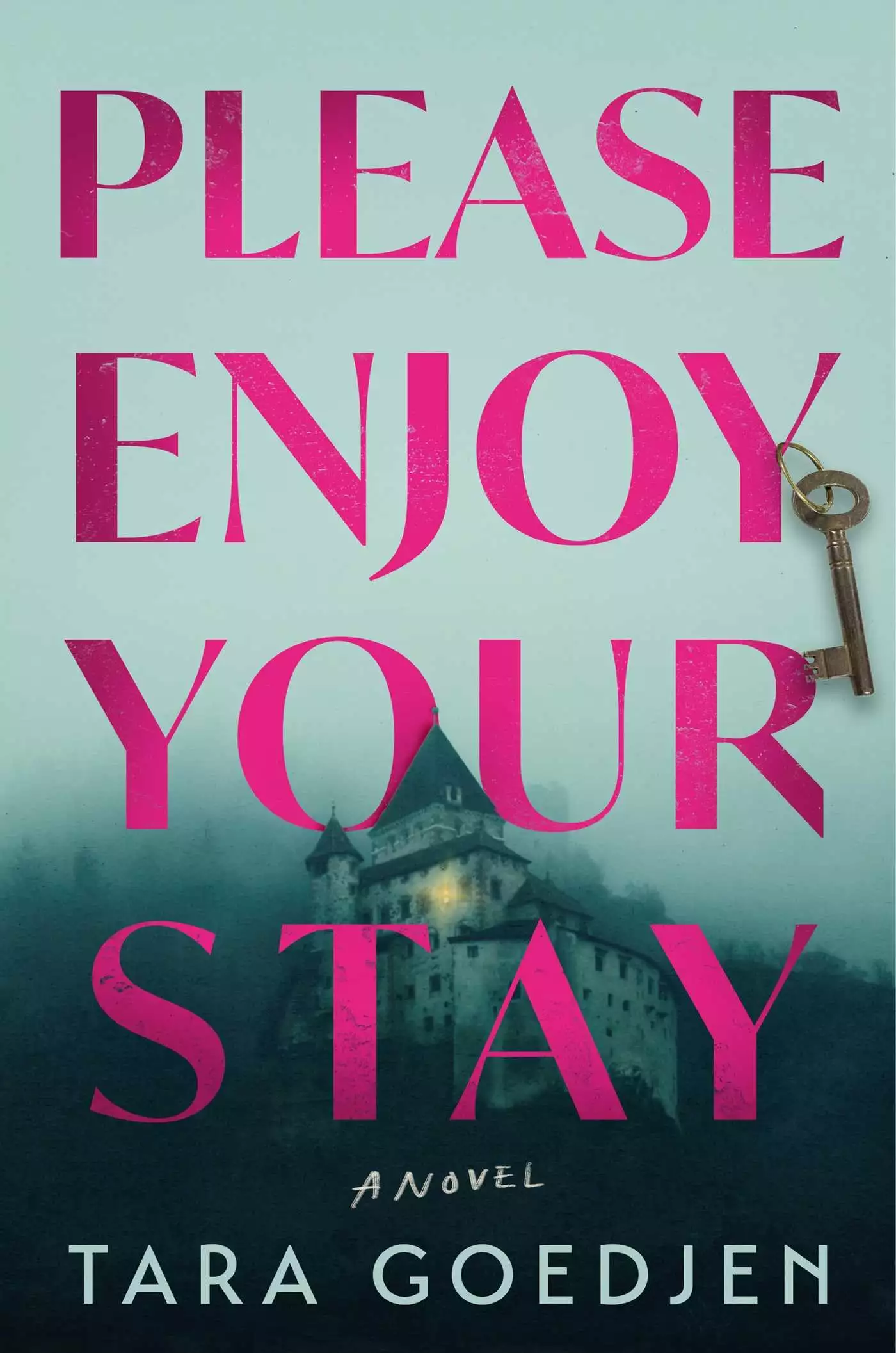
After a true crime podcast reopens her cousin’s murder case, a woman must confront her past at a glamorous European castle-turned-hotel where she follows a trail of toxic family secrets and deadly lies in this Gothic-tinged thriller perfect for readers of Lucy Foley and Ruth Ware.
When they were teenagers, Mia’s beloved cousin was murdered during their stay at an infamous castle in the Austrian Alps. As the only witness, Mia’s testimony put the killer behind bars, but it tore her life apart: the media accused her aunt, a controversial true crime author, of being involved. Now, a decade later, the murderer is appealing his conviction, and a popular true crime podcast starts covering the case, determined to exonerate him, and resurfacing lies about Mia’s family in the process.
Desperate to protect her aunt—and what she knows to be the truth—Mia returns to Austria. The castle is being revamped as a luxury hotel, and Mia gets a job as a nanny for the new owner, hiding in plain sight as she investigates, needing to set the story straight once and for all. But after someone mysteriously disappears on the property and sinister new evidence emerges regarding her cousin’s death, she realizes she might have accused the wrong man...and put her own life in danger.
Release date:
October 13, 2026
Publisher:
Atria/Emily Bestler Books
Print pages:
320
* BingeBooks earns revenue from qualifying purchases as an Amazon Associate as well as from other retail partners.
Chapter 1 CHAPTER 1 I stride to the front door just after sunset holding a seven-inch knife and an extremely heavy wok. It’s awkward to be marching up to my ex’s beach house with two objects that could be weapons, but they’re too expensive not to return. I’d found the last of Paolo’s things today while desperately looking for coffee beans in my kitchen. Instead I came across the hand-forged copper wok, which I hadn’t noticed for the past six months because I rarely cook, and when I do it’s mostly pasta. But Paolo loves this pan. And the filet knife. And he deserves to live happily ever after with them.
I hurry up his steps. I told him I would swing by, but he’s usually at work right now—he always works late. I knock anyway, obligatory, briefly debating the wisdom of leaving a knife unattended on his porch. My phone buzzes with a text, and I wonder if it’s him, if I’m showing up on his security camera at this very moment. But when I check, it’s a message from my aunt.
Turn on the news.
My heart quickens. She doesn’t normally reach out to me—I’m the one who calls to check in. Before I can reply, the front door swings open. I’m greeted by Paolo, his black hair newly cut, an even deeper tan than before, and those same wide brown eyes.
I stiffly hold out the pan and knife, nearly stabbing him in the process. “Here you go.”
“Mia, hi,” Paolo says. “Thanks for these.”
We stand awkwardly under the porch light, just looking at each other. “I thought you might be at—”
“I cleared my afternoon appointments,” he cuts in, which is somewhat surprising. We broke it off amicably but haven’t seen each other since. “Want to come in?” The softness in his voice makes my stomach flip.
I linger in the doorway as he heads into his spotless house with sweeping beachfront views and a huge flat-screen TV he must have bought. The weather report for tomorrow is on, showing off Tampa’s usual eighty-degree blue skies that I won’t enjoy because I’ll be on shift. The vase of wildflowers on the table is his new girlfriend’s touch, I’m sure. Reina was right—of course he was snatched up right away.
“I should go,” I tell him. “I’m meeting Reina for drinks tonight.”
“Is she still living in your building, or did she move?”
“Not all of us move to beach houses.” I’d meant it lightly, but Paolo gives me a look.
“Just come in for a minute, Mi,” he says, shutting the door behind me. “I’ve got something of yours, too. That leather satchel.” He means the one he gave me, the one that’s too beautiful to use. “And I still have your aunt’s book.” He starts down the hallway, then glances over his shoulder, winces. “Sorry, I never got around to reading it.”
That sounds like something I’d do—show him something important to me without telling him it was important. During our two-year relationship, I gave Paolo glimpses of my life, hoping they would somehow add up to the real me. But if I’m being honest, I was always playing a part. He believed I was the “fun” one: moving around the world, working seasonal jobs while finishing my EMT course, living life on my own terms. But the carefree person Paolo thought I was didn’t exist. Sooner or later he would have figured it out.
“I saw that she called you her ‘little research assistant’ on the dedication page, though. Did you visit the crime scene together?” Paolo grins like he’s making a joke as he veers into a room off the hallway as I wait. “I really did mean to read it. You know I loved The Bloody Benders. It was terrifying,” I hear him say from inside the room.
The Bloody Benders was my aunt’s most popular true crime book. It came out right before I moved in with her and Tristan, and was the follow-up to her successful debut about a murder in nineteenth-century Manhattan. Iris’s niche was historical true crime in allegedly haunted settings. Her third book focused on the disappearance of two British princes, and she wrote it when we all lived in her London flat together. But her fourth book, on the 1969 slaying of an Austrian heiress, she never finished.
I head toward Paolo’s balcony and slide open the door, letting in the night’s salt-tinged air. The sound of the waves mingles with the buzzing of my phone. It’s another message from Iris.
Turn on CNN. Now.
Why the hell is she texting me about CNN? There was a time when we avoided the news, when it was a constant reminder of what we couldn’t face. I find the controller near the couch and switch stations, glancing over my shoulder to make sure Paolo’s not back yet. I’m only half listening until—
“Up next, the decade-old murder that’s capturing the world’s attention, as Augustin Aiglar demands a retrial,” the newscaster says.
I whirl toward the TV. My aunt’s dated author photo is plastered on the screen.
No. No, no, no.
“Celebrated true crime author, Iris DeLaney. A luxury hotel in the Alps with a staggering history of murder. The author’s seventeen-year-old son, found dead on the same property. And a conviction in Austria that many call into question.”
Bile stings the back of my throat. I force myself to keep watching.
“Did hotel owner Augustin Aiglar really commit the heinous killing of Tristan DeLaney? Or was his mother so desperate for another bestseller that she would plot her own son’s death?”
It feels like the breath has been knocked from me. I stab the power button on the controller, but the TV won’t turn off.
“Found your things.” Paolo is back, holding the satchel in one hand and Iris’s hardcover in the other. He glances at my aunt’s book, then at the TV. “Wait, isn’t that your—”
“I have to go.” I shove the remote at him but he’s staring at the screen now, watching the recap of my cousin’s case. Some crimes attract worldwide attention—Amanda Knox–level coverage. Because of my aunt’s fame in the true crime sphere, Tristan’s murder was broadcast everywhere in 2015.
But there was a conviction. This shouldn’t be news again.
“Oh my God.” Paolo wrenches his gaze from the TV to look at me. “How come you never talk about what happened?”
Because of this. This reaction—the mix of horror and pity on his face—is exactly why I never told him everything. And when he’d asked, I lied about it. The case was tried in Austria, where there are more data protection and privacy laws, but some key details still leaked out. So Paolo knows what everyone else does: He knows that twelve years ago, while Iris was writing what should have been her next book, her only son was murdered. He knows the sole eyewitness in the case was a minor at the time. But he doesn’t know that witness was me. He doesn’t know my testimony landed the killer in jail.
And now Aiglar’s demanding a retrial.
Paolo points the controller back at the screen. “Maybe they found new evidence? Or he’s trying to get pardoned?”
“I can’t—” The floor is dropping away, and then his hand is on my arm, steadying me.
“Hey, talk to me,” he says gently. He pulls out a chair, and I’m tempted to tell him everything I’ve shut away since the trial, every single secret that I’ve never told anyone.
There’s the sound of a key scraping a lock. A woman opens the door, balancing take-out boxes, a purse. “Oh!” she says, looking between us. It registers—his new girlfriend.
I need air. I need to breathe.
“Mia, wait,” Paolo says, but I’m already striding past him, away from his beautiful home and the too-bright television, and his kind eyes that always wanted more than I was willing to give.
I beeline down the front steps, turn the corner, and cross toward the beach. I find a boardwalk that takes me onto the sand, and I trudge through it, up to the water’s edge, thinking of Tristan, of Iris.
The moon is out now, glimmering over the waves like a huge pale face. I slip off my sandals, holding them as I step in. The water swirls around my feet, colder than I thought it’d be, and suddenly I’m twelve years old again, motherless, arriving at my aunt’s home in London in the middle of a downpour, my clothing soaked, umbrella useless against the torrent of rain.
“My flat is up here,” Iris had said. Her British accent sounded just like my mother’s, but I was still getting used to the fact that I’d be living with her in London, and not with my mom in the U.S.
The keys jingled as Iris unlocked the deadbolt, the apartment dark when we stepped inside. “Tristan?” she called out, worried.
And then the door swung open behind us, and there was my older cousin, as drenched as I was, his skateboard under his arm, tall and lean and blue-eyed like Iris. “Hey, Amelia,” he said. He cleared his throat. “We’re glad you’re here.”
It sounded rehearsed—like my aunt had prepped him ahead of time. I felt the tears threatening to come again, they were lodged behind my eyes and in my throat, making it hard to speak, and I knew if I started crying I wouldn’t stop.
“I’m not,” I said. “I’m not glad to be here.” I raised my eyes and found them both staring at me. It felt like a collective held breath.
I waited for them to say, But you have nowhere else to go.
“It’s the rain, isn’t it?” Tristan said instead. “You have to get out in spite of it.” He held up his skateboard. “Come on, I’ll show you.”
Iris let out a surprised laugh and said, “You’re going back out now?”
Tristan said, “Why not?” Then he smiled at me, and it was warm and real and somehow that was enough.
That was the first time I followed him.
We went outside, where it was raining so hard that I could cry without him seeing, but I think he did see. Tears were running down my face as he showed me where to put my feet on the board, and how to find my balance. And then I was rolling down the pavement in the dark, the streetlamps reflecting over the puddles, the rain stinging my eyes, the wheels going faster and faster, and just for a moment, I forgot to be sad about my mother.
And when we went back in, Iris had the fire going, and wool socks and cocoa for me, and that night she showed me a room where I could sleep, full of books. She hugged me, held tight. “You’re not alone,” she whispered. “I’m here for you, and so is Tristan. It’ll be okay.”
And for a while that was true—until we took the trip to Austria a year later, when I was thirteen. The trip that changed everything.
We hope you are enjoying the book so far. To continue reading...

 Please log in to recommend or discuss...
