
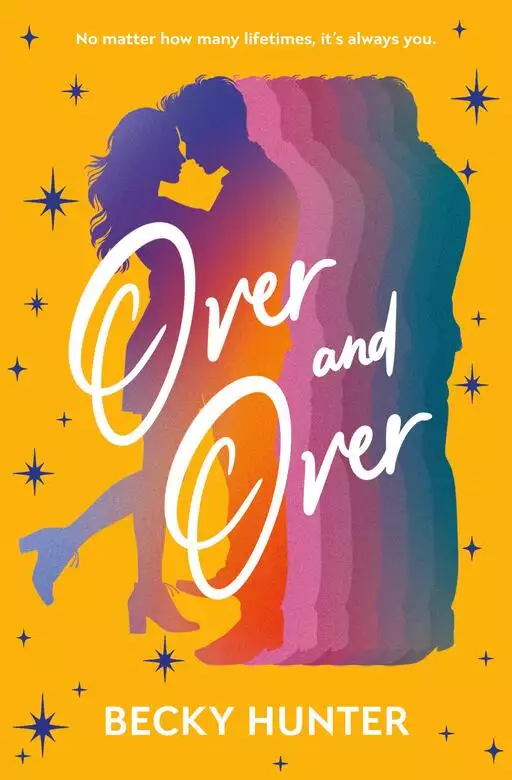
Over and Over
Available in:
- eBook
- Paperback
- Audiobook
- Book info
- Sample
- Media
- Author updates
- Lists
Synopsis
A sweeping speculative romance following two soulmates who have met in past lives—but can never escape their tragic ending—in this angsty novel, perfect for fans of Josie Silver and One Day.
Publisher: Grand Central Publishing
Print pages: 352
* BingeBooks earns revenue from qualifying purchases as an Amazon Associate as well as from other retail partners.
Reader buzz
 Please log in to recommend or discuss...
Author updates
Close
Over and Over
Becky Hunter
Lissa is drowning. Icy water surrounds her, pressing down on every part of her, clinging to her clothes, scalding her skin. Everything is a murky black. A weed twists round her foot, holding her in place as she thrashes, trying to reach the surface, even as she can’t be sure where the surface is. She mustn’t open her mouth. She knows that. But her chest is burning, more pain than she’s ever experienced, urging her to breathe, to relieve the pressure.
Distantly she hears someone screaming for her, over and over, but the voice is distorted, the tenor of it weirdly unfamiliar. This is it. She knows it is, even as her heart beats faster, urging her to keep fighting, as her arms try to claw their way through the oppressive cold.
But she can’t fight anymore. She opens her mouth, desperate for release. And water floods in.
She wakes drenched in sweat, her duvet kicked off. She is breathing heavily, her body trembling. Autumn rain lashes at the window, the only noise in the dark.
She tries to steady her breathing, placing a hand on her chest and rubbing there. She’s used to this nightmare, though that felt rougher than usual. She glances at the red numbers on her alarm clock on the bedside table—a birthday present from her dad a few years ago. A demonstration that he didn’t have a clue what to get her, but she likes it all the same.
It’s 5:30 a.m. On the 16th of September.
No surprise, really, that the dream was more vivid than usual, today of all days. Twenty years exactly since her little sister drowned. It doesn’t seem to get any easier, year on year. Perhaps because she knows by now exactly what the day will bring.
She pushes up out of bed. No point trying to get back to sleep after that.
She walks to the bathroom in her small one-bed flat. This is the first year that she’s been able to afford to rent on her own, rather than having to house share, and she loves every tiny inch of it. Being a homeowner is still a distant dream, but the relief of not having to tiptoe around on early mornings or force smiles and chats at the end of the evening is something she welcomes almost daily.
She switches the light on, tries to avoid looking at herself in the mirror. She knows she’ll be too pale, the shadows under her eyes too dark. She takes a packet of pills out of the cabinet, swallows one, then cups water from the tap to wash it down. A headache is already pressing down on her, throbbing at her temples, and she knows it’ll only get worse, despite the pain relief.
She tells herself it’s a response to stress, to tiredness. She reminds herself that plenty of people get headaches, that it’s very unlikely to be serious. And this, she thinks, is exactly why her phone is on charge in the living room rather than on her nightstand, far away from where she can start to google symptoms and go down a hole she’ll only get stuck in.
It’s the 16th of September, she reminds herself. It would be weird if she didn’t wake with a headache today. All she has to do is put one foot in front of the other, keep going until the day is done. It’s only twenty-four hours. Less, really, because she can go to bed at, what, 8 p.m.? So that’s only a little more than twelve hours when you think about it.
Twelve hours. She can get through that. She’s done it before, after all.
She arrives at her mum’s house on the outskirts of Bath at 9 a.m. It’s the same house Lissa grew up in, on the northern edge of the city, an area that has grown more desirable over the years—close enough to the center, but on the doorstep of some beautiful countryside a few minutes’ drive away. It’s probably worth a fortune now, a semi-detached three-bed like this, but her mum will never sell, and Lissa imagines the price of it would be significantly devalued given the state it’s in.
She steps through the overgrown garden, along the stone path that leads to the front door, mossy grass pushing its way through the cracks. There is a black gate to one side of the house, leading round to the back. She remembers a time when two bikes used to be propped up behind that gate, one bright blue, the other purple and silver with tassels on the handles. Her sister never outgrew that bike—never had the chance to.
She doesn’t go through the gate now, though. Instead, she fumbles in her coat pocket for the spare key, turning it in her fingers as she stares at the front door. The rain has eased off, leaving behind just the odd shower in an otherwise sunny morning, like two sides of the weather arguing with one another about what sort of day it should be.
She taps the key against her palm. She doesn’t want to go in. She doesn’t know what she’ll find. Last year, her mum had been passed out on the sofa, a sick bowl next to her, empty bottles lining the kitchen counter. The year before, Lissa had walked in to see the start of a suicide note in the kitchen, torn into pieces. She remembers the terror as she ran upstairs, screaming for her mum, who didn’t answer from where she lay curled in a ball on her bed. Lissa doesn’t think she’d actually go through with something like that, but it seems that each year, on this day, her mum gets worse rather than better. Like she sees it as the day to punish herself—and the world—for what happened.
The door swings open as she finally turns the key in the lock, and she calls out, aware of how tentative her voice sounds. No answer.
“Mum?” she tries again, heading farther into the house.
She peers into the kitchen to see unwashed dishes stacked in the sink. She’ll do those later. Clutter inhabits the house in a way that makes it impossible to see what it would be like without it, and there’s that distant musty smell that comes with neglect, no matter how much bleach you spray or how many times you hoover. The carpet has been the same for the last twenty years, frayed at the corners and stained in various places, with a rug that she thinks might have belonged to her now deceased grandmother taking center stage in the living room. The photos on the mantel above the fireplace are the same as they’ve always been, depicting a happy family that no longer exists. The whole place is a time capsule, like stepping back to the 1990s, and if ever Lissa suggests they clear some things away, or perhaps get a new carpet, she is met with a vicious tongue, red-rimmed eyes or an attempt at a joke, depending on the day.
Her mum isn’t anywhere in the house. It’s only when Lissa checks the second bedroom—her old room, which overlooks the back garden—that she sees her. She watches for a moment, one hand on the curtains she chose as a teenager—dark blue with bright, colorful birds on them. She thinks they might have been the last thing her dad bought for the house before he left it. Her mum is standing out there in a nightie and a cardigan, barefoot, staring into nothingness. Lissa’s heart twists at the sight, though she already knows there will be nothing she can do to make things better. Not today.
She heads down to the garden anyway. There used to be a swing set, but her dad got rid of it when Lissa was about twelve, in an attempt to start making a change. It’s the pond her mum is staring at, Lissa notices when she gets there. It’s been left to its own devices over the years, and by rights it probably should’ve dried up or stagnated by now, but instead it has somehow flourished, with flowers and weeds all around, buzzing insects humming with life. It seems cruel that the site of Chloe’s death can be so alive.
“Mum?”
Her mum turns, her hazel eyes, so like Lissa’s own, red and swollen. Her skin is dull, gray hair unkempt. It’s hard to tell from here if she’s been drinking, but she seems steady enough.
“You came.” Her voice is raspy. She doesn’t usually smoke, but today, anything goes.
“Of course. I always do.”
Her mum turns away, tugging her cardigan to her. Lissa wonders if she slept last night. She wonders if she too is plagued by nightmares. They won’t talk about it if she is. They never talk about it.
“Come on, let’s get you inside. I’ll make you some breakfast.” She brought bread and eggs with her—food is not always reliable in her mother’s house.
“We don’t deserve to eat today, Alyssa.” The words are small and bitter, and the “we” isn’t lost on Lissa.
“Well, we still need to.” Her voice is flat, because this is what she dreads. This, she feels sure, is why she can’t shake the nightmares, why this day never gets any easier. The blame she hears in her mother’s voice, no matter how much time passes. The blame, Lissa knows, that she deserves.
“Come on.” She turns back to the house, without looking to see if her mum is following. She will eventually. She always does.
She is exhausted when she leaves her mum’s house early evening, and the headache is much worse, despite the copious painkillers she’s taken. Stress and tiredness, she repeats to herself. It is not a sign of a brain tumor; it is not an aneurysm. It is normal. She is normal.
She checks her phone as she walks, late sunlight filtering through gaps in the trees that line the pavement, their leaves turning russet and gold. She could get the bus back to her flat on the opposite side of the city, but she needs to walk, to breathe.
There’s a message from Mia waiting for her.
I hope you’re doing okay. Thinking of you and here if you need me. Be safe. Xxx
Lissa feels irrational tears prick her eyes as she reads it—a fallout from having spent too long with her mum today. As her only cousin, Mia is probably the one person who understands how difficult this day is. Apart from her dad, of course, but either he’s forgotten or he’s determinedly refusing to acknowledge it, because she’s heard nothing from him.
Be safe.
Lissa bites her lip. It’s the only recognition that things don’t always go as planned on this date, that sometimes Lissa lets her emotions get the better of her. A reminder that what she should do is go home, shut the curtains, have a peppermint tea and a sleeping pill and fall asleep in front of Gossip Girl on Netflix.
But she comes to a stop at the end of her mum’s road. She is drained right now, yes, but she also can’t be sure that when she sleeps it will be dreamless. And for once, she doesn’t want to go back to her empty flat. She doesn’t think she can face the quiet, the tumble of anxiety that will fill the space.
Anyway, tonight is not a night for lying alone, hoping nightmares don’t plague her. Tonight is not a night for being pathetic and helpless. Her sister died on this day twenty years ago, yes. But Lissa is still here, isn’t she? She is still breathing, still living. So she might as well bloody do something with said life.
What she needs is a distraction, something to stop her spiraling. And there’s nothing wrong with that, is there? Distractions don’t have to be a bad thing; they can be healthy.
She scrolls through her contacts, hesitating over his name. Fuck it. She sends a WhatsApp. He starts to type almost immediately—he must already be out. She smiles when she sees the reply come through, something akin to excitement spiking her system. This is perfect. This is exactly what she needs.
She sets off with purpose. It’s a thirty-minute walk to the city center, but there are several e-scooter stations en route. She’s never ridden one before, always worried about the possibility of getting into an accident, but tonight seems like the moment to try it.
She scoots down the hill, passing a line of Georgian terraces. She hears the city center before she sees it—laughter and chatter and the bell chiming in the abbey. The mood is vibrant, people spilling out from bars onto the cobbled streets, the sky a pink glow above the sandstone buildings. The rain from earlier has been whisked away, but a damp chill remains in the air, so that her fingers feel icy on the handlebars. Wasn’t everyone promising an Indian summer this year? Whatever happened to that?
It’s a Saturday night, she realizes, as she passes a wine bar with al fresco seating, mimicking a European city. A Saturday on one of the few remaining warm evenings, no doubt, and here everyone is, making the most of it. Here she is, making the most of it too.
She’s not concentrating when she turns the next corner, leaning in with her scooter. She has a moment to think how she’s really getting the hang of this scootering business before she hears the horn. She jumps, the scooter wobbling underneath her. She moves to glare over her shoulder, hears the horn again as she swerves unintentionally toward the middle of the road.
Then there are hands roughly grabbing her. One on her waist, the other taking control of the handlebars, pulling her off the road and toward the pavement. She yells, sees heads turn. The taxi blasts past her without slowing down, its wheels spraying up water.
She doesn’t get to see the face of the person who has abducted her, because she’s falling, straight onto the pavement. The scooter slides out from under her and she hears a male grunt, just as she flings her hands out, catching herself before her chin hits the concrete.
Pain reverberates through her arms, and she grits her teeth against it before shoving herself up, already scowling.
A man is holding her scooter, the other hand outstretched to help her up, blue eyes—ridiculously bright—creased in concern. Oh, great, so he’s concerned that he shoved her onto the tarmac now, is he? What a fucking gentleman. She swats his hand away as she scrabbles to her feet, her jeans now coated in dirt.
“Shit,” the man says, grimacing in what she assumes is supposed to be solidarity. “Are you okay?”
She pushes her hair back from her face. “What the hell do you think you’re doing?”
He raises his eyebrows, the same color as his dark hair. “Er, saving you from getting hit by an angry taxi driver?”
“Saving me?” She lets out an incredulous laugh as she checks both palms. Grazes. Shallow, but they still might get infected if she’s not careful. “You could have killed me!”
“I don’t think so,” he says with a shrug. “If that was the plan, I would’ve just stood back and let the car do the job for me.” She’s so surprised at that—is it supposed to be a joke?—that she can only stare at him for a second. He runs the hand not holding the scooter across the back of his neck. “Look, I just was trying to help,” he says, his voice even. Calm in the face of her storm.
“Oh yes,” she says. “Because what I was really looking for was someone to help me onto the pavement face-first. It’s actually quite difficult to accomplish that on your own, so thank you so much.”
He blows out an annoyed breath. She can tell it’s annoyed from the way his lips tighten. “Look, I acted on instinct, okay? I didn’t mean for you to fall.” He jiggles the handlebar of the scooter, like he wants her to take it. Well, screw him.
“You acted on instinct? Your instincts need some work in that case, hero.” The last word drips with a sarcasm that she’s pretty impressed with, if she’s being honest.
A flash of something crosses his face, causing his jaw to spasm, before he smooths it out. “Well, given that you’re okay and not currently roadkill…” It’s actually quite annoying, how unflappable he is. She sort of wants him to rise to it. Instead, he holds the scooter out to her again.
She lifts her chin in the air. “Keep it. You clearly wanted it badly enough.”
And with a dramatic flair that would make Darcy proud, she spins away, leaving him staring behind her. She realizes too late that it was a totally stupid thing to say—that and the fact she’s supposed to check the e-scooter back in. Well, no chance of that. She’s not turning around now; she’ll just have to take the hit. Especially as there’s a tiny part of her that’s beginning to feel a bit embarrassed, because there was a car coming toward her, wasn’t there? And she wasn’t paying as much attention as she should have been. But still. A heroic gesture doesn’t usually end with the woman face-planting on the pavement. Besides, right now, a random man with a hero complex is not important. Even if he did have nice eyes.
She heads to the gin bar down one of the alleys, a nearby streetlamp flickering to life as she walks past. Warmth and noise greet her as she steps inside, the smell of citrus and spice lining the air. She does a quick scan of the room. She’ll need to wash her hands, which are now stinging, but she wants to check he’s here first.
Her eyes travel along the length of the sleek oak bar, every single stool occupied. And there he is, right at the end, an easy smile on his face as he chats to one of the waitresses. Her distraction.
Lissa sits outside a café on one of her favorite streets in Paris, the back of her neck warm in the late-afternoon sun, her head bent over her sketchbook. She doesn’t know how exactly she knows she’s in Paris given that a) she’s concentrating on what she’s drawing rather than on her surroundings, and b) she’s never actually been to Paris, but there’s no arguing the fact. The smell of coffee and cigarettes lingers in the air, the clinking of metal against porcelain mingling with the low hum of chatter.
She loves this place. It’s mere streets away from some of the worst damage from the Blitz, areas that haven’t quite recovered despite the fact it’s been ten years now. This café opened after the war, she knows, the owners determined to see Paris be all that it had been and contribute toward that in some small way. Every time she comes here—mainly at weekends, since she got the job at the school—she feels hopeful, invested in the idea of new beginnings, of building something out of the ashes.
The face is beginning to take shape in the charcoal as she sketches. It’s a face she once must have known so well, but over time she’s forgotten the exact texture of her sister’s expressions, even as she tries to call them into focus.
She hears a feminine laugh coming from inside the café as the bell on the door jingles. Hears a man’s voice calling out a goodbye. She doesn’t look up, too lost in her work now. She hears the muttered oath a split second before she feels it—searing-hot liquid seeping through the sleeve of her dress. She yelps, then reacts on instinct, pulling her arm toward her and scrabbling to her feet, her hand coming to cover the spot where the liquid scalded her.
There is a man there, apologizing to her, catching his balance from his stumble and bending to pick up his now empty coffee cup. She doesn’t look at him, though. Instead she looks down at her sketchbook, at the drawing of her sister. Coffee stains one side of her sister’s face, the charcoal edges blurring into one another. Ruined.
“Je suis vraiment désolé, excusez-moi, puis-je…?” The man is reaching toward her sketchbook now, like he might pick it up, try to save it.
“Don’t.” The word is a harsh snap, and she’s alarmed to find that tears are burning the back of her throat. It doesn’t matter, she tells herself. She has countless of these drawings, tucked away in a drawer in her bedroom, somewhere her mother will never find them. And she has other sketchbooks at home—she doesn’t need this one.
So without acknowledging the man—or his stupid apology—she bends to pick her bag up off the floor by her chair, then turns to leave. But she feels a hand on her forearm, pulling her to a stop. She wrenches it from his grip, glaring at him.
“What are you doing?” Her voice is clipped and perhaps—objectively speaking—angrier than the situation warrants. She registers, dimly, that she is speaking French—she didn’t even know she could speak French, but there you go.
He lifts his hand in apology. “Sorry. I was just trying to stop you making the same mistake I did.” When she frowns, he gestures down to the pavement by the café door. To the doorstop there, which he clearly tripped over.
She huffs out a breath, pushes a hand through her curls. “Think it’s a bit late to be playing the hero.” She raises her arm for emphasis, showing off the coffee stain on her polka-dot dress—the dress that her friend encouraged her to buy with the majority of her salary, and that she thought she should make the most of.
He grimaces. “I really am sorry.” He glances down at the table, at her ruined drawing. “It’s beautiful.”
Her stomach tightens. She doesn’t like people seeing her work, especially not things like this, which are only ever for her. “It was,” she says shortly. She was, is what she really wants to say. But she realizes, even through her temper, that this is the kind of behavior she’d scold her class for. He didn’t mean it. He is apologizing. So she sighs. “Look, I’m sorry too. You caught me off guard, that’s all. But apology accepted, okay?”
He cocks his head to the side as his gaze travels along her sleeve. He has a nice gaze, she thinks. Hazel eyes, on the edge of brown and green. And though she tells herself she’s ridiculous because of it, she feels goose bumps prickle underneath the fabric of her dress, along the line where that gaze travels. “You’re not hurt?”
She shakes her head. “I’m fine.” It had been a brief flare of pain, but it’s gone now. Still, she’ll make sure she checks it later, to see there is no lasting damage. Can’t be too careful, after all. “And I was finishing up anyway,” she lies, “so I’ll just…” She gestures to the street before moving toward it.
“Wait.” He looks like he might reach for her again, then seems to think better of it, shoving his hands into his pockets. “Can I buy you a coffee to make up for it?”
She hesitates, lingering when she probably shouldn’t. I have somewhere I need to be. The lie is there, on the tip of her tongue. She doesn’t have anywhere to be—would rather, in fact, have an excuse not to head home to her tiny apartment or to her parents’ house, where they will inevitably be arguing. Maybe that’s what makes her do it. Or maybe it’s looking down at the ruined sketch and thinking that, perhaps, when it dries in the sun, it won’t be that bad after all. Certainly the rest of the sketchbook will be usable, at least.
She meets that warm brown gaze. “One coffee.” She says it sternly, in what has become her teacher voice in the few years since qualifying. “And as long as you promise not to spill the next one on me.”
“I can promise to let you spill it on me if that would make you feel better.” She almost gives in to the smile. Almost.
He turns to the door, then glances back at her as she sits back down on the woven rattan chair. “What’s your name?”
She makes a show of smoothing out her skirt. Beside her, on a bed, somewhere else entirely, a man’s body shifts. “I only give out my name to people who earn it.”
She looks up in time to see an almost-smile cross his face, a twitching at the corner of his lips, before it’s controlled, like he’s not sure how she’ll react to it.
She can feel it now, that pull toward consciousness, those moments where you hover between sleeping and waking. But the dream lingers just a moment longer, the sound of his lyrical voice traveling along the outskirts of her subconscious.
“I’ll take that as a challenge.”
His face blurs in front of her as Lissa blinks into an unfamiliar room. Sunlight filters through the gap in the thick blue curtains, slicing a path right over her eyes. A heavy arm is slung over her waist, too hot on her skin.
Her head feels fuzzy, disoriented, like she drank too much last night, even though she only had a few gin and tonics. It’s like part of her is still there, sitting al fresco on the streets of Paris. She didn’t know she had it in her to conjure a place up so vividly. Maybe she watched a documentary on post-war Paris recently or something?
Bits of it are already fading away, the way dreams always do. But she can still hear the sound of his voice, speaking French no less—who knew her GCSE French had made such a lasting impact on her? Mrs. Cullen would be so proud.
She supposes it’s just another way of her brain processing the anniversary of her sister’s death—clearly she still has issues, if she’s imagining drawing her like that. She used to do it in real life, though it started to feel sad trying to capture someone who would never show any laugh lines or signs of aging, the things about faces she finds so fascinating in art.
But now is not the time to be thinking of any of this. Now is the time to be figuring out how to extract herself from under the heavy, hot male arm currently pinning her to the bed.
She grimaces as pieces of last night come back to her in a blur. It’s often like this, the morning after, if she ever gives way to that reckless side of her that she mostly keeps at bay. She remembers nearly getting run over, yelling at a random man—a man with blue eyes. Then seeing Mark at the bar, that wide smile he gave her as she crossed to him.
She likes that about him—his smile. He has very straight, white teeth. And last night she figured, if that wasn’t a reason to sleep with someone, what was? They’ve been skirting round the edges of it for months at work, and although she’s always used the fact that they are colleagues as a reason not to go there, that key piece of information somehow slipped her mind last night. Something she will pay for in the weeks to come, she’s sure of it.
She tries to edge out from under him, freezes when he lets out a light snore. Then blows out a breath when he doesn’t stir.
She is as quiet as she can be as she shuffles around his bedroom in the half-light, collecting her discarded clothes. His flat is bigger and more modern than hers, and is close enough to the center that they were able to walk back together last night, neither of them questioning whether she’d go home with him, that having been decided the moment she sent the text. He’d stopped to kiss her in the street, under the glow of a streetlamp. It was all very romantic, really.
Now, though, she wants out. She can feel panic spiking her system, and the last thing she wants is to have a full-blown panic attack in front of her one-night stand. And yes, okay, he’s heard about her “episode” in the office, but hearing about it and seeing it are two different things. She cringes at the memory, shoves it aside and fumbles on the floor for her phone instead.
She finds it in the pocket of her jeans. Only 10 percent battery. Lucky she knows Bath as well as she does, otherwise she’d be worried about getting home. She bites her lip as she sees two missed calls and a text from Mia, asking if she’s okay. Shit, she should have checked in. Mia will be worried, and she hates to be the cause of that. There are also three missed calls from her mum. At that, her heart clenches with something akin to dread. When she’d left, her mum had been tucked under a blanket in front of the TV, seeming settled if not exactly ha. . .
Distantly she hears someone screaming for her, over and over, but the voice is distorted, the tenor of it weirdly unfamiliar. This is it. She knows it is, even as her heart beats faster, urging her to keep fighting, as her arms try to claw their way through the oppressive cold.
But she can’t fight anymore. She opens her mouth, desperate for release. And water floods in.
She wakes drenched in sweat, her duvet kicked off. She is breathing heavily, her body trembling. Autumn rain lashes at the window, the only noise in the dark.
She tries to steady her breathing, placing a hand on her chest and rubbing there. She’s used to this nightmare, though that felt rougher than usual. She glances at the red numbers on her alarm clock on the bedside table—a birthday present from her dad a few years ago. A demonstration that he didn’t have a clue what to get her, but she likes it all the same.
It’s 5:30 a.m. On the 16th of September.
No surprise, really, that the dream was more vivid than usual, today of all days. Twenty years exactly since her little sister drowned. It doesn’t seem to get any easier, year on year. Perhaps because she knows by now exactly what the day will bring.
She pushes up out of bed. No point trying to get back to sleep after that.
She walks to the bathroom in her small one-bed flat. This is the first year that she’s been able to afford to rent on her own, rather than having to house share, and she loves every tiny inch of it. Being a homeowner is still a distant dream, but the relief of not having to tiptoe around on early mornings or force smiles and chats at the end of the evening is something she welcomes almost daily.
She switches the light on, tries to avoid looking at herself in the mirror. She knows she’ll be too pale, the shadows under her eyes too dark. She takes a packet of pills out of the cabinet, swallows one, then cups water from the tap to wash it down. A headache is already pressing down on her, throbbing at her temples, and she knows it’ll only get worse, despite the pain relief.
She tells herself it’s a response to stress, to tiredness. She reminds herself that plenty of people get headaches, that it’s very unlikely to be serious. And this, she thinks, is exactly why her phone is on charge in the living room rather than on her nightstand, far away from where she can start to google symptoms and go down a hole she’ll only get stuck in.
It’s the 16th of September, she reminds herself. It would be weird if she didn’t wake with a headache today. All she has to do is put one foot in front of the other, keep going until the day is done. It’s only twenty-four hours. Less, really, because she can go to bed at, what, 8 p.m.? So that’s only a little more than twelve hours when you think about it.
Twelve hours. She can get through that. She’s done it before, after all.
She arrives at her mum’s house on the outskirts of Bath at 9 a.m. It’s the same house Lissa grew up in, on the northern edge of the city, an area that has grown more desirable over the years—close enough to the center, but on the doorstep of some beautiful countryside a few minutes’ drive away. It’s probably worth a fortune now, a semi-detached three-bed like this, but her mum will never sell, and Lissa imagines the price of it would be significantly devalued given the state it’s in.
She steps through the overgrown garden, along the stone path that leads to the front door, mossy grass pushing its way through the cracks. There is a black gate to one side of the house, leading round to the back. She remembers a time when two bikes used to be propped up behind that gate, one bright blue, the other purple and silver with tassels on the handles. Her sister never outgrew that bike—never had the chance to.
She doesn’t go through the gate now, though. Instead, she fumbles in her coat pocket for the spare key, turning it in her fingers as she stares at the front door. The rain has eased off, leaving behind just the odd shower in an otherwise sunny morning, like two sides of the weather arguing with one another about what sort of day it should be.
She taps the key against her palm. She doesn’t want to go in. She doesn’t know what she’ll find. Last year, her mum had been passed out on the sofa, a sick bowl next to her, empty bottles lining the kitchen counter. The year before, Lissa had walked in to see the start of a suicide note in the kitchen, torn into pieces. She remembers the terror as she ran upstairs, screaming for her mum, who didn’t answer from where she lay curled in a ball on her bed. Lissa doesn’t think she’d actually go through with something like that, but it seems that each year, on this day, her mum gets worse rather than better. Like she sees it as the day to punish herself—and the world—for what happened.
The door swings open as she finally turns the key in the lock, and she calls out, aware of how tentative her voice sounds. No answer.
“Mum?” she tries again, heading farther into the house.
She peers into the kitchen to see unwashed dishes stacked in the sink. She’ll do those later. Clutter inhabits the house in a way that makes it impossible to see what it would be like without it, and there’s that distant musty smell that comes with neglect, no matter how much bleach you spray or how many times you hoover. The carpet has been the same for the last twenty years, frayed at the corners and stained in various places, with a rug that she thinks might have belonged to her now deceased grandmother taking center stage in the living room. The photos on the mantel above the fireplace are the same as they’ve always been, depicting a happy family that no longer exists. The whole place is a time capsule, like stepping back to the 1990s, and if ever Lissa suggests they clear some things away, or perhaps get a new carpet, she is met with a vicious tongue, red-rimmed eyes or an attempt at a joke, depending on the day.
Her mum isn’t anywhere in the house. It’s only when Lissa checks the second bedroom—her old room, which overlooks the back garden—that she sees her. She watches for a moment, one hand on the curtains she chose as a teenager—dark blue with bright, colorful birds on them. She thinks they might have been the last thing her dad bought for the house before he left it. Her mum is standing out there in a nightie and a cardigan, barefoot, staring into nothingness. Lissa’s heart twists at the sight, though she already knows there will be nothing she can do to make things better. Not today.
She heads down to the garden anyway. There used to be a swing set, but her dad got rid of it when Lissa was about twelve, in an attempt to start making a change. It’s the pond her mum is staring at, Lissa notices when she gets there. It’s been left to its own devices over the years, and by rights it probably should’ve dried up or stagnated by now, but instead it has somehow flourished, with flowers and weeds all around, buzzing insects humming with life. It seems cruel that the site of Chloe’s death can be so alive.
“Mum?”
Her mum turns, her hazel eyes, so like Lissa’s own, red and swollen. Her skin is dull, gray hair unkempt. It’s hard to tell from here if she’s been drinking, but she seems steady enough.
“You came.” Her voice is raspy. She doesn’t usually smoke, but today, anything goes.
“Of course. I always do.”
Her mum turns away, tugging her cardigan to her. Lissa wonders if she slept last night. She wonders if she too is plagued by nightmares. They won’t talk about it if she is. They never talk about it.
“Come on, let’s get you inside. I’ll make you some breakfast.” She brought bread and eggs with her—food is not always reliable in her mother’s house.
“We don’t deserve to eat today, Alyssa.” The words are small and bitter, and the “we” isn’t lost on Lissa.
“Well, we still need to.” Her voice is flat, because this is what she dreads. This, she feels sure, is why she can’t shake the nightmares, why this day never gets any easier. The blame she hears in her mother’s voice, no matter how much time passes. The blame, Lissa knows, that she deserves.
“Come on.” She turns back to the house, without looking to see if her mum is following. She will eventually. She always does.
She is exhausted when she leaves her mum’s house early evening, and the headache is much worse, despite the copious painkillers she’s taken. Stress and tiredness, she repeats to herself. It is not a sign of a brain tumor; it is not an aneurysm. It is normal. She is normal.
She checks her phone as she walks, late sunlight filtering through gaps in the trees that line the pavement, their leaves turning russet and gold. She could get the bus back to her flat on the opposite side of the city, but she needs to walk, to breathe.
There’s a message from Mia waiting for her.
I hope you’re doing okay. Thinking of you and here if you need me. Be safe. Xxx
Lissa feels irrational tears prick her eyes as she reads it—a fallout from having spent too long with her mum today. As her only cousin, Mia is probably the one person who understands how difficult this day is. Apart from her dad, of course, but either he’s forgotten or he’s determinedly refusing to acknowledge it, because she’s heard nothing from him.
Be safe.
Lissa bites her lip. It’s the only recognition that things don’t always go as planned on this date, that sometimes Lissa lets her emotions get the better of her. A reminder that what she should do is go home, shut the curtains, have a peppermint tea and a sleeping pill and fall asleep in front of Gossip Girl on Netflix.
But she comes to a stop at the end of her mum’s road. She is drained right now, yes, but she also can’t be sure that when she sleeps it will be dreamless. And for once, she doesn’t want to go back to her empty flat. She doesn’t think she can face the quiet, the tumble of anxiety that will fill the space.
Anyway, tonight is not a night for lying alone, hoping nightmares don’t plague her. Tonight is not a night for being pathetic and helpless. Her sister died on this day twenty years ago, yes. But Lissa is still here, isn’t she? She is still breathing, still living. So she might as well bloody do something with said life.
What she needs is a distraction, something to stop her spiraling. And there’s nothing wrong with that, is there? Distractions don’t have to be a bad thing; they can be healthy.
She scrolls through her contacts, hesitating over his name. Fuck it. She sends a WhatsApp. He starts to type almost immediately—he must already be out. She smiles when she sees the reply come through, something akin to excitement spiking her system. This is perfect. This is exactly what she needs.
She sets off with purpose. It’s a thirty-minute walk to the city center, but there are several e-scooter stations en route. She’s never ridden one before, always worried about the possibility of getting into an accident, but tonight seems like the moment to try it.
She scoots down the hill, passing a line of Georgian terraces. She hears the city center before she sees it—laughter and chatter and the bell chiming in the abbey. The mood is vibrant, people spilling out from bars onto the cobbled streets, the sky a pink glow above the sandstone buildings. The rain from earlier has been whisked away, but a damp chill remains in the air, so that her fingers feel icy on the handlebars. Wasn’t everyone promising an Indian summer this year? Whatever happened to that?
It’s a Saturday night, she realizes, as she passes a wine bar with al fresco seating, mimicking a European city. A Saturday on one of the few remaining warm evenings, no doubt, and here everyone is, making the most of it. Here she is, making the most of it too.
She’s not concentrating when she turns the next corner, leaning in with her scooter. She has a moment to think how she’s really getting the hang of this scootering business before she hears the horn. She jumps, the scooter wobbling underneath her. She moves to glare over her shoulder, hears the horn again as she swerves unintentionally toward the middle of the road.
Then there are hands roughly grabbing her. One on her waist, the other taking control of the handlebars, pulling her off the road and toward the pavement. She yells, sees heads turn. The taxi blasts past her without slowing down, its wheels spraying up water.
She doesn’t get to see the face of the person who has abducted her, because she’s falling, straight onto the pavement. The scooter slides out from under her and she hears a male grunt, just as she flings her hands out, catching herself before her chin hits the concrete.
Pain reverberates through her arms, and she grits her teeth against it before shoving herself up, already scowling.
A man is holding her scooter, the other hand outstretched to help her up, blue eyes—ridiculously bright—creased in concern. Oh, great, so he’s concerned that he shoved her onto the tarmac now, is he? What a fucking gentleman. She swats his hand away as she scrabbles to her feet, her jeans now coated in dirt.
“Shit,” the man says, grimacing in what she assumes is supposed to be solidarity. “Are you okay?”
She pushes her hair back from her face. “What the hell do you think you’re doing?”
He raises his eyebrows, the same color as his dark hair. “Er, saving you from getting hit by an angry taxi driver?”
“Saving me?” She lets out an incredulous laugh as she checks both palms. Grazes. Shallow, but they still might get infected if she’s not careful. “You could have killed me!”
“I don’t think so,” he says with a shrug. “If that was the plan, I would’ve just stood back and let the car do the job for me.” She’s so surprised at that—is it supposed to be a joke?—that she can only stare at him for a second. He runs the hand not holding the scooter across the back of his neck. “Look, I just was trying to help,” he says, his voice even. Calm in the face of her storm.
“Oh yes,” she says. “Because what I was really looking for was someone to help me onto the pavement face-first. It’s actually quite difficult to accomplish that on your own, so thank you so much.”
He blows out an annoyed breath. She can tell it’s annoyed from the way his lips tighten. “Look, I acted on instinct, okay? I didn’t mean for you to fall.” He jiggles the handlebar of the scooter, like he wants her to take it. Well, screw him.
“You acted on instinct? Your instincts need some work in that case, hero.” The last word drips with a sarcasm that she’s pretty impressed with, if she’s being honest.
A flash of something crosses his face, causing his jaw to spasm, before he smooths it out. “Well, given that you’re okay and not currently roadkill…” It’s actually quite annoying, how unflappable he is. She sort of wants him to rise to it. Instead, he holds the scooter out to her again.
She lifts her chin in the air. “Keep it. You clearly wanted it badly enough.”
And with a dramatic flair that would make Darcy proud, she spins away, leaving him staring behind her. She realizes too late that it was a totally stupid thing to say—that and the fact she’s supposed to check the e-scooter back in. Well, no chance of that. She’s not turning around now; she’ll just have to take the hit. Especially as there’s a tiny part of her that’s beginning to feel a bit embarrassed, because there was a car coming toward her, wasn’t there? And she wasn’t paying as much attention as she should have been. But still. A heroic gesture doesn’t usually end with the woman face-planting on the pavement. Besides, right now, a random man with a hero complex is not important. Even if he did have nice eyes.
She heads to the gin bar down one of the alleys, a nearby streetlamp flickering to life as she walks past. Warmth and noise greet her as she steps inside, the smell of citrus and spice lining the air. She does a quick scan of the room. She’ll need to wash her hands, which are now stinging, but she wants to check he’s here first.
Her eyes travel along the length of the sleek oak bar, every single stool occupied. And there he is, right at the end, an easy smile on his face as he chats to one of the waitresses. Her distraction.
Lissa sits outside a café on one of her favorite streets in Paris, the back of her neck warm in the late-afternoon sun, her head bent over her sketchbook. She doesn’t know how exactly she knows she’s in Paris given that a) she’s concentrating on what she’s drawing rather than on her surroundings, and b) she’s never actually been to Paris, but there’s no arguing the fact. The smell of coffee and cigarettes lingers in the air, the clinking of metal against porcelain mingling with the low hum of chatter.
She loves this place. It’s mere streets away from some of the worst damage from the Blitz, areas that haven’t quite recovered despite the fact it’s been ten years now. This café opened after the war, she knows, the owners determined to see Paris be all that it had been and contribute toward that in some small way. Every time she comes here—mainly at weekends, since she got the job at the school—she feels hopeful, invested in the idea of new beginnings, of building something out of the ashes.
The face is beginning to take shape in the charcoal as she sketches. It’s a face she once must have known so well, but over time she’s forgotten the exact texture of her sister’s expressions, even as she tries to call them into focus.
She hears a feminine laugh coming from inside the café as the bell on the door jingles. Hears a man’s voice calling out a goodbye. She doesn’t look up, too lost in her work now. She hears the muttered oath a split second before she feels it—searing-hot liquid seeping through the sleeve of her dress. She yelps, then reacts on instinct, pulling her arm toward her and scrabbling to her feet, her hand coming to cover the spot where the liquid scalded her.
There is a man there, apologizing to her, catching his balance from his stumble and bending to pick up his now empty coffee cup. She doesn’t look at him, though. Instead she looks down at her sketchbook, at the drawing of her sister. Coffee stains one side of her sister’s face, the charcoal edges blurring into one another. Ruined.
“Je suis vraiment désolé, excusez-moi, puis-je…?” The man is reaching toward her sketchbook now, like he might pick it up, try to save it.
“Don’t.” The word is a harsh snap, and she’s alarmed to find that tears are burning the back of her throat. It doesn’t matter, she tells herself. She has countless of these drawings, tucked away in a drawer in her bedroom, somewhere her mother will never find them. And she has other sketchbooks at home—she doesn’t need this one.
So without acknowledging the man—or his stupid apology—she bends to pick her bag up off the floor by her chair, then turns to leave. But she feels a hand on her forearm, pulling her to a stop. She wrenches it from his grip, glaring at him.
“What are you doing?” Her voice is clipped and perhaps—objectively speaking—angrier than the situation warrants. She registers, dimly, that she is speaking French—she didn’t even know she could speak French, but there you go.
He lifts his hand in apology. “Sorry. I was just trying to stop you making the same mistake I did.” When she frowns, he gestures down to the pavement by the café door. To the doorstop there, which he clearly tripped over.
She huffs out a breath, pushes a hand through her curls. “Think it’s a bit late to be playing the hero.” She raises her arm for emphasis, showing off the coffee stain on her polka-dot dress—the dress that her friend encouraged her to buy with the majority of her salary, and that she thought she should make the most of.
He grimaces. “I really am sorry.” He glances down at the table, at her ruined drawing. “It’s beautiful.”
Her stomach tightens. She doesn’t like people seeing her work, especially not things like this, which are only ever for her. “It was,” she says shortly. She was, is what she really wants to say. But she realizes, even through her temper, that this is the kind of behavior she’d scold her class for. He didn’t mean it. He is apologizing. So she sighs. “Look, I’m sorry too. You caught me off guard, that’s all. But apology accepted, okay?”
He cocks his head to the side as his gaze travels along her sleeve. He has a nice gaze, she thinks. Hazel eyes, on the edge of brown and green. And though she tells herself she’s ridiculous because of it, she feels goose bumps prickle underneath the fabric of her dress, along the line where that gaze travels. “You’re not hurt?”
She shakes her head. “I’m fine.” It had been a brief flare of pain, but it’s gone now. Still, she’ll make sure she checks it later, to see there is no lasting damage. Can’t be too careful, after all. “And I was finishing up anyway,” she lies, “so I’ll just…” She gestures to the street before moving toward it.
“Wait.” He looks like he might reach for her again, then seems to think better of it, shoving his hands into his pockets. “Can I buy you a coffee to make up for it?”
She hesitates, lingering when she probably shouldn’t. I have somewhere I need to be. The lie is there, on the tip of her tongue. She doesn’t have anywhere to be—would rather, in fact, have an excuse not to head home to her tiny apartment or to her parents’ house, where they will inevitably be arguing. Maybe that’s what makes her do it. Or maybe it’s looking down at the ruined sketch and thinking that, perhaps, when it dries in the sun, it won’t be that bad after all. Certainly the rest of the sketchbook will be usable, at least.
She meets that warm brown gaze. “One coffee.” She says it sternly, in what has become her teacher voice in the few years since qualifying. “And as long as you promise not to spill the next one on me.”
“I can promise to let you spill it on me if that would make you feel better.” She almost gives in to the smile. Almost.
He turns to the door, then glances back at her as she sits back down on the woven rattan chair. “What’s your name?”
She makes a show of smoothing out her skirt. Beside her, on a bed, somewhere else entirely, a man’s body shifts. “I only give out my name to people who earn it.”
She looks up in time to see an almost-smile cross his face, a twitching at the corner of his lips, before it’s controlled, like he’s not sure how she’ll react to it.
She can feel it now, that pull toward consciousness, those moments where you hover between sleeping and waking. But the dream lingers just a moment longer, the sound of his lyrical voice traveling along the outskirts of her subconscious.
“I’ll take that as a challenge.”
His face blurs in front of her as Lissa blinks into an unfamiliar room. Sunlight filters through the gap in the thick blue curtains, slicing a path right over her eyes. A heavy arm is slung over her waist, too hot on her skin.
Her head feels fuzzy, disoriented, like she drank too much last night, even though she only had a few gin and tonics. It’s like part of her is still there, sitting al fresco on the streets of Paris. She didn’t know she had it in her to conjure a place up so vividly. Maybe she watched a documentary on post-war Paris recently or something?
Bits of it are already fading away, the way dreams always do. But she can still hear the sound of his voice, speaking French no less—who knew her GCSE French had made such a lasting impact on her? Mrs. Cullen would be so proud.
She supposes it’s just another way of her brain processing the anniversary of her sister’s death—clearly she still has issues, if she’s imagining drawing her like that. She used to do it in real life, though it started to feel sad trying to capture someone who would never show any laugh lines or signs of aging, the things about faces she finds so fascinating in art.
But now is not the time to be thinking of any of this. Now is the time to be figuring out how to extract herself from under the heavy, hot male arm currently pinning her to the bed.
She grimaces as pieces of last night come back to her in a blur. It’s often like this, the morning after, if she ever gives way to that reckless side of her that she mostly keeps at bay. She remembers nearly getting run over, yelling at a random man—a man with blue eyes. Then seeing Mark at the bar, that wide smile he gave her as she crossed to him.
She likes that about him—his smile. He has very straight, white teeth. And last night she figured, if that wasn’t a reason to sleep with someone, what was? They’ve been skirting round the edges of it for months at work, and although she’s always used the fact that they are colleagues as a reason not to go there, that key piece of information somehow slipped her mind last night. Something she will pay for in the weeks to come, she’s sure of it.
She tries to edge out from under him, freezes when he lets out a light snore. Then blows out a breath when he doesn’t stir.
She is as quiet as she can be as she shuffles around his bedroom in the half-light, collecting her discarded clothes. His flat is bigger and more modern than hers, and is close enough to the center that they were able to walk back together last night, neither of them questioning whether she’d go home with him, that having been decided the moment she sent the text. He’d stopped to kiss her in the street, under the glow of a streetlamp. It was all very romantic, really.
Now, though, she wants out. She can feel panic spiking her system, and the last thing she wants is to have a full-blown panic attack in front of her one-night stand. And yes, okay, he’s heard about her “episode” in the office, but hearing about it and seeing it are two different things. She cringes at the memory, shoves it aside and fumbles on the floor for her phone instead.
She finds it in the pocket of her jeans. Only 10 percent battery. Lucky she knows Bath as well as she does, otherwise she’d be worried about getting home. She bites her lip as she sees two missed calls and a text from Mia, asking if she’s okay. Shit, she should have checked in. Mia will be worried, and she hates to be the cause of that. There are also three missed calls from her mum. At that, her heart clenches with something akin to dread. When she’d left, her mum had been tucked under a blanket in front of the TV, seeming settled if not exactly ha. . .
We hope you are enjoying the book so far. To continue reading...
Copyright © 2026 All Rights Reserved
