'A chronicle by one of India's leading spymasters... a page out of a real-life situation.' - M.K. Narayanan, former NSA and DIB.
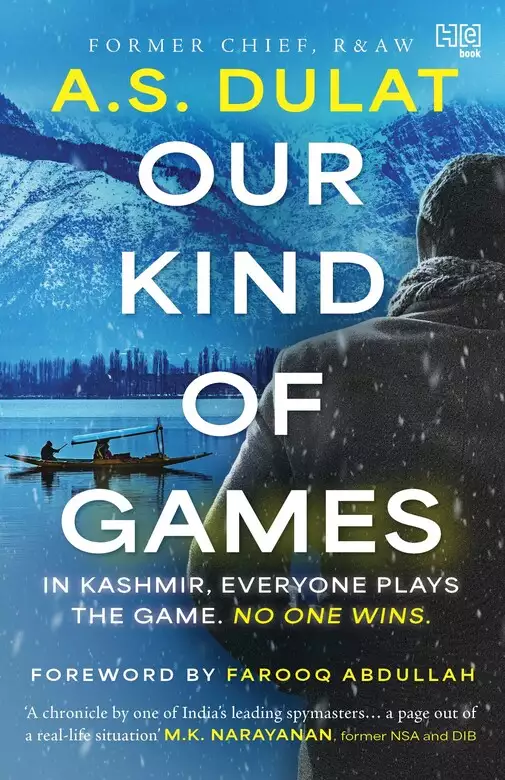
From the former head of India's external intelligence agency, in his first work of fiction - It is the early 1990s and Kashmir has become a killing field. Ranjit Soni runs intelligence operations in Srinagar during the bloodiest years of the insurgency. His job is to turn militants into sources, map terror networks and prevent the Valley from burning completely. He is good at his work and soon sees success.
There is Qureshi, the jolly middle-aged informant who drinks Old Monk and whispers secrets; Imran, the militant commander who returns from Pakistan promising peace; Major Ali, the ISI operative playing both sides; and Rehana, whose affair with Ranjit crosses every fault line that exists in the divided Valley.
As the bodies accumulate, Ranjit realizes a terrible truth: he is not preventing violence; he is fuelling it.
A morally complex novel about espionage, Our Kind of Games is a devastating portrait of politics, betrayal and the impossible equations of intelligence work in a place where everyone plays the game and no one wins.
Release date:
September 17, 2026
Publisher:
Hachette India
Print pages:
224
* BingeBooks earns revenue from qualifying purchases as an Amazon Associate as well as from other retail partners.
Even the best storytellers in the spy fiction genre sometimes produce work that feels contrived, mechanical and empty of the vitality that makes literature matter. But Our Kind of Games is anything but dull. It is exciting, enthralling and laced with a tragic romance that lingers long after the final page. This book is not merely about espionage in Kashmir. It is a profound meditation on the machinery of conflict, the cost of revolution and the despair of a people caught between impossible choices.
I have spent my life in Jammu and Kashmir’s politics. I have watched revolutions bloom and wither. I have seen young men transformed by ideology into weapons, only to discover too late that weapons do not discriminate between enemies and brothers. This novel captures something essential about that experience which official histories and government reports never convey.
This book is the story of the youth who got caught up in the intoxicating idea of revolution and who were misled into believing that a gun could deliver what negotiation could not. They came from our neighbourhoods, families and schools. They were ordinary boys until the moment they decided they would be extraordinary. The real tragedy is that their revolution ultimately led nowhere. It only caused death and destruction.
I had predicted this and had warned against it publicly and privately. The gun, I said, would bring only death to Kashmir. Years have passed and my prediction has proven grimly accurate. But accuracy offers no consolation when the cost is measured in human lives, broken families and a generation traumatized before it could properly grow.
Some of the boys were killed, becoming martyrs to a cause they believed in even if the cause was doomed. Some spent years in jail; others came out, experienced remorse and discovered that the establishment they had fought against was willing to absorb them if they renounced their convictions and accepted the logic of power. And then there are those who, having tasted the intoxication of resistance, could not fully let it go. One particularly vocal former militant, close to the leadership at one time, now believes he understands Kashmir’s future better than anyone else. He speaks of becoming National Security Advisor. The irony is almost unbearable. And the one who some called the Che Guevara of Kashmir remains in jail.
What distinguishes this novel is the author’s intimate knowledge of Kashmir. He knows this land not as an outsider studying a problem, but as someone who has lived through its transformations and understands its contradictions from within. He knows the greens at Royal Springs Golf Course, which features prominently in the story. He knows how beauty and violence can exist in the same space, how a perfect morning can be interrupted by gunfire and how love can flourish in the midst of despair.
This is not an armchair writer’s book. It is the testimony of someone who has walked these streets, navigated the checkpoints and seen the faces of those caught between security forces and revolutionary fervour.
Most of the characters in Our Kind of Games are trapped in a web of despair whether they are intelligence officers, militants, informants or revolutionaries. None of them are purely good or purely evil. All of them are human, which is to say, all of them are compromised. This moral complexity is what gives the novel its power.
Remarkably, in this narrative, enlightenment emerges from an unexpected source: the shikarawallah. The humble boatman on Dal Lake becomes the moral voice of the novel. Through him, Ranjit Soni, the protagonist who is a gentleman spy, glimpses what Kashmir truly is.
Kashmir, as this novel understands it, is despair. It is mayhem and bloodshed, as well as the beauty that persists alongside.
The novel asks the crucial question: who is to blame? The easy answer is to blame Pakistan for supporting militants, or India for its policies or the militants themselves for choosing violence. But the novel’s wisdom runs deeper. It suggests that blame is distributed across all of us, whether it is the intelligence officer seeking redemption through manipulation, the capital that sends its servants into impossible situations, the systems that turn human beings into instruments of policy or the neighbour across the border who orchestrates so much of the mayhem.
What Ranjit Soni discovers is that Kashmir is not to blame. Kashmir is simply the stage. The tragedy is created by Ranjit and by Delhi — by intelligence services operating without wisdom in distant capitals, making decisions about people they do not understand, even as the machinery of statecraft grinds on indifferently.
There is a profound philosophical observation embedded in this novel. Kashmir exists in a state of incompleteness, frozen between what it is and what it might have been, and between competing visions of what it should become. To quote an old Chinese aphorism: if the house is finished, the owner dies, that is, a project completed is a project concluded. Kashmir’s incompleteness is its curse and perhaps strangely, its strange salvation.
In this novel, as in Kashmir’s history, everybody appears to die. Death is the novel’s constant. And yet, Ranjit Soni survives and perhaps, as the novel hints, it is his ‘Kashmiriness’ that saves him. His connection to this land, even as it destroys him, keeps him tethered to life. He cannot leave Kashmir because Kashmir has become part of his identity, just as Kashmir cannot move forward because it is trapped in patterns established long before any of us were born.
What makes Our Kind of Games important is not that it provides answers because it doesn’t. It is important because it asks the right questions and refuses easy comfort. It asks: What is the cost of revolution? What is the price of intelligence work? What do we owe to those we recruit, manipulate and use? What does patriotism mean when it requires betrayal? What does love mean in a place where love is fatal?
The novel also does something rare in our literature about Kashmir: it treats its people with dignity while acknowledging their complicity. It does not reduce them to either victims or villains but shows them as human beings caught in inhuman circumstances, trying to survive, find meaning and hold on to some version of themselves even as the world transforms around them.
There is a haunting sorrowfulness in this novel that reflects the sorrowfulness of Kashmir itself. It is a sorrow that haunts the author throughout these pages and will linger with readers long after they finish.
As someone who has tried to serve Kashmir and has struggled with the contradictions it holds, I recognize the truths in this narrative. I have seen the intelligence officers and the militants, the revolutionaries and the collaborators. I have watched the gun deliver exactly what I predicted: death and nothing else.
This novel is a testament to those experiences. It is also an argument for something beyond the cycles of violence and counter-violence that have consumed us.
Kashmir deserves to be understood in all its complexity. This novel goes a long way toward that understanding.
INTRODUCTION
Abdul Ghani Lone once told me, ‘The gun has destroyed Kashmir, and yet it was an experiment that Kashmir needed to go through.’
That, in essence, is what this book is all about. The main protagonist remains Kashmir, with a gentleman spook to supplement it.
Kashmir can change overnight; Kashmiris like to believe that they are perpetually at the crossroads. Kashmir has had its ups and downs – unfortunately, more downs than ups since Partition. A massive blunder was the arrest of Sheikh Abdullah. Sheikh was big enough to turn down the Quaid’s offer to join Pakistan, and it was generally agreed that but for Sheikh, Kashmir would not have remained in India. Khan Abdul Ghaffar Khan, also referred to as Frontier Gandhi, equated Sheikh with God. After his arrest, the profoundly contrarian Rajaji had said that if we shut the door on Sheikh, we would never have peace in Kashmir. So, it was to be expected that things got much worse after the Sheikh’s disappearance from the political scene; his towering personality earned him the sobriquet ‘Sher-e-Kashmir’ and his final stamp of accession after he made peace with Indira Gandhi troubled the Pakistanis no end.
After the Sheikh was gone, Pakistan’s President Zia ul-Haq, the ISI and Amanullah Khan founded the Jammu and Kashmir Liberation Front to seek revenge for 1971. How much the bifurcation of Pakistan helped, if at all, is a moot point. Many years later, during his bus ride to Lahore, Atal Bihari Vajpayee would say that a strong, stable and prosperous Pakistan was in India’s interest; he felt that permanent confrontation between India and Pakistan would not be beneficial to either.1 The dismissal of Sheikh Abdullah’s son, the popular Dr Farooq Abdullah, within the year of his election, was to further erode Kashmiri trust in New Delhi. Ironically, Pakistan had more problems with the Abdullahs than with New Delhi. The Quaid-e-Azam wanted Kashmir without the Sher-i-Kashmir.
This book is also an evocation of a city and its people. Kashmir is the author’s obsession, and that winter of 1989-90 never leaves his soul.
This is not the story the way it happened; it is the story the way the author remembers it. Any story of Kashmir is inevitably philosophical, political and emotive, but this one is still a story and not history, with Kashmir at its core.
Agar firdaus bar ru-ye zamin ast
Hamin ast-o hamin ast-o hamin ast2
(If there is paradise on earth,
it is here, it is here, it is here.)
Four hundred years before Chaucer, and 200 years before Shakespeare, India’s first historian, Kalhana, a Kashmiri Pandit, in the classic Rajatarangini, said, ‘Learning, lofty houses, saffron, icy water and grapes, things that are even difficult to find in heaven, are common in Kashmir.’
Kashmir abounds in mountains, rivulets, lakes and springs, but there is no place quite as beautiful as the Dal on the edge of Srinagar. It is one of the most exquisite spots in the world, where the Zabarwan range, the great river Jhelum and the Dal Lake merge. It is difficult to say in which season the Dal looks the most beautiful, but there is no prettier site than the shimmering lake on a full moon night. Nothing is more striking than the ruined Pari Mahal or the fairies’ palace on the spur of the Zabarwan, built by Dara Shikoh, the philosopher-prince who may have been king.
Nature has done much not only for the lake, but also for the habitation surrounding it. Dal Gate is unarguably the most liberal part of the city and, not surprisingly, the only liquor shop of Srinagar is found as the boulevard bends towards the Dal Darwaza. People of this area have never been involved in militancy, stone-pelting or protests. A shikara ride on the Dal provides unmatched peace and serenity in this paradise on earth.
India prides itself on unity in diversity, but nowhere has this been more prominent than in Kashmir. Togetherness is a distinctive feature of Sufism and Kashmiriyat. The mosque of Makhdoom Sahib, the Sharika Devi temple and the gurdwara of the sixth Guru have existed cheek by jowl for centuries in downtown Srinagar. In this land of saints and rishis, there was little to differentiate between Shiva and Allah. Swami Vivekananda wrote that he envisioned future India with Vedanta for its mind and Islam for its body.3 After his travels in Kashmir, where he was exposed to Lal Ded’s folklore, he wrote, ‘You cannot believe in God until you believe in yourself.’4
Kashmir is nothing if not folklore. The Kashmiri would be uncomfortable leaving Kashmir and generally afraid of crossing the Banihal. As the legend goes, a Kashmiri who had fulfilled his duty of visiting Mecca said after Haj, ‘Allah, ab hum ne aap ko Dastgeer Sahib ke hawale kar diya (Allah, now you will be omnipresent in our ziarat in Khanyar Dastgeer Sahib).’ In the Sufi mind, faith always superseded God.
The Sher-i-Kashmir Cricket Stadium in Sonawar, surrounded by chinars, most of them over 100 years old, has to be the most beautiful in the world, more beautiful than Tunbridge Wells in the Kent countryside, where Kapil Dev scored 175 after India was 17 for 5 versus Zimbabwe in the 1983 World Cup. There is no better sight for a batsman at the pavilion end looking at the top of Gupkar at Shankaracharya, which was once referred to as Takht-e-Suleman (the throne of the Prophet) – Hinduism and Islam cohabiting as uniquely as they only can in Kashmir.
The call for ‘Kashmir for Kashmiris’ was first raised not by Muslim fundamentalists, but by the Kashmiri Pandits. Every nook and corner in the Valley is magical, and Kashmiriyat is its hallmark. Kashmir was also once the happy valley, a place of laughter, fun and merriment, till the gun, the antagonist in this book, spoiled it all. The Palladium cinema in Lal Chowk, the . . .
We hope you are enjoying the book so far. To continue reading...

 Please log in to recommend or discuss...
