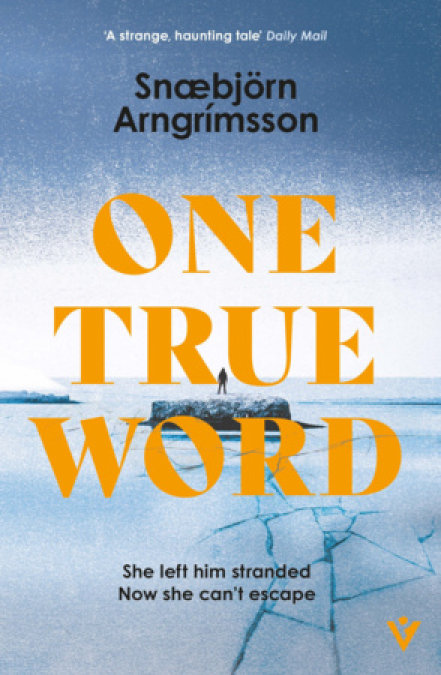
A #1 bestselling hypnotic psychological thriller from Iceland, in which a woman abandons her husband on an uninhabited island.
“So gripping I simply couldn't put it down. . . Atmospheric and original with an ending I did not see coming” — Eva Björg Ægisdóttir, author of The Creak on the Stairs
Why did she do it?
After a day of simmering tension on a trip to an uninhabited island, Júlia finally reaches breaking point. In a fit of fury she makes a reckless decision—leaving her husband Gíó marooned in the middle of a freezing fjord in the depths of the Icelandic winter. As the cold dark of night swiftly approaches, she leaves without looking back.
When she regrets her decision and returns, he is nowhere to be found. There is no trace of him, and no sign of where he may have gone. The police launch a manhunt, but soon their suspicion falls on his wife. In an attempt to shield herself from their speculation, Júlia weaves an elaborate net of lies, trying to convince the police—and herself—of her innocence. But as her story starts to crumble, dark secrets start coming to light.
As time runs out, Júlia races to discover what really happened. But is Gíó alive or dead? In hiding or hunting her down? And can Júlia get to the truth before it destroys her?
One True Word is a #1 bestseller in Iceland that has been acclaimed by authors such as Katrín Jakobsdóttir, the former Icelandic Prime Minister.
Release date:
February 3, 2026
Publisher:
Pushkin Vertigo
Print pages:
352
* BingeBooks earns revenue from qualifying purchases as an Amazon Associate as well as from other retail partners.
1. Is this what it’s like to be dead? That was my first thought when I opened my eyes that morning. Everything was black. No light, no sound, no smell. Just a dark and odourless silence. I was pretty sure I’d opened my eyes, but it didn’t make any dif- ference. I was still enveloped in the same deep darkness as before. I closed my eyes again. Lay still for a moment and then opened them wide. The same darkness. I was completely disoriented. It wasn’t just that I didn’t know whether I was still alive, I also had no idea where—or who—I was. My name had forsaken me. At first, this filled me with more fear than distress—I wasn’t sure how I was supposed to react to such a state of mind. And what could an imagined death be called, if not a state of mind? The fear felt like a powerful electrical current had sliced right through the middle of my body, paralysed me, left me breathless. It wasn’t until I pulled myself together, sat up in bed and shook myself out of my drowsy stupor that the light went on in my mind and my name returned to me. I sighed, relieved. Júlía, I said to myself. My name is Júlía. I reached behind me, and my hand smacked into the soft head- board. I pictured it in my mind—grey upholstery with grey buttons that had been sewn onto it in orderly, diagonal lines. I was hot. With my other hand, I flung off the thick duvet, fumbled on the nightstand for the remote control for the blinds and pushed the button. The motor buzzed softly in the morning stillness and snatches of light trickled through the floor-to-ceiling windows as the blinds drew up at a sedate pace. Outside, it was quiet. The day had not yet begun. That’s how I woke up that morning: a bit dazed and—hard as it may be for me to admit it now—pretty anxious, too. My head was pounding. I hadn’t slept well.
2. This is a fateful morning, I thought. It came to me suddenly, the idea that’s always slumbering in my subconscious and pops up whenever I discover just how unpredictable this world is: everything can change in an instant. The thing that shouldn’t have been able to happen, hap- pened. The world had turned upside down and I wasn’t prepared for it. Gíó—my husband—was not in bed beside me. This fact had followed me into my restless sleep, woven itself into my dreams, and filled me with a terrified foreboding because I realized he could be alive, or dead, or somewhere in between. Alive or dead? Was this my new reality? Strange how shocking it can be when the unexpected occurs. We know that our lives stand on shaky ground, depend on caprice, luck, misfortune and strange coincidences. And still, we’re caught unawares. I threw myself out of bed. The minute I stood up, I could feel how bad a night I’d spent. My head was splitting, and I stumbled into the bathroom to splash cold water on my face. A weary-look- ing woman gazed at me from the mirror over the sink, her eyes filled with resignation and hopelessness. ‘Stop feeling sorry for yourself,’ I said out loud to my reflection. I grabbed my grey robe from its hook on the bedroom door, wrapped it around me and padded out of the bedroom. Although it was still dark, I didn’t turn on any lights, just slowly made my way down the stairs in the dim morning light. I looked out the living room window. Outside, an autumnal tree stood in the garden. The birds were singing with the voices of autumn. I could hear a car honking on the street. The driver was probably blocked in, because he was laying on the horn. Soon, it would be winter. A scrap of paper was lying on the windowsill. I picked it up and saw that at some point, long ago, I’d written a single sentence on it. The letters were faint, faded from the sun, and I could hardly make them out. I’d used a pencil, written lightly, like I wanted to be sure I could erase the words. ‘Together they went to sow the same field.’ There was comfort in the line. An empty wine bottle stood in the middle of the coffee table and next to it, a glass with dregs of red wine in the bottom. The light from the living room window was shining through the green glass of the bottle. I gawped, walked over to the table and lifted it up to the light, trying to convince myself it really was empty. Did I drink the entire bottle when I came home yesterday? No, I couldn’t have. There was no way I’d had more than one glass. There was no way I’d had the whole bottle without realizing it. But it was empty, that much was certain. I couldn’t make sense of it. I ran through the events of the previous day as I went to make coffee. I’d opened the bottle of red wine in the kitchen when I got home from my trip down to the harbour. It had been late, and I was exhausted.
3. I was exhausted. That much I remembered. I was shaking with anxiety, and in my haste, I almost destroyed the cork with the corkscrew. Then I’d taken the bottle into the living room, poured myself a glass and put it on the table… Yes, I’d only had one glass before going to bed. I didn’t remember anything else. I shook my head at myself. How could the bottle be empty? Gíó and I had taken a trip to Hvalfjörður earlier that after- noon. I’d accepted a commission from a textbook publisher to write about a few female heroes in the Icelandic sagas. Among these remarkable women was Helga Haraldsdóttir, the daughter of a jarl, who’d swum the 1,600 metres from Geirshólmur, an islet deep at the base of Hvalfjörður, to a place on the shoreline called Helguvík. This act of heroism not only saved her own life but also those of her two young sons. I’d more or less forced Gíó to come with me. I wanted to sail out to Geirshólmur and had made the necessary arrangements. A farmer with whom I was friendly had lent me an inflatable boat—a ramshackle dinghy with a feeble outboard motor. I’d bor- rowed it from him once before. But I don’t have much experience sailing, so I’d asked Gíó to come with. He clearly wanted nothing to do with the expedition, though, and said, among any number of other excuses, that he didn’t have the time. In the end, he’d decided to join me, but he dragged his feet for the better part of the day. I’d started to wonder if we should postpone the outing because it was already so late. Night would be falling soon—I’d seen that sunset would be around six—and I didn’t want to sail out into the middle of a fjord in pitch darkness. There’d be no point. ‘Shouldn’t we get a move on before it gets too dark?’ I’d asked. Gíó hummed and hawed and sat a bit longer in his office, tap- ping away at his computer before getting to his feet and starting to put on his outdoor gear and shoes. ‘All right then, shall we?’ he said tiredly. He was standing in the front hall, ready to go out with his black hair tucked behind his ears and an aggrieved look on his face. Gíó was an attractive man: tall, straight-backed, broad-shoul- dered and muscular. He was an aikidoka. Something had clearly been weighing on Gíó, and he was surly because I’d been so pushy about him coming. Maybe he thought the project was boring and that there was no reason for me to mix him up in this fool’s errand. I was having a hard time reading him. ‘What’s the point of sailing out to some rock in the middle of a fjord, just because you’re writing about this woman?’ he asked, failing to hide the displeasure in his voice. ‘What are you going to do, exactly? Repeat her swim?’ ‘No, Gíó, I’m not going to swim. Relax, would you? I just think it will give my writing more heft if I visit the island in person. I get a better feel for what I’m writing about if I can see the setting with my own eyes. It’ll make the piece more vibrant, more interesting.’ ‘Then you ought to swim, too,’ said Gíó. ‘C’mon, get in there— be a real journalist.’ ‘Ugh, Gíó, stop sulking like a child. I’m no journalist. I just thought we could go on a nice Sunday drive. I didn’t realize it was going to be such a big deal for you to spend a few hours of your weekend helping me out. Do you have somewhere better to be?’ ‘I think you’re blowing this project out of proportion… There’s no reason to spend so much time on it. The pay isn’t that great, especially not if you’ve got to wrangle assistants to get it done. The farmer with the boat called me this morning. Me! Why’d you give him my number?’ So it went that chilly October day when we started out for Geirshólmur. I was having a hard time making my peace with Gíó’s behaviour. He was usually fun, a straight talker. He could turn the most mun- dane events into an interesting anecdote. He eventually turned everything into a story, although not necessarily a funny one. Rather, he was able to build an engrossing world around everyday incidents. Gíó was a born storyteller. I’d felt on edge around him the past few days. I wasn’t sure what was going on with him, and I had good reason to suspect he had some mysterious secret hanging over him. I’d grown suspicious of his every action and explanation. Gíó had always been guarded in his manner—what you might call closed off—without ever giving the impression that he was hiding something. He’d played it close to his chest for as long as I’d known him.
We hope you are enjoying the book so far. To continue reading...

 Please log in to recommend or discuss...
