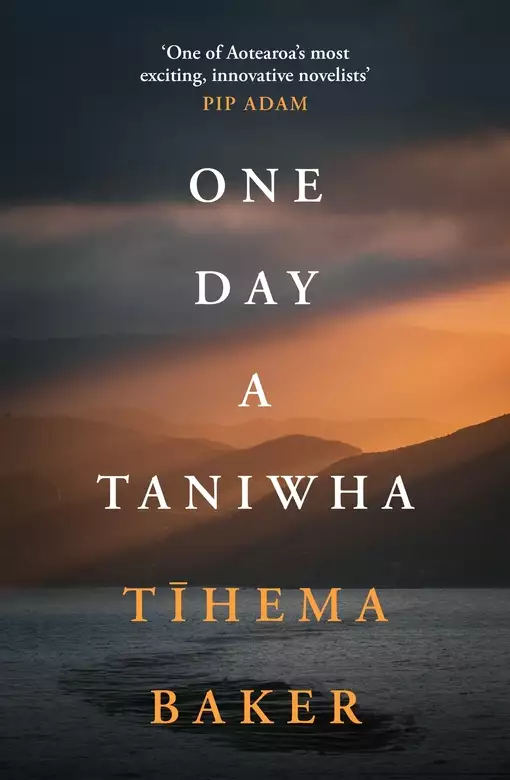
From the bestselling author of Turncoat comes a powerful new novel. As the pressure of fatherhood tightens its grip, sleepless nights and rising tensions begin to erode Hepa's sense of control. When the line between fear and reality begins to blur, can he be trusted with his own son?
Hepa hasn't slept properly in four months. His newborn son, Wī, cries through the night. The bills keep coming. The pressure to hold everything together is closing in.
Hepa tells himself to harden up. Be the pillar his family needs.
The only place he feels in control is in his dreams. Since childhood he's been able to shape them, to bend the dream world to his will. Until something begins watching back.
A presence with pāua-shell eyes starts appearing in his dreams, and then in waking life. In the shadows. In strangers' faces. Whispering to Hepa while he rocks Wī to sleep.
It feels like living with a taniwha on his shoulder. Hepa can't tell where the nightmares end and the real world begins - and he's terrified of what he might do...
Release date:
August 11, 2026
Publisher:
Hachette New Zealand
Print pages:
336
* BingeBooks earns revenue from qualifying purchases as an Amazon Associate as well as from other retail partners.
It hit me all at once. The crying. The bedside light. The wet in my boxers.
I knew then it was gonna be one of those days.
Āniwa was at Wī’s cot, bouncing him in her arms. He was wailing into her shoulder.
‘Sorry,’ I said. ‘Must’ve slept through –’
‘I’ve been at this for half an hour.’
I flung out a hand for my phone, checked the time. 6.02 a.m. Lifted the blanket, peeked at my boxers. Might as well’ve pissed myself, it was that obvious. Thirty years old and wet dreaming, are you kidding me?
‘So you taking him or what?’ Āniwa was glaring at me. Her classic murder eyes. Except there were tears in them.
I told her to hand Wī over. Waited until she’d palmed him off to me, then thrown herself back under the covers, to get up with him. Had to kind of crab-walk over to the cot so she couldn’t see the state of me.
And there we were again. Me, so beyond tired that I couldn’t remember if it was my second turn of the night or if the second had blurred into the third, humming ‘One Day a Taniwha’ for the hundredth time because it was the only song that ever seemed to work. And Wī, his cries whittling away to grizzles as he nestled his curly head into my neck.
Same spot Beth MacDonald kissed in my dream.
Beth MacDonald – what the hell? Hadn’t seen her since, what, high school? I never even liked her in that way. We used to text a lot, and there was that time at Waikawa Bay, but we were both smashed and I didn’t really remember it. Much. She was almost like one of the boys. Cool, fun to hang out with. I doubted she ever liked me in that way, either.
Or dreamed about me. Shame.
I tried to cut myself some slack. Couldn’t remember the last time Āniwa and I had done it. Well before Wī was born, that was for sure. No wonder – in the four months since, neither of us had slept for more than a couple hours at a time. And I knew Āniwa had it the worst. Up longer, more often than me. Hormones doing an absolute number on her. Nipples getting ripped to shreds. Hair falling out. Her tear still not fully healed yet. Sex just wasn’t on the cards. And it wasn’t like I could find a moment’s privacy these days to, you know, sort myself out. Body had to do what it had to do.
Still, I wondered if any of the other dads from antenatal class ever found themselves rocking their kid to sleep with a blown load in their pants.
It was almost 7.00 a.m. by the time I got Wī back down. Would’ve been earlier if he hadn’t woken the moment his head touched the mattress so that it was back to rocking and humming until he finally – finally – drifted off again. Got him back in his cot with the military precision of a bomb defusal.
Could’ve just lain down on the floor and gone to sleep right there. Forget bone-tired – every cell in my body was screaming out for sleep. But I couldn’t afford to be late for mahi again.
So I watched Wī for a while instead. Funny how quickly that always changed – one minute I couldn’t wait to gap it, the next it was impossible to take my eyes off him. Everyone said he looked like me. I thought he looked more like Āniwa. He had the same eyes, intense like they were lasering through you. Had her dimples too, and her big lips, which made tiny sucking motions while he slept. I wondered if he was dreaming. Maybe that was all he got from me. Way too vivid dreams.
When I finally tore myself away, Āniwa caught me by the arm. Pulled me close for a deep, warm kiss. Whispered, ‘Sorry. About before. I’m just so tired.’
‘I know,’ I said. ‘Get some sleep while you can.’
And she did, before I’d finished the sentence.
At least the early start meant a decent shower. I crept by phone-light down to the bathroom, stuffed my boxers down into the washing basket, and turned the water on as hot as I could handle. Stood under it until I felt awake enough to function. Changed into the work clothes I’d learned to put in the bathroom the night before for exactly this situation, and did what I could with my hair, which was weeks overdue for a clip. Didn’t bother with the beard.
Snuck into the kitchen to find the state of the fridge and pantry pretty dire. Hardly any milk, only one good slice of bread between two crusts. I left it for Āniwa.
Meant I had a few minutes before I needed to get on the road. Kitchen was a write-off – last night’s dishes scattered across the bench, the gunky remains of something we’d spilled now cemented to the cooktop. Couldn’t risk cleaning any of it because Wī’s cot was right on the other side of the kitchen wall. So I did my best with the dining room and lounge, and hoped that was enough.
Started the car, and of course the petrol light came on. Probably another case of Āniwa rushing home while Wī melted down in the back. Put in twenty bucks of petrol and somehow the card still declined. Had to pay for it off my credit card. Transferred some more over to the joint account once I was back in the car.
Waikanae was a nice enough town, but not a lot of work there for an accountant. Not a lot of work for anyone – the place was like a giant retirement village for white people. Last census had the retiree population at 36.4%. Pākehā population at 90.9%. Oldest and whitest town on the Kāpiti Coast.
Luckily Paraparaumu – which was only slightly less whitewashed but where all the jobs were – was only a ten-minute drive away. A nice quiet cruise along the old state highway. Except for one guy riding my arse the whole way. In a ute. Always a ute. With a trailer, I saw once he overtook me. Gave him a look as he went past. He ripped a finger back.
Part of me wished I was one of those people that drove into Wellington every day. Spending an hour or more in a crawling queue, listening to whatever bland, soulless sample of a classic hit the radio stations were churning out this week. No room to be overtaken by guys in utes, nothing else to do but ride it out. Space and time to think.
But then I’d remember that I’d never see Wī. Which was the whole reason I got the job at the Council in the first place. Closer to home, to him. Even though I kind of never saw him anyway. Not awake and happy, at least.
So I made do, as usual. Slipped into the office the back way, where I could beeline for the kitchenette without bumping into anyone. Brewed a nuclear-grade plunger of coffee with just enough time to browse the Council’s daily media report before I started work. A couple of the morning’s major articles caught my eye: ‘Darren Stewart doubles down on Waitangi Tribunal disestablishment’ and ‘Health Status Report 2026 – Māori health targets still tracking behind Pākehā’.
Had no time to read them. With the familiar clink of too many bangles and necklaces, Robyn appeared at my desk before I’d had my first sip of coffee.
‘Moh-ray-na,’ she said, jingling her arm on the partition next to my desk.
Robyn was one of those Pākehā who had somehow cracked the hardest part of te reo Māori – rolling the r – but still couldn’t get the vowels right.
‘Mōrena.’ I always wondered what went on in their heads when they heard it said back to them properly.
‘Just checking in – how are things today?’
This was her routine. Poorly pronounced Māori greeting, ‘just checking in’ question I wasn’t sure she really cared about the answer to, followed by whatever it was she was here to ask me to do.
‘Good,’ I said, which was my own routine.
‘Good. Hey, Janet from Comms is late with her month-end accruals again, can you follow up?’
Fucken Janet. Every month.
‘I’ll get on it.’
‘Great. Oh, and there’s a koh-har memo that I need you to review, please.’
‘Another one?’
‘Yeah, the Iwi Partnerships team are after two hundred and fifty bucks for a marae visit. Seems a bit much to me so just want to make sure it’s … you know.’
Not fraudulent, was what she meant.
‘Seems pretty standard to me,’ I told her. ‘I’m sure it’s in line with the koha policy I drafted. As always.’
‘Oh, yes, of course it will be. No, I’m not saying that. Not at all. But, you know.’
‘Yep.’
‘Fab. Oh, and one more thing. I’ll need you to redo the payroll journals.’
‘I thought Graham did those yesterday?’
‘He posted the wrong accounts. It’ll take too long if he fixes it.’
Fucken Graham.
Robyn smiled and jangled. ‘Thanks Hoe-hepa.’
Like I said. One of those days.
Except every day seemed to be one of those days.
When I got home later, Wī was already kicking off. Heard him from the street. Āniwa basically shoved him at me the moment I walked in the door.
‘I just need a minute,’ she said. Then she disappeared down the hallway.
It took forty-five minutes, but we got there. Wī fell asleep in my lap while I read to him – the reo Māori version of Hairy Maclary, which was the only book he would allow. He was well gone by the time Āniwa poked her head through the living room doorway.
‘How do you do it?’ she whispered, easing herself into the couch next to me. She’d showered and got into her pyjamas already. ‘He’s been awake for hours, then you come home and … this.’
Gave my best shrug without moving Wī. ‘Honestly don’t know what I’m doing half the time,’ I said. Āniwa laughed – just a little one, through her nose. It was nice to see her smile. ‘What did you guys get up to today?’
‘Playgroup this morning. Mum came round for lunch, which gave me a good break. All fell to shit from there, really.’
‘Par for the course, then.’
‘Pretty much.’
Her head came to rest on my shoulder. Hair still wet, but I didn’t care. I couldn’t remember the last time we’d sat like that. The last time our bodies had touched for so long. That was one of the hardest things about Wī entering our lives. I’d had Āniwa all to myself for years. My rock, my person. Now she was someone else’s. Someone who needed her more. Who would always need her more. I loved how much she understood that – from the moment he arrived it was like a switch went off in her, like she just knew what to do. How to hold him, sing to him, the type of material his clothes needed to be, how many layers he was supposed to wear. All of her being, poured into him.
Don’t get me wrong – he was my whole purpose now, too. Everything I did was for him. He was what I ran myself into the ground every day for. But he didn’t need me like he needed her. And she didn’t need me either. Not like she used to.
So I soaked up these moments. Āniwa’s touch, her hand in mine. Watching the sun fade, all quiet except for Wī’s snores, until the living room was dark and the cold began to set in.
‘Think I’m gonna go to bed,’ Āniwa yawned. ‘I’ll take bubba.’
‘You sure? I could just stay here with him until he wakes.’
Didn’t like the chances of him surviving a transfer from me to her, let alone a second one from her to the cot. More than that, I wished she’d stay just a bit longer.
‘Yeah, all good,’ she said. ‘If he wakes, I’ll deal with it. Get some kai – Mum left us a pasta bake.’
By some miracle, she managed to get Wī off me without waking him. A quick kiss goodnight, then she was gone.
I’d inhaled Joyce’s pasta bake before I knew it. Might’ve been the first time I’d eaten all day, the more I thought about it. That’s how things were now – either forget to eat altogether, or wolf it down so quickly you wouldn’t remember eating it anyway. If you could even afford it. This morning wasn’t the first time in the last few weeks our card had been declined.
After closing all the curtains and wheeling the bar heater over, I flopped myself back down on the couch. Maybe I could’ve taken my time with the kai. Actually enjoyed it for once. Judging by the silence, Āniwa had made the transfer to the cot all good. Still pretty early, too. Probably should’ve made the most of the chance to go to bed myself. It just wasn’t often that I had this.
Total, peaceful silence.
The freedom to do whatever I wanted.
So I pulled out my phone and opened up Reddit for a bit.
First post on my feed was from the r/newzealand sub:
Compulsory prayers at work – what are my rights?
I’ve recently joined a central government agency in Wellington and was a bit surprised to find that my team says a moari karakia at the start and end of every team meeting. It’s a rotating chair every week and whoever it is has to do the karakia. I’m an atheist so I’m deeply against religion in the workplace. I feel like if I say anything I’ll be accused of being racist but I really feel it’s inappropriate to force staff into this kind of thing. Can they actually make this compulsory and do I have any rights to say no?
These posts must’ve popped up at least every other week. Actually, they’d got worse since Darren Stewart and his circus of anti-Treaty, anti-vax, anti-everything clowns had got into government. Āniwa would make a good argument about karakia not actually being religious, at least in the traditional sense. Or that saying karakia in a work context was more like an affirmation, bringing everyone together for a common cause. Or creating a safe space for people to speak their minds. I saw it a bit differently. My work made me attend full-day workshops on things like ‘Business Agility’ or ‘Critical Conversations’ and you didn’t see me being a whiny little bitch about it.
The rest of my feed was filled with the usual stuff. Memes, video game news, sort-of funny clips stolen from TikTok that didn’t really fit the rules of the given sub but had thousands of upvotes anyway. A bit of chatter about something going down in the Middle East – probably the latest genocide that no one who mattered would give a shit about. More posts in the r/newzealand sub – the same headlines from the morning media report I never got to read, questions from Americans looking to move here, political commentary from all the armchair experts.
Then this post in the r/askreddit sub:
What is the most disturbing thing you’ve seen on the internet?
These were also probably posted every other week. But I was still several threads deep in the comments before I knew it. There were the regular answers: the German pipe video, ‘Love Shack’, Fujita Hisako, ‘Love Shack’ again. A fair few talked about whatever was happening in the Middle East – videos were already circulating online. Footage of a burnt-out car that apparently still had someone in it. A clip that was only referred to as ‘the mincemeat video’. One comment just left a link.
Don’t know why I clicked it. Don’t know why I kept watching. A body cam roved across what looked like corpses, too quick to really make out the context. The camera landed on a man’s face. One eye swollen shut, nose crooked, dried blood smearing his mouth. He was mumbling something to the camera wearer.
Then a machete hit his throat. In and out so fast it didn’t even register. The machete came again, and again, while the man’s mouth just kind of goldfished at each blow. A hand grabbed the man’s hair, wrenched his head free from what was left of his neck, tossed it away.
I closed Reddit. But I could still see it, hear it. Every detail. The drowned breath gurgling in his windpipe. The dull thud of the head hitting concrete. The chuckle.
Locked my phone. Sat there, in the dark. Felt like it was closing in, pressing down. Had this lurching sensation in the pit of my stomach. Folding me in on myself. The weight of it. All this fucken misery.
Wī cried out. I got up. One of those days and it wasn’t over yet.
One foot after the other. That’s what I told myself on mornings like these, when Āniwa had the car for the day. A shivery walk to the train station in the cold, damp shadow of the Hēmi Mātenga reserve. Snapper card needing a top-up. Dank, musty train ride to Paraparaumu, a guy halfway down the carriage coughing all over everyone.
Just get through the day. Headphones on, bit of Kendrick to keep me going. One foot after the other.
But when I got to Council buildings, the way was blocked. A crowd had gathered outside the entrance, signs and everything. Even through the headphones I could hear toots from passing cars, a cheer from the crowd in response every time. One of them was waving an upside-down New Zealand flag.
Didn’t even need to read the signs to know what this was about.
Ratepayers say NO was on one.
Democracy MUST prevail said another.
Wasn’t surprised to see a One Law 4 All in there.
And a Stop 3 Waters because of course there had to be one of those.
Not a brown face among them. All white or grey heads.
NIMBYs. The Hīkoi in 2024 had sparked a few failed attempts to show that white people can mobilise en masse too, but these bach-owning, swing-voting, ‘I’m not racist but’, middle New Zealand Pākehās took the cake. Just last year, they were protesting against a cycle lane being added to the Waikanae River bridge. Traffic was diverted to the expressway for a few months while it was built. That was enough to bring them out, every morning at the diversion with their signs. Just a bridge too far, apparently.
If there was anything I’d learned since working at the Council, it was that nothing seemed to satisfy these people. They wanted all the services councils provided – water infrastructure, parking, maintained parks and playgrounds – but they didn’t want to pay for them. They demanded progress, but never if it meant a minor, time-limited inconvenience, and only if it directly served them – the cycle lane a case in point. It was like they had no idea how anything actually worked. That ‘democracy’ didn’t mean you get to personally vet every decision your elected representatives made. That literally everything cost money, and that cost was getting more expensive all the time. And that money had to come from somewhere.
Then again, it was never really about the money itself. More about what the money was spent on. The only thing these NIMBYs couldn’t stand more than their rates being used on anything was their rates being used on anything Māori.
‘Bit of excitement for your Wednesday, eh?’ said Graham, after I’d navigated through the protestors and got my feet under the desk. He was one of those older guys who’d sat comfortably in the same role for the last decade. Would probably stay there too, until he retired in a few years. ‘Something to spice up Hump Day.’
Every conversation topic with Graham was somehow tied to what day of the week it happened to be.
‘Sure is,’ I said.
‘Whaddya reckon it’s about?’
‘Uh, the marae development?’
‘You think so?’
Judging by the backlash the announcement had received on the Council’s Facebook page, it couldn’t have been anything else. A joint venture between the Council and mana whenua – Āniwa’s iwi – to be built in the vacant section just down the road, across from Pak’nSave. The project had been labelled a ‘community marae’ – like a sort of shared space for community events. Mana whenua would run it like a marae of their own, but the Council would help maintain it and sit on its management committee. Probably one of the coolest things I’d seen the Council sign up to since I started there.
‘I’m pretty sure that’s it,’ I said.
‘I suppose there is a fair bit of cost involved in that one,’ Graham said. ‘Only natural that some people might not be happy about it.’
‘You know the iwi are pouring a fair bit of their own money into it too, eh?’ He would’ve known that, because we’d both seen the costings. ‘And that the marae is going to be for everyone, including those protestors?’
‘Well, yes,’ Graham sighed, ‘I suppose that’s right.’
Didn’t matter though. All that mattered to these people was the brown smudge on their picket fence. They wouldn’t be satisfied until it had been wiped clean.
‘Still, they are entitled to their opinion.’ Graham said this like he was imparting some sage advice on me. ‘It’s what our forefathers fought and died for. The right to democracy, free speech.’
‘Think the Land Wars were about something else, actually.’
‘Huh? No, I’m talking about the ANZACs. Gallipoli, you know?’
‘Oh, true.’
Headphones went on, barely came off for the rest of the day. Had more to drown out now than the general drudgery and constant onslaught of depressing media. The . . .
We hope you are enjoying the book so far. To continue reading...

 Please log in to recommend or discuss...
