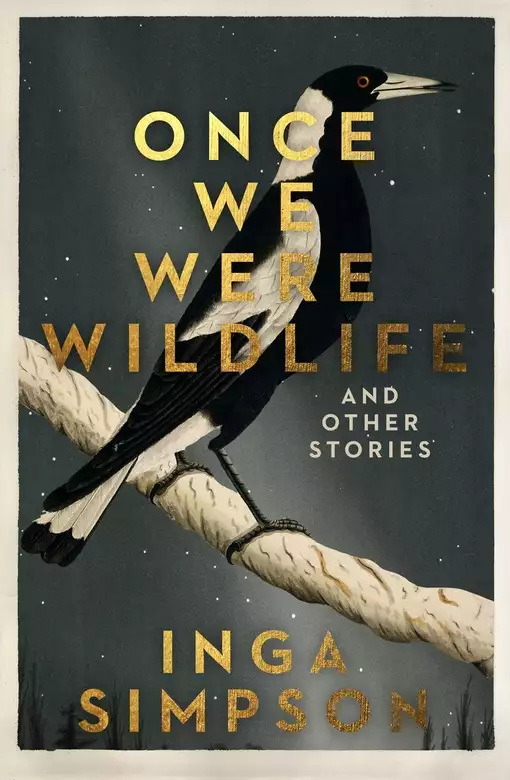
A tender, luminous collection of interconnected tales that explore love, longing and the wilderness - both within and around us.
In this compulsive compilation of eleven stories and one poem - set against scorched landscapes, wild oceans, and rocky terrain - Simpson follows people on the edge of desire, heartbreak and change.
In 'Poached', an ex-soldier finds himself between a poacher and a Bengal tiger. In 'The Wash', a woman's reckless ocean swim reveals the instinct to survive and the end of a passionate love.
From the aching intensity of romantic love to the quiet devastations of motherhood and ageing, Simpson's literary prowess keeps us riveted by the power of nature to shape human relationships and worlds. Melancholic and joyful, masterful and inspiring, this is contemporary fiction at its finest by Australia's foremost writer of the natural world, Inga Simpson.
Praise for Simpson's award-nominated novels:
'Beguiling and entertaining'Weekend Australian
'Storytelling at its best. I was enthralled' SARAH WINMAN, author of Still Life
'I loved this - gorgeous, heartbreaking . . .' ROBBIE ARNOTT, author of Dusk
Release date:
March 31, 2026
Publisher:
Hachette Australia
Print pages:
208
* BingeBooks earns revenue from qualifying purchases as an Amazon Associate as well as from other retail partners.
THEY WERE STATIONARY IN a sea of cars. The highway north was always like this on a Friday, people fleeing the city, trying to get home, get out, start their weekends. Marlen was always like this on a Friday, too: staring out the window at roadworks, construction, service stations and expanding airport infrastructure. Trying to shed her urban self and switch to the surf, mountains, trees – the life they were returning to.
She twisted the top off her beer, the usual roadie. ‘Sip?’
Gail took the bottle without taking her eyes from the road, and drank – careful, as ever, to avoid any backwash. She passed it over, her body relaxing with the alcohol: boards strapped to the roof, heading for the coast. ‘Sorry I couldn’t get away earlier.’
‘Probably wouldn’t have made much difference.’
Marlen kicked off her thongs, crossed her heels on the dash. The way she used to in Gail’s kombi after their morning surf, on the way to the drive-through for a mid-morning beer. That was more than a decade ago, when they still lived on the coast full-time, before they had responsibilities or any fat on their bellies.
Then Marlen had her first solo exhibition and got the residency in Vancouver. Gail finished her environmental studies degree and took a government job, which led to a better government job in the city. She commuted until Marlen’s rental was sold and demolished. Gail wanted to buy, get in the market, but they couldn’t afford anything anywhere near the water. And Marlen was offered the fellowship, which included a cheap studio space in the city. It was an opportunity to see if she could make it as an artist.
Gail’s dog, Ziggy, shifted behind her, his face pushed up against the window, gazing at the world going by, smearing the glass with his wet nose. Who knew what he saw, what he thought.
At last they were clear of the traffic, crossing the river and changing to the outside lane, another metal object in motion. On the water, fishers were already out, casting a line from their tinnies, watching the sun go down.
‘Your face changes right here, every time,’ Gail said.
‘It’s the light.’
She dropped the empty bottle at her feet and reached around to the esky for another.
Gail frowned. ‘We still surfing?’
‘God yes.’
The place Gail had bought was up in the hinterland, tucked into a little valley, the trees a fortress against the world. Mostly they headed straight there, but on hot afternoons in summer, afternoons like this, they went down to the water first.
The sun burned through the side window, still above the D’Aguilar Range but too low for the visor to serve any purpose. Marlen pulled her cap down over her eyes. Ziggy settled on the back seat. He used to stay up the coast during the week, for the three nights Gail spent with Marlen in the little mezzanine flat above her studio, but he had started to bark, pining, and the neighbour had complained. Like all Staffies, Ziggy was loyal, affectionate, emotional – and kind of pathetic.
She didn’t mind dogs, from a distance. They were, after all, descendants of wolves, her totem animal if ever she had one. But Ziggy did not howl; he whimpered. He was well-behaved and usually quiet, but always around, under her feet, looking up at her, wanting something she could not give. She definitely didn’t like him in her flat, his sharp claws scratching her polished floorboards.
She was starting to wonder whether she liked Gail in her place, too. It was only a few nights, but it upset her process, her routine, her rhythm. So did heading up the coast every weekend, but that was different. Up there they worked. Or they had.
IN THE CITY, EVERYTHING had ground to a halt, despite the constant noise, light and movement. What used to feel like energy, possibility, creativity, had become a negative force, and she felt herself slipping into that dark vortex, a movement as familiar and inexorable as the sea.
The work wasn’t coming. She was stuck, and so, they were stuck. After living life so deeply, gulping it in from dawn to dusk, chasing down every wave, the biggest waves, the best waves, now they were caught in the wash. They steered clear of the subject but were drifting towards the rocks all the same.
That was perhaps most painful. Neither of them was willing to do anything, to risk anything for each other – for them. When once they had risked everything, in and out of the surf, just for a few moments together.
They had been friends first, the other halves of two couples. She was teaching Gail to surf, suggesting she paddle with softer hands, or hold her chest up as she prepared to take off, or come further forwards on the board. It hadn’t taken much; Gail was a natural.
They made any excuse to be in the water. Big swell, even swell, onshore, offshore, reef breaks, beach breaks, mid-tide, high tide, even low tide. All those hours sitting astride their boards out the back, splashing their hands against the water, talking. Somewhere along the way, they paddled out too far from land without realising.
Then they were living for that charged exchange of salty skin in the back of the kombi on the way home, or on the old couch in her studio. Touching feet under the table when the four of them caught up for dinner at the weekend, every moment weighted. Their (non-surfing) partners oblivious, or so they thought – until everything blew up. The only question then was why had they waited so long, put everyone through it.
They believed they were different, that surfing made their connection stronger, pure. She could still feel the heart thump of jumping off the rocks at The Bluff, paddling out side by side, watching Gail duck dive in front of her. Her wetsuited body disappearing under the wave and bobbing up again, slick and sleek. Lining up together, Gail always on her right. The two white trails of her feet as she took off, went with the wave, grinning at the thrill of it, the skill of her own body.
Gail touched her shoulder. ‘Okay?’
‘I really need this surf, hey.’
They left the highway and, at the top of the hill, took the turn-off – the back way only locals knew. Marlen sat up in her seat and lowered the window to catch the first glimpse of the ocean off the point. The increments by which she shifted into weekend time.
‘Big swell,’ she said. ‘Real big.’
Gail made two fists. ‘Yes!’
Ziggy leaned forwards between them to be a part of it.
‘A lot of white water, though.’
When the beaches were closed after a cyclone or big storm, Marlen and her father used to swim out past the breakers and back, just because they could.
After recovering their breath, grinning like idiots, they would catch a monster wave in, surfing it with their rigid bodies, washing up on shore elated and exhausted. She learned what it was to really get dumped: the water disappearing, the land opening up beneath her, the fury of the wave smashing her straight down. The worst that ever happened, though, was a mouthful of sand or a graze on her chin. Sometimes, she might be caught short of breath or sucked a little off course. But her father had taught her that she could always swim across the rip and catch a wave in or, worst case, let it take you out and then swim to shore.
It was a practice she had continued on her own. Swimming out past the breakers, bodysurfing in. For the pleasure of it, the high afterwards. She had inherited his shoulders, the long legs, the strength-to-weight ratio that made all things possible in the water. She swam, she surfed, she paddled; she was good in the ocean, her best self.
HER USUAL METHOD OF projecting her photographs onto canvas and airbrushing them in acrylics wasn’t working. Being in the studio, looking at the cheap imitations on canvas, only reminded her that she wasn’t still out there, in the forest or the water. That nothing she did in that room was real.
Her need for the sea had become more than the search – that old cliché. It was something even surfing could not allay. And that was big, because to feel the wave push and crest, to spring up and trim along its green face, with that body of wet force beneath her, was almost sex.
Maybe it had always been there, that particular yearning that surfers and artists knew, driving her but never bringing contentment. For that was the nature of longing; there would always be another wave, another project – perfect in the imagining – just over the horizon. Lately, wave-desire had morphed into a fantasy of paddling out early one clear morning and not looking back.
WHEN THEY PULLED INTO the car park, it was half empty, unusual for a Friday afternoon. The wind was up, shushing in the she-oaks. Surfers called it Ann Street. Marlen called it Dog Shit Beach. The only off-leash beach for miles, it was always packed with dogs. But the little rock shelf, just offshore, meant a reliable break in most conditions.
Today wasn’t most conditions. The swell was broiling in uneven sets, pushing fourteen foot, rough and churning, every wave a dumper fierce enough to snap a leg rope or rip your swimmers from your body.
‘Whoa,’ Gail said. ‘It’s so messed up.’
‘Shit. It’ll be out all weekend.’
There were gutters forming, two obvious rips. The water was a foul brown-grey beneath white. Not one person was in. It was after five; the lifeguards had already packed up and gone home. The beach was ‘closed’. Not that you could really close a beach, any more than you could shut a forest. But an officious warning sign had been driven into the sand.
Marlen stared into the messy sea. So many shades and textures; a landscape like no other. Ziggy moved away and back, away and back, torn between them and an approaching labrador. Gail untangled his leash from around his legs, held him tighter.
Marlen threw down her towel, took off her hat and sunnies, peeled off her T-shirt and stepped out of her board shorts.
‘You’re not going out?’
‘I just want to get wet.’ Her bladder was full, and she needed to wash off the stink: dog, city, self-pity. The sea was calling.
Gail shook her head. ‘I’ll walk Zig.’
Ziggy was no sea wolf; he was scared of the water, and those little legs and heavy body weren’t much good for swimming.
Marlen turned to say goodbye or touch her hand, but Gail was already gone, the wind whipping sand up around her. Ziggy looked back over his sturdy shoulders, reproachful.
She felt the power of it before the water reached her knees. A suck-back that could knock you off your feet. The waves weren’t the biggest she had been out in, but they weren’t breaking clean. The swell was coming from two directions, and there was a lot of churn: sideways movement, washback at all angles, signs even she couldn’t read. She walked forwards, the current pulling hard at her legs, insistent. The water was warm, barely refreshing.
She emptied her bladder, let the white water wash it all away. As she dived, she registered the sand turning to gravel beneath her feet. A rip. Then the release of full immersion in salt, and she was standing again. Straining against the shifting water, the undertow, and the same intrusive thought: Why fight? She could no longer tell if it was her voice, or the sea’s.
A bigger set reared up, came rolling in. The first wave was going to break a second time, right on top of her. It was either stay where she was and be smashed, or dive underneath. She chose under, diving deep, pushing forwards, digging her hands into the sand to avoid being pulled back. The full force of the Pacific washed over her. She counted one, two, three waves, before she had to surface.
She found herself several hundred metres down the beach, seventy metres out. She had only floated free for a moment. It wasn’t a rip, more like an underwater highway. She had never feared them; surfers used them as an express lane to get out the back, where the big waves were breaking. But in these conditions, without the board, she was already in trouble.
Marlen tried to catch a wave, anything to move forwards, but it was a dead zone. A deep hole filled with white water, churning like a washing machine. The waves broke over her but had no force. They stopped there, slapping into the reverb from the bar. The sort of spot you knew to paddle out of quick smart. She ducked one wave but surfaced just in time to cop another in the face. There was space only to snatch a shallow breath. She set about swimming down the beach but the chop and wash upset her stroke and when she was almost spent, she found she hadn’t moved at all.
A few minutes of treading water and she was exhausted. Those damn beers. She still considered herself a strong swimmer, but the truth was it had been seasons since she had trained in a pool or swum more than a dozen strokes. If she went in, it was with the board – paddling, sure, but with a great big flotation device.
A surge of swell raised her up, allowing a glimpse of Gail, small on the shore, looking out with her hands on her head. Ziggy was running around her legs, lifting his face to the sea, then circling again.
A wave broke over the top of her. And another. She struggled to keep her head clear. There wasn’t enough time in between to get her breath back. Her body was out of oxygen already, starving. This was how it happened, how people drowned.
She wasted a full minute debating whether to signal for help. She wasn’t someone who needed rescuing in the water; she was a surfer. She rescued others. And hadn’t a part of her wanted this? All day in the city and all the way here in the car. But now the moment had presented itself, she was scared. The sea wouldn’t take her gently. Her lungs would fill with water, burning, and despite herself, her resolve, she would fight and thrash. Drowning was violent.
Marlen raised her arm.
A king set looked as if it would break right where she was. She threw a few strokes of overarm at it, trying to catch a ride, no matter what it did to her. It lifted her body and, for a moment, she thought she was m. . .
We hope you are enjoying the book so far. To continue reading...

 Please log in to recommend or discuss...
