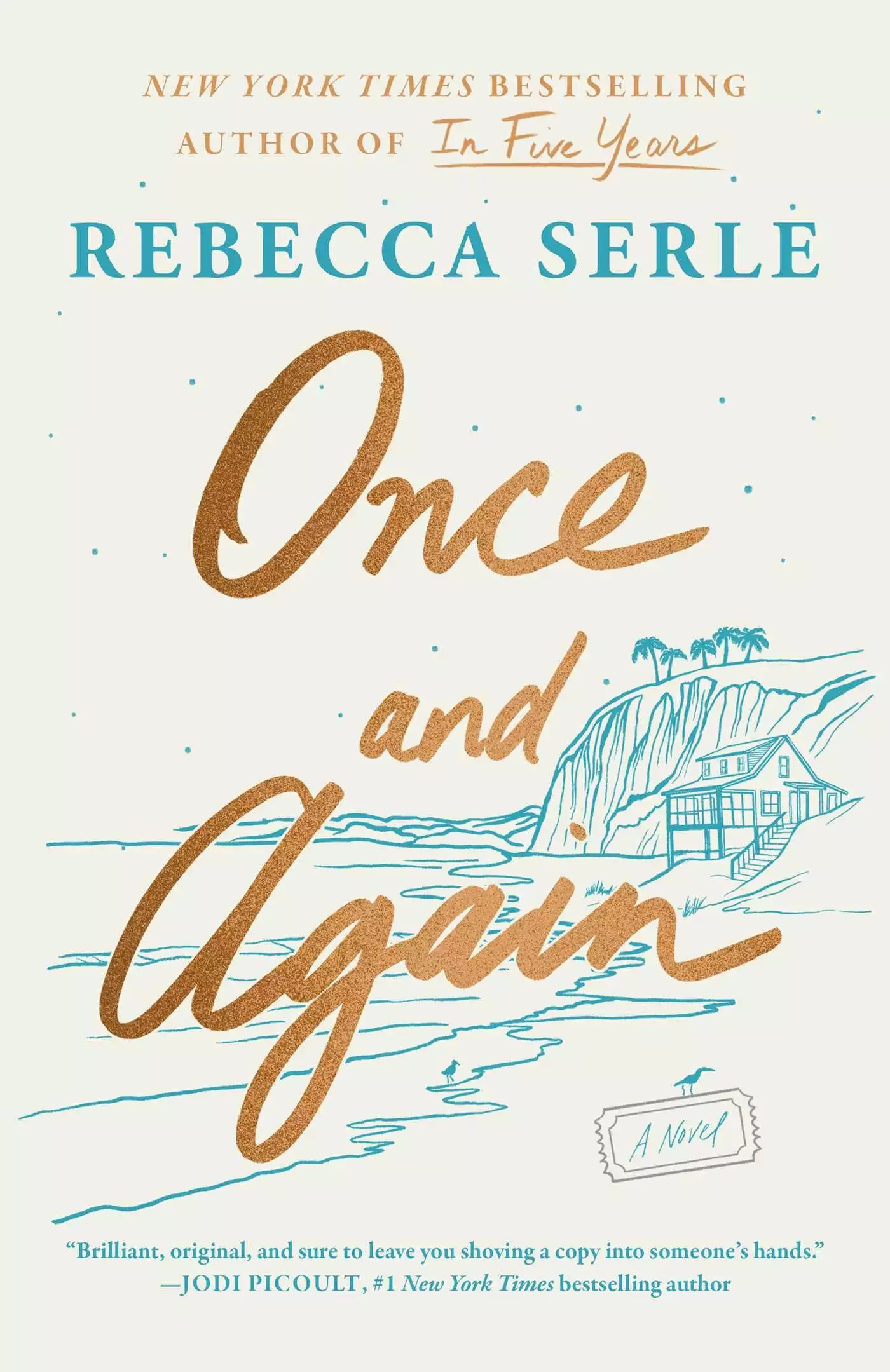
New York Times bestselling author Rebecca Serle, the author behind “heartbreaking, redemptive, and authentic” (Jamie Ford, New York Times bestselling author) modern classic In Five Years, returns with an unforgettable tale of a family of women with an astonishing gift: the ability to redo one moment in their lives.
The women of the Novak family were each born with a gift: they can, just once, turn back time.
Lauren has known since she was fifteen that her mother Marcella saved Lauren’s father from a deadly car accident. Dave is alive and happy, and out on the Malibu waves. But ever since, Marcella, her power spent, has lived in fear of what she won’t be able to reverse. Her own mother, Sylvia, is her polar opposite: a free-spirited iconoclast with a glamorous past she only hints at. Lauren has spent her life between these two role models—and waiting for her own catastrophe to strike.
Then one summer, Lauren’s husband takes a job in New York and she moves back to Broad Beach Road, back into her childhood home on the shores of Malibu. Lauren looks forward to surfing with her dad again and perhaps repairing an unspoken fracture in her relationship with her mother. What she doesn’t expect is for the boy next to door to return home as well: Stone, Lauren’s first love, who broke her heart nearly a decade before.
As Lauren falls into familiar patterns, with her family and, more dangerously, Stone, she finds herself thinking about all the choices, large and small, that have brought her to this moment. And wondering, finally, if one of them should be undone.
Release date:
March 10, 2026
Publisher:
Atria Books
Print pages:
256
* BingeBooks earns revenue from qualifying purchases as an Amazon Associate as well as from other retail partners.
Chapter One CHAPTER ONE I landed, he texts me, and I feel the ground underneath my feet once again. It’s 4:00 a.m. in Los Angeles, both too late and too early, but in the four years we’ve been together—three of them married—I’ve never been able to sleep while Leo is in the air.
For the past hour I’ve been standing in our dark kitchen, refreshing the screen of my cell phone and bathing the room in harsh blue light.
Exhale.
I pull my robe more tightly around me. I love this bungalow—built in 1958, updated in 2010; it’s charming and bright. Big windows, a sliver of a garden, walking distance to Melrose Place. But there’s no functional heat.
When I first moved in, six and a half years ago, the walls were green and burnt orange and the light fixtures were all brass, but over time I painted the walls white, wallpapered the bathroom, regrouted the kitchen, and decorated the space with a colorful mix of Rose Bowl Flea Market finds and Crate & Barrel sales. It’s charming, and organized. Despite Leo’s piles of things, I am not someone who finds clutter to be cheerful.
Go back to bed, Lauren, he writes, and I smile.
I love you.
I feel my shoulders slacken. The whirling in my stomach settles to a casual rinse cycle. He’s fine.
When I was fifteen years old, my father died in a car crash. He was driving down Mulholland in the middle of a Tuesday afternoon, slightly before rush hour. He was not speeding. A teen driver in the oncoming lane was on his cell phone. Both drivers died on impact.
I flip on the electric kettle and scoop some dark roast into the pot before my eye settles on the mail stacked on our counter. Leo forgot to go through it before he left. I fan out the letters. Insurance forms for Leo, some Ralphs coupons, and a thank-you note from my friend Delia for her baby shower. We got her a bottle warmer. I run my hand over the embossed stork and then deposit the paper into the trash can.
Leo is traveling to interview for a new job. He’s a DP, or director of photography. He started as a lamp operator on film sets and then got his (small) break when his old mentor from college asked him to be DP on an indie project last summer. He loved it. Today he’s flying out to meet Grayson Baldacci, the wildly prolific television writer, about his new show, Big Guys, an office drama that will shoot in New York. If Leo gets this, it’ll change the game for him. A steady gig, a regular income.
I’ve been an accountant for the past decade, and before that I did bookkeeping for individual clients, one of whom I still help on the side. I work at a small firm with only two other CPAs. We mostly handle retired clients living on a fixed income. The work isn’t particularly glamorous, but I enjoy the steadiness of it, the reliability. And I like the business of helping people budget their lives. The obvious: It gives me great pleasure to avoid catastrophe both personally, and professionally, even if professionally I’m not following my passion.
Leo is another story. He lights up when he talks about film. Whenever we watch a movie together, he wants to run me through the cinematographer’s shot list—why they chose a crane there or a wide here. I zone out, mostly, but I love how he sees the world: like a canvas waiting to be painted or captured or told. In Leo’s universe, it’s all already there; he just needs the right lens.
Water in hand, I walk over to the couch. The sunset image hanging behind it was painted by my grandmother Sylvia. It’s the view at our house in Malibu—the same one I grew up in.
Did he land?
My mother. We share the same history.
Yes.
Go back to sleep.
I imagine her right now, in her frayed Ralph Lauren robe, looking out at the silver water. She isn’t an early riser, my mom. That was always Dad.
My cat, Pea, stretches into the room. She looks at me wearily—This again?—and then abruptly leaves. She showed up on my doorstep four years ago, half a day before the biggest rainstorm Los Angeles had ever seen. I found her scratching at the glass. She was barely six weeks old, had all kinds of health issues, and no tag.
I’d never had an animal before, I wasn’t even sure if I should let her inside, but Leo insisted. “The rain will kill her, Lauren,” he said. “We’re bringing her in.”
She explored every nook and cranny of our bungalow and then promptly fell asleep on the rug. I knew before I went to bed that night that she was ours.
I start to smell the beans, and look down to see my cell phone vibrating on the counter. Leo is calling.
“You’re not sleeping,” he says.
I can always tell what kind of mood he’s in by his voice. Leo is gregarious by nature—far more social than I am—but when it comes to our relationship, he’s soft-spoken and gentle. Right now he seems chipper. But then again, it’s almost 8:00 a.m. where he is. I imagine him rolling off the flight in his sweatpants and black T-shirt, his backpack on his back, duffel in hand, a hoodie slung over his shoulder. Some bagel dust down his front. He’ll have slept, too. Leo can sleep anywhere.
“You’re the one calling,” I say.
Truth be told, I’m surprised. Leo is never on his phone. At home, that makes him a great husband—super present, rarely distracted. But when he’s gone, he’s often hard to get ahold of. When we first started dating I was convinced he wasn’t interested because I wouldn’t hear from him for days, sometimes weeks. Then he’d resurface, pick me up at my house, and look at me in a way that let me know he never forgot.
“True. Guess what? The guy next to me had never been on a plane before.”
“Really?”
“Makes you marvel at the miracle of modern travel. I felt like a child again.”
The coffeepot sputters and gurgles its final stream.
“How was your night?” he asks me.
I didn’t sleep much—tracking his flight, watching for any type of storm warning—but I don’t want to tell him that. Leo knows me, but he also knows what I tell him. We have been married only three years. There are still things to learn.
“I ordered from Pizzana with Tracy. She left around eleven. Then I did a little work.”
“What did you get?”
“The white pizza. And that chopped salad with the mushrooms.”
Leo hates mushrooms.
“Just remember, if you watch Summer House without me, I’ll get an alert.”
“Not if I stream it from my phone.”
He lowers his voice to a growl. “You wouldn’t dare.”
Leo and I met at the Beach Cove, a private members-only club known for its outdated furniture and WASP culture. Neither one of us belonged—Leo insists they still don’t admit Jewish people—but we were both there for Fourth of July fireworks, invited by two separate people—my friend Tracy and his friend Luke.
The thing I remember about Leo was how out of place he looked. He was dressed in sweatpants and a T-shirt, an eyeline grabber among the belted shorts and popped polos. I was surprised they let him in. And I also remember that I was attracted to him immediately. His towering frame (six foot four and two hundred and sixty pounds). His jet-black hair. And his slight English accent. He was born in Boston, raised until ten in London, and then went to boarding school in West Virginia. He’s a nomad, comfortable on the road. And though he’s seven years older than me, there’s something so playful about him you’d swear he was younger. He also looks it.
Pea sneezes in the other room.
“I miss you,” I say.
“Already?”
I take down a mug from the cabinet and pour a cup of coffee. I like it extra hot and black. I hold it between my palms. Outside I see a small bit of light start to creep through the night sky.
“I like it better when you’re here.”
Leo’s tone softens. “I know, baby. Me, too.” He clears his throat. “What time is the clinic?”
“Nine,” I say. I don’t want to tell him about how I needed to go in yesterday, because they weren’t sure of my progesterone levels.
Leo and I have been trying to have a baby since before we were married. We knew we wanted a family, and wanted one together, and after we got serious we started trying right away. Two fertility clinics and two years later we learned the reason it wasn’t happening: premature ovarian failure, which is a fancy way of saying my fertility is about the same as someone a decade older. We started to see Dr. Frankel at Reproductive Los Angeles after we got bad news at California Reproductive Center, hoping that maybe another doctor would give us better news. But we’ve done six IUIs and four egg retrievals, and we’ve never ended up with a single embryo, and I’ve never been pregnant. This month we did another Hail Mary IUI, just because.
“OK. Keep me posted,” he says. I can hear the slight wilt in his voice, the way it flattens out whenever we talk about this.
Leo is as supportive as he can be, but fertility is a language he does not speak. No matter how many times we hear the terms low ovarian reserve, high FSH, low AMH, they are just obscure data points to him. They aren’t real, not exactly. Not the way they are to me.
And he’s tired, I know he is. “How much more of this are we supposed to put ourselves through?” He keeps asking me.
I don’t know how to tell him that for me there is no answer. For me the answer is still As much as it takes to get our baby.
“I will,” I say. I want to change the subject. “And then I thought maybe I’d go out to the beach tonight.”
I can hear Leo’s smile through the phone. “They’ll love that.”
Just then I hear a rapping at the door. I startle and some coffee spills. I took over and see him waving through the glass.
“Jesus,” I say.
“What?”
“Guess.”
I lift my hand to wave and mime that I’m coming to open the door, but he’s already pulling out his keys.
“It’s not even five a.m.!” Leo says. “OK, I’ll let you go. I love you. Tell your dad he was wrong about the Lakers, and I owe him.”
We hope you are enjoying the book so far. To continue reading...

 Please log in to recommend or discuss...
