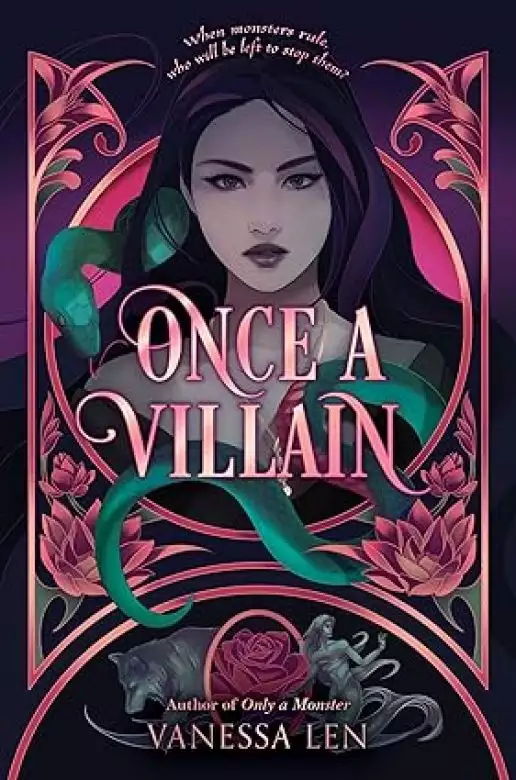
- Book info
- Sample
- Media
- Author updates
- Lists
Synopsis
"Mind-bending, heart wrenching, and unputdownable!” —Stephanie Garber, New York Times bestselling author of the Caraval series, on Only a Monster
The final book in the lauded Only a Monster trilogy is here—where the unstoppable love and high stakes of Divine Rivals meets the propulsive thrills of This Savage Song in a last-ditch, breathless race against time.
Joan has failed to stop Eleanor.
Now Eleanor rules over a cruel new timeline where monsters live openly among humans, preying on them and subjugating them.
Nick—once a hero to humans, and Joan’s first love—is tormented by the choice he made to save her over the timeline itself. And Aaron—the ruthless heir to a powerful monster family—now finds himself in a world where monsters have power beyond imagining while his feelings for Joan grow.
Wrenched between love and rivalry, the three of them must negotiate their fractured pasts to survive the new world and restore what was lost. Because only they remember that there was once a better timeline.
But how will they defeat a whole world of monsters with control over time itself?
Release date: August 19, 2025
Publisher: HarperCollins
Print pages: 416
* BingeBooks earns revenue from qualifying purchases as an Amazon Associate as well as from other retail partners.
Reader buzz
 Please log in to recommend or discuss...
Author updates
Once a Villain
Vanessa Len
“We have to get out of here,” Joan said. They were all crammed together in a dead-end alley, but they couldn’t linger. A patrolling guard was making his way along the river walk, a gold pin marking him from the scattered people on the path. “There’s a guard—”
“I see him,” Nick said grimly.
“There are two.” Aaron indicated a slight woman farther up the embankment, a hint of gold glinting at her collar. Joan hadn’t clocked her at all.
A cold wind blew across the river, cutting through Joan’s gauze dress. She wished she still had her coat, but she’d had to dump it last night, and there was no way to retrieve it now. She folded her arms as she surveyed the guards, the unfamiliar skyline. Where could they go?
On the other side of the Thames, glass towers reflected the thunderous sky. A tinted image shimmered in one of them: a sea serpent engulfing a sailing ship. Monster sigils were everywhere now: winged lions and serpents emblazoned on buildings, rippling on flags. A reminder that the world didn’t belong to humans anymore.
Now monsters reigned.
Joan turned to Jamie. “Do you think your family would help us?” The Lius would remember the previous timeline. Surely they’d take them in.
The wind lifted Jamie’s smooth black hair. He’d seemed lost in his head since Tom had vanished, but he made a visible effort to focus now. “Liu territory is just across the river. If we can get there—”
The rest of his words were swallowed by the nearby rumble of an engine. Joan and the others retreated instinctively into the shadows as a hearse-black boat emerged from under London Bridge, its pace the slow menace of a patrol. The golden lion of the Monster Court stood stark on its flank, teeth and claws bared in attack.
Joan’s cousin Ruth swore under her breath. “Well, we can’t stay here.”
Beside Joan, Nick shifted, a muscle jumping in his jaw. Joan knew what he was thinking. The last time they’d sought refuge with the Lius, Nick had been restrained, his mind controlled. Joan half expected him to argue now, but after a beat he just nodded. “Let’s go,” he said.
They slipped into the thin crowd, trying to blend in, trying not to look like the fugitives they were.
Joan knew she should keep her head down, but she couldn’t resist another glance across the river. This new London was a strange beast. Dark smoke drifted from chimneys and settled in the sky in a gloomy pall. Familiar landmarks were gone—Tower Bridge, St. Paul’s dome. In their place was a new skyline of Gothic spikes and soaring glass.
A few hundred paces to the west, London Bridge straddled the river. Not the practical concrete bridge Joan knew but the one Eleanor must have dragged here—Old London Bridge, its houses and shops quaint and strange, like a miniature Shakespearean village on the Thames.
Here, on the walkway, a man strolled by in a Roman tunic, and then a woman in a medieval gown, the heavy velvet sweeping the pavement. It was clear that monsters had no fear of discovery anymore.
Joan swallowed. All of this was wrong. It was wrong. This world wasn’t supposed to exist. Her sister, Eleanor, had seized control of the
timeline, reforging it into one where monsters ruled. And Eleanor had used Joan and Nick to do it. She’d put a gun to Joan’s head, and given Nick a choice: Joan or the world.
Joan had known what Nick would do. She’d been so sure. Nick had been a legendary monster slayer: the human hero who killed the predators among them. Given a choice between dooming humans and saving Joan, he’d only ever do one thing. Joan had closed her eyes, waiting for death.
But Nick had chosen Joan.
Joan tried and failed to catch his gaze now. He was on the far side of the path, walking with Jamie and Ruth, a dark flick of hair concealing his expression. Joan had the feeling he was avoiding her. She didn’t blame him. He had to be regretting his decision—now that he’d seen all of this.
“Hey,” Aaron murmured, falling into step beside her.
Joan tried to smile at him. “I keep expecting to be arrested.” Or worse.
Aaron feigned a neck stretch to check on the guards. “They’re still just patrolling,” he reassured her. “They don’t know we’re here.”
Joan nodded. A part of her couldn’t believe Aaron was here. For months, she’d held the memory of him quiet and close. In the privacy of her own mind, she’d conjured that posh sprawling-mansion, boarding-school voice, never believing she’d actually hear him speak again. She hadn’t wanted him to be in danger like this—to be on the run with her again. And yet some part of her was horribly, selfishly glad to be back with him.
Aaron ran a tired hand through his golden hair. Sometimes, it was hard to see beyond his otherworldly beauty, but Joan knew him well enough to register the dark circles under his eyes, the gray tinge to his complexion. When had he last slept? When had any of them?
“You okay?” Aaron asked.
Joan had been about to ask him that. “Are you?”
“Oh yeah. I love what your sister’s done with the place.”
Joan’s breath came out in a huffed laugh, surprising her. “It’s like Dracula made a city. All dark clouds and spikes.” As she spoke, she heard the plod of approaching footsteps. She swallowed and adjusted her hair, keeping her neck
covered.
Underfoot, the stone tiles were storm gray. Aaron’s own footsteps were soothingly even against them. A steady heartbeat. Joan tried to focus on that as she walked, and not on the crawling feeling at her nape.
She’d been around monsters before, of course—she was half-monster herself. Aaron, Ruth, and Jamie were monsters. But . . . as soon as she’d woken in this new world, some animal part of her had sensed a change; had almost been able to smell musk on the wind, beneath the smoke and river brine of the city. Her body had known instinctively and immediately that she was no longer at the top of the food chain.
On the other side of the path, Nick’s posture was deceptively casual. He felt it too, though. When a man in a judge-like wig pushed past, Nick’s eyes darted to his hands, tracking him until he was out of reach.
Joan succumbed to the prickle at the back of her neck and glanced over her shoulder. The black-cloaked guard was getting closer. She increased her pace, catching Ruth’s gaze as she did. Ruth nodded, whispering to Nick and Jamie.
They were almost at the bridge now. Ahead, a steep stone staircase led up to its southern limit, marked by a massive building—a castle in its own right—that seemed to cast a shadow over the entire city.
“The Stone Gate,” Aaron said.
Spikes protruded from the gate’s crowning turrets: dark balls on spindly sticks, swaying in the wind. “What are those things?” Joan wondered aloud. Weather vanes? But there were so many of them. . . .
Aaron drew a sharp breath. “Your sister is a piece of work.”
“What?”
“Don’t worry about it. Don’t look at them.”
“They’re like rotting vegetables,” Joan said. “Like—” She stopped. The breeze had carried a faint scent of decay.
Mr. Larch, her history teacher, had once talked about Old London Bridge: They displayed traitors’ heads on spikes—dipped in tar to slow the rot.
“Joan,” Aaron said softly. “You can’t stare—not in a place like this. You’ll invite questions. People will think you know someone on the
turrets.”
Joan dragged her gaze back to him, feeling sick and horribly naive. She hadn’t even realized that there were people up there, let alone that she was endangering herself and the others by staring at them.
Aaron’s gray eyes were the shade of the storm clouds above. He’d seen sights like this before, she realized—in the Middle Ages, maybe, or the Renaissance, periods when traitors’ heads on a bridge were no more notable than boats on the Thames.
Joan had never been so aware of her own sheltered upbringing. She’d been born and raised in the safety of twenty-first-century Milton Keynes and London. She’d never seen a man hanged, or a body displayed in warning. She’d never imagined that London could be transformed into this, its ancient cruelties brought back.
And . . . She glanced again at the north bank, at the open display of monster sigils. In a world where monsters ruled over humans, what new cruelties had emerged?
“Let’s get to the bridge,” she said. The sooner they were on the north bank, in Liu territory, the sooner they’d be safe. And then they could figure out how to fix all this.
“What in the medieval hell ?” Ruth said as they all hurried up the stone stairs to the bridge. “This whole city has bad vibes.”
Her voice was half-drowned by the roar of water. The staircase had placed them by the bridge’s wooden supports, huge pillars that churned the river into rapids. Eleanor had once described this noise as a hundred waterfalls. To Joan, though, it sounded more like the ocean: water smashing against rocks and cliffs.
Above them, on the bridge, a gold-and-peacock-colored banner welcomed travelers: eleanor, semper regina! celebrate her jubilee!
“Semper Regina?” Nick said dryly. “How do you have a jubilee if you’re always queen?”
“I heard someone talking about her on the walkway,” Ruth said. “She makes her subjects celebrate her rule every fifty years. Huge celebrations.” To Joan, she said: “No offense, but your sister’s a total narcissist.”
Eleanor’s not my sister, Joan wanted to say. Because no sister of Joan’s would have tortured and murdered people she loved. No sister of
hers would have created a timeline where humans suffered under monster rule.
“Can we opine more discreetly about the queen of this godforsaken place?” Aaron hissed. “Last thing I want is to be a head on a turret!”
“Doubt anyone can hear us over this din,” Jamie said. “Plus, we’re the only ones on the staircase.”
Joan looked down. The walkway below was full of people, but Jamie was right. No one had followed them up. They could talk openly for a moment. “We should have a strategy in case we get caught,” she said quickly. “If we get captured—”
“We’re not going to be captured,” Aaron said.
“But if we do, we’re the only people in this world who know that Eleanor changed the timeline. The Lius will know that there was something better before this, but they’ll only have fragments. We have to make sure at least one of us makes it to safety.”
“We’ll make it across,” Aaron insisted.
Did he believe that—or did he just want to? “Aaron, if the guards see us—”
“They won’t,” Aaron said. “We’re going to keep our heads down and move with the crowd. The guards up there will be too busy directing traffic to bother with pedestrians.”
“Might have been a little optimistic,” Aaron added when they reached the top.
“Might have been?” Nick said evenly, his hair and clothes whipping in the wind.
The bridge crawled with guards, pacing up and down, checking pedestrians and cars. Unlike the ones on the walkway, these were in uniform: red coats and charcoal trousers. Winged lions of the Court were embroidered in gold on their sleeves.
Farther ahead, past the guardhouse castle with its severed heads, the scene became surreal: charming shops and houses lined the road in clustered terraces, interrupted by buildings that had been plonked in the middle of the street, their lowest levels cut out to allow traffic to pass.
“It’s like the Very Hungry Caterpillar made a tunnel,” Nick said.
“The what?” Aaron said absently.
Joan opened her mouth to explain it, but then just shook her head. Aaron didn’t have many cultural touchstones after the Victorian era. “We
can’t cross here,” she said. “There are too many guards.”
“We can’t climb back down!” Ruth argued. “Someone will see us. They’d find that suspicious.”
“There’s no guarantee of a safer way across,” Jamie said. “Look.” He nodded toward the water. “Southwark Bridge is gone. The Millennium Bridge is gone. At least this route is busy.”
“Eleanor’s controlling the crossings,” Joan realized. She’d gotten rid of Tower Bridge too.
“We can’t hang about here,” Ruth said impatiently. “We can’t look suspicious. Come on.” She grabbed Joan’s arm, pulling her into the stream of people heading north, and the others fell into step behind them.
As they walked, the sounds of the crowd merged with the roaring water and squawks from seagulls and pigeons. The atmosphere was strange. Bad vibes, Ruth had said. Joan could feel it. Londoners were generally alert to their surroundings, but the people of this timeline seemed different. They watched each other with hard eyes as if anyone around them might be dangerous.
Joan rolled her shoulders, trying to loosen her tension. Fat drops of rain were beginning to fall. She took a deep breath of wet wood and stone, and glanced back at Jamie. “Okay?” she whispered to him. He hated the wet.
Jamie blinked as if he hadn’t even noticed the weather. If anything, that worried Joan more. Jamie had hardly spoken since they’d arrived here without his husband, Tom. Right at the end, Joan had used her power to protect them all from Eleanor’s changes to the timeline. But Tom had still been charging at Eleanor, trying to stop her. When the changes had hit, he’d been outside Joan’s protection.
Joan slowed a little so that she was alongside Jamie. “We’re going to find him,” she whispered.
Jamie dropped his gaze for a moment, his long lashes fanning down. To Joan’s relief, he focused on her when he lifted his eyes again. “He’s a survivor,” he agreed. “He has to be out there somewhere.”
“On the river or the canals,” Joan said. The Lius would know where to find him—the Lius and Hathaways were allies. They’d have to know
where he was.
Jamie lifted the flap of his jacket slightly to check on his toy bulldog, Frankie—as if reassuring himself that she, at least, was still here. He’d tucked her warmly in, her flat nose snuffling into his shirt.
Jamie opened his mouth to speak again, but then frowned as something caught his attention.
Joan followed his line of sight. The crowd had thinned up ahead, making space around a strange sculpture on the pavement, about fifty paces away. It was a bronze cage about the size of a beer barrel, and a royal seal had been soldered to its side: a lion’s head, crowned and snarling, against a backdrop of fanned peacock feathers and roses. The cage was in a set of three. Was it public art? Maybe they were intended to be seats.
Except . . . a strange shadow moved inside the first cage. Joan peered closer, trying to make sense of it. And then she drew a sharp breath.
There was a person in that cage; he’d been forced into a curled-over position, knees clutched to his chest, back bent painfully. And now Joan realized that the other cages held people too. She opened her mouth and closed it. She could almost hear Aaron’s voice in her head: It’s not safe to stare. But it was like her brain couldn’t process it. There were men in cages on a London street. A wave of horror washed over her, worse than when she’d seen the heads on the spikes.
Ahead of them, a woman paused at the first cage, her basket of red roses tipping precariously. For a second, Joan thought she was going to whisper something reassuring to the man within, but instead she spat at him, hitting the side of his face. He flinched, and Joan winced involuntarily too. Her heart was suddenly thundering.
Nick’s breath caught. He’d seen it.
“Keep walking,” Aaron ground out.
“Are those men human?” Nick growled, and Joan’s stomach churned at the thought.
“Are you going to lose it if they are?” Aaron said to him.
“Are they?” Nick said.
“I’m not close enough to see.”
Aaron had made that sound like a refusal, but when they passed the first cage, he rapped two elegant knuckles against the top bars, making its occupant glance up fearfully; he thought Aaron was going to hurt him.
pained gasps for breath—and the cage was far too small for him. The cage itself was obscenely beautiful for such a terrible purpose, the brass polished, the royal seal rendered with such mastery that the lion’s fur, the peacock feathers, the roses could have been real. A small golden plaque on the top read Damnatio ad bestias. The next cage over read Damnatio ad gladium.
The words were familiar—Joan had heard them before, maybe in a history class. But what did they mean?
Aaron waited until they reached an empty pocket of the bridge—a gap between buildings, the river foaming below. “Yes,” he said. “All three are human.”
Nick stopped, his eyes all pupil. His expression was so dangerous that Joan was sure he was going to turn back and wrench open those cage doors. She felt it too. She wanted to go back and get those men out. They couldn’t just leave them there.
Aaron stepped in front of Nick. “You can’t help them. You understand that, right?”
“Get out of my face,” Nick ground out. His muscled build made Aaron seem slighter and younger than he was.
Joan saw a flash of red at the corner of her eye. “Couple of red coats coming this way,” she whispered.
Aaron’s hands clenched by his sides. He was afraid of the guards, but he was afraid of Nick too. Nick had once been a figure of far more terror than guards. “We need to keep moving,” Aaron whispered.
Nick’s gaze flicked to the guards, jaw tightening. But Aaron was right, and he knew it. If they got themselves killed, it was over. There’d be no one to fix the timeline, and they had to fix it. He closed his eyes, and for a second Joan could read everything on his face. I did this. Those men are caged because of me. Then he nodded tightly, and forced himself to start walking again.
They passed through the cutout of a cross building, and emerged to find a huge stone arch ahead marking the northern extent of the bridge. And . . . Joan’s heart sank. Checkpoints had been set up like passport control at an airport.
There were five queues, with guards checking bags and chops—the seals that monsters used as identification. Shit. Neither she nor Nick had chops. And Aaron, Ruth, and Jamie would be discovered if they used theirs. She slowed as they approached the queues, watching the guards and trying to decide what to do.
“Leftmost guard isn’t checking as often,” she murmured. “Maybe one in ten.”
“There are five of us,” Ruth whispered back.
Joan didn’t like the odds either. “Maybe we should turn back.” But as she said it, a woman slipped away from a middle queue, heading south again. A guard jogged over to her, shouting for her ID. The guards were watching.
“Left line it is,” Ruth said.
Joan ended up behind a woman with mousy brown hair, cut brutally straight. The others filed in behind her.
“Keep things moving!” the checkpoint guard shouted up ahead. He had a booming voice—a thespian voice. It matched his thick black beard and mustache. “We all want our dinner!”
There were about fifteen people between Joan and the guard. She was already close enough to see the details of his uniform. His heavy wool coat was stained with rain, but the brass buttons had been polished to a high shine. The winged lion of the Monster Court was embroidered on his left sleeve in gold thread.
The line shuffled forward, and Joan and the others shuffled with it. All around, people rummaged in bags and pockets, pulling out monster chops.
Beyond the checkpoint, Liu territory was tantalizingly close. Joan had never been so desperate to get to an ordinary road lined with dreary office buildings.
The woman in front of Joan smiled at her. “I wouldn’t look so worried, my love. These checks are just precautionary. People always say they’ve spotted rebels, but they never really have. They’re always crying wolf.” Her smile turned toothy, as if she’d made a small joke.
The woman had a basket of roses, and Joan recognized her suddenly. This was the woman who’d spat at the caged man. On her wrist, she wore a silver bracelet with a large charm—a griffin. She was a member of the Griffith family, with the power to induce truths. Joan felt herself tensing even more.
“They only care about IDs at sunset,” the woman said, as if Joan had asked. “This time of day, it’s just quota filling. The guards want to nab
a few humans out after curfew.”
The hairs rose on the back of Joan’s neck. “Curfew?” she blurted. As soon as she’d spoken, she wished she hadn’t. She felt more than heard Nick shift his weight behind her.
The woman misinterpreted Joan’s expression. “I know it’s not quite sunset yet,” she said. “But close enough. I always say that humans should be kept on a short leash.”
The woman’s roses smelled cloyingly sweet—as if they’d been sprayed with perfume. Joan could taste it like bile at the back of her throat.
“Clear to come through!” the guard said, making the woman turn. “Next!”
And then, finally, Joan was next. The guard beckoned, white gloves bright. Joan held her breath, willing him to just let them all through. Not to check their IDs. But as she got closer, he tilted his head, frowning.
Joan swallowed hard. She’d forgotten to keep her eyes down. Was he an Oliver like Aaron? Could he differentiate monsters and humans just by looking at them? As she tensed to run, the guard raised his voice, shouting, “Someone stop him!”
There was a flurry behind them. Joan turned just in time to see a redheaded man sprinting south, maybe hoping to get past the cross building and jump off the bridge. Joan shuddered; if that was his plan, then that plan was death. No one could survive that jump. Old London Bridge was nothing like the bridges of Joan’s own London. Below, the water boiled in violent rapids.
Red coats converged, though, and within seconds, the man had been caught. He’d barely made it twenty paces.
“It’s not sunset yet!” the man said desperately. “I’m not breaking curfew! I’m—” The word was cut off by a punch to his gut. He retched.
“Joan!” Ruth whispered urgently.
The crowd surged, pushing Joan forward. Up ahead, the guard was waving her through impatiently. “Come through!” he told her, his white gloves bright.
Behind Joan, fists and boots thudded against flesh. Joan forced her attention back to the road, forced herself to walk. After a reluctant second, she heard Nick following.
Halt! she imagined the guard shouting. Show your ID!
Instead, he said impatiently: “Move on, move on!” He waved them through. “Don’t hold people up! Keep walking!”
d around the corner, and the bridge was out of sight. Then she sucked in air with a shudder, the horror of the last few minutes catching up to her.
Ruth bent double, as if she’d just run a race. “My hair’s gray now, isn’t it? I went gray in the last two minutes.”
Joan pushed a dark curl from Ruth’s face, trying to ignore the shake in her own hand. “Yeah, completely gray.” She couldn’t believe they were still alive. That they’d actually made it to safe territory.
If anywhere in this world could still be considered safe.
They’d ended up on a gloomy street of tall buildings in a style that struck Joan as not quite Victorian: narrow terraces in charcoal brick, with small prisonlike windows. The Liu house had to be somewhere around here—they just had to find it.
“We might have a problem,” Jamie said. There was a strange note in his voice.
“A problem?” Joan followed his gaze to an innocuous-looking bronze disk embedded in the pavement. It was etched with a splayed tree, leafless and withered. “That’s a burnt elm,” she said slowly. “The Argent sigil.” Ahead, she spotted another disk—about five paces away. And then another and another, all the way to the end of the street. “I thought this was Liu territory.”
“It’s supposed to be.” Jamie sounded unnerved. “I guess the territories have shifted. . . .”
Joan saw the dawning realization on all their faces then. They didn’t know this city anymore.
“New world. New rules,” Aaron murmured.
A shard of the lowering sun streaked the windows above. The sun was setting. Joan pictured guards roaming the streets, searching for humans out after curfew, and a thread of ice slid down her spine.
They’d need to figure out the new rules fast if they were going to survive.
Under the stormy sky, the buildings were funereal. The only real color came from red roses planted in dusty vases on windowsills. Back on the bridge, people had worn outfits from almost every era. Here, though, clothes were drab. Aside from the odd Georgian suit and Roman tunic, most people were in gray or black wool, paired with a lightweight gauzy fabric that Joan didn’t recognize.
If Joan hadn’t just walked up from the Thames, she would have been lost. There was nothing familiar here—not the architecture; not the street signs with their Argent sigils.
Aaron backed up under the thin lip of an eave and grimaced at his dampening suit. “We need to find an inn.”
“My family will help us,” Jamie said. “We just have to find them.”
“We can look for them tomorrow,” Aaron said. “Right now, we have to get off the streets. It’ll be dark soon.” He didn’t have to say the rest. Joan and Nick were already breaking that stupid curfew.
It wasn’t particularly cold, but the sky soon opened into drenching rain. Nick walked silently, hands in his pockets, his dark hair flattened, shirt plastered to his chest. He hadn’t said much since they’d left those men on the bridge. He was blaming himself for what was happening to them, Joan knew. For choosing to create this world instead of letting her die.
She tried to catch his gaze, but his eyes stayed firmly on the ground. She folded her arms around herself. The distance between them was starting to feel like a physical thing, a tightness in her chest that she couldn’t shake.
The rain emptied the streets. Every now and then, someone would hurry past, shielding their heads with coats and bags. Mostly, though, there was no one around.
“What do you think happens to humans out after curfew?” Joan asked. The others blinked at her, and she realized it was the first thing anyone had said in a while. “Because on the bridge, it seemed like that man was ready to die rather than get caught.” The horror of that bridge hit her again. “Eleanor put those heads on the turrets. She—”
Jamie interrupted her. “I saw Guy Fawkes’s head on the turrets once. In 1606.”
“What?” Joan said, thrown.
“Plague year,” Ruth said, sounding strained. Her gaze was down as if she was inspecting her shoes, but Joan had the feeling that her attention was on something else.
In Joan’s peripheral vision, a red uniform appeared. A guard, almost in touching distance. Fear rushed through her. Had they overheard anything incriminating? Maybe not—the rain was still roaring down.
“It was a mis-jump,” Jamie said to Ruth, trying to sound conversational. “One of my first dates with Tom. . . .” His voice shook. “We—We were aiming for 1597—we wanted to see A Midsummer Night’s Dream at the Globe.”
The guard kept walking on, and then his uniform was swallowed by the rain.
“He’s out of earshot,” Joan said, and Jamie slumped, relieved.
“That’s why I never go to see original Shakespeares,” Aaron muttered. “One wrong jump, and you’re covered in black lumps, trying to explain yourself to the NHS.”
“That’s the drawback, is it?” Nick murmured, and Aaron blinked at him as if he’d only just realized they’d been talking about expending human life.
“Another near miss,” Ruth muttered. “We have to get off the streets. Our luck won’t hold.”
circulated their descriptions, the guards would have stopped them by now. They were a distinctive group. But . . . what if Eleanor didn’t know they’d escaped? What if she didn’t have the guards out searching for them?
In her mind’s eye, Joan saw again the last moments of their battle. As the world had transformed around them, Eleanor’s power had battered at Joan’s shield, and in the final seconds that shield had cracked. Maybe Eleanor believed it had failed completely.
As they turned the corner, Joan was jolted from her thoughts. Her too-smooth 1920s shoe caught the slick edge of an Argent disk. She skidded, but she didn’t fall—Aaron’s hand was suddenly tight on her elbow.
“Thanks,” she said, a little mortified, her heart stuttering. She bet Aaron had never fallen in his life. He was almost preternaturally poised. Even the rain had just served to artistically style him; he could have stepped off this street and straight into a photo shoot for Vogue. Joan pushed her own clumped hair from her face. She suspected that she looked like a wet cat.
At least the rain was finally slowing. Or maybe Joan had just gotten used to it, because everyone else was still hunched. She lifted her face; she could barely feel the falling drops. She couldn’t feel the wind swirling through her skirt.
The realization hit her like a gut punch. Her senses were blunting; she was heading for a fade-out. She took a breath, trying not to panic. She couldn’t stop here. People would notice them if they were loitering. Focus, she told herself. She clenched her fists hard, like Aaron had taught her, concentrating on the bite of her fingernails.
Aaron frowned as if he’d seen something in her expression, and Joan realized he was still touching her. “Everything all right?” he asked.
Half-unconsciously, Joan focused on him instead—on his warm grip, the press of his fingers on her bare skin. As she did, the rain began to patter properly. She breathed out, profoundly relieved. The fade-out had ended. “Yeah,” she said. “Just lost my balance.” She had this under control. She was fine.
Aaron gave her a long look before gently releasing her.
By the time they got to Covent Garden, night was falling. The road was slick with rain, gutters puddled and gleaming under the streetlights. This area should have been full of fancy tourist shops and pubs, but the buildings were dilapidated, their bricks chipped and paint peeling. Iron bars shuttered the windows.
A few coffee shops were still open. They passed one now—a blare of noise and light in the darkness: Jacobine’s Coffee Shop. Cheapest for miles. A man staggered drunkenly out, and opened his trousers to urinate against the wall.
“Oh, for—” Aaron hopped into the road to avoid the trickle as it crawled into the gutter. “This is beyond the pale,” he muttered. “Why is Covent Garden so vile?”
“You’re talking about my family’s territory,” Jamie said mildly.
Aaron lifted his head, surprised. His fine features rearranged into rare contrition. “Sorry. I do like . . .” He paused for a good few seconds. “I like the opera house.”
Someone less even-tempered might have been insulted, but Jamie seemed faintly amused. “I’ve always liked Kensington Gardens,” he offered in return.
“I mean, they’re not in the same category, but—”
Nick cleared his throat, interrupting him. “We need to get inside.” He was a few paces behind them, surveying the street, the buildings around them. Windows. Doors. Alleyway entrances.
Wind gusted, turning frigid as it filtered through Joan’s still-wet dress. “Did you see something?” The road was empty now; the drunk man had stumbled back into the coffee shop.
“I just have a bad feeling,” Nick said. “Like guards are coming.”
Joan exchanged a look with Ruth. Gran had always taught them to trust their instincts.
“We’re a couple of minutes from the Serpentine Inn,” Ruth reassured him. “If—” She hesitated, but Joan heard the unsaid part. If it’s still here. Liu territory had changed, and so had Covent Garden. It was possible that the Serpentine didn’t exist anymore.
But when they turned into Bow Street, a vast stone building loomed out of the evening, carved lettering in the stone reading Serpentine Inn. Around the letters, snakes projected from the eaves like gargoyles, fangs bared.
d been meek, hidden in an alley and enclosed by high walls. Now it stood in plain sight on the street.
“When were you ever at the Serpentine?” Ruth made it sound like the shadiest place she could imagine.
“Me and Aaron came here once.”
Aaron’s head turned at that, and Joan’s chest constricted with the strange ache of remembering things that other people didn’t. She and Aaron had fled here from Nick—when Nick had been a monster slayer.
Only Joan remembered that timeline now, but it was still so vivid to her.
Aaron had brought her to a nondescript door in a narrow passage between buildings. Is this your first time in a monster place? he’d asked. He’d known she was scared, and he’d tried to reassure her. Dragons need not fear other dragons.
Another gust of wind came, chilling Joan to the bone. The inn was huge now—a floor taller than its neighbors. The message couldn’t have been clearer. Monsters didn’t need to hide anymore.
Joan stepped into a fug of warmth and woodsmoke. The flagstone floor was strewn with herbs, and the scent of crushed mint, thyme, and lavender rose as she walked, mingling with the smoke.
The place was crammed with tables full of people drinking ale and eating stew with thick slices of brown bread. Coins and cards were piled beside empty glasses stained with froth.
As Joan and the others shuffled in, heads turned, expressions ranging from hostile to predatory.
“Well, this is even more awful than usual,” Aaron muttered under his breath.
“It was your idea to come here,” Ruth pointed out.
“Because people don’t ask questions at the Serpentine.”
“Yeah, they’ll mug us, no questions asked.”
“They’re not going to mug us,” Nick murmured. He’d come in last, and now he closed the door with a solid thunk, cutting off the cold stream of air at Joan’s back. Ruth seemed doubtful. But the patrons were already turning away; they’d sized Nick up—with his broad shoulders and muscled frame—and decided it wouldn’t be worth it.
Joan released a breath. The dangerous undercurrent wasn’t the only difference since last time. The back wall had once been a beautiful stained-glass window, with mythical sea creatures swimming in a rippling blue ocean.
The window was still here, but in place of a sea theme, there was a hunt. People, armed with bows and arrows, chasing deer and boar and hare and lions. And . . . other people. Humans?
Joan tore her gaze away, only to find a sign posted between two of the windows, a royal seal pressed into red wax.
By order of Her Majesty, Queen Eleanor
Humans are confined to their place of residence: sunset to sunrise
Shift workers excepted (must present permit on request)
Joan shuddered. We’re sisters, Eleanor had told her when they’d last met. We grew up together in the original timeline. Joan hadn’t believed her at first—she couldn’t remember Eleanor or their family at all.
According to Eleanor, Joan and Nick had tried to foster peace between humans and monsters in that original timeline. They’d convinced the Graves to stop taking human life.
When the King had learned of it, he’d punished the whole family by erasing them from history. Only Joan and Eleanor’s line had survived. And Eleanor had sought retribution against them all—the King, Joan, Nick . . .
This started with you and Nick seeking peace, Eleanor had told Joan. So I turned you against each other. I made him into a slayer because you loved him and he loved you. Because if he killed the people you loved most, you’d never trust him again. Because when he fought back, he’d see you for the monster you are. He’d never trust you. And it worked, didn’t it? You’ll never feel the same about
each other again.
Joan felt a presence at her back. She turned and found Nick examining the sign, his mouth a flat line.
It worked, didn’t it? Eleanor had made them forget each other; had set them up to hurt each other over and over. And yet . . . Joan’s chest clenched painfully. All it took was for him to step into her space, and she was his. It was a terminal condition—she knew that now. She’d love him like this until she was dead.
“What if I ripped that sign off the wall? ...
We hope you are enjoying the book so far. To continue reading...