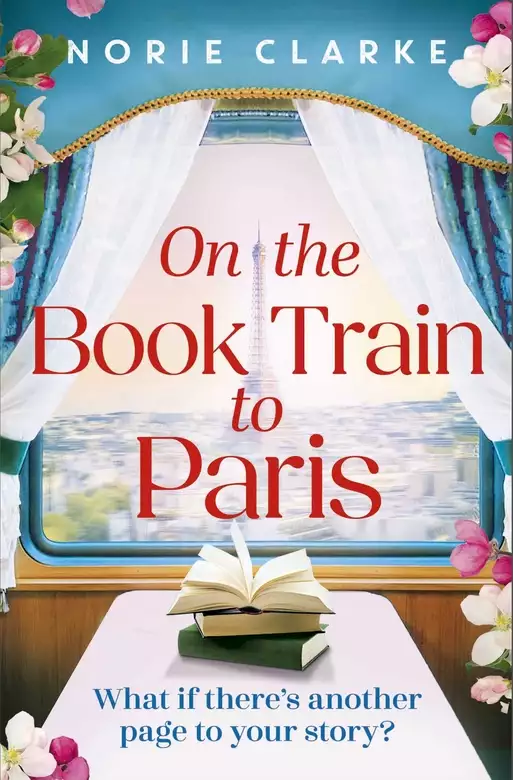
For three women in an Edinburgh bookshop, could the book train to Paris be a passport to Joie de vivre? The new warm-hearted, romantic and uplifting novel from the author of THE LIBRARY OF LOST LOVE. Carly longs to make-over the family's bookshop, but her father is resisting change. Upstairs, Fran is stumped by her next novel - and with how to fix her marriage. In the flat below, Elsa cares for her husband, in need of a short breather to gather her strength.
So when a customer drops in and asks for help at his book festival on a train to Paris, it's the chance of a petit escape. And when a book mysteriously appears in the shop that Fran inscribed to a lover in Paris years ago, it seems too serendipitous to ignore. Boarding the train with Carly and Elsa, Fran wonders if revisiting her past will help her move forward.
But there are plot twists ahead. Could Paris be the place to turn a new page...?
-----------
Readers adored THE LIBRARY OF LOST LOVE by Norie Clarke:
⭐ ⭐ ⭐ ⭐ ⭐ 'Truly beautiful...inviting and emotional. I couldn't put it down!' ⭐ ⭐ ⭐ ⭐ ⭐ 'Love, love, loved this! Gave me all the feels!' ⭐ ⭐ ⭐ ⭐ ⭐ 'Just so beautiful. Left me wanting more' ⭐ ⭐ ⭐ ⭐ ⭐ 'Lovely, lovely characters. I couldn't put this down' ⭐ ⭐ ⭐ ⭐ ⭐ 'Oh, I absolutely loved this! Such a sweet, heart-warming story of lost love and secrets kept' ⭐ ⭐ ⭐ ⭐ ⭐ 'Such a heartwarming story. Perfect for a cosy read with a few surprises. I'd recommend'
Release date:
February 1, 2026
Publisher:
Headline
Print pages:
400
* BingeBooks earns revenue from qualifying purchases as an Amazon Associate as well as from other retail partners.
I look up from where I’m reading in the garden of the crescent. In the brightness of the Edinburgh sunshine, it takes a moment to see who’s there, and when I do, my heart sinks.
‘Paul!’ I say brightly, getting up, my mind in overdrive: When did I last see you? Why now when I haven’t showered or done my hair? Who is the beautiful woman and kid in the buggy beside you?
‘How are you?’ he asks, coming in for what I think is a hug, but which turns out to be an air kiss, leaving me to style out an awkward embrace. The scent of his familiar Hugo Boss fragrance takes me straight back to three years ago.
‘Good, you know,’ I nod over-eagerly, realising that very little has changed since he left. ‘Living my best life!’
Internally I cringe. The woman in the pretty dress beside him actually does cringe though she’s quick to hide it.
‘Carly, this is Liv,’ says Paul, filling the embarrassing pause.
Liv reaches out an elegant, soft hand.
‘Nice to see you again,’ she smiles, her flawless teeth almost as perfect as her butter-blond hair.
I fixate on the word ‘again’.
Paul shifts where he stands, his brown brogues as polished as his wife’s teeth. Even on a Saturday he looks as if he’s about to head into the law firm.
And then it hits me where we’ve seen each other before. That night, three years ago, when I’d been late to arrive to one of Paul’s Saturday post-rugby drinking sessions. I’d entered the busy bar unable to find him, and I remember, as if in slow motion, one of his mates pointing to where he was. Before I’d taken another step, I saw him, and Liv, making out in the corner. I stood there for a moment, just staring, until Paul looked up. Then I ran.
What I remember most about that night is that he didn’t run after me, call or message. Just radio silence. After two years together, not even a half-hearted ‘Come back’. And even though I know he did us both a favour (rugby-playing lawyers weren’t my usual type then and definitely aren’t now – a classic example of opposites attract), there’s still the scar of rejection.
‘And who is this?’ I coo at the baby in the buggy, not wanting them to know that my mind is racing through the past.
‘This is Blair, he’s nine months old,’ says Paul, tickling the kid under his chin, who smiles, displaying four brilliant white teeth. Paul reaches out to squeeze Liv’s hand and it’s only then that it hits me.
‘He’s yours?’ I say, unable to hide the astonishment in my voice, the last three years having felt like three months.
‘Yes!’ laughs Paul, looking at me with his ice-blue eyes as if I’m from a distant planet. ‘Liv and I married a couple of years ago, and Liv fell pregnant not long after.’
‘Right,’ I nod, trying to keep up, trying not to show that I’m reeling from the punch of another person’s life effortlessly shaping up the way society wants it to, the way Paul always wanted his to, but which never felt right for me. ‘Good to see your life’s on track,’ I add, recalling how his plan was always a wife, three kids, and to be a partner by thirty-two. I assume from the size of the ring on Liv’s finger that he’s made that happen also.
‘How about you, Carly?’ asks Liv. ‘Have you found your happy ever after?’
I shake my head and scrunch my eyes, as if to imply it’s the furthest thing from my mind, when in reality it isn’t. Because even when you don’t quite fit the mould, who doesn’t want to be happy?
‘More of a career girl?’ she encourages.
Before I can answer, Paul guffaws. ‘Yeah, right! Carly, a career?’
Liv, to her credit, slaps his forearm with the back of her hand.
‘What?’ he protests, gesturing to my loose yoga gear and hair scraped up under a bamboo headband, the book on the bench. ‘Come on. Carly, am I right? Books and yoga hardly scream career-oriented. You were always one of life’s coasters. What was it you were doing? Something with books . . .’
‘Children’s literacy events,’ I remind him, recalling how ‘cute’ he used to think that was, something he thought I could easily drop should he ever convince me that marriage, kids and living for the weekend were a good idea.
‘That’s right,’ he nods, his eyes blank, evidently having no recollection of what ‘Carefree Carly’ used to do.
‘How that’s going?’ Liv asks.
I grimace.
‘Not for you?’ asks Paul.
‘The funding was pulled,’ I explain. ‘The charity folded and with it my job.’
Both of them look as if I’ve just told them I have less than a month to live. I don’t tell them that while I enjoyed the job it never really felt like the dream job, and that still, with my thirtieth birthday on the horizon, I’ve yet to find my passion in life.
‘But you’ve something to fall back on? Something new lined up?’ asks Liv.
‘Just a bit of temp work.’
‘Lovely,’ she says, though her eyes are pooled with pity. ‘And you’ve a partner to shore you up for a bit?’
I shake my head.
‘But you’ve still got a place to live,’ Paul says rather than asks, as if he couldn’t possibly imagine a world where an ex would be homeless – far too much reality for their cosy Saturday morning in Stockbridge.
I want to give them the full whammy: that my best friend and flatmate Jude, the person who introduced us, is about to move to America, and I can’t afford to take on the rent alone. That I’m surviving, not living. But I spare them the further awkwardness, allow them to keep their middle-class bubble intact.
‘I’ve got my flat in my parents’ house,’ I say, pointing to the top of Mum and Dad’s five-storey Georgian townhouse across the garden, where I’ve only recently moved back in.
‘Wow,’ says Liv, who clearly fantasises about Paul’s salary stretching to something similar.
‘Lucky me,’ I smile tersely, not mentioning that Mum and Dad have had to get rid of their lodger for me to return home just months shy of my thirtieth birthday.
‘Lucky you,’ says Liv, and she reaches out to rub my arm in a way that I’m sure is meant to be supportive but that comes across more as condolence. Her unspoken words being: who are you without a good job, a home of your own and a husband?
‘Well, we’d better get along. Good to see you,’ says Paul briskly when Blair begins to fuss, glad no doubt to have an excuse to get out of here.
‘Good to see you too,’ I call after them.
As they disappear out of sight, I muse on the fact that I don’t want Paul or what he has: his cookie-cutter relationship, his conventional career, his first child of the three he always wanted. It’s more that I’d like to have something other than nothing – just one small passion, or someone – to call my own.
After they’ve gone, I sit for a while, drinking in the warmth of the morning, the April daffodils, and the townhouses of the crescent that surround the garden.
Almost nothing has changed since I was born here – neighbours have come and gone, law and finance firms having replaced the printers and publishers of days gone by, but the rhythm of the neighbourhood remains: during the week schoolchildren weave through office workers; at the weekend shoppers pass through on their way to the city centre or out to Stockbridge for the market, and always, regardless of the day, tourists stand on street corners, their eyes on maps or phones, trying to figure out how to find the Dean Village. Inevitably they’ve lost their way from Princes Street or from Edinburgh Castle perched high on the hill overlooking the city I love most in the world.
And then there’s my home, where I grew up, a townhouse that’s been part of our family for ever. As I leave the garden and cross the street, I see Elsa and Bill, both like grandparents to me, at their table in the basement window. In the upstairs living room, Mum is folding sheets, and on the ground floor, books are piled high against the arched windows of the family bookshop, which my family has owned in various incarnations for almost two hundred years, and where I’ve worked on and off for as long as I can remember.
‘Morning,’ I say, opening the door to the shop from the black-and-white tiled vestibule.
‘Dad?’ I call, when I fail to find him in the front section of the bookshop, piled with donations for the second-hand section. He isn’t in the back section either with its huge, partly obscured French windows overlooking the long, untidy garden below and the tall trees of the Dean Village beyond. Since returning home, I’ve been more aware than ever that Dad is struggling to keep on top of the place.
‘Office,’ he mumbles.
I find him at his desk in the narrow back room, almost hidden behind books and paperwork and old coffee mugs.
‘What’s up?’ I place my book on top of the filing cabinet, its drawers bulging open, and start clearing the cups.
‘Accounts,’ he mutters wearily.
From the look of his scruffy black hair, dark eye bags and five o’clock shadow, I wonder if he’s been up all night.
‘Any improvement on last month?’
He shakes his head, rubs a hand over his brow.
‘What’s this?’ I ask, picking up a sheet of paper that’s fallen to the floor.
‘It’s nothing!’ he snaps uncharacteristically. The two of us are usually as thick as thieves, me having spent more time in the shop with Dad over the years than with Mum tucked away in her study and her head. He reaches out to take it from me, but I hold it just out of reach, reading the red-letter demand.
‘I had no other choice,’ he confesses, when it becomes clear he’s taken out a significant loan.
‘Does Mum know?’ I ask, shocked.
He shakes his head and wipes his eyes. ‘She doesn’t need to know. Phil’s rent was helping with repayments but, well, you know . . .’ He indicates towards me. I reason he doesn’t mean to make me feel bad, or regret his decision to let the lodger go, but still a part of me can’t help thinking, Mum and Dad are in deeper trouble because of me, their almost thirty-year-old daughter who needed to come home because she can’t afford to rent a place of her own.
‘I can find somewhere else to live, I can take on any old job,’ I say, prepared to give up the temp work, and put passion-searching on hold, if it keeps the wolves from Mum and Dad’s door.
‘No! This is for me to fix, not you.’
I stand for a moment, not sure what to say or feel other than sadness for Dad and a great desire to help, but how, I don’t know.
‘Maybe you should tell Mum; she might know how to help.’
‘I don’t want your mother knowing; she’s enough on her plate as it is. Understood?’
I’m not entirely sure I agree, pretty certain Mum would want to know and help, but Dad’s stare, one I haven’t seen before, tells me not to mess with his decision.
‘Fine,’ I say, holding up my hands, figuring it’s his business not mine. ‘But at least let me help you write a newsletter this month.’ Ideally he needs to be doing them weekly, but given he hasn’t been receptive to the idea since I started suggesting them ten years ago, I figure baby steps is the way forward for now.
‘Maybe later, Carly,’ he says, and I bite my tongue, ever hopeful that one day he’ll take advice about what might transform the place back into the burgeoning neighbourhood bookshop it once was, and which I know he can make it again.
Through the door next to the office, I head into the entrance hall which is lined with jackets of every fabric and size, shoes for all weathers and hats in every colour of the rainbow, anything to keep the cold Edinburgh winds at bay. I ascend the stairs I used to slide down as a child. There’s a staircase leading down to Elsa and Bill in the basement, another heading up to Mum and Dad’s apartment on the first and second floors, and a final set of stairs goes to my flat right at the top. There are no doors between the apartments; only the artwork helps differentiate between the spaces: pottery and wall-hangings in the basement; my mum and grandmother’s paintings in the middle floors, and framed photographs on my walls.
‘Hiya, love,’ Mum calls as I head up to my space.
‘Morning,’ I call back, catching sight of her cleaning the bathroom, a sure sign that she’s still suffering from writer’s block. It dawns on me that Dad is probably right not to tell her about his debt – the worry would only further hinder her creative flow.
‘Did you enjoy your reading time?’
She appears on the landing when I’m halfway up the last flight of stairs, a cloth and cleaning fluid in hand.
‘It was OK,’ I say, deciding not to tell her about how it felt to run into Paul; Mum and I have never really been ones for sharing our emotions, she having always been more concerned with the practical aspects of life.
From the stairs above, I look down at her slight figure in a cable sweater and jeans, her brown hair pulled back messily in a ponytail. As a child she was a dancer, which still shows in her sinewy body. At her turned-out feet are books and baskets filled with notebooks, magazines and pencils, items that have been moved from one room to another but haven’t completed the journey back. Like Dad, she looks tired.
‘Just grabbing a shower then I’ll help Dad sort some donations.’
‘It’s a wonder to me where all those books come from,’ she says quietly.
‘Mostly local, some from further afield,’ I say, thinking her comment an odd thing to say; Mum knows better than I do that the bulk of our donations come from local house clear-outs.
‘I mean the content of the books, the actual words,’ she says absently, looking at the cloth and bottle in her hand as if she’s only just noticed them.
‘Mum, quit worrying. You’ll find your next idea; you’ve written twenty-five books already, remember?’
‘Yes,’ she sighs, shaking herself back with it. ‘You’re right; ideas are everywhere.’
‘When you stop looking . . .’ I offer, continuing up the stairs.
Figuring it’s time I look for a job, I scrunch-dry my long dark hair and apply a skim of make-up at my vintage dressing table, then select some wide jeans, a T-shirt and slouchy cardi before heading to the kitchen.
Juice in hand, I park myself on my mustard sofa and plonk my feet on the tapestry footstool, then take out my phone. Through the trees of the crescent’s garden, the castle looms large in the distance with the top of the Scot Monument just visible. Both remind me of late summer evenings spent roaming the city centre as teenagers, Jude always with me, in search of fun.
Above the fireplace, a photograph I took at university of Fringe street performers reminds me of summers handing out flyers in return for free tickets to shows. And on the shelves, photos of yoga weekends and mini-breaks with Jude sit amongst crystals and books, and plants I try desperately to keep alive. But it’s one photo in particular that catches my eye, of me with Jude and her husband Adam on their wedding day. Jude and Adam are lit up with love, and I am too, on the outside, but on closer inspection, my smile is slightly forced, and my eyes aren’t sparkling. I remember thinking as the shutter clicked that here was a moment that Jude was experiencing that I might never experience or, if I did, might not be capable of sustaining for ever.
Casual friends would never recognise that anxiety in me. They’d call me footloose, ‘Carefree Carly’, as Paul called me, just as my mother hoped I’d be.
‘It’ll take someone really special to get Carly to settle down, to tick all the boxes on her list,’ one friend said after Paul and I broke up.
Only Jude knows that my lack of commitment and desire for perfection in a partner is rooted in something deeper, ‘in fear’, as she once said, and I never forgot.
‘Carly?’ Jude’s voice calling up the stairs pulls me out of the thought-spiral I’d fallen into.
‘Hi,’ I say when Jude arrives in the living room. She sits on the couch next to me, her blond, neck-length curls as bouncy as she is. I push away a memory of Ben: confident, creative, emotionally intelligent and loyal. Ben was the full package, but even he didn’t make the grade. ‘Too laid-back,’ I’d told Jude, the day after I’d broken up with him. She’d looked at me in despair, and though I wasn’t going to admit it, I knew I’d made a mistake but had no idea how to fix it.
‘What’s up? You look a bit glum,’ Jude says, taking the remains of the juice she knows I won’t drink and finishing it for me.
I shrug. ‘I bumped into Paul,’ I say, not sure whether my gloom is because of Paul, job-hunting, or being more of a hindrance than a help to Dad, or all three.
Jude pulls a face of ‘eugh’ and I laugh. ‘Let me guess: still at the law firm, married, one kid.’
‘How did you know that?’ I ask, expecting her to say that she’s heard through the grapevine.
‘Mr Conventional doesn’t deviate from his life plan.’
I laugh at how well Jude knows me, the strict ban I now have on conventional men, and how we always gently mock people with life plans. ‘Trouble is, at the moment I can’t help wishing I had a plan of my own.’
‘What’s so great about knowing every step of your life in advance?’ she asks, perplexed at my sudde. . .
We hope you are enjoying the book so far. To continue reading...

 Please log in to recommend or discuss...
