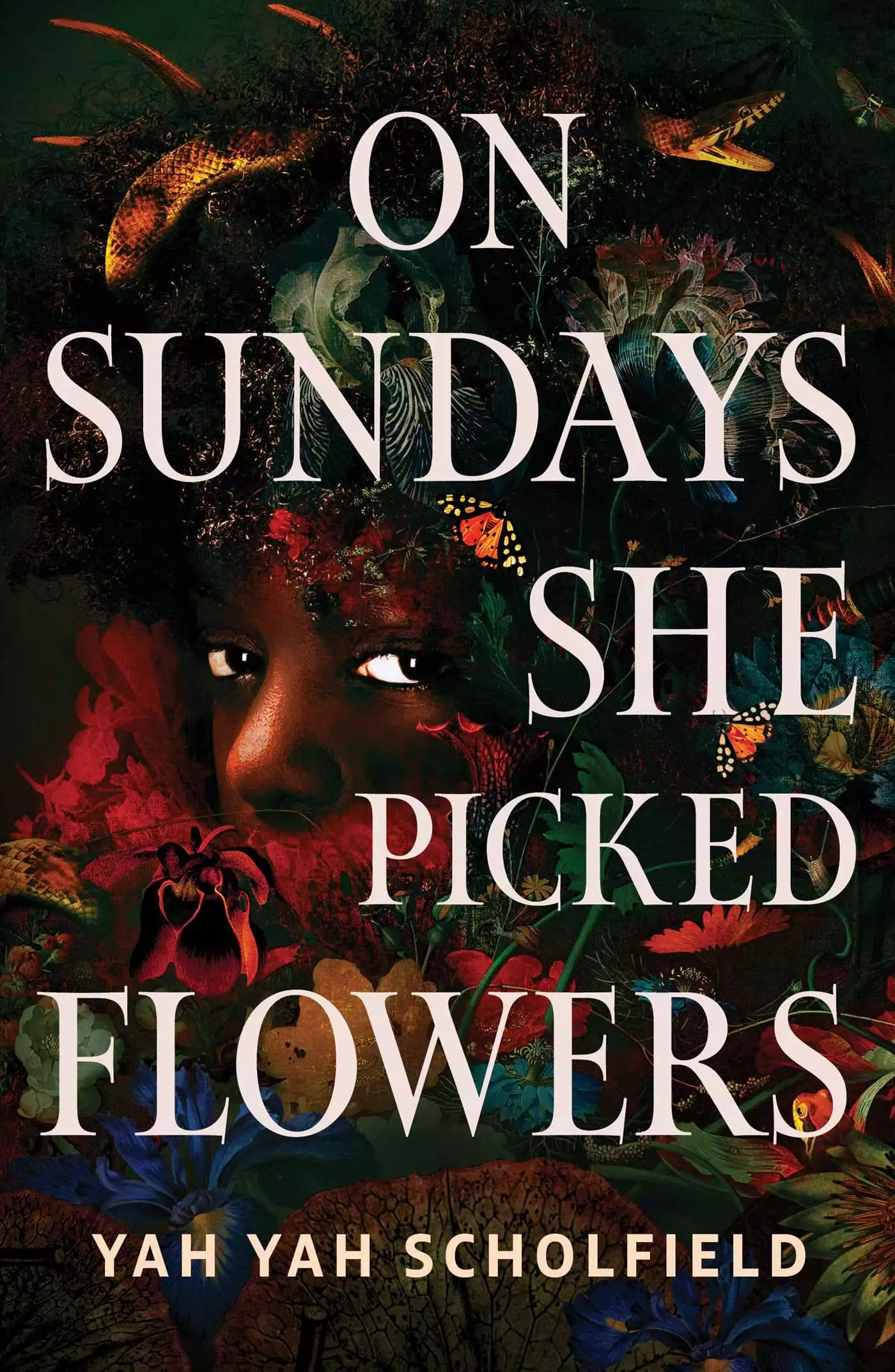
Lone Women meets Sorrowland in this sinister and surreal Southern Gothic debut about a woman who escapes her family home to the uncanny woods of Northern Georgia and must now contend with haints, ghosts, and a literal beast in the woods.
When Judith Rice ran away from the house she grew up in, she thought she severed her abusive mother’s hold on her. Seventeen years later, she’s made a home for herself in a cottage secluded deep in the forests of northern Georgia. Jude believes she’s settled into a quiet life.
But when an enigmatic woman shows up on her doorstep, Jude’s tentative peace is threatened by the stranger’s presence. The woman is beautiful but unsettling, captivating but uncanny. Caught between her desire for this woman and the violence that seems to simmer just beneath her skin, Jude’s past and present clash as the woman stirs up memories that force her to reckon with the violence of her escape years ago.
Haunting and thought-provoking, On Sunday She Picked Flowers is a propulsive debut exploring retribution, family trauma, and the power of building oneself back up after breaking down.
Release date:
January 27, 2026
Publisher:
S&S/Saga Press
Print pages:
240
* BingeBooks earns revenue from qualifying purchases as an Amazon Associate as well as from other retail partners.
Ma’am cracked Jude’s skull against the wall for talking back, and the realization that no one was going to save her struck Jude like a revelation from God.
Smack of bone against plaster, brick. Sudden darkness, sudden flash of white light—was it the act itself that schooled her, or was the pain her teacher? Or maybe it was the apathy of her audience, her mother’s quilting circle (religious women, saints in knee-length skirts and compression socks) glancing briefly at Jude’s crumpled body before returning to their sewing. Ma’am stepped over her, sat among her friends as Jude stumbled to her feet. Her face was wet—blood, thank God, rather than humiliating tears—and she knew she could no longer live in her mother’s house.
That it took Judith Rice forty-one years to come to the conclusion was proof of only a hopeful nature. Or was it naivete? Jude certainly felt naive when she bowed to pray to her mother’s god, as silly as a little girl wishing on shooting stars, dandelions. What could he give her that hadn’t already been denied? Strength? Resilience? Mercy, maybe, if such a thing existed.
No paintings of God were hung in the Westmoor house, so Jude imagined her grandfather, stern and humorless as he glared from his position on the living room wall. It was to him that she directed her prayers for freedom, pious and patient, and then her curses, though these she quickly corrected with apologies. If ever once Jude pleaded with the Lord to strike Ma’am dead, strike her dead, strike the bitch dead, only Jesus knew it, and he knew her heart, didn’t he, knew she didn’t mean it, not really. He alone knew that Jude wasn’t as spiteful as her prayers, that she’d rather there be peace. On her knees, she asked for patience, time—if only she and Ma’am had time away from each other, time to think and let the bitter sentiments settle, then things could be sweet between them. Normal, familial; friendly, even, like the mothers and daughters on TV.
Jude couldn’t say which blow it was that knocked the prayers from her mouth like teeth. Only remembered chasing after them, running her hands through the carpet to find this or that plea, all the while knowing it was useless. Of course, God wasn’t listening to her. Of course, Jesus wasn’t her friend. They were her mother’s men, and all the time she was on her knees, begging, crying out for her freedom, they were at work with Ma’am, whispering in her ear, colluding on crueler and viler punishments.
Up in her bedroom with the lights off and the curtains pulled, a wad of gauze pressed to her gashed head, Jude nursed thoughts of escape alongside her concussion. She could get a bus out of town, but wait—how would she get the ticket, never mind leave the house? And if she did, somehow, manage to leave her mother’s house, where could she go? So cagey were the Negroes of Vine City, so protective of themselves and nervous of outside influence. Nothing entered and nothing left. Jude recalled her past attempts to escape, each of them thwarted by neighbors, nosy folk from church—once Jude had gotten as far as Ashby Street before a minister her mother knew had corralled her, protesting, into his car and returned her home. Ma’am had wept and bought locks for the doors that could only be opened by keys she kept on her person.
Her mind was a tangle, bus routes and city names and paths of egress muddling, twisting, knotting. Pressure on her chest, weighing on her belly; she panted, fought for breath. The corners of her bedroom, childish and pink, folded in and in, squashing her, and a voice like wasp’s wings beat against the glass of her brain. The only way out is through, and aren’t there spiders who eat their mothers, and can’t you just— Wouldn’t it be easier to just—
Jude flattened the thought. She waited until her mind felt clear to slowly lift the hand, peeking underneath to see the idea, oozing and twitching, a cockroach near death.
She was not a violent person, Jude. When she felt the need to be ugly, when the meanness was too much for the frangible cage of her body and her hands itched to break something, someone, she broke only herself. Tailoring pins in the palm of her hand, needles jammed into her thighs—she alone took the brunt of her ire, the copper of her blood, as she lapped at an injury, as comforting as the cut itself. But to turn the blade outward…
Well, said the wasp-wing voice, it isn’t like you’d be hurting anything real. Hadn’t Ma’am long ago severed their ties? Hadn’t she made it so clear to Jude that the blood that bonded them meant nothing to her? Jude’s rage would touch only what little of the bond that remained—the terrific physical form, the birthing body that resisted and resented. It was only the afterbirth, and like the placenta, it needed to be expelled lest it poison the body. It was up to Jude to decide what to do with it afterward, whether she’d discard it or burn it, bury it in the garden.
It was near dark when Ma’am brought her a bowl of greens and two aspirin. Jude took small bites of the cabbage, swallowed the pills, and half listened as Ma’am talked her way around a non-apology. When her plate was clear, Ma’am set it on the nightstand and put a warm, wrinkled paw to Jude’s forehead.
“How’s your head?”
Splitting, aching. “It’s alright, Ma’ammy.”
“That aspirin gon’ take the pain out.” She hummed, picked lint off Jude’s comforter, did anything but look Jude in the face. “Want anything special-like for dinner tomorrow?”
This was her way—cruelty and then candy. No more able to parse the kindness than she was able to stomach the meanness, Jude learned to take each act, sweet and bitter, as they came, never once growing accustomed to the shifting ground on which she stood.
A verbal apology, a real apology, was out of the question. One did not apologize to a child, especially not if that child was one’s own. Instead, there were invitations to run errands, permission to pick out any fruit she liked at the market. Flash of light, ages of pitch darkness; hands roughly shaking her awake, icy water shocking her back to consciousness. Scars were salved over with baby dolls, broken skin and bones by good food, collards or cornbread, the stickiest pig’s foot set aside for her.
Now that they were older, Ma’am was less likely to play at making nice and Jude was less likely to be appeased. Still, Jude did not turn down the trips to Rich’s or Davison’s, did not turn down her mother’s offers to buy any bright, shiny thing she saw. She knocked the teeth out of Jude’s mouth once, sent blood and adult molars flying across the hardwood; in return, Jude got the closest thing to an admission of fault—a slice of warm pound cake drizzled with lemon glaze, permission to use the car, permission to be alone.
They meant nothing, Ma’am’s apologies, and nothing changed. Sweets and treats were nice, but they wouldn’t make her a woman in her mother’s house, wouldn’t make her anything more than a whipping girl. There was no future, only Jude and Ma’am graying and decaying, Ma’am’s cane cracking her back and Jude standing there and taking it, smiling like an idiot even as she was mashed into a pulp.
Jude blinked slowly, froggily, and said, “Can we have beef stew?”
Ma’am left her then—pat on the hand, dry kiss to the bandaged head—and Jude waited until the door was fully closed and her mother’s shuffling steps had receded to her own room before slipping out of bed. Carefully, mindful of her headache, Jude knelt and felt the floor for a loose board. She found it, lifted it and set it aside, and reached into the slot for her collection of secret things.
She was fourteen when she started helping with her aunt Phyllis’s tailoring business. What little money she made—a nickel for buttons, a dime for every item mended, and a quarter for each choir robe she returned with a straight hem—went into Ma’am’s pockets, for her upkeep, but what Jude kept for herself she hid under the floorboard in a tea tin alongside slim, well-used diaries, a tube of red lipstick, beads, costume bracelets, acorns, and other small treasures.
There was just a little over two hundred dollars in her tea tin in ones and fives and coins. Kneeling, Jude counted and recounted her stash, tucked it back into the tin, and dragged from beneath her bed a hefty quilted bag. This she filled with necessities—skirts and modest dresses she’d cut herself, plain starched shirts, a pair of slacks she’d purchased but never dared wear outside her bedroom, nightclothes, underthings, tights, a pair of flat black shoes, and her sewing kit. Of her contraband collection of pulpy fantasies and romances she kept in her closet, Jude packed only Jane Eyre and a newer Baldwin. For toiletries, she took her toothbrush, a washrag, and an unopened bar of soap.
She looked over her haul, her things packed tidily into her bag, and the sight of it was some relief. She could, if she was smart, get out of the house with this bag and a coat alone. Comforted by the thought, Jude slid the bag back beneath the bed, replaced the tin of money and her secrets beneath the floorboard, and crawled back into bed.
The sleeplessness didn’t surprise her. Too much was on her mind, her plans and her injury, and Ma’am, mostly, what sort of woman she was. Her mother, a trinity unto herself—saintlike Ernestine, lover of the Gospel, believer of prayer, she served on the ushers’ board at Mount Tabernacle Pentecostal, smiled without teeth and walked tightly, stiffly, so her hips wouldn’t sway; Nessie, smiling toothily, giggling, played card games with her sisters and despised drunks but cheerfully took sips of gin, if Vivian or Phyllis was offering. And then Ma’am, who smiled rarely and hissed and snapped and could not be pleased. Nessie knew dances she’d made up back in Sparta, wore her hair in wild braids and bared her legs; Ma’am whupped Jude for being fresh, for listening to secular music, for the sliver of bare midriff accidentally exposed. You could meet Ernestine’s gaze, could tell Nessie a story and have her throw back her head to laugh at it; when Jude looked Ma’am in the eye, all she got was a knock to the side of her head.
All three, at least, stank of jasmine.
Only after fitful sleep and changing her bandages did Jude stop to consider herself and what sort of woman she was. She was, at forty-one, a child still, slump shouldered and cowed. Where she came from, she did not know. There was a golden band on her mother’s finger, but no one ever said anything to her about a father, and there were no pictures of Jude in the photo albums. It was pointless to ask Ma’am anything; the best she got from Ma’am were abbreviated anecdotes about the plantation in Sparta where she came up, sharecropping, or half stories about her aunties fussing over infant Jude, the sisters whispering to one another about Jude’s muteness, how she never seemed to laugh or cry or make any of those charming noises babies were supposed to make.
“You was the quietest thing. Your auntie Vivian, she thought somethin’ might’ve been wrong with you, considerin’.”
“Considerin’ what, Ma’ammy?” Jude would ask, hopeful for a scrap of something from her mother’s mind, some thread to connect them, but by then, Ma’am would be tired of talking about the past, done with all them questions, and didn’t she learn Jude any better than to pry?
Her own memories of her childhood were spare, more sensation and sound than image: the whistle of a wooden hairbrush cutting through the air and landing thwack! against the meat of her thigh; her grandfather’s gangrenous leg perched on an ottoman, pipe smoke obscuring his face as he whittled some small toy for her; sudden bursts of color and joy at Auntie Vivian’s wedding, Auntie Phyllis’s wedding, followed by the strained restraint of the parlor at Pappy’s wake, the wake of her infant cousin.
There was school, briefly, but that was ruined soon enough by the taunting of her peers, the disdain of her teachers. Clearly, they saw something in her or they’d consulted with Ma’am beforehand, each of them having decided, independently, that Jude was too fat, too Black, too tall, and too damn ugly.
Jude thought it was true, then. In the dark of her bedroom, consulting her reflection in a hand mirror, she wasn’t sure. In the glass: black eyes, mournful and barren; dark striped skin, mottled with scars, the mouth perpetually frowning. The mirror would not show the rest of her, how beneath the pressed hair and fractured skull there was a mind that spiraled and wandered and flashed, electric, with thoughts chthonic.
She did not see what her mother saw, could not understand what thing lived inside her that made Ma’am hate her so. Jude was her mother’s child, Ernestine’s match, and they shared everything from eyes to smile to singing voice, so what was it? Jude came to her mother innocent, curious, and watchful, and each trait was perverted; her curiosity into mere nosiness, her innocent silence into surliness.
Jude’s head bandage oozed. She put a hand to it, saw her blood shining black on her fingers. She considered the state of her skull, the ease with which Ma’am hurt her. Did it cost so little, her blood, that her very own mother could spill it without blinking? Was her life so forfeit that saints, her aunts, could watch her bleed and feel for her no pity? The roach of violence twitched its legs, righted itself, and scuttled to the forefront of her brain.
Love was not enough. Sweet talk and sweet times, bowls of cabbage and slices of cake—they wouldn’t mend what had been broken. If it was, all this time, love that had stilled Jude’s hands and made her faithful to her mother, she would cut it from her chest. If the only way out was through, if it had to be red and terrible and violent, so be it.
For her freedom, for her life, Ma’am would have to die.
We hope you are enjoying the book so far. To continue reading...

 Please log in to recommend or discuss...
