'A mystery and an elegy for the death of old-fashioned journalism, it's a book that will warm your heart.' The Observer Fiction To Look Out For in 2021
‘Splendid read [...] Funny, poignant, perceptive and plenty of sharp elbows along the way.' Val McDermid
Thorn Marsh was raised in a house of whispers, of meaningful glances and half-finished sentences. Now she's a journalist with a passion for truth, more devoted to her work at the London Journal than she ever was to her ex-husband.
When the newspaper is bought by media giant The Goring Group, who value sales figures over fact-checking, Thorn openly questions their methods, and promptly finds herself moved from the news desk to the midweek supplement, reporting heart-warming stories for their new segment, The Bright Side, a job to which she is spectacularly unsuited.
On a final warning and with no heart-warming news in sight, a desperate Thorn fabricates a good-news story of her own. The story, centred on an angelic apparition on Hampstead Heath, goes viral. Caught between her principles and her ambitions, Thorn goes in search of the truth behind her creation, only to find the answers locked away in the unconscious mind of a stranger.
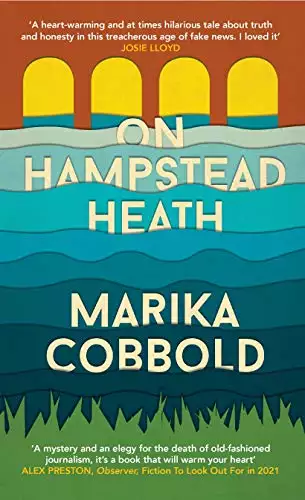
Marika Cobbold returns with her eighth novel, On Hampstead Heath. Sharp, poignant, and infused with dark humour, On Hampstead Heath is an homage to storytelling and to truth; to the tales we tell ourselves, and the stories that save us.
Release date:
April 15, 2021
Publisher:
Arcadia Books
Print pages:
204
* BingeBooks earns revenue from qualifying purchases as an Amazon Associate as well as from other retail partners.
‘A mystery and an elegy for the death of old-fashioned journalism, it's a book that will warm your heart’ Alex Preston, The Observer, Fiction to Look Out For in 2021
‘Marika Cobbold writes with such a light, witty touch, strewing the story with great one-liners, but she isn’t afraid to tackle dark themes too, and manages to bring even minor characters to vivid life with just a few telling strokes. On Hampstead Heath is a deliciously romantic comedy of misunderstandings and misbehaviour – I loved it’ Clare Chambers, author of Small Pleasures
‘With On Hampstead Heath, Marika Cobbold has rebooted the Hampstead Novel for the 21st century. Instead of focussing on its usual topics of middle-class adultery and delusions of grandeur, she has written about unexpected love, work and how truth can change even the most unprepossessing of situations. Like the heroine of a screwball comedy, her heroine Thorn is prickly, witty and memorably bonkers. A delightful novel’ Amanda Craig
‘A heart-warming and at times hilarious tale about truth and honesty in this treacherous age of fake news. I loved it’ Josie Lloyd
‘A brilliant and brave take on fake news and its fallout. So of the moment. Witty and clever but with depth of emotion lurking at the centre’ Elizabeth Buchan
‘Just finished and loved On Hampstead Heath by Marika Cobbold – clever and funny with a splinter of melancholy running through it. It's a superb read’ Frances Quinn, author of The Smallest Man
‘Few writers balance darkness and light as well as Cobbold. Her eighth novel features a prickly local journalist as its protagonist and is an engaging story of truth, lies and the tales we tell’ Sarah Hughes, i, 75 of the best books for 2021
‘On Hampstead Heath was so refreshing and unexpectedly needed, like feeling the sun on your face in winter. Funny, astute, and aching in all the right ways, I was utterly charmed’ Tor Udall, author of A Thousand Paper Birds
‘Marika Cobbold's look on life is unique and very entertaining’ Katie Fforde
‘On Hampstead Heath is exactly what is needed at this time. A romantic story tempered with a sharp wit and written with knowledge and love of place in which it's set. It also has a wonderful hero’ Adèle Geras
1
I grew up in a house of whispers, of meaningful glances and half-finished sentences.
‘Tell me.’
‘Tell you what?’
‘What you’re not telling me.’
‘Don’t be silly.’
‘Tell me!’ I shouted.
‘Rudeness will get you nowhere,’ they said. Then they sent me to my room.
‘My room is somewhere,’ I said.
These conversations never ended well.
People asked, as people do, ‘So, little girl, what do you want to be when you grow up?’
‘I’d like to be God.’
I blame the vicar. He was the one who told us, “Nothing in all creation is hidden from God.”’
All I wanted was to know.
Unsurprisingly, I did not grow up to be God. Instead, I became a journalist. A journalist is a seeker of Truth, its upholder and defender. Or so I thought.
Where lies go unopposed, democracy dies. A long time ago, when I first started out, I embroidered the words, badly, in cross stitch and hung the framed canvas above my bed, as a reminder, should I need one, of why I became a journalist. Now it hides, face to the wall, at the back of my wardrobe; a reminder, should I need one, that I’m a liar and a hypocrite.
I flicked through my clothes. What does a liar and a hypocrite wear on judgement day? It sounds like the start of a joke. What does she wear?
Something light and loose, but not voluminous.
That won’t have them rolling in the aisles.
I’d asked him to meet me on Viaduct Bridge. It was where it all began; the place where, by some strange alchemy, I might yet turn fiction into reality.
It was early still, and overcast, but by the time I got to the Heath the sun was shining. I thought, it's a bad omen, the sun always shines when something truly shitty happens in my life. It's why I believe in a higher power. Chance does not do irony.
I stood on the bridge, looking down at the still water. What was it like, I wondered, down in that mirror-world of bridge and trees?
The minutes ticked by and turned into half an hour. I checked my phone but there were no messages. He wasn’t coming. I don’t know why I had imagined he would. Hope, I suppose; that prankster makes fools of us all.
Five more minutes, I told myself, no more.
I looked out across the pond. The mandarin duck was there, with his grey-feathered friends. It seemed their tranquil morning swim would not be disturbed after all.
But here he was, crossing the bridge towards me, his hair copper in the morning sun. But no halo – the halo would have been too much; he was splendid all the same.
I raised my hand in a wave. He didn’t wave back. I stuffed my hand in my trouser pocket.
‘Rose.’ He gave me a curt nod.
‘Thank you for coming.’
‘Sure.’
And there we were, two little people whose lives did not amount to a hill of beans in this vast, indifferent universe. Only there is a different universe, there always is: a tiny, self-important one, built by us, for us. A fool's universe, if you like, but that's OK, because in that universe, he and I, standing there on Viaduct Bridge, mattered a great deal.
‘What did you want to see me about?’
‘I was hoping to explain.’
He shrugged. ‘Fine, explain away.’
I opened my mouth but nothing came out. He glanced at his watch, shifted from foot to foot, like someone cornered by a talkative stranger. I lost my nerve.
‘I was drunk and on a deadline.’
‘You’re a journalist. That's not an explanation, it's an ordinary day at the office.’
Unfair, but this was not the time to argue.
‘I’d never planned for things to go as far as they did.’
His tone was brisk. ‘People never do.’
‘The story, it took on a life of its own, like Frankenstein's monster. I was powerless to stop it.’
‘No, you weren’t.’
I took a step towards him and my hand, being just a limb, incapable of understanding, reached out for his. ‘Rufus, please.’
He took a step back.
I said, ‘You really can’t forgive me?’
He looked down at my hand, then back up at me.
‘No. No I don’t think I can.’ With that, he began to walk away.
The sun just kept on shining, bathing the bridge in golden light, turning the duckweed emerald.
‘But what will I do without you?’
He turned to look at me. ‘Work,’ he said. ‘Isn’t that what you do?’
I took the phone out of my pocket and put it down on the ground. I scrambled over the railings and onto the ledge, closed my eyes and jumped.
2
I’d go so far as to say that, until the Goring Group bought the London Journal, my life was made up of more good days than bad, and that's despite my lousy childhood and my husband leaving me for a woman who had named her dog Teddy Pom Pom.
I had worked at the Journal for the best part of thirteen years, the past five as news editor. It had been thirteen happy years, with scarcely a day apart and barely a quarrel. Had anyone asked me where I saw my future, I’d have smiled a gauzy smile and said, right here, writing the history of tomorrow.
And then came the announcement: the London Journal had been sold, sold to the man in the back, yes, you sir, with the large media company and a sideline in household appliances, or is it the other way around? Going, going, gone.
The Goring Group hired a ‘media consultant’, a beige man with the uncanny ability to be underfoot in five places at once, to write a report. This report was very long, containing ever more ingenious ways of saying exactly the same thing: the London Journal was a fine publication, a standard-bearer for journalistic integrity. It pointed out how we, unlike many other news outlets, had successfully avoided dumbing down while remaining accessible to a wide cross-section of the public. Having studied this report the new management concluded that nothing becomes success like a massive upheaval. Our much-loved editor-in-chief chose early retirement in much the same way that Socrates chose hemlock, and in blew Angela Foster on the winds of a summer storm, armed with a business plan and a jar of homemade chocolate chip cookies.
Along with her cookie jar, Angela Foster brought something we’d never had before: a managing editor. Joe Moffat, she said, was an innovator with a background in digital marketing. At this point, Fahran, our political editor, suggested that a background in journalism might have come in handy, but Angela Foster silenced him with a look and an offer of a chocolate chip biscuit. Two weeks later Fahran was gone. Where to? The Register? Siberia? Small Household Appliances? Obituaries? For his sake I hoped it was obituaries. There's a great art to a properly executed obit, a balance to be struck between libel and hagiography. I know because sometimes, when the nights draw in and I have nothing else to do, I write my own. If nothing else, it focuses the mind.
I understand the desire to put one's stamp on a new place, make oneself at home. Some people bring a photograph of the family to put on their desk, or a pot plant, or perhaps a special mug with something amusing written in the glaze, like: ‘Who Are You Calling a Mug?’ If you’re confident you bring ideas and suggestions about areas of possible improvements, and if you’re a dog, you cock your leg against your colleagues’ desks. Unfortunately for the employees of the London Journal, to Joe Moffat, nothing said ‘home’ like an axe.
The next three months saw the Arts section reduced from six pages to two and the book club abolished. A decision was made to increase the proportion of images to text by thirty per cent, and an instruction given to keep the word count of the average articles, be it news, feature or comment piece, to no more than three hundred words. Headlines, on the other hand, were to become longer. It was all about ‘readability’ apparently, and readability meant getting a sufficient gist of a story to post a link on social media, without having to read beyond the headline and the first paragraph. I suggested to Joe Moffat that it might work with books too: make the title and chapter headings longer so that people could talk about the book in their book club without having the bother of reading the whole thing? I got the worrying sense that he thought it wasn’t a bad idea.
Unease crept along the corridors like mould. Not even a memo from the sports editor referring to Joe Moffat as ‘the word-cunt’ could lift our spirits. And then came the tyranny of the clicks: how many times did someone, somewhere, click on an online article? Where once there was harmony, fear and suspicion flourished. Dirty deals were struck: I’ll click yours if you click mine. Does your grandmother go online? She's got time on her hands, doesn’t she? Would your kid like to earn some extra pocket money? There were even rumours of colleagues employing the services of professional clickers. The journalistic integrity for which we had been praised was ditched, as Moffat ordered us to get down and dirty; trading truth for populist headlines, replacing reasoned analysis with rabble rousing. ‘I want,’ he said, ‘to give our readers something new to be angry about every day.’
The opinion editor and the business editor favoured quiet resistance over open mutiny. I agreed, for now.
Some three months into the new order, I got an email from Joe Moffat's PA asking me to have lunch with Joe. I was pleased. The occasion, part work, part social, would be an opportunity to raise my concerns.
3
It was a Tuesday in late October. I took off my scarf and my trench coat as I walked to the restaurant where Moffat and I were meeting. Throughout June, July and August, razor sharp winds had shaved the leaves from the trees, rain had stopped play and sent brides scurrying into the church, bedraggled veils trailing. Only now, on the cusp of winter, did summer decide to put in an appearance.
Chez Coupe, or ‘Chop's’ as some ancient wag had renamed it, would not have been my venue of choice, but Joe was new in town and his PA may have relied on an out-of-date food guide. I say ‘out-of-date’ because in its day, Chop's had definitely been in the top ten ‘places to be seen’, its regulars being models and It-girls and men who may or may not have slept with Princess Margaret. But they were gone now, off to the great rehab in the sky. Pascal Coupe, too, was long gone. Who owned the place now? Perhaps no one did. Perhaps it simply carried on regardless, like the Marie Celeste, or one of those centenarian left-behinds of the Imperial Japanese army still defending a corner of a remote Pacific island.
The waiter, a young man in a suit wide enough to contain an entire second waiter, barely looked up as I entered. ‘I’m afraid the toilet is out of order but there's a public...’
I told him I was there for lunch and, once over his surprise, he showed me to a table by the window where I sat gazing out at the street, like one of Edward Hopper's lonely souls in a downtown diner.
While I waited I went through my arguments in my mind. I would have to be circumspect, tactful, when voicing my unease over the direction the Journal was being taken. Joe was the editor after all, and although he clearly wasn’t up to it, I couldn’t expect him to see it that way.
The minutes ticked by. A middle-aged couple came in, looked around then exchanged some words and withdrew. I don’t think it was me. I checked my emails on my phone while the waiter in his too-big suit hovered like a feral dog, too used to kicks and blows to come up close. Was the suit a hand-me-down, I wondered, passed from waiter to waiter with solemn ceremony since the dawn of Chop's time?
By now Joe was more than half an hour late.
If I run late, I at least make sure to arrive in a rush and a whoosh, apologies at the ready, but Joe Moffat hung back at the door like a surly child torn from games with his friends to ‘say hello to the nice lady’.
I gave him a little wave. He arranged his face into what could pass as a jovial expression.
‘Jenny, thanks for meeting me. Not kept you waiting long, I hope.’
I looked around for Jenny. She wasn’t there. Not unless she was exceptionally tiny and couldn’t be seen above the table.
Joe sat down. ‘I have to be back at the office for a two forty-five meeting but if we order straight away, that should give us plenty of time.’ He craned his neck, searching for the waiter who, with immaculate timing, had stopped hovering and disappeared.
He picked up the menu. ‘So what do you recommend?’
‘Your guess is as good as mine.’
He frowned. ‘I thought you were a regular.’
‘That must have been Jenny.’
He looked confused. ‘Did I call you Jenny? Sorry. Thor.’
‘Thorn,’ I said. ‘As in the side. Not Thor as in Norse god.’
He smiled, mechanically. ‘Of course.’ He put the menu back. ‘I’m sure it's all delicious.’
I gave him a pitying look. He was like a character in a soap opera, mouthing ‘we have all the time in the world’ moments before the inevitable plane crash.
Recklessly, he went on to order plaice in lobster jus accompanied by pommes de terre du Chef and a medley of vegetables.
I asked for a plain omelette.
‘Any wine with your meal?’ the waiter asked.
‘Just water. Tap.’ Joe turned to me with the air of someone showing off an accomplishment and said, ‘I can’t drink at lunchtime. Blunts the thought processes.’
‘There's no such word as can’t,’ I said. ‘Practise and you’ll get the hang of it in no time.’ I was trying to lighten the mood, but it remained unlightened. The waiter waited. I said that I, too, would have water. Across the table, Joe watched me as if I were a piece of unattended luggage. Tick tock.
The waiter returned to say that Chef was not doing omelette that day.
‘Even I do omelette,’ I said.
‘I’m afraid guests aren’t allowed in the kitchen,’ he said.
He passed me the menu. ‘The oxtail stew is very popular with our regulars.’
Not wanting to kick a man when he was down, I ignored the fact that Chop's had no regulars. Other than Jenny, obviously.
‘I’m sure it's delicious but I don’t eat mammal.’
The waiter gave me a blank look. Joe glared. I felt uneasy. I’m a journalist. Being glared at is usually mother's milk to me. But this was my boss.
I addressed the waiter. ‘What I mean is I don’t eat anything with four legs. Two legs, yes – unless it's primate. I frown on the consumption of primate.’
The waiter did his best to reassure me. ‘You’ll be safe with the oxtail. No legs in there at all.’
‘Tell you what, I’ll have the soup. Soup is good.’
The waiter leant over my shoulder and pointed to the soup section. He smelt of stale sweat. Such a sad smell, telling of long hours toiling and no money for dry cleaning.
‘There's tomato, French onion, stilton and cauliflower, mushroom...’
‘I’ll have the tomato soup.’
He straightened up. ‘And to follow?’
‘I’ll have the soup as a main course.’
‘Anything to start with?’
‘Just soup.’
‘We have cauliflower and stilton, mushroom...’
Joe interrupted. ‘For God's sake, how hard can it be? One course. One soup. Tomato.’ The waiter, looking hurt, plodded off, his too-long trousers bunching at the ankles. I turned an accusing eye on Joe. Gratuitous rudeness to one whose job depends on not answering back is unacceptable.
Joe had the kind of face that, once upon a time, would have cleaned up at Bonniest Baby competitions. On a grown man, the domed forehead, the round eyes, the button nose and rosebud mouth, looked faintly sinister. He was clearly ill at ease, rolling his neck as though his collar was pinching, although his shirt was open-necked, wriggling and scooting on his chair as if his underpants were riding up between his buttocks.
I asked him how he liked London.
‘It's a great city, but it's not Manchester.’
It was hard to argue with that, so I didn’t.
‘I’m into hiking and cycling, so Manchester's easy access to the countryside really works for me. And the vibe, it's just more authe. . .
We hope you are enjoying the book so far. To continue reading...

 Please log in to recommend or discuss...
