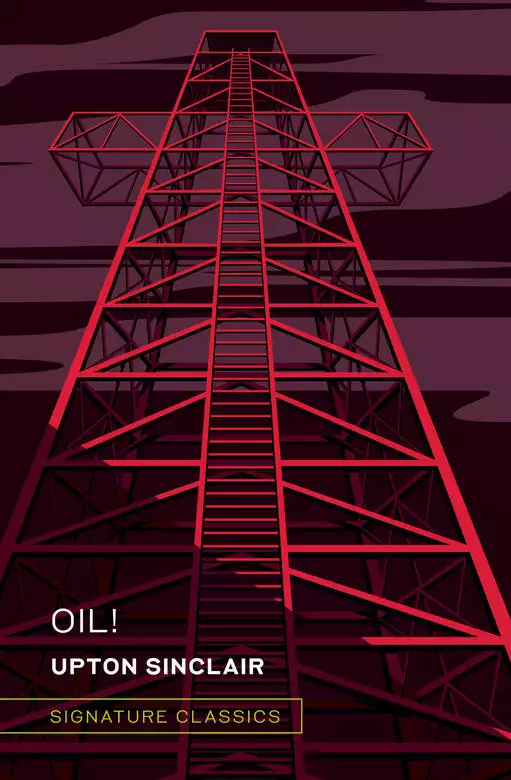
Discover the story of Oil! with this striking collector’s edition from Union Square & Co.'s Signature Editions series! The classic texts that shaped our culture feature exclusive cover art by distinguished artist Malika Favre. Her bold, graphic style gives each classic literature book a small masterpiece for a jacket. Collect the set or prize this Oil! special edition as your showpiece literary classic.
Oil! follows James Arnold Ross and his son, James Arnold Ross Jr., as they do whatever it takes to run their very own oil well. Ross's son—nicknamed Bunny—provides an idealistic counterpoint to his father's avaricious dealings. Their story intertwines with that of Eli Watkins, a revivalist preacher who seeks spiritual power. As the stories of the Ross and Watkins families intertwine, the struggle between the material and the spiritual sharpens.
Literary history and meaning: Oil!, by Upton Sinclair, was first published in 1927. Set in California during the early twentieth century, the novel tells the story of the oil industry's rise to power and its impact on society, politics, and the environment. It is a searing indictment of capitalism and corporate greed, echoing Sinclair's earlier works, such as The Jungle. Its importance as a classic literature work lies in its unflinching portrayal of the human cost of industrialization and its exploration of themes such as corruption, social justice, and the struggle for economic equality. Its relevance today is evident in its commentary on the ongoing tensions between industry and the environment, as well as its exploration of the ethical dilemmas surrounding unchecked corporate power and wealth inequality.
Release date:
September 5, 2023
Publisher:
Union Square & Co.
Print pages:
560
* BingeBooks earns revenue from qualifying purchases as an Amazon Associate as well as from other retail partners.
THE ROAD RAN, SMOOTH AND FLAWLESS, PRECISELY FOURTEEN feet wide, the edges trimmed as if by shears, a ribbon of grey concrete, rolled out over the valley by a giant hand. The ground went in long waves, a slow ascent and then a sudden dip; you climbed, and went swiftly over—but you had no fear, for you knew the magic ribbon would be there, clear of obstructions, unmarred by bump or scar, waiting the passage of inflated rubber wheels revolving seven times a second. The cold wind of morning whistled by, a storm of motion, a humming and roaring with ever-shifting overtones; but you sat snug behind a tilted windshield, which slid the gale up over your head. Sometimes you liked to put your hand up, and feel the cold impact; sometimes you would peer around the side of the shield, and let the torrent hit your forehead, and toss your hair about. But for the most part you sat silent and dignified—because that was Dad’s way, and Dad’s way constituted the ethics of motoring.
Dad wore an overcoat, tan in color, soft and woolly in texture, opulent in cut, double-breasted, with big collar and big lapels and big flaps over the pockets—every place where a tailor could express munificence. The boy’s coat had been made by the same tailor, of the same soft, woolly material, with the same big collar and big lapels and big flaps. Dad wore driving gauntlets; and the same shop had had the same kind for boys. Dad wore horn-rimmed spectacles; the boy had never been taken to an oculist, but he had found in a drugstore a pair of amber-colored glasses, having horn rims the same as Dad’s. There was no hat on Dad’s head, because he believed that wind and sunshine kept your hair from falling out; so the boy also rode with tumbled locks. The only difference between them, apart from size, was that Dad had a big brown cigar, unlighted, in the corner of his mouth; a survival of the rough old days, when he had driven mule-teams and chewed tobacco.
Fifty miles, said the speedometer; that was Dad’s rule for open country, and he never varied it, except in wet weather. Grades made no difference; the fraction of an ounce more pressure with his right foot, and the car raced on—up, up, up—until it topped the ridge, and was sailing down into the next little valley, exactly in the center of the magic grey ribbon of concrete. The car would start to gather speed on the down grade, and Dad would lift the pressure of his foot a trifle, and let the resistance of the engine check the speed. Fifty miles was enough, said Dad; he was a man of order.
Far ahead, over the tops of several waves of ground, another car was coming. A small black speck, it went down out of sight, and came up bigger; the next time it was bigger yet; the next time—it was on the slope above you, rushing at you, faster and faster, a mighty projectile hurled out of a six-foot cannon. Now came a moment to test the nerve of a motorist. The magic ribbon of concrete had no stretching powers. The ground at the sides had been prepared for emergencies, but you could not always be sure how well it had been prepared, and if you went off at fifty miles an hour you would get disagreeable waverings of the wheels; you might find the neatly trimmed concrete raised several inches above the earth at the side of it, forcing you to run along on the earth until you could find a place to swing in again; there might be soft sand, which would swerve you this way and that, or wet clay which would skid you, and put a sudden end to your journey.
So the laws of good driving forbade you to go off the magic ribbon except in extreme emergencies. You were ethically entitled to several inches of margin at the right-hand edge; and the man approaching you was entitled to an equal number of inches; which left a remainder of inches between the two projectiles as they shot by. It sounds risky as one tells it, but the heavens are run on the basis of similar calculations, and while collisions do happen, they leave time enough in between for universes to be formed, and successful careers conducted by men of affairs.
“Whoosh!” went the other projectile, hurtling past; a loud, swift “Whoosh!” with no tapering off at the end. You had a glimpse of another man with horn-rimmed spectacles like yourself, with a similar grip of two hands upon a steering-wheel, and a similar cataleptic fixation of the eyes. You never looked back; for at fifty miles an hour, your business is with the things that lie before you, and the past is past—or shall we say that the passed are passed? Presently would come another car, and again it would be necessary for you to leave the comfortable center of the concrete ribbon, and content yourself with a precisely estimated one-half minus a certain number of inches. Each time, you were staking your life upon your ability to place your car upon the exact line—and upon the ability and willingness of the unknown other party to do the same. You watched his projectile in the instant of hurtling at you, and if you saw that he was not making the necessary concession, you knew that you were encountering that most dangerous of all two-legged mammalian creatures, the road-hog. Or maybe it was a drunken man, or just a woman—there was no time to find out; you had the thousandth part of a second in which to shift your steering-wheel the tenth part of an inch, and run your right wheels off onto the dirt.
That might happen only once or twice in the course of a day’s driving. When it did, Dad had one invariable formula; he would shift the cigar a bit in his mouth and mutter: “Damn fool!” It was the only cuss word the one-time mule-driver permitted himself in the presence of the boy; and it had no profane significance—it was simply the scientific term for road-hogs, and drunken men, and women driving cars; as well as for loads of hay, and furniture-vans, and big motortrucks which blocked the road on curves; and for cars with trailers, driving too rapidly, and swinging from side to side; and for Mexicans in tumble-down buggies, who failed to keep out on the dirt where they belonged, but came wabbling onto the concrete—and right while a car was coming in the other direction, so that you had to jam on your foot-brake, and grab the hand-brake, and bring the car to a halt with a squealing and grinding, and worse yet a sliding of tires. If there is anything a motorist considers disgraceful it is to “skid his tires”; and Dad had the conviction that some day there would be a speed law turned inside out—it would be forbidden to drive less than forty miles an hour on state highways, and people who wanted to drive spavined horses to tumble-down buggies would either go cross-lots or stay at home.
II
A barrier of mountains lay across the road. Far off, they had been blue, with a canopy of fog on top; they lay in tumbled masses, one summit behind another, and more summits peeking over, fainter in color, and mysterious. You knew you had to go up there, and it was interesting to guess where a road might break in. As you came nearer, the great masses changed color—green, or grey, or tawny yellow. No trees grew upon them, but bushes of a hundred shades. They were spotted with rocks, black, white, brown, or red; also with the pale flames of the yucca, a plant which reared a thick stem ten feet or more in the air, and covered it with small flowers in a huge mass, exactly the shape of a candle-flame, but one that never flickered in the wind.
The road began to climb in earnest; it swung around the shoulder of a hill, and there was a sign in red letters: “Guadalupe Grade: Speed limit on curves 15 miles per hour.” Dad gave no evidence that he knew how to read, either that sign, or his speedometer. Dad understood that signs were for people who did not know how to drive; for the initiate few the rule was, whatever speed left you on your own half of the highway. In this case the road lay on the right side of the pass; you had the mountain on your right, and hugged it closely as you swung round the turns; the other fellow had the outside edge, and in the cheerful phrase of the time, it was “his funeral.”
Another concession Dad made—wherever the bend was to the right, so that the mass of the mountain obstructed the road, he sounded his horn. It was a big, commanding horn, hidden away somewhere under the capacious hood of the car; a horn for a man whose business took him on flying trips over a district big enough for an ancient empire; who had important engagements waiting at the end of his journey, and who went through, day or night, fair weather or foul. The voice of his horn was sharp and military; there was in it no undertone of human kindness. At fifty miles an hour there is no place for such emotions—what you want is for people to get out of the way, and do it quick, and you tell them so. “Whanhnh!” said the horn—a sound you must make through your nose, for the horn was one big nose. A sudden swing of the highway—“Whanhnh!”—and then an elbow jutting out and another swing—“Whanhnh!”—so you went winding up, up, and the rocky walls of Guadalupe Pass resounded to the strange new cry—“Whanhnh! Whanhnh!” The birds looked about in alarm, and the ground squirrels dived into their sandy entrance-holes, and ranchmen driving rickety Fords down the grade, and tourists coming to Southern California with all their chickens and dogs and babies and mattresses and tin pans tied onto the running boards—these swung out to the last perilous inch of the highway, and the low, swift roadster sped on: “Whanhnh! Whanhnh!”
Any boy will tell you that this is glorious. Whoopee! you bet! Sailing along up there close to the clouds, with an engine full of power, magically harnessed, subject to the faintest pressure from the ball of your foot. The power of ninety horses—think of that! Suppose you had had ninety horses out there in front of you, forty-five pairs in a long line, galloping around the side of a mountain, wouldn’t that make your pulses jump? And this magic ribbon of concrete laid out for you, winding here and there, feeling its way upward with hardly a variation of grade, taking off the shoulder of a mountain, cutting straight through the apex of another, diving into the black belly of a third; twisting, turning, tilting inward on the outside curves, tilting outward on the inside curves, so that you were always balanced, always safe—and with a white-painted line marking the center, so that you always knew exactly where you had a right to be—what magic had done all this?
Dad had explained it—money had done it. Men of money had said the word, and surveyors and engineers had come, and diggers by the thousand, swarming Mexicans and Indians, bronze of skin, armed with picks and shovels; and great steam shovels with long hanging lobster claws of steel; derricks with wide swinging arms, scrapers and grading machines, steel drills and blasting men with dynamite, rock-crushers, and concrete mixers that ate sacks of cement by the thousand, and drank water from a flour-stained hose, and had round steel bellies that turned all day with a grinding noise. All these had come, and for a year or two they had toiled, and yard by yard they had unrolled the magic ribbon.
Never since the world began had there been men of power equal to this. And Dad was one of them; he could do things like that, he was on his way to do something like that now. At seven o’clock this evening, in the lobby of the Imperial Hotel at Beach City, a man would be waiting, Ben Skutt, the oil-scout, whom Dad described as his “lease-hound”; he would have a big “proposition” all lined up, and the papers ready for signature. So it was that Dad had a right to have the road clear; that was the meaning of the sharp military voice of the horn, speaking through its nose: “Whanhnh! Whanhnh! Dad is coming! Get out of the way! Whanhnh! Whanhnh!”
The boy sat, eager-eyed, alert; he was seeing the world, in a fashion men had dreamed in the days of Haroun al Raschid—from a magic horse that galloped on top of the clouds, from a magic carpet that went sailing through the air. It was a giant’s panorama unrolling itself; new vistas opening at every turn, valleys curving below you, hilltops rising above you, processions of ranges, far as your eye could reach. Now that you were in the heart of the range, you saw that there were trees in the deep gorges, towering old pine trees, gnarled by storms and split by lightning; or clumps of live oaks that made pleasant spaces like English parks. But up on the tops there was only brush, now fresh with the brief spring green; mesquite and sage and other desert plants, that had learned to bloom quickly, while there was water, and then stand the long baking drought. They were spotted with orange-colored patches of dodder, a plant that grew in long threads like corn silk, weaving a garment on top of the other plants; it killed them—but there were plenty more.
Other hills were all rock, of an endless variety of color. You saw surfaces mottled and spotted like the skins of beasts—tawny leopards, and creatures red and grey or black and white, whose names you did not know. There were hills made of boulders, scattered as if giants had been throwing them in battle; there were blocks piled up, as if the children of giants had grown tired of play. Rocks towered like cathedral arches over the road; through such an arch you swung out into view of a gorge, yawning below, with a stout white barrier to protect you as you made the turn. Out of the clouds overhead a great bird came sailing; his wings collapsed as if he had been shot, and he dived into the abyss. “Was that an eagle?” asked the boy. “Buzzard,” answered Dad, who had no romance in him.
Higher and higher they climbed, the engine purring softly, one unvarying note. Underneath the windshield were dials and gauges in complicated array: a speedometer with a little red line showing exactly how fast you were going; a clock, and an oil gauge, a gas gauge, an ammeter, and a thermometer that mounted slowly on a long grade like this. All these things were in Dad’s consciousness—a still more complicated machine. For, after all, what was ninety horsepower compared with a million dollar power? An engine might break down, but Dad’s mind had the efficiency of an eclipse of the sun. They were due at the top of the grade by ten o’clock; and the boy’s attitude was that of the old farmer with a new gold watch, who stood on his front porch in the early morning, remarking, “If that sun don’t get over the hill in three minutes, she’s late.”
III
But something went wrong and spoiled the schedule. You had got up into the fog, and cold white veils were sweeping your face. You could see all right, but the fog had wet the road, and there was clay on it, a combination that left the most skillful driver helpless. Dad’s quick eye noted it, and he slowed down; a fortunate thing, for the car began to slide, and almost touched the white wooden barrier that guarded the outer edge.
They started again, creeping along, in low gear, so that they could stop quickly; five miles the speedometer showed, then three miles; then another slide, and Dad said “Damn.” They wouldn’t stand that very long, the boy knew; “Chains,” he thought, and they drew up close against the side of the hill, on an inside curve where cars coming from either direction could see them. The boy opened the door at his side and popped out; the father descended gravely, and took off his overcoat and laid it in the seat; he took off his coat and laid that in the same way—for clothing was part of a man’s dignity, a symbol of his rise in life, and never to be soiled or crumpled. He unfastened his cuffs and rolled up the sleeves—each motion precisely followed by the boy. At the rear of the car was a flat compartment with a sloping cover, which Dad opened with a key; one of a great number of keys, each precisely known to him, each symbolical of efficiency and order. Having got out the chains, and fastened them upon the rear tires, Dad wiped his hands on the fog-laden plants by the roadside; the boy did the same, liking the coldness of the shining globes of water. There was a clean rag in the compartment, kept there for drying your hands, and changed every so often. The two donned their coats again, and resumed their places, and the car set out, a little faster now, but still cautiously, and away off the schedule.
“Guadalupe Grade: Height of Land: Caution: Fifteen miles per hour on curves.” So ran the sign; they were creeping down now, in low gear, holding back the car, which resented it, and shook impatiently. Dad had his spectacles in his lap, because the fog had blurred them; it had filled his hair with moisture, and was trickling down his forehead into his eyes. It was fun to breathe it and feel the cold; it was fun to reach over and sound the horn—Dad would let you do it now, all you wanted. A car came creeping towards them out of the mist, likewise tooting lustily; it was a Ford, puffing from the climb, with steam coming out of the radiator.
Then suddenly the fog grew thinner; a few wisps more, and it was gone; they were free, and the car leaped forward into a view—oh, wonderful! Hill below hill dropping away, and a landscape spread out, as far as forever; you wanted wings, so as to dive down there, to sail out over the hilltops and the flat plains. What was the use of speed limits, and curves, and restraining gears and brakes?—“Dry my spectacles,” said Dad, prosaically. Scenery was all right, but he had to keep to the right of the white-painted line on the road. “Whanhnh! Whanhnh!” said the horn, on all the outside curves.
They slid down, and little by little the scenery disappeared; they were common mortals, back on earth. The curves broadened out, they left the last shoulder of the last hill, and before them was a long, straight descent; the wind began to whistle, and the figures to creep past the red line on the speedometer. They were making up for lost time. Whee! How the trees and telegraph poles went whizzing! Sixty miles now; some people might have been scared, but no sensible person would be scared while Dad was at the wheel.
But suddenly the car began to slow up; you could feel yourself sliding forward in your seat, and the little red line showed fifty, forty, thirty. The road lay straight ahead, there was no other car in sight, yet Dad’s foot was on the brake. The boy looked up inquiringly. “Sit still,” said the man. “Don’t look round. A speed trap!”
Oho! An adventure to make a boy’s heart jump! He wanted to look and see, but understood that he must sit rigid, staring out in front, utterly innocent. They had never driven any faster than thirty miles per hour in their lives, and if any traffic-officer thought he had seen them coming faster down the grade, that was purely an optical delusion, the natural error of a man whose occupation destroyed his faith in human nature. Yes, it must be a dreadful thing to be a “speed-cop,” and have the whole human race for your enemy! To stoop to disreputable actions—hiding yourself in bushes, holding a stopwatch in hand, and with a confederate at a certain measured distance down the road, also holding a stopwatch, and with a telephone line connecting the two of them, so they could keep tab on motorists who passed! They had even invented a device of mirrors, which could be set up by the roadside, so that one man could get the flash of a car as it passed, and keep the time. This was a trouble the motorist had to keep incessant watch for; at the slightest sign of anything suspicious, he must slow up quickly—and yet not too quickly—no, just a natural slowing, such as any man would employ if he should discover that he had accidentally, for the briefest moment, exceeded ever so slightly the limits of complete safety in driving.
“That fellow will be following us,” said Dad. He had a little mirror mounted in front of his eyes, so that he could keep tab on such enemies of the human race; but the boy could not see into the mirror, so he had to sit on pins and needles, missing the fun.
“Do you see anything?”
“No, not yet; but he’ll come; he knows we were speeding. He puts himself on that straight grade, because everybody goes fast at such a place.” There you saw the debased nature of the “speed-cop”! He chose a spot where it was perfectly safe to go fast, and where he knew that everyone would be impatient, having been held in so long by the curves up in the mountains, and by the wet roads! That was how much they cared for fair play, those “speed-cops”!
They crept along at thirty miles an hour; the lawful limit in those benighted times, back in 1912. It took all the thrill out of motoring, and it knocked the schedule to pot. The boy had a vision of Ben Skutt, the “lease-hound,” sitting in the lobby of the Imperial Hotel at Beach City; there would be others waiting, also—there were always dozens waiting, grave matters of business with “big money” at stake. You would hear Dad at the long distance telephone, and he would consult his watch, and figure the number of miles to be made, and make his appointment accordingly; and then he had to be there—nothing must stop him. If there were a breakdown of the car, he would take out their suitcases, and lock the car, hail a passing motorist and get a ride to the next town, and there rent the best car he could find—or buy it outright if need be—and drive on, leaving the old car to be towed in and repaired. Nothing could stop Dad!
But now he was creeping along at thirty miles! “What’s the matter?” asked the boy, and received the answer: “Judge Larkey!” Oh, sure enough! They were in San Geronimo County, where the terrible Judge Larkey was sending speeders to jail! Never would the boy forget that day, when Dad had been compelled to put all his engagements aside, and travel back to San Geronimo, to appear in court and be scolded by this elderly autocrat. Most of the time you did not undergo such indignities; you simply displayed your card to the “speed-cop,” showing that you were a member of the Automobile Club, and he would nod politely, and hand you a little slip with the amount of your “bail” noted on it, proportioned to the speed you had been caught at; you mailed a check for the amount, and heard and thought no more about it.
But here in San Geronimo County they had got nasty, and Dad had told Judge Larkey what he thought of the custom of setting “speed traps”—officers hiding in the bushes and spying on citizens; it was undignified, and taught motorists to regard officers of the law as enemies. The Judge had tried to be smart, and asked Dad if he had ever thought of the possibility that burglars also might come to regard officers of the law as enemies. The newspapers had put that on the front page all over the state: “Oil Operator Objects to Speed Law: J. Arnold Ross Says He Will Change It.” Dad’s friends kidded him about that, but he stuck it out—sooner or later he was going to make them change that law, and sure enough he did, and you owe to him the fact that there are no more “speed traps,” but officers have to ride the roads in uniform, and if you watch your little mirror, you can go as fast as you please.
IV
They came to a little house by the roadside, with a shed that you drove under, and a round-bellied object, half glass and half red paint, that meant gasoline for sale. “Free Air,” read a sign, and Dad drew up, and told the man to take off his chains. The man brought a jack and lifted the car; and the boy, who was always on the ground the instant the car stopped, opened the rear compartment and got out the little bag for the chains to go in. Also he got out the “grease gun,” and unwrapped that. “Grease is cheaper than steel,” Dad would say. He had many such maxims, a whole modern Book of Proverbs which the boy learned by heart. It was not that Dad was anxious to save the money; nor was it that he had grease to sell and not steel; it was the general principle of doing things right, of paying respect to a beautiful piece of machinery.
Dad had got out, to stretch his legs. He was a big figure of a man, filling every inch of the opulent overcoat. His cheeks were rosy, and always fresh from the razor; but at second glance you noted little pockets of flesh about his eyes, and a network of wrinkles. His hair was grey; he had had many cares, and was getting old. His features were big and his whole face round, but he had a solid jaw, which he could set in ugly determination. For the most part, however, his expression was placid, rather bovine, and his thoughts came slowly and stayed a long time. On occasions such as the present he would show a genial side—he liked to talk with the plain sort of folks he met along the road, folks of his own sort, who did not notice his extremely crude English; folks who weren’t trying to get any money out of him—at least not enough to matter.
He was pleased to tell this man at the “filling station” about the weather up there in the pass; yes, the fog was thick—delayed them quite a bit—bad place for skidding. Lots of cars got into trouble up there, said the man—that soil was dobe, slick as glass; have to trench the road better. Quite a job that, Dad thought—taking off the side of the mountain. The man said the fog was going now—lots of “high fog” in the month of May, but generally it cleared up by noon. The man wanted to know if Dad needed any gas, and Dad said no, they had got a supply before they tackled the grade. The truth was, Dad was particular, he didn’t like to use any gas but his own make; but he wouldn’t say that to the man, because it might hurt the man’s feelings.
He handed the man a silver dollar for his services, and the man started to get change, but Dad said never mind the change; the man was quite overwhelmed by that, and put up his finger in a kind of salute, and it was evident he realized he was dealing with a “big man.” Dad was used to such scenes, of course, but it never failed to bring a little glow to his heart; he went about with a supply of silver dollars and half dollars jingling in his pocket, so that all with whom he had dealings might share that spiritual warmth. “Poor devils,” he would say, “they don’t get much.” He knew, because he had been one of them, and he never lost an opportunity to explain it to the boy. To him it was real, and to the boy it was romantic.
Behind the “filling station” was a little cabinet, decorously marked, “Gents.” Dad called this the “emptying station,” and that was a joke over which they chuckled. But it was a strictly family joke, Dad explained; it must not be passed on, for other people would be shocked by it. Other people were “queer”; but just why they were queer was something not yet explained.
They took their seats in the car, and were about to start, when who should come riding up behind them—the “speed-cop”! Yes, Dad was right, the man had been following them, and he seemed to scowl when he saw them. They had no business with him, so they drove on; doubtless he would take the filling station as a place to hide, and watch for speeders, said Dad. And so it proved. They had gone for a mile or two, at their tiresome pace of thirty, when a horn sounded behind them, and a car went swiftly by. They let it go, and half a minute later Dad, looking into his little mirror, remarked: “Here comes the cop!” The boy turned round, and saw the motorcycle pass them with a roaring of the engine. The boy leaped up and down in the seat. “It’s a race! It’s a race! Oh, Dad, let’s follow them!”
Dad was not too old to have some sporting spirit left; besides, it was a convenience to have the enemy out in front, where you could watch him, and he couldn’t watch you. Dad’s car leaped forward, and the figures again crept past the red line of the speedometer—thirty-five—forty—forty-five—fifty—fifty-five. The boy was half lifted out of his seat, his eyes shining and his hands clenched.
The concrete ribbon had come to an end; there was now a dirt road, wide and level, winding in slow curves through a country of gentle hills, planted in wheat. The road was rolled hard, but there were little bumps, and the car leaped from one to another; it was armed with springs and shock-absorbers and “snubbers,” every invented device for easy riding. Out in front were clouds of dust, which the wind seized and swept over the hills; you would have thought that an army was marching there. Now and then you got a glimpse of the speeding car, and the motorcycle close behind it. “He’s trying to get away! Oh, Dad, step on her!” This was an adventure you didn’t meet on every trip!
“Damn fool!” was Dad’s comment; a man who would risk his life to avoid paying a small fine. You couldn’t get away from a traffic officer, at least not on roads like this. And sure enough, the dust clouds died, and on a straight bit of the highway, there they were—the car drawn up at the right, and the officer standing alongside, with his little notebook and pencil, writing things. Dad slowed down to the innocent thirty miles and went by. The boy would have liked to stop, and listen to the argument inevitable on such occasions; but he knew that the schedule took precedence, and here was the chance to make a “getaway.” Passing the first turn, they hit it up; the boy looked round every half minute for the next half hour, but they saw no more of the “speed-cop.” They were again their own law.
V
Some time ago these two had witnessed a serious traffic ac
We hope you are enjoying the book so far. To continue reading...

 Please log in to recommend or discuss...
