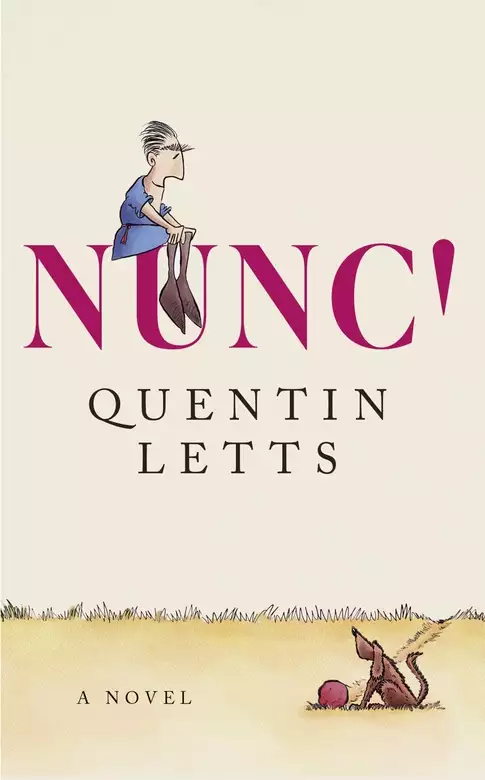
Jerusalem is ruled by rosemary-scented King Herod. By the bougainvillea in Deuteronomy Square, Reuben's tea stall keeps customers sweet with lemon koloochehs. Onesimus the greengrocer piles his polished pears and pineapples in ziggurats, blind harpist Tabitha captivates bachelor Pharisees, Roman sentries doze and the widower Simeon, beset by gout and befriended by a dog called Shlomo, watches the passing promenade. By day Simeon dodges bossy superintendent Kedar. By starlit night he contemplates lost loves and the visits of a bad-tempered angel.
Quentin Letts's delightful tales bring first-century Jerusalem to quirky life and show how the prophet Simeon, whose Nunc Dimittis became one of the great canticles of Christendom, can help an ailing twenty-first-century Englishman come to terms with his fate.
Nunc! is a gracious yet beautifully navigated meditation on life, love and death.
Release date:
April 3, 2025
Publisher:
Little, Brown Book Group
Print pages:
57000
* BingeBooks earns revenue from qualifying purchases as an Amazon Associate as well as from other retail partners.
THEY built things to last in ancient days and the cathedral town still had a stretch of its walls from Roman times. Luftwaffe bombers had failed to destroy it. So, more surprisingly, had post-war urban planners.
Alex Symons, an open-faced, corduroy-trousered Englishman, sixty-two years of age and on the cusp of corpulence, gazed at the wall through the car’s rain-streaked windows. The Vauxhall’s wipers whirred as the traffic waited for the lights to change. Anne would need to move into the right-hand lane but Symons resisted the urge to tell his wife how to drive. He no longer had the energy for that sort of thing.
His mind was on other things: this looming appointment with the specialist; and that Roman wall. Shoppers were scurrying past it without a thought, their capacity for wonder blunted, if it had ever existed, by a desire to escape the rain. Two thousand years those stones had stood. Grass withereth, flowers fadeth, luminous bone turns to dust, but masons’ stones endured. The one gap in the wall was where, in a burst of municipal energy in the seventies, a council bulldozer created a shortcut to the supermarket. Beside this pathway a sign, ordering cyclists to dismount, was now bent out of shape. It had been targeted by young vandals or, perhaps, the shade of a long-dead Roman builder affronted at modernity’s cheek.
Red, amber, green. An Audi estate was slow to release its handbrake and by the time Anne persuaded a lorry driver to let her switch lanes they missed the light. This gave Symons more time to contemplate the Roman wall. Anne raised a hand to thank the lorry driver. Her eyes were still on the rear-view mirror as she said: ‘I know you think I should have changed lane earlier.’
‘I didn’t breathe a word!’ said Symons. Then, more soothingly: ‘Thank you for driving.’ It wasn’t easy for either of them.
Right at Centurion Road, over a couple of mini roundabouts, then half a mile up the hill before you dipped left into the modern housing estate that had been built on former glebe lands. In ghostly acknowledgement of that, the roads had churchy names: Canon Crescent, Archdeacon’s Dell, Temple View. The windscreen wipers continued their wheezy routine as Anne turned the steering wheel and brought the car into Jerusalem Row where the Sinai heart clinic was found. She parked opposite the pay-and-display.
‘Five minutes early. Perfect. You wait here. Shouldn’t take long.’
‘I’ll come in with you,’ she said.
‘No, I’ll be fine on my own, poppet.’ He didn’t often call her that.
The clinic’s porch was littered by a couple of old sweet wrappers and, though it was months since autumn’s rot, a sycamore leaf as wide as a farmer’s palm. Inside, Symons found the receptionist reading a celebrity magazine. When she deigned to acknowledge his arrival he gave his name and made some small talk about the weather. She suggested it would ‘brighten later from the east’.
‘Oh, good.’
‘Simon, did you say?’ She began tapping at her keyboard.
‘Not quite. Symons with a y.’
The clinic’s muggy air carried a tang of cleaning fluids. Lockdown-era edicts about social distancing lingered on the noticeboard. ‘Are you our ten-past-eleven, Simon?’
‘Yes. An appointment with Dr Gabriel. Symons is my surname.’ From a speaker on the ceiling drifted a sentimental song. Helping us to relax this Monday morning, that was Eva Cassidy with the immortal ‘Danny Boy’ …
‘Ah yes, here you are.’ The receptionist settled into her patter. ‘Fill in a form while you’re waiting. The doctor’s just with another patient. Take a seat and you won’t have long.’
That was one way of putting it.
Presently a pensioner came wheezing down the corridor and was led away by a younger woman. ‘That was the eleven-o’clock, Mrs Pepper – used to run the jewellery stall in the Buttermarket,’ said the receptionist. She pressed a button to admit Symons to the corridor. ‘I’ll have your form if you’ve finished with it, Simon. Second on the right. No need to knock.’ And yet he did knock. He was not sure why. A cheap, institutional door yelped on its hinges and there came a tired ‘Enter’.
In Dr Gabriel’s room a plastic chair stood at the angle left by Mrs Pepper. Symons noticed a yellow box of tissues on the desk. ‘Thanks for coming,’ said the doctor as she completed formalities from the previous appointment. She removed her glasses, rubbed an eye, refocused and smiled weakly. Symons knew he was unwell but forty-something, over-worked Dr Gabriel looked worse. If she wasn’t careful, she’d be the first to peg it. A handbag lay open on the floor. Symons could see keys, mobile telephone, a tub of chewing gum, personal touches amid the bland carpet tiles. ‘You’ve come alone?’
‘My wife is outside in the car. She doesn’t like surgeries.’
‘Can’t say I blame her.’ A pause. ‘Look, the tests are not encouraging. I had a discussion with your surgeon last night. The prognosis has worsened beyond any point where it makes sense to operate. At this stage there is only so much one can do. I wish I could be more encouraging.’
‘I see.’
‘Your general practitioner and other colleagues will devise a pain-management strategy and do their best to make you less uncomfortable. The EOL sector is pretty good these days. It’s really out of my hands now. If this is any consolation, I doubt you will need to return here. Our part of the journey is complete.’
‘EOL?’
The doctor summoned some softness. ‘End of life. There is counselling available, for you and your family. People do often find that helpful. One patient’s partner told me it was even joyful. That may seem an odd word but this can be a time of heightened emotion and affirmation. It can be surprisingly positive.’
‘There’s no chance of improvement?’
‘One can never say never but we have tried everything.’
‘I’m pretty fit.’ Symons patted his gut.
‘You could pass for a man ten years younger. Your diet has been reasonable. You have never smoked; your drinking has been slightly below average; and your notes show that you have maintained an active lifestyle. I wish more patients were so disciplined. But there is no justice, just genes. If we had caught it earlier, that might have made a difference.’
‘You closed for lockdown.’
‘Lockdown was unhelpful. Lockdown was an anomaly.’
‘Jesus.’
The doctor looked away for a moment, as if contemplating a retort. Whatever it was, she thought better of it. ‘A nurse will visit you at home and talk through palliative pathways. We are blessed in this county with an excellent hospice movement, despite funding challenges. I wanted you to know as soon as we were sure. I wanted to tell you in person.’
‘Thank you for that. How many months?’
‘Six, maybe.’
She gave him leaflets. The health service was enthusiastic about leaflets. They offered helpline numbers and support groups’ email addresses. They explained what financial help the state offered patients below a certain income. Information on leaflets was of limited use, everyone knew, but the point was to be able to place something in a patient’s fingers, something physical to clutch, to have to remember to take home. It lent the day shallow purpose. When people visited a doctor they expected to be given something: a blister-pack of pills, a next-appointment card or in extremis a leaflet. When the receptionist saw patients leave with nothing more than a leaflet, she knew it was bad, insofar as she cared.
Symons was in a daze. Tight in the chest, he walked down the corridor towards the reception area. The radio was playing ‘Que Será, Será’. ‘Will we have rainbows?’ asked Doris Day before concluding that the future might not be ours to see. As he turned the handle of the outside door Symons heard the receptionist complain that her twenty-past-eleven was running late. The late twenty-past-eleven following the soon to be late Alex Symons.
Back outside, the early-April rain revived him a little. He splashed towards the car park. No rainbows were evident.
‘Well?’ asked Anne once he has settled himself in the passenger seat. She started the engine. It was easier to talk when the car was running.
‘Not terribly good news, I’m afraid.’
‘Another round of chemotherapy?’
‘Chemo was an option for the first cancer but not now. I may have gone through that hell for nothing. They say there is no longer anything they can do. Shall we go? The ticket expires soon.’
‘What do you mean, no longer anything they can do?’
‘The doctor said I have run out of options. I am dying, apparently.’
‘Oh, Alex.’
‘Knew I should have gone private.’
‘Oh, Alex.’ She started to crumple.
‘All they’re interested in is getting rid of us. Let’s go. Come on, don’t worry about it.’
‘You’ve been told that, and you want me not to worry?’
‘Shall I drive? You’re in no state.’ Though he had not been up to it earlier he now felt strong enough to drive, despite his gout. There was something to bite into now, something to confront, and certainly no time to waste sitting in the wrong lane at road junctions. They changed seats in silence. In the drizzle.
Back home they had a row. Neither of them had much felt like lunch. He had taken more painkillers than was stipulated for a dose. Anne feared it could harm his kidneys. Trying to make light of it, he countered: ‘That hardly matters now.’
‘I’m going upstairs for a lie-down,’ she said, colour on her cheeks.
A half-cut apple and sliver of ham remained on the plate where she had tried to eat. He picked it up and jettisoned the whole thing, plate included, in the bin. He slipped back into his coat, folded the newspaper into his pocket and hobbled round the block to Cloisters wine bar. Hock might help.
‘Small or large?’ asked Robin. Rob was a mate, probably his best, though the field of candidates for this title was admittedly small.
‘Half-carafe. Probably shouldn’t but what the hell.’
‘Lunch menu? The kitchen has pretty much closed but I can probably get them to do you something. The lamb casserole’s good.’
‘Bloody lamb.’ It was a running joke. Cloisters was known for its lamb and the chef cooked it pink. ‘Just wine, thanks. Good and cold. I’ll grab that table by the door. Can I borrow a pen? Might do the quick crossword.’
‘Here. I’ll bring the wine over.’
They had met as undergraduates at their college, St Luke’s, and shared digs in their final terms. A few years later Rob came to stay for the weekend with Symons and his first wife – not long before she died, poor love – and they were walking back to the house after a few beers when Rob noticed ‘For Sale’ signs outside a derelict chapel near the cathedral. Symons didn’t think Rob was serious when he announced, a week later, that he had made an offer on the place. It was swiftly accepted. With imagination and not too much capital Cloisters had quickly become a successful business. That felt like a lifetime ago.
The hock was cool and sharp. Symons made progress with the crossword and watched the late-lunchtime crowd: a few tourists, some hipsters with beards, a student being fattened up by his mum who was making a fuss about him being too thin. What a loud voice she had. A Range Rover stopped outside the bar and a county woman swept in amid clouds of scent and pink pashmina. She embraced a blazered man. Rob knew the woman – ‘Good afternoon, Scilla’ – and automatically brought her a large glass of vodka. A delivery boy, using his backside to open the door, arrived with two boxes of vegetables. He took them down to the cellars.
‘That traffic warden’s around, Ben,’ said Rob.
‘Won’t be a moment,’ shouted the boy. When Symons had first moved here you could park where you liked but the streets were now terrorised by a traffic warden called Keith. He was nicknamed ‘Kruel Keith’ because he seemed to take elaborate pleasure in dispensing penalties.
Hock and painkillers slowly worked their alchemy. Though the chest tightness eased, other problems did not. Where did one start with a pre-grieving wife? A Frenchman or American would declare his love with florid artistry but Symons was English. In thirty years he had never felt easy telling Anne she meant the world to him. If he agreed to see counsellors, they would only try to make him cry. How could you analyse something so instinctive, and now painful, as love for your wife? Shrinks went through the motions. There would be rote routines and sing-song clichés and more leaflets. He didn’t want that. He wanted to live. He wanted to drive his sporty Mazda down a country lane with sunlight glinting through the trees. He wanted to hit the ski slopes or sit by the fire with a whiskey for the autumn internationals. The doctor’s answer to his question about the possibility of improvement – ‘One can never say never’ – was as blunt as these people got. Six months felt insufficient. Even at his most pessimistic he had hoped for a little more than that.
An hour or so passed and Rob talked him into having a sticky lemon cake to mop up the hock. Symons slipped a mouthful to Solly, Rob’s spaniel. Solly had the best begging eyes in England.
‘You spoil that eejit dog,’ laughed Rob’s wife, Nora, from the kitchen, flour in her hair and over her apron. There was more on her nose. Rob and Nora, dark-curled and from Donegal, had married late. Some best friends would have been jealous but all Symons felt was pleasure that his friend had married such a fine woman.
As the wine and drugs drifted through his body he flicked on his mobile and trawled cancer chat-groups for information about cardiac sarcoma. No one was terribly cheering. In time an email arrived from Josh. ‘Hi, Dad. Any word on those test results? By the way, we’ve been to the hospital ourselves and we have news. Mia is pregnant! I think Mum guessed something last time we were down. Due date end of December. Could be a Yule baby.’ The message ended with a kiss.
Bad news he could tolerate. Good news was too much. His eyes began to swim and his chin pruned. Love for Josh overwhelmed him. It broke him to think of the boy’s happiness being ruined by this cancer. Josh was so decent, always eager to do the right thing, trying to obey the rules. How could he make sense of something so random and hurtful?
Symons slipped out of Cloisters unnoticed. He did not want anyone to see that he was upset. Rob might merely conclude that Symons had drunk too much, which perhaps he had, but that was not the whole story. A shrewish wind blew and Symons raised the collar of his coat. Everything felt accentuated, sharpened, every smell and sound and sight. He was in the world yet apart from it, hovering over it. Most oddly he had never felt more alive, almost above life rather than in it. Was it the drink doing this or was it those pills? Or simply this surfeit of emotion?
As he was walking through the cathedral close a cassocked verger came out of the main entrance’s wicket door and placed an advertising board on the pavement: ‘Evensong 5.30 p.m.’ That was in just over half an hour. A gust of choral voices leaked out through the doorway. Symons pushed on the small entrance and nearly tripped as he stepped over its lip. His gouty toe made its protests known but they were soon forgotten.
Churches have that same smell: polish, candle wax, flagstones, a suggestion of communion wine. Symons was not one to bob at the altar but that smell did at least persuade him to take his hands out of his coat pockets. The cathedral choir was practising in the stalls and it became apparent that the ‘Magnificat’ was causing problems. God had scattered the proud in the imagination of their hearts but the ‘scattered’ needed three syllables and a skittish rhythm. ‘Maybe one more time if you don’t mind,’ said the choirmaster. The verse flowed better this time. ‘Right, we’ll just canter through the responses. Then the “Nunc”, please.’
Symons took a pew to the back, by a pillar where he would be less obvious. After some hesitation he slid to his knees. Someone had gone to the trouble of embroidering these hassocks, after all, even if kneeling might exacerbate that gout in his right foot. What to pray? How to pray? Did prayer count if you only tried it when you were in a jam?
God, look after my wife. Have mercy on my son. Deliver the child safely. Josh will make a good father, better than me. Please, I’m barely coping.
It was no good. A toddler was wailing in the south transept, the gift-stall operator was packing away her wares and the choirmaster again interrupted the music to make further adjustments. Symons’s prayers remained stubbornly earthbound. He lifted himself back on to the pew and eased the numbness from his right leg just as the organist embarked on the ‘Nunc Dimittis’. ‘Lord, now lettest thou thy servant depart in peace.’ The men’s voices soared, soldierly in unison. When the two parts split at ‘and to be the glory of thy people Israel’, the tenors went nuts.
And now, at last, Symons felt an inner surge. The trebles and altos entered at the Gloria and the piece acquired a stately sway. The choirmaster became so immersed in the music that his shoulders were rolling. To the organ’s chords there was a thrust, a force, a richness beyond anything words could say. These musical phrases powered onwards, mocking stagnation, abandoning each brief settlement of harmony. Up at the altar the hard edges of the gleaming cross began to lose their definition and become fuzzier, giving way to an idea of different realities, a different age.
As in Cloisters earlier, Symons found his eyes brimming. Yet that was not the only explanation for this shifting perception, this blurring sense of transference. It was as if the ages were melting and . . .
We hope you are enjoying the book so far. To continue reading...

 Please log in to recommend or discuss...
