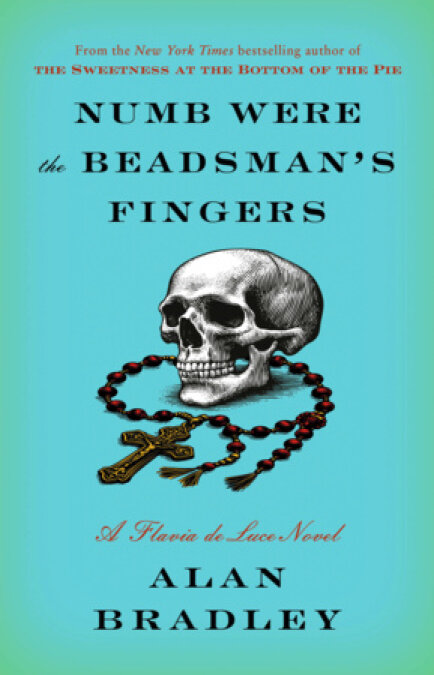
A nun’s corpse leads beloved amateur sleuth Flavia de Luce to uncover decades-old secrets in this charming final novel in the New York Times bestselling series.
“I love the Flavia de Luce novels! Flavia is the best female detective I’ve ever read, full of realism, self-confidence, and emotion (in roughly equal parts), and her tales are hilarious, engaging, and occasionally heartbreaking.”—Diana Gabaldon
In the cloisters of Golgotha House, a mere binocular’s-squint away from Buckshaw, a nun lies dead. When her fellow sisters prepare her corpse for burial, they discover that their companion has been living a shocking lie for years. The truth about her past, and the dark reasons she harbored for escaping it, are impossible to fathom.
Charged with cracking this mystery is the firm of Arthur W. Dogger & Associates (Discreet investigations)—consisting, of course, of the inimitable young Flavia de Luce and her faithful partner-in-detection Dogger.
Working under the eye of a glowering Mother Superior, Flavia and Dogger must uncover a decades-old crime and a secret that lies an ocean away—along with a trail of deception that lies closer to home.
Release date:
November 3, 2026
Publisher:
Bantam
Print pages:
256
* BingeBooks earns revenue from qualifying purchases as an Amazon Associate as well as from other retail partners.
“But when the Sisters of Clemency began to . . . well . . . disrobe Sister Garance, to wash and prepare her for the grave, they made the most shocking discovery.”
The speaker was Cynthia Richardson, the vicar’s wife, and we were alone in the vicarage kitchen. I leaned forward in eager anticipation, trying not to let my eyes goggle or my mouth hang open. Shocking discoveries among nuns were few and far between.
“The body,” Cynthia said, lowering her voice to a whisper and glancing back over each shoulder before continuing, “was that of a male: a man who bore the scars of a life hard lived, including several bullet holes. Healed, of course.”
“Holy crow!” I said.
“Flavia . . .” she cautioned me.
“Sorry, Cynthia. But what a ripping yarn.”
“It’s not a yarn, Flavia. It’s the truth.”
I let out a low whistle.
“Are you positive? Where did you hear a thing like that?”
“Denwyn was consulted,” she said. “But you mustn’t breathe a word.”
“Makes sense, though,” I said. “He’s outside the faith but utterly trustworthy.”
She sighed deeply. Much too deeply.
Even though it is said not to exist, my female intuition went off like a fire alarm.
Cynthia’s second sigh was a distress rocket from a sinking ship.
“Come on, Cynthia,” I said. “We’ve known each other my whole life. You can talk to me. You know you can.”
“The vicar’s wife,” she said, her lower lip trembling, “can talk truly to no one except the vicar. When in fact . . .”
She dissolved into tears, her shoulders shaking. She put her head down on the table and buried her face in crossed arms.
I was about to say, “Is it this stuff about the corpse in the convent?” but this was no time for stiff-upper-lip humor.
“Is it this business about the Sisters of Clemency?” I asked, patting her shoulder tenderly.
“No,” she sobbed, tossing her lowered head. “It’s Denwyn.”
Denwyn? Her husband? The vicar? It seemed scarcely credible. Whatever could that good man have done? But who was I to interfere?
Mrs. Mullet’s husband, Alf, had once told me that whoever listens to sides in a marriage quarrel is twice a target and twelve times an outcast.
“Tell me about it,” I said.
She mumbled something into her elbows.
“What?” I asked, perhaps too harshly. She resumed her sobbing.
I got up and took a fresh tea towel from the handle of the cooker.
“Here,” I said in a take-charge voice. “Use this to dry your eyes.”
She reached out and grabbed it, and for a moment the tea towel vanished into her tented arms.
Snuffling, she glanced up, her eyes wet and red.
“I’m such a fool,” she said. “Why didn’t I see?”
“See what?” I asked.
“Denwyn,” she said. “I think Denwyn’s been drinking.”
“Drinking? The vicar?”
She nodded so vigorously that a tear splashed onto the tabletop.
“Whatever makes you think that?”
“He’s been going out at night . . . staying out late . . . coming home smelling of alcohol. When I try to discuss it with him, he goes all oblique.”
“Are you sure? About the alcohol?”
“Flavia . . . if you knew anything at all about my family, you’d know that I recognize the smell.”
“Golly,” I said. “Sorry.”
“Don’t be sorry,” she said with a merry but artificial laugh. “It’s my fault. I shouldn’t have said anything.”
“Do you want to talk about it?”
“No,” she said, tossing her head and laughing. “It was a sudden loss of decorum. Have you ever had one of those?”
“Three times a day,” I replied. “Like clockwork.”
Cynthia smiled weakly. It was time to change the subject, and we both knew it.
“Tell me more about this mystery man. I’m dying of curiosity.”
It was a poor choice of words, but I was anxious to get away from the topic of her husband. Talking too earnestly about family makes me queasy.
“Well, it’s no easy matter,” Cynthia said. “Even after the body is identified, the man cannot, obviously, be buried in the sisters’ cemetery. They are hoping we can find a corner for him here at St. Tancred’s.”
“Out of sight, out of mind,” I said.
“Something like that,” Cynthia said. “We prefer to think of it as Christian charity.”
“What caliber were the slugs?” I asked.
“Oh, Flavia!” Cynthia said, physically recoiling. “What a horrid question.”
“Not to a curious mind,” I said. “Most bullet wounds in England are from a .455 Webley while those in America are from .38 caliber weapons, such as the .38 Special.”
I had absorbed this handy bit of knowledge from Philip Odell, the fictional detective on the BBC wireless series. “A Crook of the Highest Caliber,” the episode had been called, and I had made notes as I listened.
“Do you suppose the sisters would let me probe the scars?” I asked.
“Flavia!”
“Well, you can’t properly classify bullet wounds by poring over books of fairy tales.”
“In any case,” Cynthia said, changing the subject, “the Reverend Mother is anxious to identify the deceased and notify her family—sorry, I mean his family.”
“And the police,” I added.
“No!” Cynthia said. “As far as we are aware, no crime has been committed, and the sisters are hoping to have it passed over in silence.”
“As Christian charity demands,” I said with a grin.
“As Christian charity demands,” Cynthia said after an almost imperceptible pause. “Some of the sisters are pressing the Reverend Mother to find out by whom their order was infiltrated, and why. Others say that to pray properly for the soul of Sister Garance, they require a real name. This latter is perhaps a dubious claim, but in any case, the whole situation is unsettling. Tranquility must be restored at any cost. They thought that you and Dogger could quietly . . . well, to avoid calling in the police . . . look into Sister Garance’s prior history. To avoid any breath of scandal. I’m sure you understand.”
Aha! I did understand, and I ought to have seen it coming. Dogger and I had founded a firm called Arthur W. Dogger & Associates (Discreet investigations). The recently adopted capital D in Discreet and the lowercase i in investigations were intentional. Dogger and I knew how to draw in the jittery blue bloods.
“I shall consult my fellow principal,” I said, although I knew I didn’t need to. We had never discussed it, but I knew Dogger would be as keen on corpses in convents as I was.
I could barely wait to gnaw over the bones of a new case with him. So many questions were already rattling round my brain. Who was this man that had so successfully posed as a nun? From what, or whom, could he be hiding? What could he possibly have done to warrant such a strange deception? Would we be putting our lives in danger by meddling in his extraordinary secret?
“A word of warning, Flavia,” Cynthia said. “A Reverend Mother is a formidable individual: a most formidable individual. She has to be. You must not underestimate her.”
What an odd thing to say, I thought. Did Cynthia know more than she was telling me?
As if she could read my mind, she reached out and touched my hand tenderly.
“All I’m saying is this: God’s true servants have mighty and often unsuspected powers. It is well to keep that in mind.”
And with that she stood up and left the room, leaving me to make my own way out.
I had been given my marching orders.
We hope you are enjoying the book so far. To continue reading...

 Please log in to recommend or discuss...
