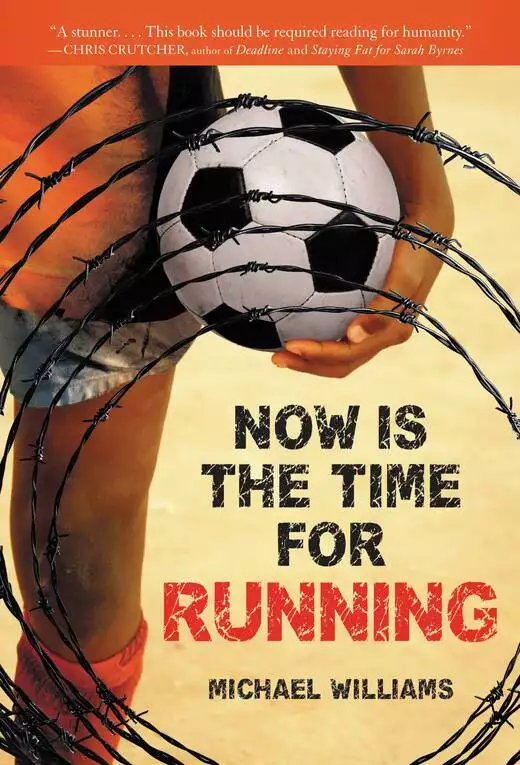
A captivating coming of age story of heartbreak, hope, and brotherly love, when tragedy strikes, Deo's love of soccer is all he has left—can he use that gift to find hope once more?
Just down the road from their families, Deo and his friends play soccer in the dusty fields of Zimbabwe, cheered on by Deo's older brother, Innocent. It is a day like any other ..until the soldiers arrive and Deo and Innocent are forced to run for their lives, fleeing the wreckage of their village for the distant promise of safe haven. Along the way, they face the prejudice and poverty that await refugees everywhere, and must rely on the kindness of people they meet to make it through.
Relevant, timely, and accessibly written, Now Is the Time For Running is a staggering story of survival that follows Deo and his mentally handicapped older brother on a transformative journey that will stick with readers long after the last page.
Release date:
March 12, 2013
Publisher:
Little, Brown Books for Young Readers
Print pages:
240
* BingeBooks earns revenue from qualifying purchases as an Amazon Associate as well as from other retail partners.
The game is 2-2 when the soldiers come in their jeeps down the path to Gutu.
Javu shouts at me. “Kick, Deo, kick!”
I catch the ball between my foot and the earth and point. “The soldiers are coming,” I say. The boys stop playing. They turn
to look at where I’m pointing.
The president must have sent them. Perhaps he has heard how hungry we are? Grandpa Longdrop said that when there was no more
sadza, no more cassava, and when the people cried with hunger, then the soldiers would come. He says our president will never let
us go hungry. Grandpa Longdrop is never wrong, but I have never seen soldiers bringing food.
“We can still win before they get here,” shouts Shadrack. “Kick, Deo. I’m open.”
I turn back to the game. Javu is out right, running wide. He has his hand up in the air, calling for the ball. If I pass to him, he will be blocked by Pelo the Buster. Javu could never
get around heavy Pelo, the best defender in Masvingo Province. Better to make some Deo magic myself.
I scoop the ball up with my foot, flick it up in the air, and head it past Bhuku, who is the plodder of the group. Shadrack
runs into the space to my left. This is going to be so easy.
The old one-two-three move. First touch to Shadrack, pushing the ball through the legs of Pelo, and then Shadrack sending
it back onto my right foot. A quick glance up at Lola in goal, crouching now, ready to save my cannon shot—or so she thinks!
I move to kick the ball with my right foot but don’t. The reason? Pelo the Buster is sliding toward me in a slow-moving heap
of knobby knees, thick shins, and big feet to collect the ball and to upend me. I toe the ball into the air, jump over his
legs, and kick with my left foot as hard as I can. The ball sails past Lola’s open arms.
“It was too high!” she shouts. “Too high!”
“She’s right, Deo. That’s too high.” Bhuku points at the imaginary bar my ball supposedly sailed over.
Innocent goes mad on the sidelines. He runs up and down, with his arms outstretched like the wings of an airplane, screaming,
“Goooaaal!”
“Innocent said it’s a goal,” I point out. “And he can see from where he’s standing.”
It is always like this. When Lola misses, then the shot is always too high. I’m not sure why we let a girl play with us, but
nobody else wants to be goalie, so she’s useful. I like Lola and I don’t like her. She can be friendly one moment and moody
the next. Innocent says that’s why he stays well away from girls—he can’t make up his mind whether he likes them or not.
“He’s your brother. Of course he thinks it’s a goal.” This is Bhuku again, all hands on hips, head cocked back as if he has
been robbed in broad daylight.
“No use asking that one. He’s crazy,” says Pelo, tapping his temple with his finger. “What does he know about—”
Pelo the Buster does not have the chance to finish what he’s saying because he has to deal with my fist in his mouth. Nobody
talks about Innocent in front of me. Pelo should know better.
Shadrack wraps his arms around me and pulls me away. Pelo is looking to give me some of my own medicine. I glare at him, daring
him to come at me, but he looks past me. Pelo the Buster can beat me any day of the week, but right now something else is
more important to him than busting my brains.
The jeeps carrying the soldiers.
I hear their engines. They are closer now.
The jeeps bump and rattle down the path where only cattle and villagers coming from Mlagisa Town and Embandeni Kraal have
walked. There are five, maybe six, soldiers in each jeep. Some of them are in full battle fatigues; others just wear army waistcoats and belts with ammunition. They all carry guns, porcupine quills pointing at the sky. They hold their
guns as if the weapons weigh nothing. As if they are not dangerous. But I know the terrible noise they can make, and I have
seen a cow cut in half from a burst of one of those guns. The soldiers look at us but don’t see us.
These men have been all over Zimbabwe. They went to Zaka when the people cried with hunger, but now the people cry no more.
They went to Chipinge when the people were angry from hunger, so angry that some of them were killed. Auntie Aurelia told
us that her niece was one of those who were hungry. She did not say how she bled to death. Auntie Aurelia cried for seven
days and then spoke about her niece no more.
The soldiers have been to faraway Kamativi, but no one speaks about what they have done there. And now they are here—in Gutu,
my home.
The president said the people should not be angry. He said we were hungry because the white man was blocking the food from
coming into our country. He is right about the problem of our food. We eat only enough to keep us hungry. I have heard my
amai talk to Grandpa Longdrop about food that is supposed to come from America, but it has not come yet. My amai is a teacher in Gutu. She has been writing to a church in America and telling them about how we have no food here.
The truckers no longer come from South Africa. They no longer bring stuff to fill the shelves of Mr. Singh’s shop in Bikita. Grandpa Longdrop said that the road from the south is
quieter than he can ever remember. Amai grows quiet, too, when he speaks of the road and its trucks. She has long since stopped
going to the gas station, hoping that one special trucker might come back.
I have stopped thinking about him too. Amai doesn’t talk about him anymore, and it’s hard to ask questions about him. She
cries or gets angry when I mention my father.
The soldiers drive past us. In the front jeep, a soldier sits with his boot up on the dashboard. He wears a red beret and
sunglasses. He raises his hand, and the jeep stops with an angry spurt of dust. The soldiers standing behind him grip the
crash bar. One nearly topples to the ground. The other jeeps pull up behind. Red Beret climbs out and walks toward us. His
face is a mask. I notice his black belt, his revolver in a leather holster, his heavy boots, and his shiny sunglasses. I do
not see his eyes but see myself twice in his glasses. I look small and bent out of shape, just a scrappy kid in blue shorts
wearing a no-longer-white school shirt and standing in the dust.
“You’ve got a good left foot. Bring me the ball.” He speaks, but I do not move. I am watching both of my scared reflections
in his glasses. My mouth is open. I close it and swallow.
Pelo runs over and hands him the ball. It is no proper soccer ball. It is a pouch of cow-leather patches sewn together with
twine, stuffed with tightly rolled plastic.
Red Beret throws my ball into the air and kicks it. The ball folds into itself. The men in the jeep laugh. He turns toward
them, and they shut up. This man has broken my ball.
I am only half scared now. The other half of me is angry. He didn’t need to break the soccer ball Grandpa Longdrop made for
me.
“I hear there are dissidents in this village. Is that true?” His words are soft. I cannot trust them. In his question I can
feel the metal teeth of a leopard trap.
I look blankly at him. If I say no, then he will know that I know what a dissident is, and then he will want to know what
I know about dissidents. If I say yes, then there will be more trouble than I can even imagine.
“Who does your father vote for?”
This is a question I can answer easily. “My father does not live here. He lives on the road.”
“And your father?” He looks at Pelo.
“The president,” says Pelo the Buster.
The man snorts as if this was the wrong answer.
“Your game is finished.”
He steps on the ball, which lets out a long fart. No one thinks it’s very funny.
“I will speak to the people of Gutu and find out if what you tell me is true.” The soldier is talking to all of us now. I
see us in his glasses. We all look the same: small, scared children in the red dust. He turns around and walks back to the
jeep.
I look around for Innocent. He is no longer standing beside the pitch. He is scared of soldiers and must have slipped away when the jeeps arrived. I should go and look for him, but I
cannot take my eyes off Red Beret.
He jumps back into the front jeep. We are forgotten now. He lifts his hand and makes a cutting gesture in the direction of
our village. The driver puts his foot down, and the jeep jumps forward, causing the men at the back to grab hold of the crossbar.
As soon as the jeeps are gone, we scatter.
I throw away the rolled plastic from my dead soccer ball. The leather pouch is all I need to make a new one.
I must find Innocent. Soldiers make him nervous. And when he’s nervous, he talks too much, and then there could be trouble.
Blood trouble.
The jeeps are parked in the center of Gutu. They are empty now. The soldiers are everywhere. I look for Innocent, but he is
gone. All around me, people are moving toward Red Beret. He watches us as if we are cattle being herded across a river. His
soldiers move from home to home, holding their guns in the air. Their faces show nothing. They neither smile nor shout. They
neither push nor pull. But still the people move as if they are being shouted at, as if they are being pushed and pulled.
“Deo, where is your brother?” My amai has found me. She looks frightened.
“He ran away when the soldiers came,” I say, not looking at her, knowing that she will be angry with me. Innocent may be ten
years older than I am, but I always look after him. I should not have let him run away.
“You must find him, before they do. Deo! Are you listening to me? Find Innocent. You must look after your brother.” Amai is worried, looking around but not seeing her special son.
But it’s too late. One of the soldiers walks up to us. I cannot slip away. Behind him, I see Grandpa Longdrop coming out of
our home. My amai calls to him, and the soldier allows her to fetch him. I feel better now that Grandpa Longdrop is here.
Grandpa Longdrop puts his arm around my shoulders and leads me to where everyone else has gathered. His hand may be wrinkled,
but it is strong. His face may look like the cracked, dried mud of the water hole, but his eyes are always kind.
“Have you seen Innocent?” I whisper to him.
He shakes his head and lifts his finger to his lips. Perhaps he has hidden Innocent. I’ve learned to expect the unexpected
from Grandpa Longdrop. He knows so much about everything that sometimes his words make me dizzy. He can tell you about the
planets. When it will rain and when it won’t, when to plant beans and when to watch for the calves to drop. How electricity
works and where the dead go when they die.
Of course he would kill me if he knew I called him Grandpa Longdrop. But the story of how he was born made me laugh so hard
that I always think of him as Grandpa Longdrop. Amai told me how her grandmother gave birth to her son while she was sitting
on the long-drop. She pushed too hard going to the toilet and if it weren’t for the umbilical cord, they would have had to fish the newborn baby out of the shit. Your grandfather is a survivor, she said to me. He survived
his birth, the liberation war, running the white man’s farm, and now old age—he can survive anything. His real name is Grandpa
Doro.
We face Red Beret, who waits for us to be silent. Lola and her family are brought forward. She has two older brothers, who
look scared. The soldiers hold them by their arms. Perhaps they were trying to run away?
We wait for Red Beret to speak.
“Bring me the food.”
This is not what I expected. Does he not know we have nothing, that there is no food here? I see the adults look at one another
as if he has asked them for diamonds, or gold bars, or television sets.
Food? Why would he want what we do not have?
“Bring. Me. The. Food.” One of the soldiers repeats Red Beret’s command. His words sound like the hiss from a snake.
All around me, the adults talk at once to one another. The men send the women back to their homes. My amai looks at Grandpa Longdrop with a question in her eyes, and he nods to her an answer I do not understand.
“Amai?”
She waits for Grandpa Longdrop to tell her to go. She is the last of the women to go to her home. I look up at Grandpa Longdrop,
and he squeezes my shoulder.
“We need to listen to these men, Deo. These are our president’s men. He has sent them here with good reason.”
Grandpa Longdrop loves the president. He fought with him in the war for liberation. He’s told me stories about how he met
the president when he was a younger man, how they fought together in the bush, how the president promised them freedom, and
how they won the war against the colonizers. Because he was loyal to the president, he was given a farm. It was good for a
while, living on that farm. I don’t know why we had to leave. Grandpa Longdrop doesn’t talk about the farm much. But he loves
the president and is a proud member of Zed, the president’s political party.
The women return with pots of porridge, a few ears of corn, plates of offal, pumpkin leaves, okra, black pap scraped from
the bottom of the pot, a basket of eggs, chickens tied up at the ends of poles. The pile grows in front of Red Beret, but
he does not look at it. If this is all the food in Gutu, a village of more than a hundred people, it is not very much. Looking
at what our neighbor has, I see that he has no more than we do. Pelo’s amai has brought her goat. It is skinny and bleats to be let free.
Amai brings our food. Red Beret watches her as she places it in front of him. He smiles at my amai with the grin of a hyena.
Grandpa Longdrop feels my muscles tense. He squeezes my shoulder in warning.
“This is not the food I am looking for.” Red Beret speaks again and pulls a paper from his pocket. “Who is the teacher in Gutu?”
I feel my amai stiffen beside me. She steps forward.
Red Beret holds out the paper and calls her with the. . .
We hope you are enjoying the book so far. To continue reading...

 Please log in to recommend or discuss...
