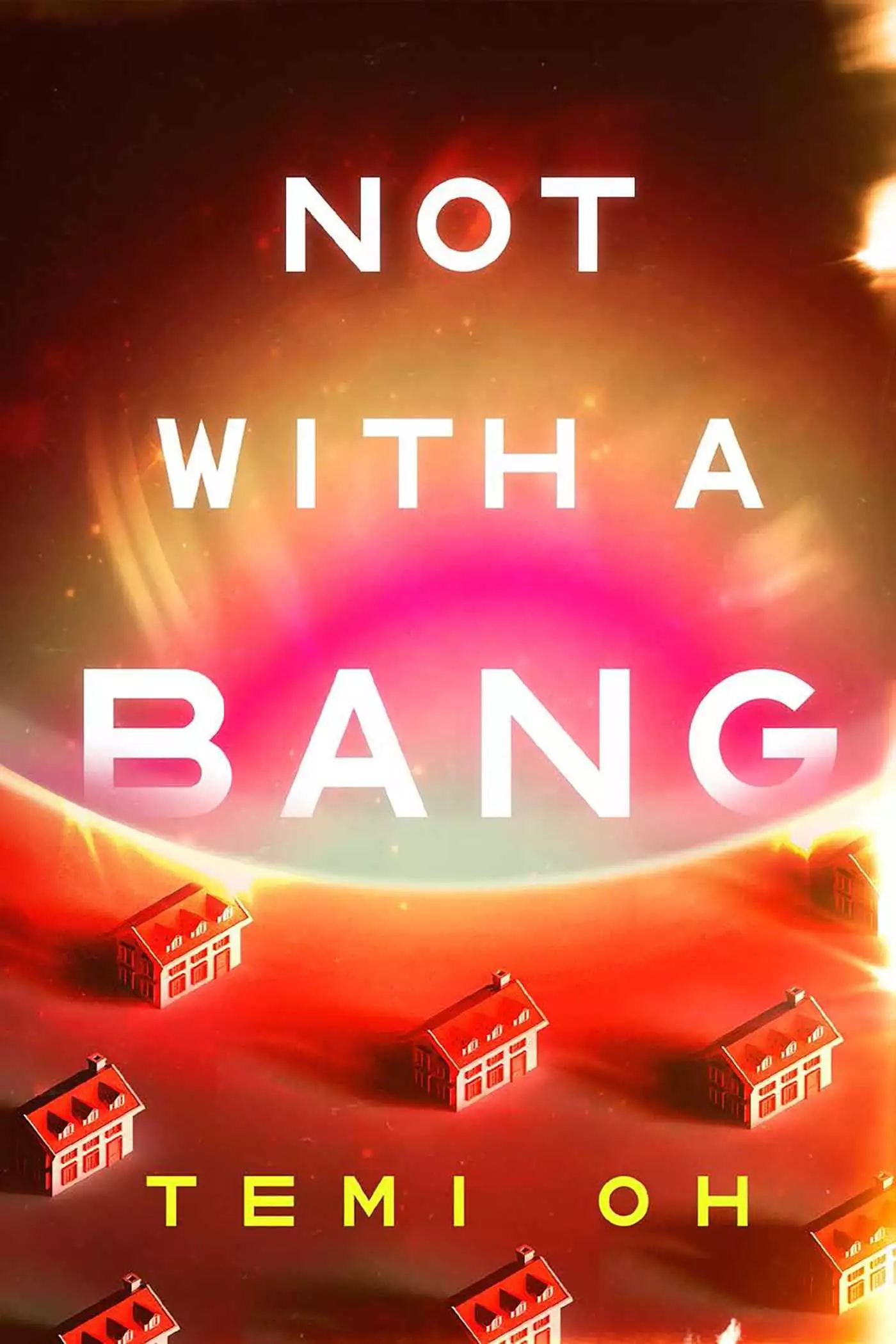
When the world finally ends, will you see it coming? Will you be prepared?
In the summer sky, a celestial object is fast approaching, due to slingshot around the Earth and disappear again. And everyone has their own theory on what it is – a meteor, a planet, aliens?
Meanwhile, the Minton family is in crisis. Briar Minton can’t stop thinking about the girl who went missing six months ago. Investigating her disappearance takes her down a rabbit hole, deep into the world of a cult and the extraterrestrial intelligence they claim is communicating with them.
At the same time, her father Marcus is becoming more unhinged after losing his job as a policeman, becoming obsessed with doomsday prepping and forcing his wife and four daughters along for the ride. He is completely convinced, and maybe even a little bit hopeful, that the apocalypse is imminent.
As the celestial object approaches, the Mintons reach breaking point.
Can they find their way back to each other, at the end of the world?
PRAISE FOR TEMI OH:
‘Spectactular… Science fiction at its best’ SAARA EL-ARIFI, Sunday Times bestselling author of The Final Strife ‘Fascinating’ GUARDIAN ‘Moving, powerful, and deeply human’ LOCUS MAGAZINE ‘A major new voice. Read Temi Oh today. Everybody will be reading her tomorrow’ STEPHEN BAXTER, author of World Engines
Release date:
July 14, 2026
Publisher:
Simon & Schuster UK
Print pages:
400
* BingeBooks earns revenue from qualifying purchases as an Amazon Associate as well as from other retail partners.
My mother would spend a couple of minutes every morning imagining what it would be like to lose everything she loved. The way some might count sheep, she counted backwards: the bed, the walls, her house, her husband, her daughters, one by one.
She’d picture the bed kneecapped by termites, white paint flaking off its four posts. The house snatched up in the blistering maw of some freak electrical fire. Steel herself against the thought. A bed was just a bed. A home was just a home.
Except she used to tell us that that bed was the loveliest thing she owned. That she hoped to be buried in it, hoped we’d lash it to a raft, her cool body under its quilted duvet, and set it sailing down the Thames.
“The Princess Bed,” our father teasingly called it. It was maximalist, bombastic, ostentatiously feminine, completely impractical—like my mother.
Five days before the world ended, she had been dreaming of an army of carpenter ants riddling holes into the magnificently carved headboard when her phone buzzed and startled her into wakefulness. She snatched it off the dresser.
An unidentified number. “Hello?”
“Is this Ms. Kimona Minton?” Leopard-skin dapples of sunlight fell on her muslin sheets.
“Doctor.”
“Sorry?”
“It’s Doctor Minton.”
There could be damp in the walls, in the joists and rafters. The house could crumble all at once like a diseased tooth. She tongued a familiar gap in her gums and imagined it.
Maybe it would be a relief. She’d never imagined she would grow old in the place where she had watched her own mother die, too young, of a tumour that had spidered through her skull.
“Claire? Is that you?”
“You have to answer these questions for security.”
“Fourteen Albert Road, Clapham, SW11…” She trailed off, glancing at the clock on the wall. It wasn’t even 7 a.m. “Isn’t this a bit early?”
“Sorry.” The voice on the phone was a little sheepish.
“Didn’t you say to expect a letter? That if the results were clear, I would get a letter. Not a call. A call is…”
“Yes…” Claire sounded hesitant. “Dr. Minton, the results from your biopsy—”
It was something about the tone of her voice. Kim felt a sick swoop in her stomach, terror and dread. Sweat needling the tips of her fingers. “Wait!” Slightly breathless. “Once you tell me, it will always be true.”
There was an arc to these stories, Kim knew. They began with some innocuous symptoms, headaches that were usually worse in the morning, fatigue, slight muscle weakness on her right side, a perfunctory visit to a GP, and ended with…
“Can I just hang up now and save my life?”
“You know it doesn’t work that way,” Claire said, not unkindly.
“It’s just, today is almost the worst day. My eldest daughter, Aaliyah, is getting married this weekend, and on Thursday we have this fancy rehearsal dinner and…”
“This is urgent.” Claire sounded as if she was losing her patience a little. “The sooner we start treatment…” she continued, but Kim stopped listening. She could taste bile in the back of her throat. Her eyes flitted out to the untended garden. Yellow sprays of dandelions across the sun-struck grass. Aaliyah had insisted they celebrate Kwanzaa the previous year, had decorated the house extravagantly in red, green, and black bunting that still hung on the washing line, cracking in the wind like her heart against her sternum. The sight was so familiar and suddenly strangely dear.
“Briar wants me to watch Hero’s approach with her…” I had set up a telescope on the porch ready for the night when the planet would hurtle into view. I had told her, “It’s a once-in-millennia event,” when I’d asked if she could take the night off work to watch it with me. “I’ll catch the next one,” she had replied breezily.
“This will only get worse if you ignore it,” Claire warned.
“Look, I’ll call you back later.” Kim moved to end the call and said, “By Sunday, it will be over.”
She meant the wedding.
For a long time, I believed that I hated my mother. If you’d asked me that summer, when I was seventeen, I would have given you a dozen reasons why.
She’d worked abroad for a couple of years when we were younger, leaving our father and grandfather to raise the four daughters she’d left behind. Motherless years of going to school without brushing our teeth, of matted hair and mismatched socks. After which, she’d returned a stranger to us.
It seemed to me that her whole self was a palace she built and rebuilt again every morning from the ground up. And always slightly differently. Stage makeup, mannerisms, hair. She had a variety of wigs that she kept on foam stands in her closet. There was the short black bobbed one she’d wear to parents’ evening, the auburn one she took on holiday, the ombré blonde for nights out. My favourite was the Afro she wore once to Notting Hill Carnival, which made her look like Erykah Badu. I can’t remember when I first discovered that they were wigs. But I do remember how, aged ten, I opened her closet to find those blind polystyrene heads lined up on a shelf like Bluebeard’s dead wives. Startled, I’d whispered, “Oh,” as if at the answer to a riddle I already knew.
It wasn’t just her appearance that changed; her entire personality shifted depending on who she was around. Her accent was full of cut glass when she spoke to her colleagues or the other parents at our school. But it grew round and undulant when she logged into Zoom calls with her cousins in Kwara State.
Sometimes she was a great mother, sometimes she wasn’t. Sometimes she was needy and affectionate, sometimes she was prickly and reserved. Her moods always seemed to affect the temperature in the house. That quicksilver crackle of her laughter from downstairs could coax the sun from behind a cloud. She could give something a sideways glance, and I’d go from loving it to despising it. I hated the power that she had over me. More than anything, because I was convinced that she didn’t love me. I used to try to get her to admit it.
One evening, a few months before the wedding, I said it quickly so as to catch her by surprise: “The house is on fire, who do you save?”
I was sure it would be Aaliyah. Longed-for Aaliyah, who they’d conceived after a couple of devastating losses. Our grandad used to joke that Aaliyah might as well have been gold-plated, and, for most of her life, they’d treated her as if she was. When I was ten, she’d won a scholarship to an exclusive tennis academy. She’d been on track to win her first Grand Slam title when she’d broken her wrist in a skiing accident a week before the Wimbledon Championships. A complicated fracture with severe ligament damage—specialist surgeons had told her she’d never play tennis again. At twenty-two, she’d remade her life, impressively, immediately. A couple of months later, she returned from a date to announce that she was engaged to the millionaire cousin of her former tennis coach, setting the wedding date so soon after her engagement that we’d initially—wrongly—assumed that she must be pregnant.
“I wouldn’t choose any of you,” my mother reassured me when I asked. “I love you all equally.” I was sure this was what the parenting books instructed her to say. She didn’t look up from her laptop.
Four years after Aaliyah was born, Mum had returned to school to study for a PhD, but she’d had to drop out when she discovered that she was unexpectedly pregnant with me. She said that she’d cried during that first ultrasound because she’d been so hopeful. After all that waiting and the losses, there was almost nothing more terrifying than hope. Watching the little early flicker of a foetal heartbeat projected on the screen in the clinic, she’d felt like a homeward-bound astronaut glimpsing Earth for the very first time.
“Okay,” I tried, posing the question a different way. “That planet, Hero, has peeled away from its orbit and is trundling like a bowling ball right for us. The collision will grind all our bones to salt. But there’s a space shuttle scheduled for launch just in time to save only one of us. Kim, which daughter would you choose?”
“That’s ridiculous,” she scoffed. The UK Space Agency had released a short press statement, claiming that Hero would pass through our solar system at a distance of approximately 0.08 AU. Current modelling indicates no risk to Earth. “And I hate it when you call me Kim.”
It never seemed possible that Tanice, my younger sister, could be her favourite child. You might have seen her eyes behind a visor in that historic photograph. That summer, Tanice had just turned sixteen. She was the most beautiful, the most like Kim. But they argued too much. The perfect symmetry of Tanice’s face might have destined her to move through the world with a kind of ease, but she was too acerbic and impetuous, lacking in some essential empathy.
I tried again. “You open the door, and a woman who looks exactly like you makes a claim on your life. She’ll only leave if you feed her three children. Which do you choose?”
I should have guessed that she would probably save Chantale. Chantale, the surprise late-in-life baby, her heart’s complete delight. When she played that game with herself every morning—mentally pulling apart her life as a boy might pull the wings off a fly—her stoicism always crumbled at the notion of losing Chantale. Who was seven. Who was scared of everything. Whose front teeth Kim still kept in her purse. Although she claimed she didn’t have a favourite, it was clear to see that when the promised floodwaters came for our house, Chantale was the one she would fling onto the life raft first.
“Briar?” she said, finally looking up. “Why are you doing this?”
Do you think of them as the “Before Times” as well? My memories of the beginning of that summer possess a kind of nostalgic loveliness. It was June, and exams were over. There was a heat wave coming, and the air smelled of pollen and petrol. If the year was a Ferris wheel, we were at the highest part, the end of the beginning, the longest days. Aaliyah’s wedding to look forward to. Summer holidays. I wouldn’t have said I was happy then, but I should have been.
It would be over before we knew it, and if we’d been scouring the news that week, we might have noticed some of the signs. Those plane crashes in Jaipur, the freak weather in San Francisco, the power failures on the space stations, those people on the Reddit forums who claimed they were all dreaming the same dreams.
For Mum, it began with the birds. When she hung up the phone that morning, the vacuum-sealed silence of the house was unnerving. It was Monday. Tanice should have been taking too long to get ready, playing her music obnoxiously loud in the downstairs bathroom. I might have been braiding Chantale’s hair in front of early morning children’s TV.
Kim pulled on her dressing gown and headed downstairs. When she called out our names, there was no reply. It was as if her family had been raptured.
She opened the front door to check for the car out in the driveway, and when she did she saw Hannah, the single mother from flat 7C across the road. She was standing on the tarmac in slippers and a nightshirt. Blood spattered on one shoulder. She seemed shaken.
“Are you okay?” Kim called, but she didn’t seem to hear.
She put on her slippers and walked out towards Hannah. As she did, her sole crunched something in the parched dirt of our driveway. “Ew.” There was a smear of blood across the beige rubber. For a second, she thought it was ketchup. A fried chicken bone some kids had tossed. But when she looked up, she discovered more corpses, strange explosions of blood and meat splattered across the hot asphalt.
“One hit me,” Hannah said, tilting her head to her shoulder.
Kim looked up at the sky, shielding her eyes against the sun, which was waxing behind fleecy clouds, as if she could plot the dying bird’s trajectory.
“Some kind of avian flu?” she suggested. There had already been an outbreak that year, and it was still difficult to get hold of eggs at the supermarket.
“Oh. Does this mean I’m infected too?” Hannah’s eyes widened with concern.
“No, no…” Kim said, when in fact she had no idea.
Gabriel—our other neighbour, from the new-build mansion whose outdoor bins were mainly filled with takeaway boxes and empty cans of protein powder—had been trying to pull his car out of the driveway when he noticed them. He wound his window down.
“Looks like someone shot them all,” he said.
“Do you think we should call someone?” Kim asked. The birds looked, to her, as if they’d made a suicide dive at high speed for the pavement.
“Pigeon funeral directors?” Gabriel teased. Hannah had tears in her eyes.
“No,” Kim said. “The council. Or environmental protection? DEFRA?”
“Yeah,” he said and rolled his eyes. “You do that.” They watched him drive away.
“Are you okay?” Kim asked Hannah again.
She wiped her eyes and nodded.
“It’s just the lack of sleep, you know… At first, I thought I was dreaming this. A rain of dead birds. Gross.” She shuddered.
“It gets better,” Kim said lamely. Hannah’s son was almost two. But then, there’s always some new shit, she didn’t add.
“Do you think it has anything to do with…” Hannah looked up at the sky. “The comet that’s coming?”
“You mean the planet,” Kim said. “Hero.”
“Right, yeah. That’s what they’re calling it now?”
It wasn’t possible to see yet in the sky.
“It’s not ‘coming,’?” Kim reminded her, the way the news anchors and scientists did. “It’s a flyby. It’ll be in our sky for a little while and then gone forever.”
“Yeah… hopefully…” Hannah said.
“Not ‘hopefully,’?” Kim said. “Certainly.” Hannah just nodded and continued gazing upwards.
In the beginning, my mother had treated the bunker like an illness Dad just needed to get over. It had started in February, a couple of days after his suspension, with digging. He’d woken one night as if from a bad dream, put on his gardening shoes and an old headlamp from the camping gear, grabbed a shovel from the shed. By morning, he’d dug deep enough to make his own grave.
Every time Kim’s gaze flitted to their wild lawn and the hatch in the ground, her gut clenched with fury at him.
The morning of the dead birds, we were all underground in our bunk beds. The hiss of the air lock woke us. Kim leaned down the hatch and said, “You’re going to be late!” She started making her way down. It was impossible for even Chantale—the lightest of us—to descend that ladder without a cacophony of squealing metal and groaning wood.
Our mother turned when her bloodstained slippers hit the ground. We must have looked like voles to her, three pairs of jet eyes in the gloom. The bunks rocked and whined as we rose.
Kim discerned the cyan glitter of her husband’s eyes at the back of the room.
“Marcus.” There was steel in her tone. “You said you wouldn’t do this anymore.” She was thinking about Tanice, who a few months ago had sprained her ankle so badly climbing out of the bedroom window that she’d had to use crutches for a week.
“I said I wouldn’t do it on school nights.” He’d just woken up, and there was sandpaper in his voice.
“Today is Monday,” she said, working hard to swallow back her fury. He’d been losing track of the days of the week a lot recently.
“It can happen at any time, Mum,” Chantale said, rolling out of her bunk and rubbing the grit from her eyes. The sight of her almost broke Kim’s heart. She wore an oversized camo jacket—Dad’s—on top of cartoon-print pyjamas, and there were a couple of healing scabs where brambles had scratched her bare feet.
“Okay, sweetheart, I know.” Kim ruffled her hair and said, “But if you don’t start getting ready now, you’ll be late for school.”
“It’s not like I asked for any of this,” Tanice said, rubbing her arms against the early morning chill. I wondered then if she was referring to the drills or our family in general. She’d fallen asleep in her basketball gear, baggy shorts, and a pink-and-black jersey that said RAINMAKER on the back. Yesterday’s mascara made gummy smudges down her cheeks.
“Aaliyah’s back on Wednesday,” Kim said. She’d been in Portugal for her hen party. “Then there’s the rehearsal dinner on Thursday… Can we put a pause on all this until after the wedding?”
Dad was hunched in a camping chair, on watch. “These evacuation procedures,” he said, taking off his glasses to rub at a scratch, “need to be second nature.” Then, his old motto, “We don’t lose anything by being prepared.”
“Don’t we?” I asked. For once, I was on my mother’s side. I had been thinking of the cold. Of Tanice’s fear of heights. Of how I couldn’t move into my own room because Chantale was jolted awake by terrors every night and kept sleepwalking into my bed, mumbling about the gas cloud, the solar flare, the whiplash of lethal power from our sun to our sole Earth. Of how Aaliyah’s rushed engagement was probably a sign of how desperate she was to escape our family.
“When the sh—” Dad bit back the word. “When things get bad up there, we’re going to want to be down here.”
“Dad?” Chantale asked. “When it’s the ‘real thing,’ can I bring a friend?”
“This isn’t going to be a sleepover, Chantale!” he hissed, then, through gritted teeth, asked, “Who?”
“My friend Isla?”
“From Brownies?” Kim asked.
Tanice rolled her eyes. “If we have to spend the rest of our natural lives listening to the two of them talk about ponies…”
“Isla has a family of her own,” Marcus said. “A father. It’s his job, really, to be prepared.”
Kim examined Marcus then, as if for the first time in a while. The problem with marrying someone born the same year as you is that you get to watch yourself grow old. His face had been like a Dorian Gray portrait of her own. There were the silver hairs she tucked under her wigs, there were the creases their years of money worries had etched into his brow, sunspots from every heat wave, bags under his eyes from four children’s worth of stolen sleep.
Chantale’s muffled sniffs were the first sign that she had started crying.
“Hey…” I reached down to hug her and felt how cold she was.
“But what if they’re not?” she said, pushing me away.
“What?” Dad asked. She was properly sobbing then.
“Prepared!”
Mum snapped and ushered all of us out of the bunker. Told us that if we were ready in twenty minutes, she would drive us all to school. Tanice helped Chantale out, still sniffling, and they headed into the house. I lingered outside in the grass, by the hatch, listening to the voices that echoed up its makeshift shaft.
“I told you,” I heard Mum say as soon as she thought we were out of earshot, “not to talk like that in front of the children.” I could imagine them at opposite ends of the bunker, their long shadows thrown across the steel floor plates.
Kim used to believe that my father had changed more than she had. Physically, perhaps. I’ve seen a photo from the first night they met, at the eighteenth birthday party of a friend, and, in it, Marcus looks like Kurt Cobain. He was too proud to wear his glasses, and so there is a faraway look in his shortsighted eyes. She had spotted him onstage, covering for the drummer in a cover band, and when she went to compliment him after the performance, he had been so embarrassed that he’d almost choked on his beer. He had been shy but kind. She’d loved the way he flicked his dirty-blond locks out of his eyes. He was the sort of white guy her friends used to tease her that she would probably end up with. She used to list in her head the things that she loved about him. He was a good cook, a good dad, a good dancer. He was honest, almost to a fault. He was loyal. A true romantic.
And yet.
“We can’t keep doing this, Marcus.” He searched her face as she said, “You know that thing that people say about frogs boiling? How they don’t notice the water getting hotter if it happens slowly? It’s like all of this. Ever since you lost your job—the drills, the conspiracy theories. The nightmares.”
“They’re not nightmares,” he argued.
“You think something terrible is about to happen. But maybe it already has.” My mother was thinking about everything that had happened last summer and that had led to his eventual suspension. But, as usual, my father swerved away from the topic.
Marcus said, “Have you heard of Flatlanders?”
“What?”
“They live in two dimensions; we live in four…”
“What are you talking about now?” She would have appeared especially tall because of how low the ceilings were. Flanked by neatly organized shelving units, labelled boxes of rice and pickles, packs of egg replacer and Angel Delight.
“Three dimensions of space, one of time. Imagine time, flat as a sheet of paper. And a little crease in it that allows us—me—to see…”
“To see what?”
He said it quietly. “The future.”
There was a stunned silence. I can imagine the incredulity on Mum’s face. Or maybe, by then, it was only disappointment.
How has this happened? she thought, a sinking in her gut. How had she ended up married to a man who’d built a doomsday bunker?
“More than ninety-nine per cent of the species that have evolved on Earth are now extinct,” Marcus continued. “Extinction is the rule! What makes you so sure that we will be the exception?”
“I don’t know,” Kim sighed. “Tell me which of those species built rockets or cultured penicillin or eradicated a virus?”
Marcus puffed in contempt.
“Is this about Hero?” Kim had seen the tabs open on his laptop, watched him late at night with his amateur astronomer’s star chart.
“I don’t know… maybe,” Marcus replied a little sheepishly. “What if the disaster is coming, and I’m the only villager shouting in the shadow of Vesuvius?”
Kim winced. “How many men in history have believed that they knew the day that the world would end?”
“And aren’t the doomsayers always right…” he pressed.
“… eventually?” Kim raised an eyebrow.
There was a calendar on the wall behind him with big crosses through the days we ran drills. Almost everything else in his life had fallen away, other than this. How long until he exhausts this morbid fervour? Kim asked herself, as she did almost every day. Running drills and stockpiling cans. Waiting for the world to flip around for him again. Waiting in agony, preparing, practising for something dreadful that would never actually happen.
“Maybe the thing that terrifies you,” she said, “is not disaster, not eruption or fallout.” She saw it clearly now, what was on the other side. “It’s this.” She gestured at the air, towards their inherited house—the one in the city he’d always longed to flee—the challenging daughters, the naysaying world. Maybe it was true for her, too.
“This life. Your little life.”
We hope you are enjoying the book so far. To continue reading...

 Please log in to recommend or discuss...
