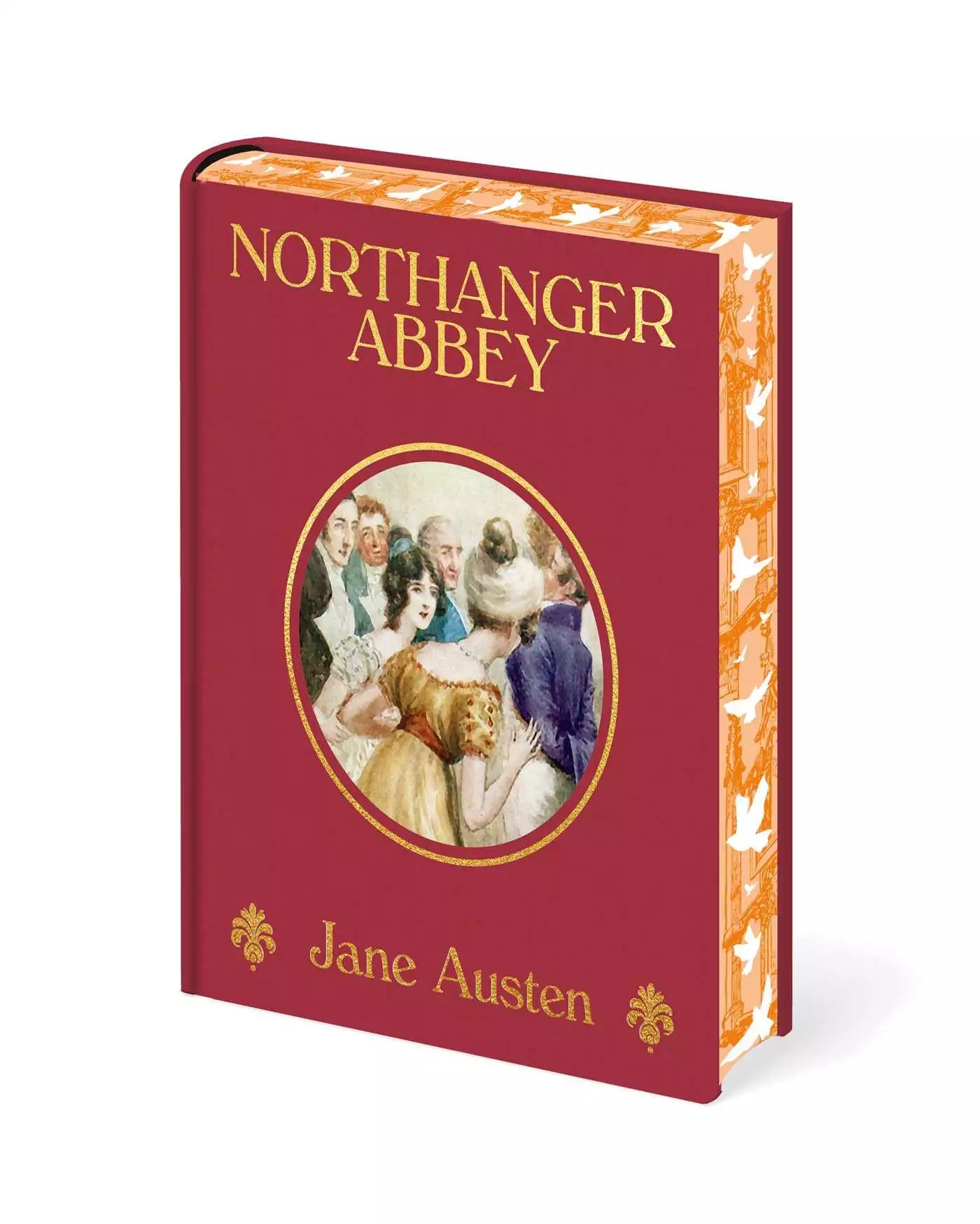
This elegant collector's edition presents Jane Austen's classic novel, Northanger Abbey, featuring gold cover embossing and gilded page-edges.
On Catherine Morland's first excursion into fashionable society, she meets the distinguished Henry Tilney and is invited to visit his home, Northanger Abbey. A devotee of Gothic novels, Catherine hopes that the Abbey will live up to her the haunted ruins conjured up in her imagination. But as she explores the mysteries of the house, her expectations lead her quite astray... While poking fun at popular fiction, Catherine's story also exposes the difference between illusion and reality, and shows how her artless approach to people attracts true friendship and love.
This beautiful pocket-sized gift edition contains the classic and unabridged text, presented with a gold embossed cover design, ivory pages, beautifully designed endpapers and goldgilded page edges. Part of the ArcturusOrnate Classics series, this book makes wonderful gift for any lover of classic literature.
ABOUT THE SERIES:Arcturus Ornate Classics are beautifully bound editions of iconic literary works across history. These compact, foil-embossed hardbacks are printed using deluxe ivory paper and make the perfect gift.
Release date:
November 30, 2026
Publisher:
Arcturus Publishing Limited
Print pages:
224
* BingeBooks earns revenue from qualifying purchases as an Amazon Associate as well as from other retail partners.
On December 16, Jane Austen is born in Steventon, Hampshire, England, to the Reverend George Austen and his wife Cassandra Austen (née Leigh). Jane is the seventh of eight children, six boys and two girls.
1776
The thirteen British colonies in America declare independence from Great Britain. The American Revolution, which had begun in 1775, will continue until 1783 and eventually pit Great Britain against several Native American tribes and European powers, including France.
1778
France declares war on Great Britain. Great Britain remains at war, often with France, during the following decades. These military campaigns will allow Austen’s brothers Francis and Charles to enjoy distinguished naval careers.
1783
A seven-year-old Austen is sent to boarding school in Oxford and then Southampton with her older sister Cassandra, but the sisters return home after a few months, due to a fever epidemic that has left them gravely ill.
1785
From July until December of the following year, Jane attends boarding school with Cassandra once again, this time at the Abbey School in Reading.
1789
The French Revolution begins. France remains in a state of upheaval for ten years, and the ersatz Comte de Feuillide—the French husband of Austen’s cosmopolitan cousin Eliza de Feuillide—will be executed in 1794.
1790
Having written satirical fiction for several years, a teenaged Austen composes Love and Freindship [sic], dedicating it to her cousin Eliza de Feuillide, who will marry Jane’s brother Henry several years after the death of her first husband.
1793
Austen likely begins to write Lady Susan. It remains unpublished during her lifetime.
1794
Ann Radcliffe publishes her gothic thriller The Mysteries of Udolpho, which figures prominently in Northanger Abbey as Catherine Morland’s favorite book. Udolpho is a best-seller.
1795
Austen likely begins work on an early, epistolary version of the novel Elinor and Marianne, which will later be rewritten and eventually published as Sense and Sensibility.
Beginning in December, a twenty-year-old Austen enjoys a serious flirtation with Tom Lefroy, the Irish cousin of neighborhood friends, but any chances of marriage are rendered unlikely due to the young people’s straitened financial circumstances. They apparently never meet again after he leaves in January of 1796.
1796
From October to August of the next year, Austen writes the novel First Impressions, an early version of Pride and Prejudice, which will become her most well-known and best-loved work.
1797
Cassandra’s fiancé, Tom Fowle, dies of yellow fever overseas. Cassandra and Jane remain unmarried and, except during some solo visits to friends and relatives, live together harmoniously in various households until Jane’s death.
In November, Austen’s father, impressed by First Impressions, sends an inquiry about publishing it to Thomas Cadell, who summarily declines the offer, without looking at the manuscript.
Austen begins reworking Elinor and Marianne into Sense and Sensibility. It will not be published for more than a decade, however.
Toward the end of the year, Austen visits Bath, a location central to Northanger Abbey, for the first time, accompanied by her mother and Cassandra; they stay with Mrs. Austen’s brother James Leigh Perrot and his family.
1798
During the late summer and early autumn, with her parents and Cassandra, Jane visits her affluent brother Edward at his estate in East Kent; there, she is regarded as a rather poor relation and has the opportunity to observe the manners of the wealthy.
Austen begins writing Susan, the first version of the novel that will later become Northanger Abbey. Despite Austen’s efforts, it will remain unpublished until after her death almost twenty years later.
1799
In May and June, Jane again visits the health resort town of Bath, this time with her mother and the household of her ailing brother Edward.
1801
After the Reverend George Austen retires, he and his wife, along with Cassandra and Jane (who continue to live with their parents since they are unmarried), move to Bath. Jane is initially reluctant to make the move but acquiesces even though she remains unenthusiastic about living in Bath.
1802
On December 2, shortly before her twenty-seventh birthday, Jane receives a marriage proposal from Harris Bigg-Wither, the younger brother of her close friends and former neighbors. Although she initially accepts the proposal, she calls off the engagement the next morning.
1803
After Austen revises Susan (later to become Northanger Abbey), her brother Henry sells the manuscript for ten pounds to publishers Crosby and Co., who advertise it but never publish it.
During either this year or the next, Austen starts working on her novel The Watsons; however, presumably distraught over her father’s death in 1805, she never completes it.
1805
After an extremely brief illness, the Reverend George Austen dies unexpectedly in January in the family’s Bath lodgings, leaving Jane, Cassandra, and their mother primarily dependent upon Jane’s brothers for housing and support.
1806
After some family visits, Jane, Cassandra, and their mother move to Southampton to share a home with Jane’s seafaring brother Frank and his wife, Mary. The Austen women’s unmarried friend Martha Lloyd (sister-in-law of their eldest brother James) accompanies them.
1809
Thanks to her wealthy brother Edward, Jane moves to Chawton Cottage in her native Hampshire with Cassandra, their mother, and Martha Lloyd. Jane lives here for the rest of her life.
1811
Sense and Sensibility is published anonymously on commission by Thomas Egerton in a deal that Jane’s brother Henry strikes and for which he generously pays. The novel sells out by 1813, with a modest but not insignificant total profit to Austen of 140 pounds.
1812
In November, the publisher of Sense and Sensibility, Thomas Egerton, pays 110 pounds for the copyright to Pride and Prejudice.
1813
Thomas Egerton publishes Pride and Prejudice in a three-volume edition. It gains favorable notice from the few critics who review it and finds a reading public. Austen remains anonymous: the work is advertised as having been written “by the Author of Sense and Sensibility.”
1814
Austen’s novel Mansfield Park, begun in 1811, is published by Thomas Egerton and sells out within six months, earning Austen 350 pounds, but Egerton decides not to risk publishing a second edition.
Austen begins writing Emma.
1815
Emma is published by John Murray on commission late in the year. (The title page is dated 1816.) The book is dedicated to the Prince Regent, an admirer of Austen’s work.
1816
Austen’s brother Henry repurchases the manuscript of the still-unpublished Susan (later Northanger Abbey) for ten pounds. Austen re-titles it Catherine and composes an “Advertisement” noting the earlier failed attempt to publish the work.
In February, a 750-copy, three-volume second edition of Mansfield Park is published by John Murray. This edition loses money, however, and the publisher later sets off these losses against Austen’s profits from Emma.
In late May and early June, Austen feels unwell; she travels with Cassandra to Cheltenham, presumably to try to improve her health by drinking the waters there. The author’s health waxes and wanes until her death the next year.
In August, Austen completes her novel Persuasion. It will be published posthumously.
1817
From late January to the middle of March, as her health continues to decline, Austen writes several chapters of a novel that will later be called Sanditon, a work that tellingly includes a satire on hypochondria and health cures. The novel will remain unfinished.
In the spring, Austen feels extremely weak, suffering from mysterious recurring fevers and exhaustion. She and Cassandra accordingly repair to Winchester in late May to seek better medical care.
Austen draws up her will on April 27. After a provision for her funeral expenses and a few modest bequests, she leaves the remainder of her estate, including any later sums due to her, to Cassandra.
On July 18, having suffered a severe fit the previous evening, the forty-one-year-old Austen dies before dawn in Winchester. She is buried in the north aisle of Winchester Cathedral.
1818
Northanger Abbey and Persuasion appear posthumously in a handsome four-volume set that includes a “Biographical Notice of the Author” by Jane’s brother Henry and Jane’s own 1816 “Advertisement” describing the publishing history of Northanger Abbey.
1843
Jane’s sister, Cassandra, burns most of the letters she has received from Jane; Cassandra also excises portions of several of the remaining letters that she wills to her nieces.
1845
Cassandra dies on March 22.
1870
Richard Bentley publishes A Memoir of Jane Austen by Jane’s nephew James Edward Austen-Leigh (the son of her eldest brother James).
1871
The second edition of J. E. Austen-Leigh’s Memoir of Jane Austen appears, again published by Bentley. Lady Susan and The Watsons, a superseded chapter of Persuasion, and a description of Sanditon are published for the first time in this edition.
1884
Lord Brabourne, Austen’s great-nephew (the son of her brother Edward’s daughter Fanny Knight), edits a two-volume Letters of Jane Austen, published by Richard Bentley in December.
1913
Jane Austen, Her Life and Letters, a Family Record, by Austen’s great-nephew William Austen-Leigh and great-great-nephew Richard Arthur Austen-Leigh, is published.
1932
Jane Austen’s Letters to her Sister Cassandra and Others, compiled by R. W. Chapman, is published.
1952
My Aunt Jane Austen by Austen’s niece Caroline Austen (the younger daughter of Jane’s eldest brother James) appears, published by the Jane Austen Society almost a century after its initial composition in 1867.
JANE AUSTEN’S 1818 NOVEL NORTHANGER ABBEY PROVIDES readers with the humorous domestic fiction many have come to enjoy in other popular Austen novels, such as Pride and Prejudice and Emma. Austen’s witty and acute portrayals of human foibles in this amusing love story ring as true today as they did in the early nineteenth century—modern readers will recognize many characters from the present day in Austen’s reckless drivers, teasing siblings, boastful braggarts, proud flirts, image-obsessed fashionistas, fickle frenemies, status-seeking parents, and loyal lovers. Moreover, along with providing the humor of social satire and the excitement of romance, Northanger Abbey has served to introduce generations of readers to a thrilling and sometimes unfamiliar genre—the gothic novel—via heroine Catherine Morland’s favorite book, The Mysteries of Udolpho. Thus, even as Northanger Abbey delights readers on its own merits, it also provides them with a gateway to exciting new literary adventures.
Jane Austen was born into a large, dynamic family of overachievers who provided her with an entrée to a variety of fascinating worlds. Born on December 16, 1775, at Steventon Rectory in England’s county of Hampshire, the young Austen was surrounded by relatives who wrote poetry, edited literary magazines, performed plays, preached sermons, managed farms, taught school, joined the Navy, got themselves adopted by glamorous distant relations, and conducted romantic foreign intrigues. While Austen’s formal schooling was limited, her own home provided educational resources aplenty: her Oxford-educated father, the Reverend George Austen, had married Cassandra Leigh, the accomplished niece of the master of Oxford’s Balliol College; together, the couple ran a boys’ school in their home while maintaining an impressive private library. Although she had begun writing humorous fiction before she was even a teenager, and although she had had the good fortune to be born into a family that both recognized her talents and encouraged her literary efforts, success came relatively late to Jane Austen. Indeed, when her father attempted to sell the first version of Pride and Prejudice in 1797, he was swiftly rejected. Austen’s attempt to publish an early version of Northanger Abbey in 1803 also came to naught. Even after her brother Henry had persuaded a publishing house to print Sense and Sensibility in 1811—when Austen was already thirty-five—the publisher insisted on printing it on commission, putting all the financial risk on the Austens. Fortunately, Sense and Sensibility sold out within two years. Austen’s greatest literary success came next with Pride and Prejudice, which was finally published in 1813 and was followed by Mansfield Park in 1814 and Emma in late 1815. As she had no home or fortune of her own, the unmarried Austen passed her adult life living with her sister, Cassandra, her father (while he lived), and her mother, with sundry other relations and friends joining their household at various points. Herself childless, Austen played the devoted aunt to dozens of nieces and nephews, maintaining a busy correspondence with them, encouraging their literary efforts, and counseling them upon their romantic affairs. Austen’s health began to decline shortly after she turned forty, and after suffering a series of mysterious fevers that her doctors were powerless to cure, she died peacefully at the age of forty-one on July 18, 1817, her head cradled in the lap of her devoted sister, Cassandra. Austen is buried in Winchester Cathedral.
Northanger Abbey details the entry into the wider social world of young Catherine Morland, who has never before left the village of her birth. Chaperoned by the ineffectual but good-hearted Mrs. Allen, Catherine navigates the fashionable spa town of Bath and grapples with problems any teenage girl might still face today—how to find a partner at a dance; how to discourage unwanted romantic attentions while encouraging a favored suitor; how to balance the competing claims of friends who seek her company; how to earn the goodwill of the family of the young man whom she likes; and how to deal with a drama-queen best friend. As she explores this new social world, the initially naïve Catherine eventually learns to decode the behavior of her love interest, the witty clergyman Henry Tilney; Henry’s sweet sister, Eleanor; and his tyrannical father, General Tilney; along with the boorish John Thorpe and his coquettish sister Isabella, the beloved of Catherine’s brother James.
The narrative also highlights Catherine’s love affair with the popular media of her day, particularly Ann Radcliffe’s 1794 novel The Mysteries of Udolpho, a best-selling thriller that had inspired many similar female gothic novels and was still immensely popular when Austen initially wrote Northanger Abbey, in which she parodies the genre of the female gothic novel as a whole. This genre, an ancestor of the modern detective story, often features young, orphaned heroines exploring secret spaces while seeking to discover hidden truths. Udolpho is no exception, as its orphaned protagonist Emily St. Aubert explores the creepy castle of Udolpho seeking the truth about awful family secrets, ghostly visitations, tragic deaths, and mysterious disappearances. Like a modern teenager blurring the line between her favorite television series and reality, under the influence of Udolpho, Catherine begins to interpret the world around her as if she herself inhabits a gothic novel, particularly when she visits the Tilneys’ intriguing ancient family estate, Northanger Abbey—with predictably problematic results.
Catherine’s unmitigated joy in reading Udolpho highlights a major theme in Northanger Abbey: the importance of striking a balance between the pleasures of reading and the judicious appraisal of what one has read. From a pro-reading perspective, Northanger Abbey uses characters’ ability to appreciate novels as a litmus test of their broad-mindedness and intelligence: On the one hand, the sexist and ignorant John Thorpe disdains Udolpho without having read it and speaks slightingly of all novels except two authored by men—presumably, he feels that most novels are too “feminine” for him. On the other hand, the egalitarian and learned Henry Tilney delights in Udolpho, noting unabashedly that he read it “in two days—[his] hair standing on end the whole time” and insisting moreover that men read “nearly as many [novels] as women” do.1 Based on these characterizations, Northanger Abbey clearly applauds reading for pleasure. Sounding a cautionary note, however, the narrative warns of the dangers of being carried away by what one reads: Catherine herself is nearly led astray by her tendency to view the events of her world through the spooky lens of Udolpho and is finally persuaded to rely more upon her immediate experience than upon the conventions of literature to interpret the world around her.
Due to her Udolpho-inspired investigations, Catherine can also be viewed as both an exemplar and a parody of the “almost-detective,”2 a protagonist of the female gothic novel who performs investigative functions but whose questions are generally answered indirectly instead of directly through her own efforts at detection and who has a strained relationship with both language and vision. Catherine certainly has a vexed relationship with language: “candid” herself, she spends much of the novel puzzling over the disjunction between people’s words and their deeds, ultimately developing the judgment to better interpret the social falsehoods and self-deceptions that surround her. Catherine’s problematic relationship with vision can be seen when she is herself caught snooping: rather than seeing what others have hidden, she herself becomes seen while attempting to evade observation. Yet while this “almost-detective” is proven technically wrong in some of her suspicions, she is actually a better sleuth than she appears: As Maria Jerinic aptly notes, “Catherine’s suspicions … are not completely unfounded.”3 While the specific crime Catherine postulates may not have occurred, she has correctly read the character of the person whom she suspects of committing it. Thus, as Thomas Keymer points out, perhaps Udolpho “has … not misled Catherine at all; on the contrary, [it] has helped her perceive [the character in question’s] nature more accurately than anyone else.…”4 Accordingly, instead of leading Catherine entirely astray, Udolpho has alerted her trusting heart to the very real possibilities of evil lurking in a seemingly sheltered domestic sphere.
Another element of Northanger Abbey that may intrigue modern readers is that this nineteenth-century novel appears to endorse a relative fluidity of gender roles. Perhaps unsurprisingly, given that Austen herself was surrounded by boys during her childhood, heroine Catherine Morland is first introduced as an active ten-year-old tomboy, “fond of all boys’ plays,” who “hate[s] confinement and cleanliness, and love[s] nothing so well in the world as rolling down the green slope at the back of the house,” and as a fourteen-year-old who values “cricket, baseball, riding on horseback, and running about the country.” This traditionally masculine childhood underlies Catherine’s teenage navigation of the traditionally feminine social roles that she is expected to fulfill as a consumer of fashion, a dance partner, and a potential wife. Thus, even at the apparent culmination of Catherine’s accepting her socially determined role as an adult woman, a hint of gender nonconformity still lurks: “Catherine would make a sad, heedless young housekeeper,” frets her mother, contemplating the possibility of the tomboyish Catherine becoming a bride with a household of her own. Just as Catherine presents a multifaceted version of femininity, so Henry Tilney demonstrates a complex version of masculinity: In the process of gently mocking Mrs. Allen’s fashion obsession, Henry showcases his own familiarity with the finer points of fashion, thereby implying that he can easily partake of an “overtly female sphere of knowledge,”5 as Darryl Jones describes it. As mentioned earlier, Henry likewise rejects any gendered restrictions on men’s reading; he notes: “The person, be it gentleman or lady, who has not pleasure in a good novel, must be intolerably stupid.” Thus, both the hero and heroine of Northanger Abbey reject strictly fixed notions of gender in favor of an androgynous liberty for men and women to pursue the activities that suit them.
As a counterpoint to Catherine and Henry’s more nuanced visions of femininity and masculinity, the ill-mannered Thorpe siblings believe in a war of the sexes. Catherine’s flirtatious friend Isabella Thorpe makes several declarations that characterize men as a uniform, monolithic other, such as “you men think yourselves of such consequence.” Isabella’s boorish brother John likewise characterizes women monolithically and simplistically, making assertions like “You women are always thinking of men’s being in liquor.” Ironically, the Thorpes’ protestations underline the fact that they themselves commit each of the faults they ascribe to the opposite gender. Thus, in their misguided attempts to acquit themselves of bad behavior, the Thorpes paradoxically end only in proving that bad manners and thoughtless behavior are equally the province of men and women, accordingly supporting the novel’s larger theme of gender fluidity.
Two important motifs running through Northanger Abbey—and indeed, through many of Austen’s novels—are the opposing concerns of, on the one hand, not having the fortune (or the parental consent) required to marry a desired partner and, on the other hand, being tempted to marry purely for mercenary or self-interested motives. Interestingly, Austen experienced both of these romantic difficulties herself. In terms of disappointed love, Austen’s letters record her daring but ultimately fruitless flirtation with her neighbors’ visiting Irish cousin Tom Lefroy at a series of local balls: “… I am almost afraid to tell you how my Irish friend and I behaved,” a twenty-year-old Austen writes to her sister, Cassandra. “Imagine to yourself everything most profligate and shocking in the way of dancing and sitting down together.”6 Unfortunately, the young people’s growing mutual interest may have been swiftly thwarted by their elders, as neither member of the couple had the funds to support a household; after this visit, the pair likely never met again. Conversely, several years later, when she was in her late twenties, Austen faced the counterpoint to this problem when she was offered plenty of money—but presumably not enough love—to support a marriage: On the evening of December 2, 1802, Austen received what must have been an unexpected marriage proposal from Harris Bigg-Wither, the shy younger brother of the close friends whom she was visiting, a man who stood to inherit great wealth and property. Austen initially accepted, but she soon thought the better of a match not based upon love, no matter how financially advantageous it might have been for herself and her family, and she broke off their ill-considered engagement the next morning. Perhaps in some measure due to Austen’s own experiences with these equally unappealing extremes, Northanger Abbey charts a middle course between the Scylla of a penniless love match and the Charybdis of an advantageous but loveless union—those characters in the novel who seek to marry for love are forced to be patient until financial means and parental approval can be secured, while those who wish to marry primarily from mercenary motives are thwarted altogether.
Northanger Abbey has a long and storied publishing. . .
We hope you are enjoying the book so far. To continue reading...

 Please log in to recommend or discuss...
