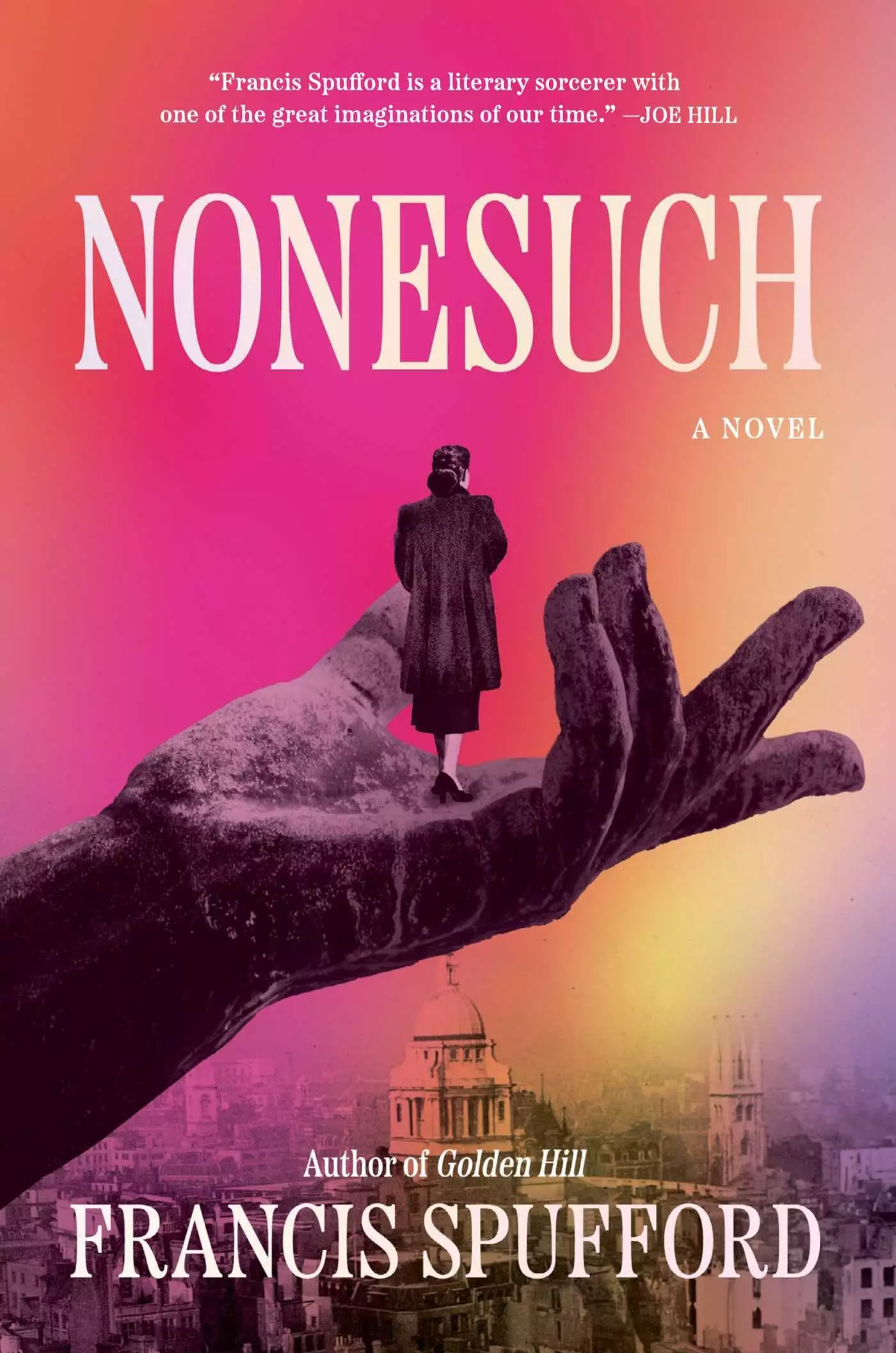
A spellbinding tale about an ambitious young woman who must thwart an occult plot by time-traveling fascists during the chaos of the London Blitz—from “one of our most powerful writers of wayward historical fiction” (The Washington Post).
Following the acclaim of his previous novels Golden Hill and Cahokia Jazz, Francis Spufford delivers a masterpiece of literary fantasy, hailed by Joe Hill as “a book that scoops up all the wonder and hope and pleasure of the Narnia novels, and pours it into a story for grown-ups.”
It’s the summer of 1939, and the air in London is thick with the tension of impending war. Iris Hawkins, a fiery young financial secretary, has a chance encounter with Geoff, a genius engineer from the new technology of television. What was supposed to be one night of abandon draws her instead into a nightmare of otherworldly pursuit—into a reality where time bends, spirits can be summoned, and history hangs by a thread.
Soon there are Nazi planes droning overhead. In a time when death falls randomly from above each night, when the streets are darker than the wildest forest and all the men are away in uniform, the defense of the city is in the hands of its women. But Iris has more to contend with than just the terrors of the Blitz. Over the rooftops of burning London, in the twisted passages between past and present, through the vast night sky and across the tiny screens of early television, a fascist fanatic is travelling with a gun in her hand, and only Iris can stop her from altering the course of history forever.
Both a thrilling page-turner and a profound exploration of ambition, love, and the fight against tyranny, Nonesuch is a story that is as enchanting as it is urgent. Packed with twists, tension, and wonder, it is a triumph of storytelling.
Release date:
March 10, 2026
Publisher:
Scribner
Print pages:
448
* BingeBooks earns revenue from qualifying purchases as an Amazon Associate as well as from other retail partners.
1. Wild Wood: August 1939 Wild Wood August 1939 i She was on the up escalator at Leicester Square Tube station, checking her lipstick in the mirror of her compact. On the other side, tired clerks and shopgirls were being funneled away downward, weary at day’s end, ready for home and supper, but over here, riding up past the panels of polished wood, past the framed advertisements for face cream and cigarettes, past the bronze torches throwing roundels of electric glow onto the tilted white ceiling above—over here she was in a chattering crowd, being carried up to pleasure on the ever-cycling treads of the magic staircase.
Up ahead was the circular ticket-hall, and the hot light of an August evening spilling into it from every exit. Up ahead were shows, dinner, dancing, the teasing and pleasing and tasting and smiling and satisfying of a West End night. A weekday night, true, not the dionysiad of a Friday or a Saturday night—and with the news pressing at it, pinching at the pleasure, trying to extinguish it with worry if you paid attention. But still with anticipation enough in it to quicken the pulse. Still with the hours of promise ahead. The air was warm and getting warmer. She was wearing the silver dress, bias-cut so it flowed over curves and clung there mermaid-close. It was right for the Savoy, but it needed protecting till she got there. Up to August, hem twitched in her free hand to keep it out of the treads. Up to the late-summer glow in the cheeks and the prickle at the hairline; up to city dust and city speed and city noise. Up to the twenty thousand streets! To the babble of the pavements, to the bray of horns and the bells and the shouts of the newsboys selling bad news and the snatches of music from opened doors. To the lively air, with all its smells of petrol and beer and perfume and tobacco and cooking food swirled into motion by the busy passage of human bodies. To the foyers of the theaters, where the crowds were in strict evening dress, and the democratic glamour of the cinemas, where people were dressed and dressed up any way they liked. Up to gold and to gilding, to dear and to cheap delight. Up to life, waiting to be seized, moment by moment, every chance not taken lost forever.
But as she stepped out into the evening on the Charing Cross Road, her senses busy, more was happening around her than her eyes could see or her ears hear. Above the billboards and the rooftops where the sunlight was ripening to orange-gold, the air over London quivered, and not just with heat. The August sky was furrowed with vibrations, but such fine ones, such fast and delicate oscillations, such minute needle-point jittering of the fabric of empty space, that she would have needed to be an organism made of something finer than flesh and blood to feel the quick waves moving. Or to turn on a radio. It was humans who had written themselves onto the air, after all, adding the means to carry their own concerns along on the slight accelerations, or the slight deformations, of what was traveling along up there anyway. Twist that dial. Between the bands of crackle were flying voices in all the languages that filled the sixteen skies of Europe, and skimmed more weightlessly than midges over the waters of the Rhine and the Danube and the Thames and the Volga. Fearful voices, complacent voices, threatening voices, triumphant voices, all reporting what Mr. Molotov had agreed with Mr. Ribbentrop, and repeating Poland, Poland, Poland. And music! Europe danced tonight, frantically, to a babel of rhythms. Congas in Paris, violins in Vienna, kettledrums in Berlin, saxophones in Soho, an impossible orchestra. Last, among the voices and the instruments, a single signal, very recent, carrying pictures. One fuzzy thread of images. Turn the dial to the needle-fine shaking of the sky at 45 million hertz, and what was that? A white pill of light streaked across a gray herringbone soup that was meant to be grass. Len Hutton, 165 not out, was hitting the last ball of the last Test match before war stopped play. A draw against the West Indies. Another fraction of a turn and it was only the thick hiss of static again in the shaking sky.
Charlie Tremlett was waiting for her at the steps of St. Martin-in-the-Fields, looking exactly like what he was: a floppy-haired overgrown schoolboy, with a schoolboy’s straightforward appreciation and gratitude for what felt good. A pleasantly rangy sportsman’s body. Honorable according to his lights; too dumb for complications, in her experience so far. As she approached he was taking a pull from a flask, which he tucked hastily away. It seemed a bit hasty altogether for the very beginning of an evening. She didn’t think of him as a drinker, except in the ordinary social sense. But then when she got close she saw there was an expression on his face she was unfamiliar with, and it deepened as he took in the silver dress. Disapproval? No, embarrassment.
“You look ripping, Iris,” he said.
“But?”
“What do you mean?” he said.
“I mean, your next word is obviously going to be ‘but.’ You look ripping, Iris, but something. But what?”
“Oh, I get you. Well. The thing is, here you are, all dressed up—and the chap we’re meeting up with, and the girl he’s got along—well, they’ve rather put the kibosh on the Savoy. They’ve booked us a table for supper at some frightful little Eyetie place in Soho. And I sort of have to go along because—well—you know how it is—”
She did. Because Charlie was a jobber on the Stock Exchange floor, by all accounts a reasonably effective one, he depended for his income on a flow of orders from brokers like tonight’s chap, who needed therefore to be cosseted, gone along with, indulged in whatever their idea of an agreeable time might be.
“I’m most frightfully sorry,” Charlie said, sounding as if he were about twelve and on the headmaster’s carpet. “Feel like I dragged you out under false pretenses. And you looking so glamorous too.”
“Never mind,” said Iris. “Not your fault. Come on then, let’s go and butter up your broker. We can always double back to the Savoy later, and do a little dancing then. And things. No rule against that, is there?”
“No,” said Charlie, brightening. “No, there isn’t. Thank you. You’re a wonderful girl.”
“And don’t you forget it,” she said, and took his arm, having restored the gleam of anticipation to his eye. Probably to hers too: the advantage of a really expensive hotel, especially if you kept the desk staff well-oiled as Charlie took care to, was that they operated by quite different rules of respectability. The beds at the Savoy were wide, firm and comfortable.
“So, who is this chap of yours?” she asked as they were heading north.
“Bit of an odd fish, actually,” said Charlie.
“In what way? You know, apart from his thing for spaghetti.”
“Oh, very good.—Well, he’s terribly clever, and apparently he’s some kind of socialist,” Charlie said, with the air of one naming an obscure disease.
“You don’t get many of those in the City.”
“No! But Cleaverings don’t mind, it seems, because he is so clever. Makes them a packet, even if he disapproves. And he hangs about with all sorts of nobs and intellectuals—tries to teach the Labour front bench the financial ABC, that sort of thing.”
“Charlie—” she said uncertainly.
“What? Oh good grief, what a hole.”
They were standing in front of a narrow slot of a restaurant next to an Italian grocer’s, sharing with it a strong mingled smell of good olive oil and garlic. It wasn’t a hole, though it had none of the Savoy dining room’s chromium and chandeliers. It was dim, with candles on the little round tables, but the side wall had a mural on it receding into chiaroscuro that had Serious Art written all over it. She could tell what kind of place it was, and who its habitués were likely to be, even if Charlie couldn’t, and she hesitated on the threshold. But he was already through the door, grinning cheerily.
“Miles, old man!” he cried. She followed.
The odd fish was seated about two-thirds of the way back into the gloom. He had one of those male faces which, even when its owner is still in his twenties, shows what he will be like in confident middle age. Lidded eyes, hair receding from temples gleaming in the candlelight. He stood up.
“Charlie, good evening,” he said. “May I introduce Eleanor?”
His companion, sprawled in her chair in a tweed skirt and a frayed brown jumper, lifted the hand that was holding a cigarette from table height to head height in salute. She seemed to have a bandage round her wrist.
“Hello!” said Charlie. “This is Iris. Lovely girl, works at C&B.”
“Good evening,” said Charlie’s broker again. “Miles Ormond.”
“Hallo,” said Iris, “Iris Hawkins,” and heard Watford unmistakably in her own vowels, as if she had whole avenues of prosperous-but-not-posh suburbia tucked away in there. And the Girls’ Grammar School. And the future she hadn’t wanted, in which a good girl could hope for a nice young man with prospects in the building trade, or a solicitor’s office. That world, lost but refusing to be gone, inexorably following her around and speaking out of her mouth.
“I hope you don’t mind,” Ormond said, “I took the liberty of ordering the wine. Montepulciano. Pretty good, I think.” He poured.
“Oh, vino is vino, as far as I’m concerned,” said Charlie. “In vino veritas, hahaha. Cheers.”
The wine was black with occasional garnet points in the candlelight. Iris looked at Ormond’s Eleanor across the table, and saw nothing to contradict her fears and everything to confirm them. Short red curls, darkened like the wine in the gloom. No makeup at all. No nail varnish either; gray stuff under the fingernails instead. Eleanor looked back, something in her face that Iris very much did not want to kindle into amusement.
“What a dress,” she said, blowing smoke, and her voice—oh of course it did—had the ringing confidence of Oxford women’s colleges, and radio announcers, and actresses trained at RADA. “Very glamorous indeed. Almost Hollywood.” Her tone was not hostile. More zoological.
“Isn’t it marvelous?” said Charlie. “Trust Iris for the glad rags! So, what are we eating?”
Ormond passed across the menu. Charlie furrowed his brow at it.
“I thought I was dressing for a different kind of evening,” said Iris quietly. Charlie shot her a look of reproach, evidently taking this as unhelpful criticism of their hosts.
“I can see that,” said Eleanor, kindly. “Don’t worry: you really do look marvelous. I couldn’t wear anything like that. I ruin good clothes just by looking at them.”
“Bis-tecca al-la Fi–, alla Fi—” Charlie spelled out. “Is that a steak? I could inhale a steak tonight very happily.”
“What happened to your hand?” Iris asked.
“Chisel slipped,” said Eleanor briefly. “Occupational hazard. ’Nother one for my collection of cuts and bruises.” She put out the cigarette, and spread her fingers in the candle glow. They were covered in little white lines that Iris realized must be scars.
“Just don’t actually chop anything off,” said Ormond mildly. “I like your hands with all the fingers attached. I’m fond of them.”
“Gosh,” said Charlie. You could almost see, marching across his forehead in illuminated letters like a headline at Piccadilly Circus, the words YOURS IS A RUM ONE, ISN’T SHE? The idiot still hadn’t grasped the situation. “So, sorry, is that a steak?”
“Yes,” said Ormond. “What about you?” he asked Iris. “I thought I’d fill Eleanor here up with liver and sage, while I had the chance. She could do with the iron. Internally, not externally, for a change.”
He had a way of saying something funny, she saw, while remaining completely straight-faced. It might not have been a test, but ignoring the joke seemed like a short way of demonstrating that she wasn’t worth joking with.
“I’m not in a very ferrous mood,” she said, and Ormond tilted his head an appreciative half an inch: probably his equivalent of a hearty guffaw. “Would you choose for me?” Iris went on. “I don’t really know my way around Italian food.”
“Surely. How hungry are you, if you don’t mind my asking?”
“Reasonably.”
“Very well then, one reasonable Italian supper coming up.” Ormond summoned the waiter—summoned him by name—and then ordered, at length and in Italian, for all of them.
“The gift of tongues!” said Charlie. “My mother spoke French, but somehow it passed me by.” He had downed his glass of wine and he was getting pinker.
“I don’t expect you’ve ever needed it,” said Eleanor.
“That I have not,” agreed Charlie earnestly. “Always happy to stay with the colonial issues and the Kaffirs, you see. Can’t specialize in everything.”
“ ‘Kaffirs’?” said Eleanor, raising an eyebrow.
“South Af—” Iris began, and at the same time Ormond said, “Mining stocks.” He stopped and waved his hand at her to proceed.
“Shares in South African mines,” said Iris.
“Yes; and talking of that,” said Charlie winningly, “I had a thought or two you might be interested in.”
“Really?” said Ormond. “It’s hard to believe there’s going to be much of a private market for gold, for the next little while at least.”
“You mean because of the news,” said Charlie. “Come, come, my dear chap: Don’t people always make a bit of a beeline for gold when there’s a crisis? And I’ve heard—” Off he went, into a sales pitch for the splendid prospects of a particular mine under development west of Johannesburg. Ormond listened courteously, and went on listening while waiters brought an array of plates and dishes of all sizes. In front of Charlie they placed a steak, sizzling. In front of Iris, two green and purple figs, with a tiny cream cheese in the shape of a heart.
“Oh, that’s very nice,” said Eleanor. She had been served what looked like a piece of toast, with a smear of tomato on top.
“Would you rather swap?” said Iris.
“No!” said Eleanor, laughing.
Iris cut herself a small wedge of fig and dabbed it cautiously with the cheese. Her only previous acquaintance with figs was with the dried kind, offered as a constipation remedy or the filling of a biscuit, and she was expecting the same slightly fusty, gummy sweetness. Instead the combination was… delicious.
“Good, isn’t it?”
She took another mouthful. Charlie talked on; Ormond listened on, eating something unidentifiable with a fork, and expressing with the set of his shoulders a sardonic disbelief which Charlie seemed totally unable to read. The two women looked at each other.
“You’re a sculptor?” said Iris.
“Yes,” said Eleanor. “At the Slade.”
“Well, it was either that or a painter, as soon as I saw your nails.”
Eleanor turned the hand that was holding her toast-thing, and regarded them complacently.
“Filthy, aren’t they? You can get the stonedust out, but it takes so much scrubbing, and they’ll only get like that again tomorrow, so why bother.”
Iris looked down at herself, silver-clad, manicured.
“I suppose you have to, if you work in an office,” Eleanor offered. “So what do you do?”
“I’m a secretary,” said Iris.
“And is that interesting?”
Iris gave this question the answer it deserved, which was none at all. She pretended instead to be fully occupied by cutting up and eating the figs and cheese, but its deliciousness was of the miniature variety, and all too soon she had to look back up. Eleanor, with a puzzled expression, was trying to catch Ormond’s eye. Probably in a moment she would succeed: Charlie’s continuing sales pitch for gold stocks was taking on a hectic edge, as Ormond was responding less and less. He had finished whatever-it-was he had been served and was gazing into his wineglass, bored endurance legible on his face. It was seeming less and less likely that the end of the meal could be reached successfully.
“So,” Iris said suddenly, to Ormond. “What assets do you think make sense, if war comes?”
Charlie glared at her. She had never tried to get him out of a conversational jam before, it not having been that kind of connection, and he did not seem to welcome the idea of being helped. Perhaps he didn’t recognize that that was what she was doing.
“When war comes, surely,” said Ormond.
“You think it’s as certain as that?” she began to reply, but Charlie talked over her.
“Oh come on!” he said. “We don’t know, do we? A year ago, war looked like an absolute sure thing, panic in the streets and all that, I was talking to my old dad about a billet in the East Surreys, ready to do my duty—and then it made a noise like a hoop and rolled away. No war. Everyone calmed down again. My money says: same again. The johnnies in the Foreign Office will do their stuff and this time next month, we’ll all be laughing about it. Don’t you think?”
“I’m afraid not,” said Ormond. “This time, from everything I hear, we’re in for it.”
“Where should the clever money go then, if not gold?” Iris asked him. “America? Is that far enough away?”
“Interesting,” said Ormond, turning slightly to face her. “Probably yes, in the sense that, if the world burns, it would take a long time for the flames to reach Wall Street. But not necessarily for British investors.”
“Why?”
“Iris!” said Charlie between his teeth.
She ignored him, and so did Ormond.
“Because I cannot imagine any way for Britain to fund a war—a big war—without mobilizing British holdings abroad. The paperwork is already drawn up to forbid the export of capital. When war comes, and the money runs out, every share that anyone owns over here in Westinghouse or US Steel or Paramount Pictures is going to be requisitioned in short order.”
“The money runs out?” Charlie repeated incredulously. “The money runs out? Poppycock. Sorry, but—really! This is the financial capital of the world, old man.”
The waiter was hovering, trying to take away plates and to put down new ones, but Ormond was ignoring him; he was leaning into the candle flame to light a new cigarette, fully engaged for the first time.
“Take the total of British gold and dollar reserves,” he said. “Slightly north of five hundred million in sterling. Then estimate the cost of total war—say, four million a week—and divide by it. The money runs out in two and a half years. And that’s if we’re winning.”
“Of course we’d win,” said Charlie. He poured himself another glass of wine, sloppily.
“I hope so,” said Ormond. “I really do. But whether we’re winning or losing, the emphasis—to answer your question, Iris—is going to be on budgeting for survival, by managing demand and directing resources.”
“You’re assuming that Mr. Keynes is going to be in the ascendancy at the Treasury?”
“I am, yes,” said Ormond.
“Despite everyone still arguing about the General Theory?”
“Oh, you don’t have to agree with it to be influenced by it. You don’t even have to have read it. He’s won; he’s won so thoroughly he’s become part of common sense.”
“Voices in the air?” said Iris.
“Exactly!” said Ormond, laughing. “Exactly so. You’ve read it yourself then, I take it?”
“Yes, I have.”
“And… what did you say you do for a living, Miss Hawkins?”
“She says she’s a secretary,” put in Eleanor.
“Hmm,” said Ormond.
“Iris!” hissed Charlie. “You’re making a fool of yourself.” He was staring at her as if she’d grown a second head.
She was just as surprised. She had had no clue that anger was anywhere close under Charlie’s amiable surface. On the whole she was confident she could spot the angry men and steer clear of them. You had to be able to, if you were of any kind of adventurous disposition.
“One of us is,” said Iris. Eleanor was looking from person to person. There was a sharp burn in Iris’s leg. Charlie had tried to kick her under the table, and missed, and got the side of her calf instead, by the feel of it scraping off some skin.
“Now,” said Charlie, with a tight and over-toothed smile, “that’s all very well, but it’s a bit airy-fairy for a practical chap like me. Not to mention desperately gloomy! Wine, women and song are more my watchword. Watchwords, I suppose. Three of them!”
Iris was gazing at her plate, where little pale parcels dribbled with green oil had appeared. She felt a tentative tap on the back of her hand: two of Eleanor’s fingers, sandpapery to the touch.
“Would you care to come and powder your nose?” Eleanor asked.
“Yes I would. Thank you.”
“This way, then. We’ll leave them to the wine and song, shall we.”
They wove between the tables. Eleanor knew the way, as a regular. The Ladies, at the maximally dark, very back end of the restaurant, was a little cubbyhole with only just enough standing room for two. But it had a light over the mirror bright enough to show, when she pulled up the hem of the dress, that Charlie had torn a hole in her stocking and, yes, in her skin too. A dark-red trickle was running towards her ankle. She breathed through her nose and tried to smile.
“Oh dear,” said Eleanor. “Would you like a sticking plaster? I never have a lipstick on me, and I rarely have a clean handkerchief, but I do always carry sticking plasters. Peculiar habits of the profession, you see.”
“Yes. Please.”
“Gosh, it’s tight in here, isn’t it. Tell you what, you roll down the stocking, and I’ll get down here and see if I can minister to the affected part. Look,” she went on, a moment later and crouched at Iris’s feet, “I think I was rude to you, back in there. And is that interesting?” She was mimicking her own voice. “Just what my mother would say.—Here we go, hold still.—So patronizing. Do you ever get that? You open your mouth, and your mother’s voice comes out?”
“Not really,” said Iris, ignoring the door in her mind, the one with the scorch marks round it, that led to everything mother-related. “Thank you. You’re being very kind.”
“Basic comradeship among females, I assure you. There; how’s that?”
“Much better. He’s ruined the stocking, though.”
“It won’t show, honestly. Not with your hemline down there. It really is a marvelous dress. Give me a hand up? I’m only a trainee contortionist.”
“You all talk such nonsense all the time,” Iris said, heaving at Eleanor. She was surprisingly heavy. Stone-cutting muscles, presumably.
“ ‘You all’?” Eleanor queried. “Oh, you mean us educated bods. But you don’t do so badly at nonsense yourself. ‘Ferrous’ was very funny, I liked that. I suppose,” she went on cautiously, “that your chap in there isn’t quite such an idiot as he seems?”
“He is, though. He’s exactly that much of an idiot.”
“Then… why…?”
The gap across worlds was just too great. Not so much the class one, as the perpetual gulf between bad girls and good. Eleanor no doubt was full of advanced and tolerant ideas about all sorts of things—had queer friends, sunbathed with nothing on her top half, was familiar with the works of Marie Stopes. But if she said to her, Because he’s quite good in bed, there’d be blushing, and awkward silence, and a sudden end to basic comradeship among females.
She settled for: “Well, he’s not exactly my chap. Not in a serious way. He just takes me out, now and again.”
“Oh,” said Eleanor. “I thought he was… oh.”
“No, he’s not. He’s just a boyfriend.” The inoffensive word; the one that Iris hoped would stop the downward relegation of the pretty-but-common girl that was going on in Eleanor’s mind, before it arrived down in the grim commercial cellar of human arrangements. “And he is an idiot. He’s made a complete hash of this evening. He’s—mistaken the nature of the occasion,” she said, turning her voice into a parody of Eleanor’s parody of herself. Eleanor grinned. “He thought it was going to be a cigars-and-chorus-girls kind of thing. When in fact you’re actually Mr. Ormond’s fiancée, aren’t you.”
“We’re engaged, yes,” said Eleanor.
“And he still hasn’t worked it out. And when he does he’s going to be unbearably ashamed, and he’s going to be too much of a dolt to hide it. He’s going to behave as if he’s accidentally brought a tart to meet a duchess. I’m not a tart,” she said fiercely.
“I can tell you’re not,” said Eleanor. “I’m not a duchess, for that matter.”
“You’re respectable, that’s what counts. You belong with the sisters of people he went to school with. He’s not a subtle thinker.”
“He’s not, is he. He was gawping like a goldfish when you started talking economics with Miles.”
“Well, he’s never heard me say anything like that. He looks at me and he sees, you know, bosom and hips.”
“And you don’t… mind?” asked Eleanor.
“Not till now. Because it’s not his brain I’m interested in either. I look at him and—well, anyway. It’s been fun, usually. But this is horrible.—Sorry.”
“Oh, don’t be silly. I see that it is. You’re sitting there waiting for him to humiliate you, and when you tried to save him from himself, the stupid swine kicked you.”
“Yes.”
Eleanor considered. “Do you want a rescue?” she said.
“What do you mean?”
“Well, it would mean ditching your dinner—and losing the rest of whatever you and the swine had planned for the evening—but there’s a back way out through the kitchen, I happen to know. We could run away.”
“What about Charlie and…?”
“I can send in a note with the waiter. Miles will cope; Miles always copes, he’s very soothing. And he knows where we’re going on to. He can meet me there.”
“Are you sure? You lose your supper too.”
“Oh well. Call it my good deed for the day.”
“Charlie will be furious.”
“How tragic…” ii Cambridge Circus was all busy glare from the neon signs in red and green and white and blue. It was dark now, but the night was sealed away somewhere up above, beyond the radiant glow.
“What now?” said Eleanor, when the escape was complete and they were standing on the curb, getting their breath back.
Already, the rush of the laughing run through the alley full of dust
We hope you are enjoying the book so far. To continue reading...

 Please log in to recommend or discuss...
