The note from Ruthie arrived at breakfast with no preamble, flashing on the glowing face of my pocket watch: At what age do human children grow teeth?
On the long list of things my nephew didn’t know, this was one of the least surprising. His expertise was deep but mostly limited to three topics: operation scripts for the sentient shipmind, cocktail combinations, and his husband, John.
Even back on Old Earth, three and a half centuries before, I doubted he had spent much time around children. I hadn’t, either—Ruthie himself being the exception—but I wasn’t about to admit it.
A quick search through the ship’s infobank got me the answer to his question: six months to a year. I sent it along, then sat back with a restorative sip of tea.
True peace proved elusive: Unease flowed in with the bergamot in my breakfast blend.
The little light on my pocket watch’s case flickered, indicating my nephew had replied. I opened it and glanced down. And what age do they start speaking?
Twelve to eighteen months, I sent back, after more research.
I finished my tea.
After a long moment, and slowly, as if each letter were being inked in my own heart’s blood and I had to wait for it to ooze out drop by drop, I followed up:… Why?
A small silhouette of clock hands spinning, the sign Ruthie was composing a reply. I rose from the table to put my teacup in the washer, the better to give myself one final moment of respite.
His response: Then I fear the poor thing will be able to bite us before they can explain why they’re so upset.
This was one of those times I hated being right.
I rubbed the burgeoning headache from my temples. Unbelievable. Here we were, in a spaceship endless light-years from Earth, on the way to a home we’d never seen, with ten thousand adults whose bodies had been carefully treated to prevent conception and reproduction so the population would remain stable for the length of our centuries- long journey across the stars—
—and Ruthie had somehow managed to come up with a baby.
And of course, as a ship’s detective, and Ruthie’s only relative, it was my duty and my thankless task to find out how.
It couldn’t be the retromats: Although theoretically they could fabricate anything a person could remember, in practice there were limits on their use. Candles, for instance, were prohibited, because the combination of a spaceship and a naked flame had never led to anything good in all of human history. Living things were also forbidden—though some of the geniuses down in Forward Starboard Seven had managed to make mechanical animals and automata quite persuasively lifelike, using retromatted components. Perhaps this baby was something like that, and Ruthie had only been fooled?
No. Whatever my nephew’s faults—and they were legion—he was brilliant with mechanical things. If this alleged baby had been an automaton he’d have written with jubilant delight, not those hurried, harried questions.
But even assuming someone had removed the controls and managed to get a retromat to recreate a living, breathing, apparently screaming human child—the amount of mental focus and energy that implied was astonishing. Implausible. One might even say impossible.
Which left only one other, only slightly less impossible possibility: Someone had made a baby the old-fashioned way. Two human bodies, gooey bits out, overlapping in space and time.
Stars, what a nightmare.
None of us was supposed to be able to bear children during the long passage on the Fairweather. The physical rigors of the process were bad enough on a planet, let alone here in the mystery and depths of distant space. Who knew what kind of risks pregnancy would have out here, with the strange magnetics and the physics and the constant threat of radiation? And the birth was only the first step! After that you had to educate them, to help them grow and thrive, and while we weren’t ever going to run out of food or water or cocktail supplies, this was a ship, and living space was our most finite resource.
It was thought by the architects of our journey that it would be simpler, on the whole, if we simply paused the whole process until we were established on solid ground again.
There was also something … uncanny, let’s be honest, about the idea of a human who’d never set foot on solid ground. To have never smelled the rain, felt the sun, dug fingers into the grit and grime of a planet.
Well, now we had one. A child of the stars, born between worlds.
My peace would probably be nonexistent for the next little while.
On my way, I sent to Ruthie.
Then I tucked my watch back in my pocket, wrapped my fern shawl around my shoulders, and set out.
Spring on most of the Fairweather wasn’t quite the same as spring on Earth. There was no sense of thawing in the air, no change in temperature to signal the flow from one season into another. We counted the months to pass the time. But in the garden of the Greenway, every growing thing seemed to be breathing in after the long winter’s exhale: plants poking up from the earth, petals unfurling, leaf buds veiling the once-bare limbs of deciduous trees. A few stray apple blossoms had even woken early, blinking at the humans passing by. I walked through their dappled shadows and caught a hint of that familiar scent, so full of ancient promise, as I made my way down to Ruthie and John’s apartment in Forward Port Five.
Nobody answered my knock, but I hadn’t expected them to. So I passed my thumb over the lock and let myself in with my detective’s access. “Hullo, John,” I said, then froze.
For John Pengelly, Ruthie’s husband and the most talented mixer of memories on board the Fairweather, looked as though someone had tied a rope to his ankle and then dragged him up a set of stairs carpeted in burlap. His stick-straight hair stuck straight in all directions. His eyes rolled white with barely abated panic. His tie had a full inch between the knot and his collar, and his shirt buttons—buttons, plural!—were buttoned wrong. One of them wasn’t even buttoned at all!
I couldn’t have been more shocked if I’d walked into the room and seen him brandishing a bloody knife over a murdered corpse. Or wearing navy shoes with black trousers.
The hardest part of being a ship’s detective was having to see people at the nadir of what they could bear. And John had clearly reached that point.
He was sitting in the center of the floor, surrounded by various lengths of wood. Two of them were clutched in splinter-wracked hands. One lay snapped to one side, beside a metal spring frame with several springs gone sproing.
John looked up at me with haunted eyes. “Dorothy, what are you doing here?”
“Ruthie sent me a note,” I replied. I nudged a spar aside with one toe, thinking ominously of shipwrecks. “Where is my dear nephew?”
“Upstairs,” John said, and shuddered. “With that creature.”
And so thus warned, I ascended to the bedrooms on the second floor.
I could hear the child even before I raised my hand to knock. It was that awful, colicky wail, the kind that went through you like a drill until you fell to pieces. I pushed open the door to the bedroom.
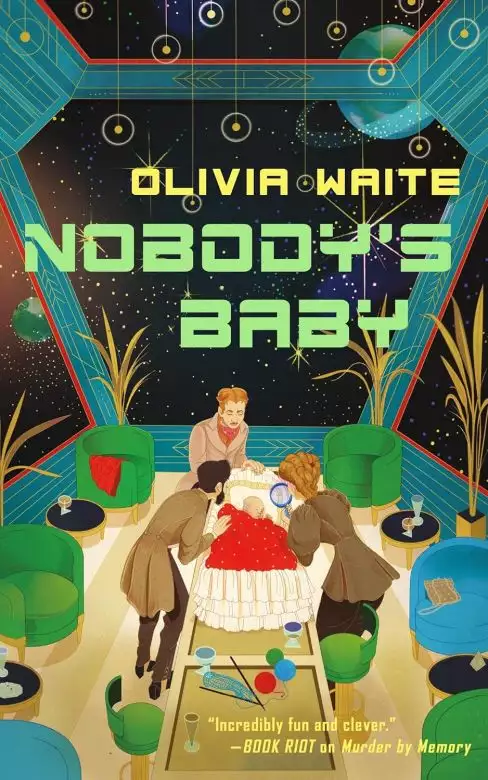
The large bed was as disheveled and exhausted as a feckless youth on day five of a lost weekend. Striding back and forth beside it, bare feet tangling in the coverlet and kicking it aside by turns, was Ruthie: brown curls mussed, sweater sleeves rolled up, bags beneath his eyes, and with—yes indeed—a baby in his arms. He was bouncing it, up and down, as he walked, back and forth, making soothing little shushing sounds in a hopeful voice.
I couldn’t resist a fond auntly smile—no matter that my body was currently midtwenties, and Ruthie a good decade older than that. Nephews were nephews, no matter the age.
Ruthie looked up and seized on me, the way a sailor washed overboard seizes the life buoy bobbing by in the maelstrom. “Finally!” he cried, though it had been, at most, ten minutes since my note. “Take this for a moment, will you? I have to see about John.”
And he deposited the squalling bundle in my arms and left the room.
The baby wailed harder.
I took a deep and bracing breath.
If I was going to solve the mystery of where this baby had come from, I was first going to have to solve the mystery of how to get them to shut their adorable trap. And fast, before the three of us lost our minds.
The baby wailed again. I ignored that for the moment and looked the infant over. They were young, quite young. No teeth, as my nephew had noticed, and young enough to be colicky. They had a pinafore-type garment wrapped around them, and beneath that—fortunately—was a diaper that—fortunately—was fresh and properly applied to their—likely his—anatomy. So that was one problem we weren’t having yet.
Copyright © 2026 by Olivia Waite
We hope you are enjoying the book so far. To continue reading...
Copyright © 2026 All Rights Reserved

 Please log in to recommend or discuss...
