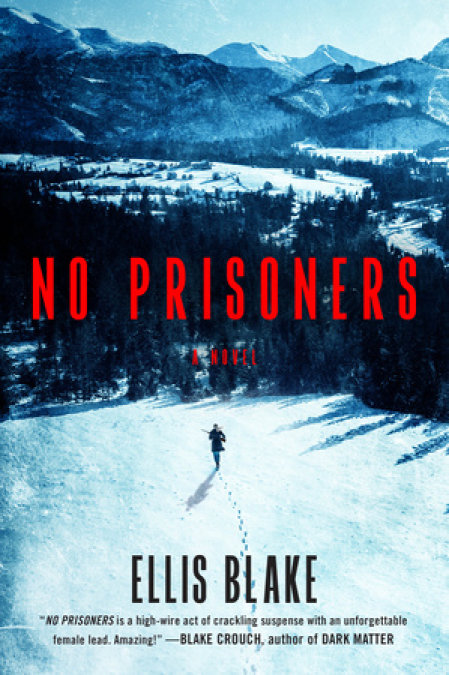
“No Prisoners is a high-wire act of crackling suspense with an unforgettable female lead. Amazing!” —Blake Crouch, author of Dark Matter and Recursion
A riveting neo-crime thriller in the vein of A Simple Plan, about a brilliant physicist searching for her missing husband, and the beleaguered detective in her way
Hannah Lyon is a brilliant, celebrated physicist, employed by a think tank outside of Albuquerque to question the very nature of how the world works.
And her husband is missing.
But not only is she struggling to cope with his sudden, baffling disappearance, no one believes her when she insists that Adam would never just leave. He was a loving husband, but more than that, a devoted father. He would never leave their young son Joe behind.
Detective Aloysius Hunt assures Hannah they’re doing everything they can to find Adam, but Hannah doesn’t trust him. Lou Hunt has done nothing but stonewall her at every turn.
With no help from the authorities, Hannah is on her own to find Adam and bring him home, but uncovering the truth means revealing dark secrets in her husband’s past, and her own. Secrets better left buried.
When Hannah notices a red SUV stalking her every move, she takes matters into her own hands and sets No Prisoners speeding towards its shocking conclusion.
Twisty, gritty and evocative, No Prisoners by Ellis Blake blends heart-pounding suspense with an emotionally resonant, razor-sharp exploration of grief, set against an unforgiving, icy landscape.
Release date:
July 21, 2026
Publisher:
G.P. Putnam's Sons
Print pages:
400
* BingeBooks earns revenue from qualifying purchases as an Amazon Associate as well as from other retail partners.
CAUTION: This email originated from outside of Penguin Random House. Please be extra cautious when opening file attachments or clicking on links.
1
It was a habit now, and she didn't know why. Maybe it was the hour, reducing the world to its basics. A certain clarity in the dark. Lying there night-blind in the two a.m. silence, heartbeat counting the time, all she had was love and duty.
In the faint moonlight she got up and went along the hallway to his bedroom door.
He lay on his back with his head sideways on the pillow. A hand raised and curled beside him, like the fading gesture of a great idea. Sometimes she thought she'd stand there all night. Freezing cold and her breath misting weakly, but the sight of her child safe was a comfort against everything. She went back along the hallway to her bedroom and dressed quickly and removed the rifle from above the wardrobe.
She locked the door behind her when she went outside. The breeze humming high up in the trees and the branches ticking with it as they swayed, each contact clear and brittle. As she stepped off the porch her boots crunched in the new snow. Two inches of fresh powder. Soft flakes coming down aswirl. She zipped the coat to her chin and tucked her mouth inside the collar, hitched the rifle strap on her shoulder. A fairy-tale aura with the woodland dark and the polished-bone moon issuing a pearly light. She wore a xenon headlamp, but there was no need for it yet. She walked uphill, a loose zigzag. Hard work in the snow, but the nighttime air seemed to compensate. Rich and piney, every lungful crisp to the very depths.
This was the southwest edge of the national forest, and it was not uncommon to see wildlife. A neighbor had lost a dog to a mountain lion last year, and even in winter black bears weren't guaranteed to hibernate. Human neighbors with their pets and outdoor trash were too rich a food source to ignore.
It was a fifteen-minute climb to the hilltop, and halfway there she saw something: a peripheral glimpse, flagged by instinct as sentient motion. She raised the rifle and scanned the trees slowly. Branches gray and kinked and wicker-thin. Daubed here and there with snow.
Nothing.
She turned on the headlamp, and the beam lanced off between the trees. She made the same slow sweep, and there, thirty feet away, the twin-jewel gleam of eyes looking back. She held steady, and the shades of gray resolved to form a bobcat. Motionless, foreleg bent and raised, as if disturbed midstride. She brought the rifle higher and sighted through the scope. Eyelash brushing on the lens. The image blurry, glaucomic, and then sharpening as she toggled in the distance. The animal's face quartered neatly by the hairline of the reticle. Green-gold eyes, seeming to emit their own light.
"Go on."
She watched it through the scope. Not a twitch. The face so detailed and symmetric she thought maybe there is a god. She had her finger to the cold arc of the trigger and she'd taken up the slack. To hover there at the cusp of the action was to know she could do it.
"Go on. Go on, now."
Nothing.
Then the face simply vanished from the scope. Such a sudden and complete absence, it seemed to have pulled a trigger of its own. She lowered the rifle, the animal bolting away into the night, light-footed on the snow. Fluid and linear economy. She watched it disappear, and then turned and walked back down the slope toward the house.
*
It was light at seven a.m. She went downstairs and watched from the living room as the day emerged. Trees black and still on the snow-clad hills. The scene pretty in its monochrome starkness.
She took the binoculars from the kitchen drawer and glassed the dirt road that wended through the valley. Precise and narrow and empty. Their closest neighbor was a mile away, and the forest cover gave a feeling of remoteness. She logged on to the computer in the study nook by the kitchen and checked her email. Still nothing. Nothing on her cell phone. She held it higher for improved reception, saw the signal bars come and go. No new messages.
For the past three weeks, she'd left the phone in the kitchen at night. It was the only way she could sleep. Before that-the first two weeks-she'd lain awake, reaching for it every fifteen minutes. On occasion she'd drift off and dream she'd heard it, wake to silence and the phone lying dormant on the nightstand. And the last few nights this new thing. An inchoate need to face something in the dark.
She ran a search on Google and then checked the missing persons web pages. Nothing had been posted. Nothing pertinent, anyway. Every day there were more faces of the disappeared. Dozens, hundreds. All of them with their own concentric circles of sadness and angst: people wishing they'd come home. She opened the security camera recording from the gas station on Cerrillos Road. Another new habit. This was his last known location, as established by his credit card history. Eight-seventeen p.m. on a Thursday, five weeks ago. She'd obtained the file from Santa Fe PD. They'd spliced the forecourt and sales-office footage to give a sense of narrative. She watched his Ford Bronco signal and turn in off the road. Slight bounce and cradling as it came up the step to the concrete forecourt, headlights starry and briefly whiting out the feed. She watched him turn and then stop by a pump. An oblique, downward angle. Wet tire treads arc-wise and spectral on the concrete. Every detail felt important, portentous with no sound. There were no other vehicles, no other customers. She watched him standing by the rear of the truck, nozzle hooked in the tank. She studied him for some clue about his fate, something revelatory. Like his stance or expression might forecast what came next. He replaced the nozzle on the cradle and the video cut to inside the sales office, a shot from behind the counter as he approached to pay. Small talk with the cashier, a laugh in that hooked-mouth, crinkled-eye way of his. She dragged the progress bar back and forth, replaying it. That small gesture a conduit to memory. There he is on vacation. There he is arriving home. There he is in the kitchen, on her birthday, Joe assisting. There he is the day she met him. She let it play, and he swiped his card and left.
The absence in their lives felt disproportionate. Every moment laden with what was gone. Gone now, and what might be gone in the future. Another forty, fifty years of life. It felt like that potential had been summed up and lumped in front of her, a kind of deadweight in the present moment.
Sudden shock, loss. She'd never grow accustomed to being alone in the bed. Like a flash-forward, a prelude of her last years. Alone in a bed for two, and wondering how much time she had left.
Listen to you. He's coming back. You're going to find him.
The phone in the kitchen rang. She picked up the cordless handset.
"Hello?"
"Hello. Is this Hannah?"
"Yes."
"Sorry to call so early. It's Margaret here. Number twenty-seven."
"Hi."
"Yes, hello. I believe I mentioned it's my turn as neighborhood wildlife warden and-"
"That's right. Sure."
"I just thought I'd call and let you know. Judy Gresham down at number five, she's had her trash all pulled apart again. Snowfall's covered the prints, but it's obviously a bear. I just wanted to let you know so you can-I'm sure you'll want a close eye on that young man of yours while there're animals around."
"Yeah. Thank you. I've been keeping him inside."
This was the second time Margaret had called with bear updates. It was unclear if she was simply being diligent in her warden duties, or if there was an ulterior social motive. She was widowed, apparently, and lived alone up here. Probably in need of contact and company. If that was the case, Hannah felt sorry for her, but she didn't want to bring her nearer than phone-call distance right now. She had her own problems.
"OK. Well, if I can help at all . . . I'm only just up the road. And of course, do call if you see anything."
She stood by the living room window again and raised the binoculars.
"Sure. We'll be out today, but I'll keep an eye open."
"Well, terrific. I appreciate it. I think if everyone's helping, it will make a difference."
"Yeah, no doubt."
She heard Joe's alarm go off as she ended the call. He came downstairs tousle-haired and squinty in his pajamas. "Are you making eggs?"
She placed the binoculars on the side cabinet. It was glass fronted, a pawnshop acquisition from years ago. Since Adam's disappearance, Joe had established it as a shrine to family achievement. He'd got it started with his football certificate and player-of-the-year award, augmented those with the highlight of his homework projects: a papier-mâché model of Mount Saint Helens, captured mid-eruption. Adam was represented by an old high-school tennis trophy, grinningly retained for twenty years as evidence of a dazzling career, thwarted by familial duty. And from its box under the stairs, Joe had unearthed Hannah's master's degree from UNM, awarded it pride of installation next to Mount Saint Helens. It had prickled her eyes when he told her with little-kid solemnity that even though he had more items on display, his achievements were her achievements, too.
"Are you making eggs?"
"Yes. But only for people who say please."
He tipped his head back, let his mouth gape. "I say please all the time."
"Needs to be every time."
He sighed. Ordinarily the back-and-forth with its sullen edge would have irked her, earned him a firmer rebuke. But given what had happened, she was grateful for something that felt normal. He was usually talkative and engaged, but he'd been withdrawn since the disappearance. She'd told him that Dad would come home, but she didn't know if the assurances sounded truthful or just hopeful. She knew that the probability of finding Adam was diminishing with time: every day a smaller chance of a happy ending. But that aside, she felt she had a duty to live within that ever-narrowing gap of hope. A duty to all three of them.
"Please can I have eggs."
"What sort of eggs?"
"Scrambled."
"Scrambled, please."
"Scrambled, please."
"All right. I might have some, too."
He sat on a stool at the countertop. "Who called?"
"The lady up the hill. Reminding us about the bear."
He sat with his elbows on the counter, jaw cupped in upturned hands. In pensive fashion, individual fingers raised and then settled back against his cheek. She could almost run a count to when he'd ask the question.
"Where do you think Dad's gone?"
She turned on the stove. Gas odor, soft whump of the flame. "I'm not sure." Trying to speak lightly, imbue the topic with inconsequence, but her voice sounded high and false. "Maybe he's sitting at a counter somewhere else. About to cram egg in his face, too."
She smiled, but he wouldn't meet her eye. She put the eggs in a pan, cut a corner off a pat of butter and stirred it in.
"Do you think he'll come back?"
"I think so. We just have to be patient, don't we?"
"Yeah."
"You shouldn't worry about it, though. We just have to get on with things."
"Yeah." Sounding unconvinced.
"Do you promise?"
"Promise what?"
"Promise that you don't worry."
He didn't answer.
"Have you done your test?"
"No."
"Right, well, you better do it before you eat. Bring it down, if you like."
He fetched the glucose kit in its zippered pouch and opened it on the counter. He uncapped the vial of test strips, fed a strip into the base of the digital meter. A wince, a moth-flutter in his eyelids as he touched the automatic lance to his finger, and the device made a spring-release click as it jabbed him. He returned the lance to its elasticated loop, and then squeezed out a drop of blood from his finger and touched it to the test strip. The meter beeped.
"How is it this morning?"
"It's still thinking."
"I think it'll be eighty-four."
"I think it'll be . . . seventy-eight. It says seventy-eight."
"You didn't guess fast enough. It was already on the screen."
"It's good, though. Seventy-eight is good."
"Seventy-eight is very good."
She made him tell her the carbohydrate content for two slices of toast, and then he input the value on the insulin pump he wore in a pouch around his midriff. The pump was the size of a cell phone, maybe a little thicker, controlled by a glossy touchscreen and tethered to his abdomen by a thin, transparent tube. They had to change the infusion set every three days.
He said, "One point seventy-five units."
"One point seven-five. That's right."
"Can I push the OK button?"
"Yes. Push the OK button."
They ate at the breakfast counter, opposite each other, catching each other's eye every now and then. It made him laugh.
She smiled. "What?"
"I don't know. It's just funny."
She tidied up her plate and watched him finish. "Good?"
"Yeah. Yum." He slid his own plate away. "Why'd you get the binoculars?"
"So I can see the bear."
"But you got them before the bear."
"I just like seeing what's around."
"You didn't used to."
"I didn't always have binoculars."
"Yeah. But why'd you get them, then?"
"I don't know. Because I wanted them, I suppose."
Silence, but he knew she was trying to unpick that last answer.
"How much insulin do you have?"
He checked the screen on the insulin pump. "Ninety-two. Ninety-two units."
"Plenty. All right, go brush your teeth and get ready. And don't forget your black hole."
The black hole had been homework for the last ten days. The assignment was to build something with a space theme. Given the circumstances, she'd offered to email Mrs. Ashcroft for an exemption, but Joe seemed to accept the challenge with enthusiasm-no doubt bolstered by his success with Mount Saint Helens.
His first attempt had been prepackaged meals for astronauts: slices of apple, onion, and capsicum that he'd then vacuum sealed. She'd told him it was a great idea but encouraged him to investigate another option. The black hole components had been obtained from the school art department, and comprised a twelve-inch-diameter polystyrene ball mounted on a wood-based receipt spike. The whole thing was then immersed in black paint. She'd told him the effect was quite striking, but maybe it needed something else, just to finish it off. A long phone call ensued between Joe and Ian McCarrie, her colleague at the New Mexico Institute, and the outcome of that discussion was every ballpoint pen in the house was dismantled, the internal spring glued at one end to the surface of the black hole-the event horizon. This, apparently, was Hawking radiation.
We hope you are enjoying the book so far. To continue reading...

 Please log in to recommend or discuss...
