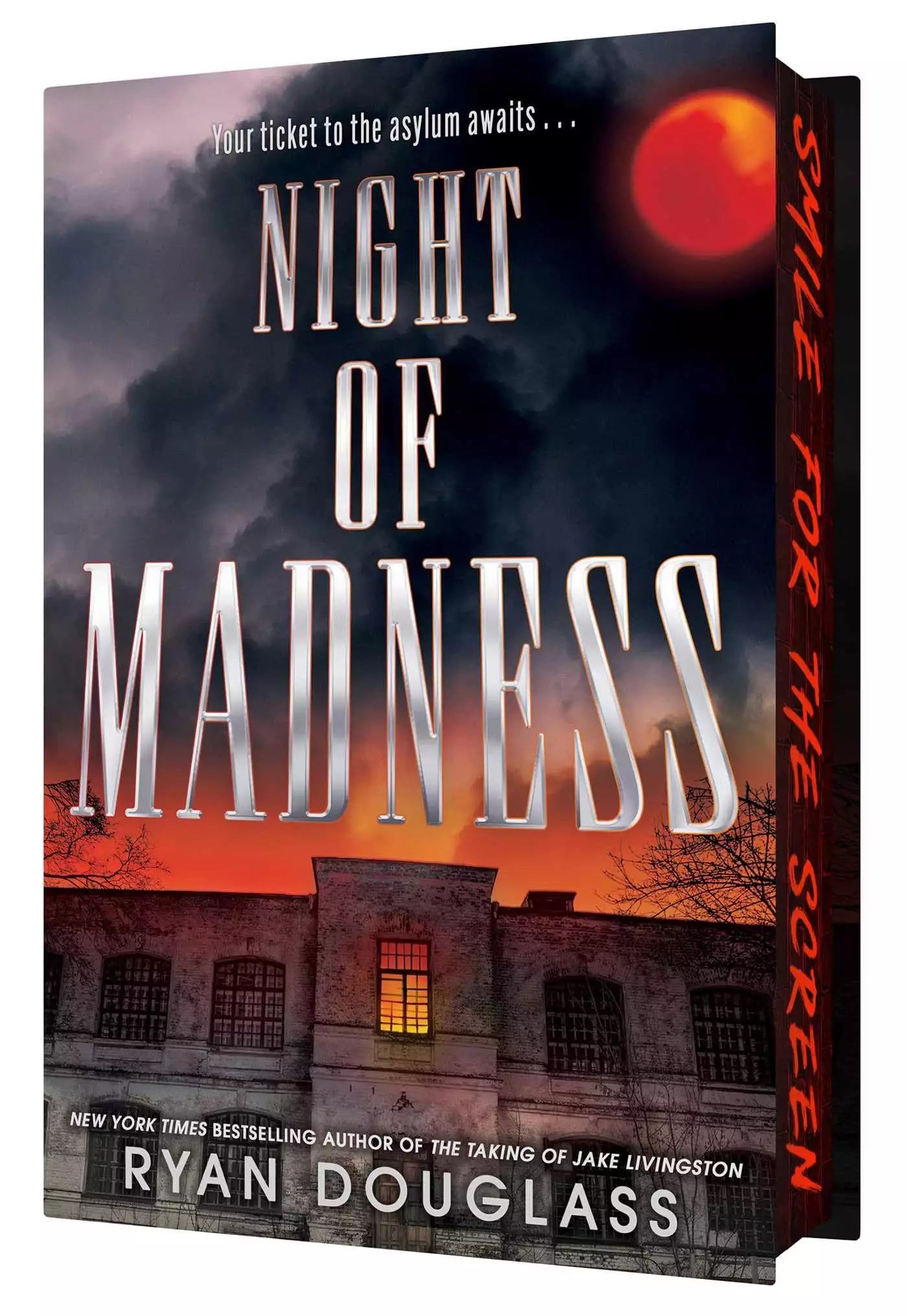
Teen influencers compete in a horror movie–themed overnight competition, only to realize the real test is staying alive in this chilling, blood-soaked horror novel from the New York Times bestselling author of The Taking of Jake Livingston and the production company behind Clown in a Cornfield.
Mara is a horror buff whose only fond memories of her dad are bonding over movies by Jack Stanley—the producer of the eighties. Stanley’s campy slasher movies may have kept Mara’s fraught parental relationship on life support and gained a cult following, but the man himself has faded from the public eye…until he announces a contest centered around Asylum, his most terrifying film. Five teen influencers will be invited to spend the night on the fully constructed set; whoever sticks it out until morning wins a hundred thousand dollars.
Stuck in a dead-end job, Mara seriously needs that cash. She may not be a famous influencer, but there has to be a way to manufacture an online presence that will capture Stanley’s attention. With the help of her brother and best friend, Mara finds some creative solutions to her dilemma and lands herself onto the roster of the lucky chosen few by way of her engaging authenticity.
When Mara and the other contestants arrive on set, it’s a horror fan’s dream being immersed in the asylum setting, but as the night wears on, they realize the danger is more than movie magic… They’re not there to win or lose but to live or die. As Mara fights to survive, she discovers an inner ruthlessness she didn’t know she had. Just how far will she go to see the sunrise—and will she still recognize herself by the end?
Release date:
September 29, 2026
Publisher:
Simon Pulse
Print pages:
304
* BingeBooks earns revenue from qualifying purchases as an Amazon Associate as well as from other retail partners.
Chapter 1 1 YOU TOLD YOURSELF NOTHING could scare you. You paid to prove it. That no matter how dark the world got, you could charge into its danger, beat it at its own game. That’s the kind of person you are. So when the door slams behind you, its echo like a gunshot, and the asylum swallows you up, you feel an adrenaline rush that outweighs all fear.
A metal detector arches through the center of the room like a portal. Its blinking red light blends with the cool blue of a monitor mounted in one corner. Its screen shows grainy footage of you, glitching and reforming, your uncertainty on full display in the claustrophobic entryway—your body language betrays the confidence you thought you had.
But at least there are five other people, lined up like cattle to be scanned with crackling handheld wands, and they too seem rather uncertain.
Once a team of guys has proven you’re not carrying anything dangerous, you’re ushered forward with the crew.
There’s a quiet girl who refuses to blink. A couple whispering like this is a cute stop on a tour of dates. Another person cracking jokes to hide his nerves: “So many camera monitors—do we get paid if we’re used in promo?”
None are more suited to be the hero than you—confident, youthful, independent without being lonely, eyes set with the perfect balance of vigilance and determination.
When the guards exit through the door you all came in through, you don’t flinch—you nod the group toward the stairs ahead and say, “Guess we go up?”
You’re right—the only way forward is the steep concrete staircase ahead. It’s flanked by walls of cracked tile, swimming-pool blue. Fluorescent lights sputter overhead, casting after-images and distortions—they too are colorful, as if a lighting designer was having a little too much fun.
During the climb up the stairs, people around you flicker in and out—ghosts in a haunted reel, practically stripped from their personalities and all distinguishing features in the darkness. So it’s easy to feel alone, and creeped out, until you reach the next floor.
It’s doing its best—peeling paint, rust-streaked sinks, an abandoned wheelchair—but it all feels staged, like a low-budget movie set. Nothing feels functional—just assembled.
A doctor steps out from a recessed doorway, her eyes sharp but her mouth trembling.
“Welcome to Shadow Ward,” she says austerely, as if the name itself is a curse. She turns and guides your group down the hallway as she speaks. “It’s important to keep the volume down inside the facility. We have about fifty patients, each with their own eclectic triggers and sensitivities. Security detail is somewhat loose.”
The quiet of the place unravels into a jungle of noise, a jungle of characters, as the place sucks you into its haunted mania. Baby voices, the banging of metal, some screaming to top it off.
A patient bursts through a doorway, sizes you up, tests your personal boundaries.
You cling to yourself. And you keep going. Because however creeped out you are, this journey—this tour—is far more fascinating than scary. More a distraction from the drone of routine, the trouble of feeling nothing at all.
If anything, the illusion of its realism is a joke. You can pop in and out of it, remember you have somewhere safer to go when you’re done.
You take a deep breath, inhale the sweet smells of latex and synthetic fog, and a little laugh comes out. None of this is scary, because none of this is real.
And the most unsettling thing about this place? There are actually people desperate enough to work here.
Joke’s on you. I’m one of them. Not a visitor chasing a scare, but the lunatic hired to be it. Mental Patient 17, per the script—but my real name’s Mara.
Hour seven of my shift and my knees are dead sick of me giving them no relief, and life’s begun to feel meaningless. I start gnawing on the prop bread, left among the abandoned trays and bent spoons. It’s good for snacking on when energy is low.
I watch a monitor in a corner of the cafeteria, which flickers with footage of tonight’s visitors inching down the hallway just outside.
“You’re braver than me,” says my coworker Romy. She’s watching me from the table she’s sitting on top of.
“Free food,” I say, with a shrug.
“It’s so… stale,” Romy returns, passive-aggressive and pointed, as if throwing a dart. “And probably full of bacteria.”
But it’s not stale—it’s refrigerated when we’re not here. So I don’t waste energy on a comeback. Something about Romy looks held together with cheap box dye, chopped blond bangs, and old gum. She moves like she’s used to being overlooked and underestimated but like the world owes her something. So she postures like she’s above me, despite being here too, clocking into work because she’s aged out of babysitters and babysitting.
The double doors open, pulling us out of the conversation as the visitors arrive.
Romy gets into character—assuming a position like a spider. She kicks a chess piece off the floor so it clatters across the linoleum, rolling past the shoes of a hospital worker swaying in place and a man pressing his hands to his head like he’s holding his skull together.
I wrap my fingers through the iron grid on the back of the vending machine and climb up to the top to get a bird’s-eye view of the oncoming crowd.
Ten of them. Teenage geeks, bro types, some kids dressed to seem tougher than they are. Their bravery wanes as they take heed of Romy and our other patients. Still, they laugh, as if nothing could break their bravado.
One girl leads the group, in the sense that the whole crowd orchestrates itself around her confident stride. She’s wearing this glossy violet dress that probably costs more than my entire closet. It stops mid-thigh and swishes when she walks. Her shoes are strappy leather things with spikes on the back, like they’re made for zebra-kicking someone in the face.
Who is that? I know her from somewhere, but not from school.
She steps closer to the vending machine, then tilts her head, as if sensing something is off.
“Hey,” I whisper.
She looks up and gasps, clutching her chest. “Oh my God. You got me!”
And that’s when it clicks.
Victoria, from Instagram. Well, she’s famous on every platform, because she posts every day, everywhere.
We’ve never met. But I know her well.
[0:00–0:03] Victoria stretches awake on silk sheets, far too happy to be up so early.
[0:04–0:06] Matcha swirls around a golden spoon. Her kitchen’s like an IKEA set.
[0:07–0:09] Cute mirror pout behind a vanity full of perfume bottles and moisturizers.
[0:10–0:12] Dewy skin tutorial. The bathroom’s so clean, it can’t help but reflect her perfection.
[0:13–0:15] Wine toast at sunset. Victoria sits on a terrace with string lights and too many pillows. The setting is a reminder that rich parents let their kids drink as teens.
Yes, it’s that Victoria. Viral candy for every social media algorithm she touches. But what’s she doing here?
I loll my head to one side, staring through Victoria’s face like I’m an X-ray. And when I speak, it’s in my husky, mental voice—practiced and perfected. “Can you hear that?”
It gives her pause. “Hear what?” she asks, leaning in.
“The voice.”
Victoria blinks and then snickers. “Hold on.” She fishes her phone out of her bag, points it at my face, and snaps a picture. “This is so cute.”
I raise a hand to block the flash, but a piece of the machine beneath me gives, causing me to wipe out on the floor.
Victoria jumps back. I roll over and cough from the impact.
But I don’t ask for help. Victoria’s too busy recording anyway, cataloguing my suffering as if the slip were part of the act.
“Oh gosh—are you okay?” she asks, a phony lilt to her tone. “Love your dedication, but be careful?”
I sit up, ignoring how my spine fights me. “You’re not supposed to have your phone out, you know. It’s a privacy thing.”
“Seriously?” She flips her hair and starts keying away on her phone. “Why else would I come here but to film this ridiculousness?”
“Victoria!” someone calls from the doorway, ushering her into the next room.
She signals she’s about to catch up, and then she smiles at me. “Really good job, by the way!” she chirps. “Good luck with all this.” And she runs to catch up with the group.
Once the people usher out, I duck into the staircase between crowds, massaging my lower back. This place has a way of reminding me that no matter how in control I feel, the floor’s always there to knock me down a peg.
And the worst part? I don’t even feel embarrassed. Not anymore. Just tired. Tired of spending all summer playing a freak for pennies. I know that you can end up hating any place you work at if you work there too long, but there’s got to be something better than this.
Minutes later, I push through the creaky door of the control room and find my friend Storm and our boss, Tina, glued to the monitors. Tina’s got short blond hair and a tough demeanor, the type of person who gets a thrill from hauling kegs.
She turns as I enter and starts clapping with a smirk of pride. “Mara, that was beautiful. Wiping out off a vending machine is exactly the kind of dedication I hired you for.”
“Yeah, I meant to do that,” I say, plopping down in a swivel chair in front of the control board.
I grab a bottle from the minifridge under the table and look up at the monitors. A new group is joking and laughing at the entrance, but my eyes lock onto Victoria on a different screen. She’s snapping a scared-face selfie under a strobe.
“God, this place is gross,” she mutters, loud enough for one of our cameras to pick it up. “I can’t even get a good selfie.”
Storm just snorts at the comment, twisting a knob on the soundboard so we won’t hear anything else she says. “Well, folks, the queen hath spoken.”
“Victoria hates anything that’s not overpriced luxury,” I say, dry as dust.
“This y’all’s friend from school?” Tina asks, eager to be in the know.
“Nah, she’s LA based,” Storm answers. “She does, like, travel-and-style influencing. The good news is, if she posts a video, we’ll get more business from out of state. Sometimes people show up just to see how unscary things are.”
“I’m surprised she’d even visit this place,” I say. “Her family’s got enough money to buy a haunted house and put it on their property.”
“But then she couldn’t virtue signal and show she supports the little guys!” Storm responds, tone dripping in sarcasm.
“Or she’s here because they’re shutting down Asylum,” Tina offers.
Asylum is the bigger, better haunted house on the other side of the highway. Storm and I tried to get into Asylum first. It was a franchise house, part of a larger theme park. Working there paid more. And it wasn’t a “boo” haunted house like ours, where anybody can walk around. It was extreme. As a visitor, you had to sign a waiver to let the actors touch you, separate you from your friends, torture you in private so no one could intervene. And that kind of gruesome challenge attracted more traffic than the mild stuff. The owner, Jack Stanley, had millions of fans who wanted to live inside one of his movies, at least for a day, and that’s what the Asylum house gave them.
But the process to get in was super gatekept, loaded with interviews. We both got disqualified along the way, because we were too young and apparently “too green” for the jobs they were offering.
I was the one who spotted the Help Wanted sign in the dingy window of Shadow Ward, where it slumped between a pawnshop and a vape lounge in the Warehouse District.
But Storm made sure we got hired.
“You don’t sell your scare,” he told me while picking through musty costume bins after our first shift. “You just show up and expect people to be spooked.”
I hadn’t known what to say then. I still don’t, really. But I remember the way he said it, like it wasn’t an insult but a fact. And like he believed I could do more than scream for minimum wage in a bloodstained costume.
“Wait—Asylum’s closing?” I ask Tina. “Why?”
Storm shoots me a look. “Are you seriously this offline?”
“I’m online,” I say, rolling my eyes. “Just not in Stanley-verse hell. Well, not anymore.”
“Jack’s launching a reality show,” Storm says, and then he gestures grandly as if selling it to viewers. “Night of Madness. Five influencers. Five survival challenges pulled from the movie. Last one standing gets a hundred grand.”
“A hundred thousand?” I blink. “You’re kidding.”
I pull out my phone and Google the competition. A black-and-red website loads. Beneath a countdown timer is a requirement list in all caps:
NATIONAL ONLY.
MUST BE 18+.
MUST HAVE A VERIFIED PLATFORM.
MUST BE UNAFRAID TO DIE ON CAMERA.
“Of course.” My voice escapes me like a sigh. “You need a platform to enter.”
And I don’t have one, mostly because I don’t post anything. I’ve never seen the appeal in attention farming through fifteen-second loops. Social media is too loud, and it’s empty. I’d rather be lost in a book like Discipline and Punish, imagining how I’d survive societal collapse. Or talking to a person, at least, rather than performing for a screen.
“Read the fine print,” Storm says, leaning over, scrolling down to the bottom of my screen. “ ‘Entrants with smaller platforms can get their posts sponsored with cheat codes included in the new Stanley-verse merch. Load your code into the website, and your content will be featured on the front page.’ For a time, at least.”
I read along with him, mind spinning. I mean, if anyone can enter, I might stand a chance. But still, it sounds like a humiliation ritual, and people who enter things like this are absurd.
Am I willing to be terrorized on camera for a hundred grand?
That kind of money would mean freedom from this job, enough to launch my future and enough to get out of Texas—this tumbleweed-and-horse-themed escape room I’ve never seen the outside of. Jesus bumper stickers everywhere and yet not one person you see is foreign to sin—tailgating, early drinking, gossip, snapping at the neighbors’ kids. It does get to be confining. I’ve lived here my whole life and can’t find the point of staying.
Storm looks up at me like he’s trying to solve a puzzle.
“You’re thinking about it,” he says in a low voice. “Aren’t you?”
I shrug. “It’s a shit ton of money—how can you not?”
“And it’s a gap-year fund. If you’re into that.”
He knows I’ve been talking about taking a break between high school graduation and college (against my mom’s wishes, but that kind of makes it even better). I’ve been dreaming of that year of freedom and funding it myself for almost my entire life. Traveling. Getting tattooed. Learning my style. Exploring what life has to offer outside of school and summer jobs.
I’ve got one year left to figure out what I really want. And I definitely don’t want to spend that year building a boring corporate future. I remember sitting on my bed last spring, doomscrolling through summer listings—babysitter, barista, cashier—every ad competing for how much it could waste my time. Then, buried three pages down, I saw the sign: Actors Needed. The pay was fifteen dollars an hour, but I could play in costumes and terrify people, which would be way more fun than folding graphic tees with top-forty tracks looping in the background.
Maybe that’s why the idea of the competition haunts my thoughts as my shift drags on. I start thinking of how I’d play a reality show. Not a drama queen but a fan-favorite, underdog type with cynicism and deadpan wit. I’d walk into the house, see a madperson with bloodshot eyes, and be moved not at all. As all my competitors would jump away from the threat, I’d hold eye contact with the person until they got scared. Very Daria. Very Wednesday Addams.
Whatever my shtick, being a TV star would beat bed rotting this summer or dreaming of a way out of my dead-zone life and doing nothing.
And I’m still young enough to take a ridiculous chance.
At 10 p.m., I collapse onto the break-room bench, the bench whose padding oozes more foam every day. One shift down, one more around the corner.
The cracked plaster walls are papered in tattered posters for drag shows, Safety First signs, and concerts that stopped happening years ago, when this place was repurposed.
I peel off my costume gown, throw on my overshirt, and pull out my phone.
Victoria’s Instagram story is at the top of my feed. I don’t know why I follow her, but I still do, as if I’ll miss out on something if I remove myself.
I take a deep breath and open her story.
There I am with a camera light up my nose at an angle that is almost intentionally unflattering, designed to turn me into a prop rather than a person.
Victoria’s voice: “Are you okay?”
I told her filming wasn’t allowed, and she went on to post my wipeout for the entire world to see.
My grip around the phone tightens. “No, Victoria,” I whisper. “I’m not fucking okay.”
“Who are you talking to?”
I jolt and find Storm standing behind me, squinting as he opens his locker and gathers his bag.
I darken my phone screen. “No one. Just… the wolves in me.”
He raises an eyebrow, but thankfully, he doesn’t push. “Okay? Sure.” He slings his bag over his shoulder. “Ready?”
“Yup.” I spring to my feet.
We move down the hall and through the back exit. We swerve around a homeless man shouting something at the sky. And in the sky, just over some trees, you can see the top point of Asylum’s tower across the highway, its spectacle-screaming, corporate-entertainment excess.
Jack Stanley’s theme park dwarfs ours in size and relevancy. A big strobe from the park once blinked at the sky, and screams boomed over loudspeakers to attract drivers with an interest in grotesque horror. But the spotlight and noise have dimmed now. They’ve temporarily closed it, but it’s been losing its groove for a few years. It’s like Asylum is from a different time period—one both nostalgic and too archaic to appeal to young people, and everyone’s moving on.
I reach my car and unlock the door, sliding into the driver’s seat. Storm opens the passenger’s side door, which creaks like it wants out of this life.
“Big influencers are coming to our spot rather than Asylum now,” Storm says, thoughtful intrigue in his voice as he tucks in, pulls on his seat belt. “It really is becoming less relevant. Probably why Jack decided to do this show.”
“I take it you’re not submitting anything to the competition, then?” I ask.
“Oh, I definitely am,” Storm says, like I’m insane for even questioning it. “And you should too. Hello? One hundred thousand dollars to do what we do already? I’m so in.”
“One hundred thousand is so much money.” I pull the gear stick down and twist around to back up the car. “Any competition offering that much is for people with better luck than me.”
“Or better luck is for people who believe they can do these things,” Storm says, his tone chiding. “You lose nothing by applying.”
“You mean besides trading in my quiet, invisible life as a swamp ghost for a spotlight that could follow me forev—”
I pause, slam the brakes. We jerk forward. My hand jumps to lock the door.
I saw something. Behind the car. A face. A man. Just standing there. Watching us.
I turn to Storm.
“What happened?” he asks, frozen in place. “You flipped on me.”
“You didn’t…?” I look into the side mirror and then the rearview. But the person is gone.
Storm didn’t see him. Only my mini freak-out. And now I’m left to question if there was ever a man to begin with.
“Nothing,” I say.
I shake it off and continue backing up.
Paranoia. That sense that danger could be near even in the most mundane of instances. I’ve lived with it so long, it’s part of my day-to-day.
I grew up the older of a pair. My parents were teens when I was born—two youths figuring out who they were. So we all figured it out together. I learned early to listen for the screen door to creak when one of my parents left, double-checked the locks when they forgot, shut off the lights so the neighbors wouldn’t notice the chaotic fights that would explode in our home.
When my brother was born four years after me, the world got busier. I had to watch him too—make sure he didn’t put something dangerous into his mouth or swallow too much of the world’s darkness too soon. I became a watchdog at the age of seven.
And that’s why I think that if I were to enter something like the Night of Madness survival show, the challenges wouldn’t scare me.
We’re mostly silent for the ride, but I can feel that Storm is still thinking about the competition, about the possibilities it would offer us.
He glances at me as we pull into the lot of his apartment building. “So, you’re really worried about being seen? You can put on a zombie face three days a week and grrr in people’s faces, but not this?”
I shrug, tapping the wheel. “This is different. There wouldn’t be any zombie makeup. Just me in front of the world. Look, I’ve avoided attention my entire life because it feels like less of an energetic expense than being on full display.”
“I gotcha.” He leans back, smirking with a tinge of mischief. “It doesn’t have to be strictly you, though. You decide what version of you the camera sees.”
Something about that feels too fake for my style.
“I’ll let you know if I come up with a persona that feels right for it,” I tell him, still not ready to give it much energy.
“Fair,” he says. “Can’t wait to see what she looks like.”
I put the car in park, and Storm hops out.
“Stay safe,” I say, as he slings his bag over his shoulder.
“You too, swamp ghost,” he returns, leaning down for a playful wink before turning and trekking toward his building.
By the time I pull into my own driveway, my nerves are somewhat soothed from that jump scare I may have created myself. While annoying, there’s a quiet security that comes with living with your entire family.
Grandpa’s asleep on the couch when I push open the front door, his head tilted back, mouth wide open, toes sticking out the end of a blanket. The glow of a Western movie flashes across his snoring face—a face I feel increasingly responsible for each time he nods off. We’ve got so many hospital bills, Mom has started hiding them, as if in hopes they’ll handle themselves.
I weave into the kitchen and drop my backpack onto a chair to unload today’s grocery haul: one (1) pack of soup, one (1) box of Nutri-Grain bars. Straight from the food bank and into the pantry, slotting neatly in our doomsday stash of nonperishables, because who knows? Maybe tomorrow’s the apocalypse.
Task complete. Next order of business: retreat to where no one can find me.
I make a beeline to my room, pop in my headphones, and fall back onto the bed. Above me, the star of my personal horrific nightmare looms—Jack Stanley’s infamous Masked Killer. Orange ski mask, dripping blade, hollow eyes carrying the perfect mix of blank and sinister, watching me like he will murder me gently with the most brutal weapon imaginable.
Sometimes I wonder about what’s beyond the waking realm—not death exactly, but whatever’s on the other side of monotony. A place that feels less like a cage and more like somewhere to finally spread out.
My life is fine. The lights are on, the AC works, and the family gets along, for at least half the year. But I so often feel like I’m rolling with the punches, looking for a unique spark.
I sit up in bed and find myself in the mirror behind my door. I push my hair over my head so it covers one half of my face, my hair’s frizz forming a disheveled curtain like Spanish moss in a dark bayou. Behind the bush you can hardly see the girl with the dark undereye circles of a middle-aged lady. You don’t see my sad eyes—they’re smoky and mysterious now.
I could totally become “someone” online if I put my heart in it. Skip college—at least at first—dodge the internship grind, and fake it for a TV show.
I sweep out of bed like I’m stepping onto a runway and go to study my body in the mirror. It’s rare I do this, but sometimes I can’t help but overanalyze. I’m not too curvy or too flat. Somewhere in the middle, and with a wardrobe half full of outfits that mostly drown my shape rather than fit it, often by design.
I’m not the girl people can’t stop staring at. Not like Victoria. And maybe that’s the point.
That’s what makes a hot girl online so powerful, so arresting. That her status quietly mocks those of us who don’t have much and elevates her while turning us into the stage beneath her feet. That’s how it is on social media. The ones with the most to aspire to get seen the most. Because when you’re someone with little to hide and lots to show, you get to face the world with freedom. Nothing has the power to hurt you—so nothing can really scare you.
We hope you are enjoying the book so far. To continue reading...

 Please log in to recommend or discuss...
