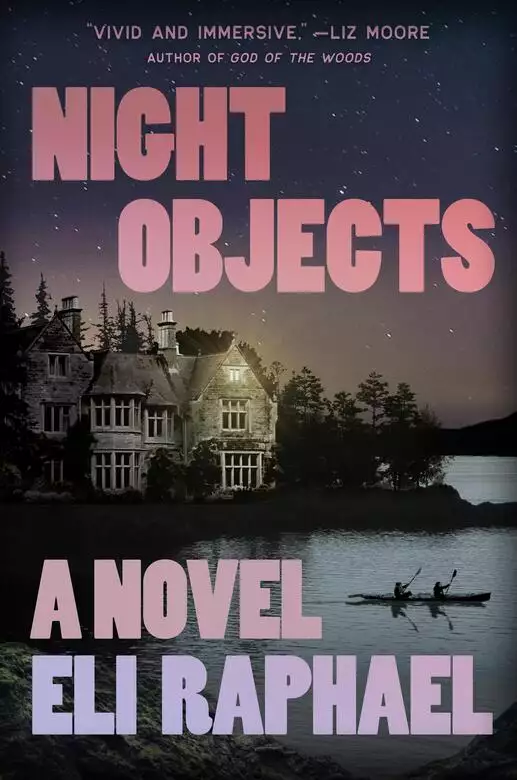
In this “vivid and immersive” (Liz Moore) debut, Eli Raphael conjures the windswept coast of Washington State and a boarding school steeped in privilege and deadly secrets—a remarkable story of grief, power, and the dangerous price of belonging.
It is true that I wished him dead dozens of times. Hundreds, even. But I, Lenny Winter, did not kill that boy.
Lenny Winter is fifteen years old when she moves with her parents to an aging houseboat off the rugged coast of Washington. She imagines a quiet life spent charting constellations and chasing her dream of becoming an astronomer. Instead, a sudden tragedy shatters her world and catapults her to Blanchard, a renowned boarding school for the Pacific Northwest's elite, where wealth and tradition rule.
Blanchard is dazzling, insular–and haunted by its own legends. At its heart lurks the Pascalianum Club, a secret society known to shape the school's greatest and most notorious students, and whose influence stretches far beyond campus walls. Hungry to belong, Lenny is drawn into its orbit, even as she senses that the club feeds on the very vulnerabilities she is desperate to hide. As privilege collides with grief and loyalty warps into obsession, Lenny’s choices will lead to an unforgettable reckoning—and a murder investigation that will test every story she tells herself about guilt, power, hope, and who she is becoming.
Sweeping, suspenseful, and deeply moving, Night Objects is both a gripping mystery and a profound coming-of-age story—asking what we risk, what we become, and who we hold dear, when the need to belong eclipses everything else.
Release date:
May 26, 2026
Publisher:
Grand Central Publishing
Print pages:
1
* BingeBooks earns revenue from qualifying purchases as an Amazon Associate as well as from other retail partners.
I was fifteen the summer I learned to do brightwork. This was the same summer I first tried—and failed—to view the Virgo A galaxy.
My mother and Yip sat me down in April: When school let out in early June, we would leave Miami. My mother felt guilty about the whole thing. She chewed her lip. Her overbite gave her a leporine air, which always made me feel oddly wistful and tender. But I did not wish to feel wistful, nor did I particularly wish to feel tender. I didn’t mind that we were moving, but the decision had been made with such quiet and sudden finitude. I wanted to feel sullen. I tried out a brooding glance.
“Don’t be like that,” my mother said. The pay she brought in as a community college sociology adjunct didn’t stretch far in Miami. Yip, who’d been medically discharged from the army after a traumatic brain injury, received a small disability check each month. They wanted to move somewhere quiet, somewhere with affordable housing.
That was the other big news. My mother and my stepfather had decided to pack all our belongings into a U-Haul and drive across the country to move onto a small houseboat. Yip had grown up sailing on Boston Harbor. He said he’d never forgotten what it was like to fall asleep rocked by the waves.
“Think of how easy it’ll be,” said my mother, “to stargaze from the boat.”
She kept twirling a hank of her hair, tangerine strands long against a freckled hand. Her paternal grandfather had been a Glaswegian, his wife a Muscovite. The other grandchildren had inherited the wife’s dark coloring, but my mother had her grandfather’s reddish hair, which paired oddly with her sallow skin. She was a copper penny, emitting a humming, quick glow—equal parts alert and nervous, an animal in the wild, coiled and ready to release.
She looped another strand of hair around her finger and tugged.
“Okay, kitten, look. The high school up there has a joint astronomy program with the community college. Or…” She paused, rested a hand on Yip’s knee. “There’s a boarding school nearby. Near-ish-by. Blanchard, I think. They have their own astronomy lab. Tassia Dex went there, actually. Remember? The one who served on the Kepler exoplanets mission?”
She was desperate; my parents could never afford to send me to boarding school. But what was there to cling to in Miami? I had few friends to bid farewell to when we left.
“Doesn’t it rain a lot in Seattle?”
“We’re not moving to Seattle,” said my mother. “But yes, it rains in Washington. Not during the summer, though. There’s good visibility then.”
Had I been more uncertain, that alone would’ve convinced me. I’d wanted to be an astronomer for as long as I could remember. I had no good reason for thinking this would be possible. My mother, who’d been a physics major in college before she failed fluid mechanics, approached stargazing with an exaggerated corniness. We had a cheap tabletop telescope that we brought on camping trips; she’d cheered the first time I located Venus on my own. In the strange alchemy that transmutes a parent’s dreams into their child’s, her excitement became my own.
And then there was Carl Sagan. I was allowed to watch TV only on Saturdays, and we got only PBS. In elementary school, I’d eat bowl after bowl of cereal on the green velvet couch, poking my toes through the spots in the fabric worn silky thin, watching Cosmos. The way Carl Sagan explained the mysteries of the universe made them seem simple, as if anyone could understand them with enough time and hard work.
He also looked almost exactly like Yip, my stepfather. When Carl (as I called him in my head) spoke, it was as if he was talking directly to me. There was an episode where Carl explained that apple pies and stars were made of the same chemicals. I watched it so many times I could say his lines along with him. Thinking about the universe beyond Earth’s atmosphere, about a space so huge and different that I could never fully understand it, made my head swim in a warm, woozy way.
And so, on an April morning twelve years ago, when my mother said that I’d make new friends, that I would hike mountains and learn to rock climb and see stars I hadn’t known existed, I considered what Carl would do were he to find himself in my position.
I told my parents that I would love to move to the Pacific Northwest.
Our journey from Miami to northwestern Washington state wound through the muggy swampland of the Florida-Georgia border; the flat khaki scrub and curved turquoise sky that make the snow globe of New Mexico; a freak late spring blizzard coming into Montana; and finally—the thick, fresh, gray salt air of the northwest. You make it over the mountains of Yakima, past the peach fields and red dust, and you can’t yet see the ocean. But you can lick the breeze or the back of your hand or your lips, and you can taste the salt. It fills your eyes and your lungs, and you become puffy with the weightlessness of the air, the sky, the clouds, the spicy piney needles that litter mudroom floors and settle into dark flannel crevices in the beds of loggers and beauticians and fishermen.
The town was called Port Angeles. Highway 101 was the only way in. Just as we crossed town limits we were spit out at the top of a hill. There was a brown building with a sign that said PIZZA PIZZA PIZZA! An older woman wearing a mullet and a nametag stood outside, smoking a cigarette. Then four coffee huts in quick succession: Bean Me Up Scotty!, Joe-nsing, Café a Day, and Deja Brew. Beyond Café a Day was miles of ocean. We drove down another hill into downtown: two streets running parallel to the water. Many of the businesses were closed. Still, there were people down here, packs of middle schoolers eating chips and Entenmann’s doughnuts, a couple of women with plaid shirts loose and baggy over leggings. A man wearing jeans, steel-toed boots, and a safety vest sat outside the dollar store.
“Oh,” I said. “Whoa.”
One of the cross streets had revealed a mountain range, comically lovely, with vicious peaks and purple-white snow. My throat tightened. It was like realizing you hadn’t breathed in several seconds and then taking in so much air you thought it might kill you.
“Hurricane Ridge,” Yip said. “The Olympic Mountains.”
We continued. Something pleasantly fetid moved through the car’s rolled-down windows, the iodine-rich stink of tangled seaweed and slippery fish. Now we were on a wide street called Marine Drive, which contained a gas station, another coffee hut, and two hangars, each with a large depiction of a boat. A few blocks later, we arrived. The marina’s parking lot was quiet. There was a small diner, closed for the day. A dozen cars, mostly beaters, but one or two newer models. Dotted around the edge of the parking lot, on slings of wood and cinder blocks, were several sailboats. They’d likely seemed tamer in the water, but they loomed over us as we exited the car, land-wrecked storks dozens of feet tall.
My mother was right. The visibility was outstanding. The stars in Miami were a weak, smoggy blanket scattered across a bleached sky. On the Olympic Peninsula, it was the exact opposite. I sat on the top deck the night we arrived. We were far enough north that dusk did not fall until nearly eleven, at which point I was swimming through a thick soup of starlight and indigo. The sky pulsed with a silent urgency that demanded closer examination. I’d known there were billions of stars in our galaxy, but I had not believed it until we arrived in Port Angeles.
I didn’t like the moody Northwestern days in the beginning, the sky so bloody orange at dawn, a thick delicate fog looming over the marina. I’d dress for cold and rain, only to be tricked by hard yellow sun pouring onto the rigs by midmorning. Afternoon brought drizzle, or wind or more fog, or the uneasy low pressure of a coming storm, blowing in from the yawning black mouth of the Pacific, barely tamed by the scrap of land that was Ediz Hook. The Spit, as it was sometimes called, was a curving, man-made finger of rock, sand, and gravel just past the abandoned paper mill, a cloister for the seagulls and the more libertine high school students.
I rarely went out there. I was expected to help with the unpacking and refurbishing of our new home. She was a forty-foot Pearson houseboat, built in 1975, up for auction in an estate sale. The rest of the estate had sold quickly, but the boat sat rotting in a Seattle marina for two years, her hull accumulating a thick layer of barnacles and green algae. The insistent stench of mildew clung to the air inside the cabins. The estate’s executor agreed to sell the boat for an extremely reduced price, and my mother and Yip used their tax refund as a down payment.
The saloon had a small kitchen, a galley with a narrow gas stove and a refrigerator. Below the galley, down a short flight of wooden stairs, was my small berth. There was a narrow bunk built into the wall, several cubbyholes, and, most promisingly, two portholes. Beyond the galley on the main level was Mom and Yip’s cabin, which led to the aft deck. The name she came with was Piece of Ship—fitting in a marina whose boats included an Elvira’s Sandal and a Snaggletooth. Nevertheless, we renamed her: first Pilot’s Boy, then Swan Maiden. “She’s a hard one to name,” Yip had said through a wreath of pipe tobacco.
But—finally—we named her Goodnight Moon, which has always reminded me not of the illustrated children’s book, but of that Pablo Neruda poem about the naked woman whom he saw as brightness itself, his whole world, the moon living in the lining of her skin.
Two weeks after we arrived, a man named John Spaulding came to measure for galley counters. The sun had come out earlier than usual, and the sky was freckled with clouds, a powdery azurite, what Baba, my grandmother, would have called in Russian goluboi shto ubivayet serdtsi—the blue that kills the heart. It was the first truly warm day of summer. One of the marina’s friendlier stray cats lay in the shade on the aft deck, below the hanging pot of birdfoot nasturtiums and Plains violets. A breeze brought the smell of fresh-cut logs off the strait, where they waited in cargo ships, stacked like the toothpicks they would become upon their arrival to Japan or Macau or Taiwan, or whatever Chi-nee city they sail away to. (John Spaulding was dismissive both of political correctness and the logging company. Yip told me that the sentiment behind this was mutual and involved a broken contract and an incident concerning fifty pounds of smuggled German kielbasa and a pack of wild dogs.)
I sat cross-legged next to Watchee, John Spaulding’s dog, who lay panting and whimpering in the heat. John Spaulding hadn’t worked on a Pearson in some time—since the summer of ’98, he said over his shoulder, tape measure dwarfed in his hands, which were crusted, creased, deeply gnarled. Later, after I began to woodwork more seriously, I understood why. The burns, the glues, the sharp tools and harsh chemicals are all part of the trade. Despite the heat, he wore thick Carhartt jeans. The black hem of his cotton T-shirt drifted over his waistband, lacy with holes and snags, frayed bits worn transparent with age. His hair was tied at the back of his neck, the ossified tail emerging sheepishly from the bottom of his baseball cap like a small, flea-bitten rodent.
His eyebrows squiggled up and he said, “You want to learn to brightwork? Pay you five dollars a rail.”
“What’s that?”
“All the rails and wooden odds and ends on this boat need sanding and varnishing.”
“Alright. Sure.” Then, wondering if I was being rude, I added, “Sir. I mean, yes, sir.”
“Just John Spaulding, kid.” He pocketed his tape measure, grunting deeply as he hoisted himself up, then nudged Watchee with his foot. “Fat bastard.” He hopped into his little rowboat skiff with surprising agility, then called out, “Be right back.”
Yip came down the finger pier toward me. “Pushkin. Hey.”
I don’t know when Yip started calling me that. He had nicknames for everyone. Our old cat, Wallace, dead for three years by then, had been Walnut. My mother, Lucretia, was Tish or Tita or Lucy Loo. Sometimes I was Lentil. Never my full name, Alena. “Pushkin” was Yip’s little joke about my mixed background: my mother a Russian Jew, father an African Christian.
The difference between me and the real Pushkin was that his father stuck around. Last we heard, mine was homesteading up in the Yukon with a twenty-year-old Haida woman and their newborn. It didn’t make any difference to us. Yip married my mother when I was two years old. To me, his face existed outside of time. Slanted green eyes; big, long nose; eyebrows almost meeting in the middle. Yip was scratchy knitted wool sweaters, infrequent but fierce hugs that smelled like cherry pipe tobacco, long bicycle rides that led nowhere—stopping to examine the birds circling above with the binoculars he carried around his neck: Look, Pushkin, wo-o-o-ow, a snail kite. Worn comfortability.
“Isn’t that funny?” said Yip. “The guys in the boatyard said he’s always gone by John Spaulding. Not John. Not Mr. Spaulding. You can’t separate the two.”
Watchee whined low in his throat. I knelt to stroke his wet nose. John Spaulding’s skiff returned. Behind him, in a seated hunch, was a girl. She wore black jeans, a black hoodie, and thick eyeliner. I’d seen her before, hanging around the telephone booth at the top of the dock, writing in a small notebook. She was miserably out of place on the skiff. John Spaulding hauled himself onto the pier. He offered a hand to the girl, who gave him a withering glare, adjusted her Coke-bottle glasses, then clambered out, all graceless limbs and feet.
“My niece,” said John Spaulding. “Sara. We should get you two together before school starts.” He gestured between us. “That way you each have a new friend.”
“Fuck off,” Sara muttered. Clearly she’d been forced to come meet me.
“Bit prickly,” John Spaulding said in a stage whisper. “No, you’ll get along great. Sara’ll help you get settled in at the high school.”
Her frown indicated that she’d rather not.
“Alright,” said Yip. “Lenny looks about ready to learn to brightwork. Sara, you’re welcome to join us for dinner tonight.” He walked up the dock toward the boatyard to pick up sandpaper and turpentine.
Sara tugged her phone out of her pocket and plopped herself on the finger pier, her back to me and her uncle. Fine. I’d survived in Miami with few friends. I could do the same in Port Angeles.
Of course, none of us knew then what would happen. How the summer would take an irrevocable turn. What awaited me come fall.
Goodnight Moon was in bad shape. Still, she had beautiful wood railings running three-quarters around the boat. Not teak, but a rich reddish tint, speckled with paint, gummy layers of badly aged varnish, long black scars notching the surface like dimples, and faded patches on the leeward side. John Spaulding gave me a heat gun and a flat sharp metal spatula to strip the old varnish. He moved down the companionway, flipped on a little transistor radio, extracted a ragged sheet of sandpaper from his back pocket, and attacked the railing. Kansas wailed around us—Carry on, my wayward son—I had to yell to be heard. The first day, I didn’t bother. I worked up the courage on the second afternoon.
“Yip says you lived out in Neah Bay.”
“That’s right.” He picked at a tooth with his fingernail then sanded the outside curve of the railing.
“Why?” We’d been out to there once. It took nearly two hours to reach the tiny town. Moving to Washington had felt like an adventure when we were still in Miami. Now that we were here, even the busyness of Port Angeles and its twenty thousand residents seemed strangely futile, positioned as they were between the jaws of the Pacific Ocean and hundreds of miles of forest. The farther west you traveled, the greater that wildness grew, pressing on and on, a hungry void.
John Spaulding made a face. “Well,” he said. He pronounced it wull. “I was young and drunk and a jackass, and I wanted to live somewhere more rural.” He elided the vowels when saying rural so that only the growling r’s and l remained. “That’s about it.” He slid me a good-natured grimace. “You and Sara. Always asking me questions.”
Sara had said a total of fifty words during dinner the previous evening. She’d asked me to pass the salad and answered my mother’s questions about school with dry statements: Yes, we have extracurriculars and Sure, the teachers are okay and No, I don’t play any sports (there had been an implicit the fuck do I look like? at the end of that sentence, which I’d intercepted but my mother had either missed or ignored). My mother had spent the evening orchestrating the conversation, which she seemed to enjoy; if pressed, Yip could perform geniality, but my mother had always carried him socially.
Sara was a true-crime fanatic—she’d briefly grown animated enough to tell the abbreviated version of the Port Angeles Lady of the Lake. Cheating wife caught by violent husband. Bludgeoned to death. Dumped in the lake. The water so cold that the fat in her flesh saponified. Before she’d left, Sara told my mother that her biryani was the best fried rice she’d ever had. Then, without saying goodbye, she’d stepped off the boat onto the finger pier, up to the ketch she shared with John Spaulding. If I craned my neck, I could see its rusting mizzen mast from our galley window.
“Well?” said John Spaulding. “The rails aren’t going to sand themselves.” He fanned a stack of sandpaper in my direction.
Later, over lunch, my mother and I discussed the first couple weeks in Port Angeles.
“Last night was fun,” Mom said. “With Sara?”
“She has resting bitch face.”
“She was nervous, kitten.”
Nervous—Sara? Sara with her belly button piercing and her you-seem-like-an-idiot scowl and her endless chain smoking of clove cigarettes in the women’s showers near the dock office? My mother dragged a spoon along the rim of her mug. A tell. She worried about me fitting in. Her new job as an assistant professor at Peninsula Community College began in a few weeks. I suppose she wanted to meddle, push me to make new friends while she still had the time.
“I guess,” I said. “Sure.” And then, because she still hadn’t put down her spoon, I said, “I was thinking about walking into town. There’s a movie at six. Maybe Sara wants to join.”
Our only family rule was that we ate dinner together every evening, no exceptions. But things were changing. My mother was trying to construct an alternate future for us here. The newness of it lurked in the violently colored vegetables she bought from the farm stand down the street; it was in the way the cashiers asked Did you find everything okay? and seemed to mean it.
She crunched on a potato chip, delaying her answer for a long moment. Then she smiled her soft, rabbit smile. “If I didn’t know any better, I’d think you were using Sara as an excuse to get out of dinner.”
July went. I scraped and sanded and applied coat after coat of varnish to Goodnight Moon’s brightwork. The wood became familiar to me, the smell most of all, the way it flew up my nose on clouds of sawdust, then down my throat. Sara and I developed a loosely conceived companionship, watching TV on the top deck a couple nights a week in awkward silence. Sometimes she’d steal a few beers from John Spaulding’s fridge and we’d get a little tipsy up in the women’s restrooms at the top of the dock. Life probably would have continued in much the same way—brightworking, unpacking, settling into our new life in Port Angeles, starting the school year at the high school—had I not decided, one day in August, to attempt to view the Virgo A galaxy.
It’s been over a decade since I graduated from Blanchard. I lie in bed most nights cataloging all the bad decisions I made that year, the ones that led to destruction. When the catalog grows too large, I try to convince myself that I still might’ve been sent away to boarding school, still might have met Henry and Sloan and Vikram. Still would have fallen into the same trap. That things might have turned out the same, regardless. And maybe they would have.
But probably not.
On August 18—two months after our arrival in Port Angeles—I asked my mother over breakfast if she wanted to go stargazing that evening to view Virgo A. It was a galaxy, one of the largest in the local universe, a deep-sky object with a supermassive black hole in the center. My mother had finished her semester prep. Yip pulled our telescope from the storage locker. It lay before me, our new life. I only had to reach out and take it.
We skimmed away from the marina in Yip’s red kayak, my mother steering. As I paddled, my headlamp cut through the pixelated darkness. We had planned to leave earlier, before the sun set, but she’d lain down after dinner to stave off a headache. The evening felt powdery and half-real, the kind where it seemed possible to dissolve into the atmosphere.
We were headed to a cove called End of the World Beach, named for its positioning on the Strait of Juan de Fuca. Despite Port Angeles facing the Canadian city of Victoria, Reddit had informed me that it would be impossible to see any of their lights from the beach at End of the World. Perfect viewing conditions. I’d spent the previous few years wanting to be older, but in that moment, I remember feeling happy to be fifteen.
As if sensing my thoughts, my mother said, “I was only a few years older than you the first time I tried to view Virgo A. It’s one of the Messier objects.” Our paddles dipped into the water, rustling like silk against skin. “M87. I think it was discovered in seventeen hundred and—” She trailed off.
“Mom?” I pivoted, looking behind me. She’d stopped paddling and was watching the water, befuddled.
“What?”
“You were saying something about Virgo A.”
“Um,” she said. “Yes. The Messier objects.”
Charles Messier. He’d been a comet hunter, my mother explained, so he’d spent a lot of time examining the sky. The French, you know? But he realized that there were dozens of objects among the stars that seemed to be comets but weren’t. He made a list of the astronomical objects, all 110 of them, which, it turned out, were nebulae, clusters, and galaxies.
“The list is very accessible for modern amateur astronomers,” my mother said. “Our telescopes are much more powerful than Messier’s. You could observe all the objects in one night if you wanted to. In fact, when I was an undergrad, we treated it like a date. There was this huge hill behind the astronomy lab, so you’d stake out a quiet spot near a bush, observe the first couple dozen objects, make out for a bit—”
“Please, I beg of you.”
“And then you’d fall asleep, and the next thing you knew it was dawn. Actually,” she said, “I don’t think I ever successfully completed a Messier marathon. Maybe we should try to stage one.”
“You want to do a French stargazing marathon for nostalgia’s sake?”
“Humor me. We’d map out all the objects on a chart, using their right ascension and declination, along with a window of time for each equatorial coordinate. We’d start in the west, right as the sun sets, so that we could view the first few objects before they dip below the horizon. Then we’d work our way east and hope we could view all the objects before the sun rises. We’d have to remain awake all night, obviously. Both of us. Some objects come into view at the same time, which can be challenging.”
She’d taken the same tone she used to unpack the specifics of the structural-functional approach to human behavior: highly technical, with a hint of the supplicant.
“The Messier marathon wouldn’t happen until spring anyway. That would be our best chance at viewing everything. Think about it,” she said. “After tonight you’ll have a little practice. You know, Virgo A was one of the first objects Messier identified.”
We reached the cove after an hour and pulled the kayak to shore. I spread out a blanket, and my mother unpacked the telescope, a thermos of coffee, peanut butter sandwiches.
I pointed to the sky. “Pleiades are out already.”
My mother squinted. “God, I’m getting old. I can’t see anything.” She rubbed her eyes, then her temples.
Time moved strangely around us. My vision adjusted to the lack of light, and I began to see the ripples in the sky that Van Gogh had been so obsessed with. This always happened when I observed the stars. A hush came over me, a tunnel vision blocking out all extraneous stimuli. It was an hour or two before I asked my mother if she wanted a turn at the telescope.
She must’ve been asleep, because she half-opened her eyes and said, “What?” Then she blinked. “We should go.” She struggled to her feet, tripping over my own in the process. “We should go back home.”
“What? Wait.” Virgo A would soon be visible. “Just another half hour. Please?”
“I don’t feel well, kitten.” She screwed the top back on the thermos, placing it in the backpack with exaggerated care, as if she’d forgotten how bags worked and was reading from a manual: Unzip bag. Separate the sides. Place thermos inside.
“Leave me here and come back in the morning,” I said desperately.
She stumbled on the edge of the blanket, then held her head. “You’re being ridic—rid—” Her words sounded wet, like they were trying to force themselves around a swollen tongue. She breathed deeply, through her nose.
“And you’re being so unfair.”
“Come on.” She came toward me, clumsy hands shooing me from the blanket so she could fold it.
I crossed my arms.
“Lenny. Really?”
“No.” I was whining, but it didn’t matter anymore. She bent over me, half of her face pulled into an almost-smile, the other half lax. I was so upset that the strangeness of her behavior was a distant thought, one I wouldn’t return to for hours. She tugged on my elbows, strands of my hair catching against my arms as she pulled. “Mom!” I flared out my arms against her. She lost her balance, fell hip-first on the telescope, and yelped.
I recrossed my arms, in too deep.
She rose to her knees, groaning, drawing quivering breaths through her nose. “Coooome—come on now. I don’t feel well. Let’s go.”
“This is bullshit,” I said, and the last word caught in my throat. There were other words—about how long it had been since we’d gone stargazing together. How long I’d have to wait now that school was starting. The Messier marathon she’d suggested wouldn’t be until the spring.
My mother didn’t say anything, and I don’t think she noticed the tears sliding down my face. I closed the telescope’s lens and shoved it in the backpack, where it clanked against the thermos, then stalked down the beach, my mother stumbling behind me. We carried the kayak to the water.
Because I was sitting in front of her, it was several minutes before I realized we were drifting. I saw, through the midnight shade, that she was slumped over her paddle. I scrabbled for the flashlight, the kayak rocking, almost upending us. I forced myself to slow my movements then shined the flashlight on my mother’s face. Her eyes were closed. Her mouth hung slightly open, the eerie half-smile still on her lips.
“Mom? Mom!” No response. I pulled my phone from the backpack, but it was useless—no reception. The emergency radio was next to the sandwiches, but as I clicked it on, I realized I had no idea how to use it.
A coldness descended over my brain. We were forty-five minutes from the marina, and every one of those minutes felt like a million years. I paddled and paddled, every stroke becoming a mantra, please please please please, although I couldn’t say what exactly I was asking for, or of whom I was asking it. This had happened once before. She’d fainted—low blood sugar. A nameless, irrational fear rose in me, the same one that stalked me every evening after I clicked off the light, before I jumped into bed.
By the time I made it back to the marina, a strange tranquility had taken hold of me. I steered the kayak to the dock beside Goodnight Moon, hopping out, calling for Yip, tying off the boat, trying to figure out how we’d get my mother onto the pier. Yip popped his head out of a porthole, saw us, and was outside in a matter of seconds. He yanked my mother out of the kayak with no regard for the concrete and wood, which skinned her legs.
“What happened?”
“She was fine and then she just—” I paused. Yip didn’t need to know that I’d pushed my mother on the beach, just minutes before she passed out. Maybe she’d hit her head? No, I decided, I would tell him later. After she woke up. I unclenched my hands. They were wet. Blood was already drying in the creases of my palms. I’d ripped them open while I was paddling.
My brain was still suspended. I felt e. . .
We hope you are enjoying the book so far. To continue reading...

 Please log in to recommend or discuss...
