
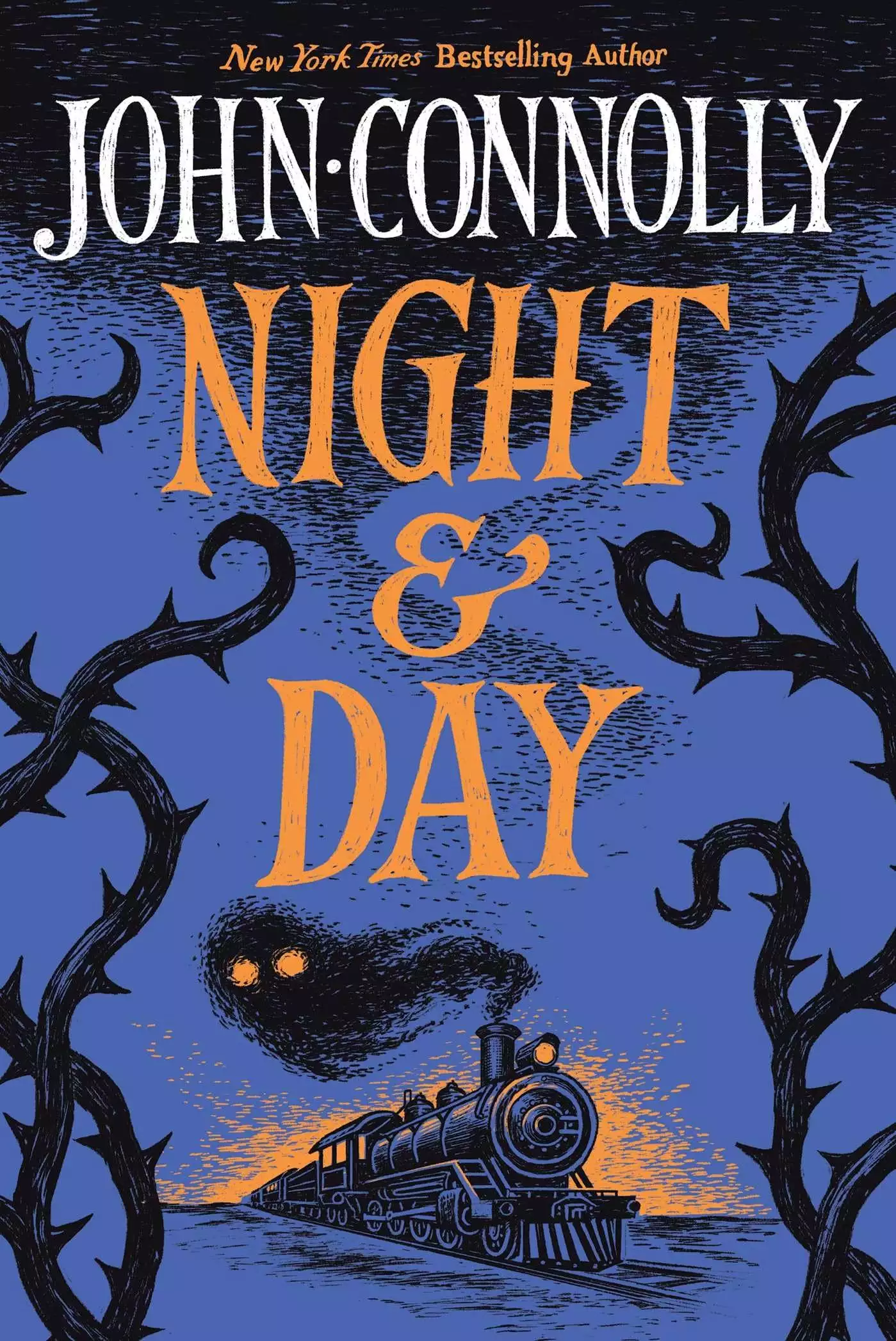
Night and Day
- eBook
- Paperback
- Audiobook
- Book info
- Sample
- Media
- Author updates
- Lists
Synopsis
New York Times bestselling author John Connolly, “one of the best thriller writers we have” (Harlan Coben, #1 New York Times bestselling author), returns with a shivery collection of supernatural tales.
Filled with eerie surprises and dark delights, Night and Day takes us from the dusty shelves of an uncanny library filled with fictional characters to a bunker deep beneath the earth where scientists seek revenge on old Nazis; from an English marsh haunted by a mother and her son to a country house where a grieving widower finds comfort from a most unlikely source. Concluding with the author’s account of how an obscure horror film brought him closer to his lost father, and how nostalgia can help to keep us sane, this is a collection that will move, entertain, and keep you reading late into the night.
Release date: October 22, 2024
Publisher: Atria/Emily Bestler Books
Print pages: 368
* BingeBooks earns revenue from qualifying purchases as an Amazon Associate as well as from other retail partners.
Reader buzz
 Please log in to recommend or discuss...
Author updates
Night and Day
John Connolly

Miss Haining, the latest custodian of the Caxton Private Lending Library & Book Depository, had resigned herself to never understanding entirely the institution’s intricacies. It was some consolation to her that she was, in this matter, as in many others, following in a proud tradition of Caxton librarianship. At some critical juncture in their involvement with the Caxton, each of her predecessors had thrown up their hands in defeat when it came to comprehending its workings, dating back to William Caxton himself, the library’s somewhat unwilling founder, and therefore the first in a long line of baffled conservators.
On a basic level, the operation of the Caxton was easily explained. When a novel achieved a singular status with the reading public (generally after the death of its author), a first edition of the book in question, wrapped in brown paper and tied with string, would appear on the Caxton’s doorstep, soon to be followed by the fictional character or characters responsible for its popularity. Now and again, due to some fault in the system, a character might arrive before the book, causing confusion or even mild shock for the librarian. Whatever the order of delivery, the physical environs of the Caxton—which, like a novel, were capable of containing multitudes—would already have conjured living quarters to accommodate them, always with a window through which could be glimpsed the world of their respective book, just in case a character should feel the urge to wander among the familiar. Funding for the library, involving the rounding up or down of fractions of pennies, was so ingrained in the systems of publishing that even the most scrupulous of accountants often failed to notice it. If they did, they never succeeded in establishing the cause, or the ultimate destination of the nubbins, and subsequently gave up—or, on occasion, went mad, and then gave up.
How Caxton came to establish the library that bore his name was one of the first stories passed down to their successors by departing librarians. Mr. Berger had shared it with Miss Haining over tea and scones, just as Mr. Gedeon had shared it with Mr. Berger some two decades earlier. It was a valuable introduction to what was to follow, since it was so improbable that everything else seemed marginally more acceptable by comparison.
As Miss Haining approached retirement, it had fallen to her to pass on the founding narrative of the Caxton to one Marjorie Dobbs, who had found her way to the library after having her purse pinched by the Artful Dodger. (The library had a way of choosing—or luring—replacement librarians. Some of Marjorie’s predecessors had variously arrived there on the trail of Anna Karenina, Robinson Crusoe, Hamlet, and on one particularly memorable and confusing occasion, an enormous white rabbit cursing a pocket watch.)
Here, then, as told by Miss Haining to Miss Dobbs, is the origin story of the Caxton Private Lending Library & Book Depository.
Following the success of his first printing of The Canterbury Tales, William Caxton—writer, merchant, and, most importantly, printer of books—woke one morning in 1477 to find five individuals dressed as characters from that same work arguing among themselves in his yard in London’s Almonry, by Westminster, seemingly with no idea as to how they’d come to be there, or so they claimed. They were respectively dressed as the Knight, the Miller, the Wife of Bath, the Summoner, and the Nun’s Priest.
The popularity of his edition of Chaucer had taken William by surprise, albeit pleasantly. Discovering five ne’er-do-wells—or worse, four players and their bawd—loitering on his premises, apparently with some fixation on the text, was less welcome.
“Look,” said William, “is this some kind of joke?”
“I shouldn’t have thought so,” said the Knight. “And if it was, what kind of joke would it be?”
He looked genuinely perturbed, like one who laughed little and didn’t quite understand the concept of japery.
“We’re meant to be here,” said the Nun’s Priest. “We may not know the ‘how’ of it but the ‘why’ is clear enough.”
“Not to me it isn’t,” said William.
“The book,” explained the Summoner. “You offered life to the book, and so offered life to us.”
So sincerely did he speak that he gave William pause.
“You’re not telling me—”
“We are,” confirmed the Summoner.
“No, it can’t—”
“It can,” said the Wife of Bath.
“And it is,” concluded the Miller. “Now,” he added, to a murmur of agreement from the rest, “how about some breakfast?”
William gaped. He was an imaginative man—he could not have loved stories and been otherwise—but he was not a gullible one, or else he would have long since become a failure in business. He had a nose for dishonesty, and it wasn’t twitching. If the five people before him weren’t telling the truth, it wasn’t because they didn’t believe themselves to be. Furthermore, it was obvious from their stance that they weren’t going anywhere for the time being, or not before being fed.
William sent for a kitchen boy.
“Inform the kitchen that we will have guests for breakfast,” he told the boy. “And be so good as to wake Master Wynkyn from his rest.”
After the food had been served, followed by extensive questioning by William and his assistant, Wynkyn de Worde, it began to creep up on the printer that if these were not lunatics, there was a possibility, however unlikely, that they might actually be who they professed to be—five of Chaucer’s pilgrims. William didn’t want to accept it, for reason alone dictated that it couldn’t be so, but he felt a creeping sense of unease. He was a writer and printer. He gave physical form to stories. If a tale could assume length, breadth, and weight in the world, why not also the characters it contained?
William hurriedly ushered the pilgrims into an empty storage shed before anyone could begin asking awkward questions, not that he was short of further awkward questions of his own. Once the five were settled, with a trusted retainer watching the door, William and Wynkyn sat down over cheese and small beer to decide what was to be done with a group of fictional personages who had, it seemed, stepped off the page and into the real world. Wynkyn, like William, understood the power of books and had required surprisingly little convincing to fall into step with his master. For Wynkyn, there had always been a magic to the Caxton press—it gave material form to ideas and made tangible the intangible—and this latest development merely confirmed it.
The five pilgrims couldn’t be permitted to wander the streets of London, that much was clear, not least because they included the Knight, in full regalia; the Miller, complete with bagpipes; and the Wife of Bath, who had already felt up a stable boy before marking the cook as a candidate for husband number six. Given free rein in the city, they’d end up attracting the attention of a justice of the peace. From there, it would be a short hop to the Marshalsea or Bedlam, with a strong chance of William and Wynkyn joining them in one or the other.
“Then there’s the question of what happens should the rest of them arrive,” said Wynkyn.
“The rest?” William barely avoided choking on a piece of hard cheese. He hadn’t even considered that more of them might show up. “What are we supposed to do with thirty-one pilgrims?”
“I suppose we could direct them to the Archbishop of Canterbury,” offered Wynkyn. “I mean, Canterbury was always their destination.”
“Old Bourchier will have us arrested,” said William, glumly. “Or worse, burned at the stake for sorcery.”
Wynkyn paled and touched a hand to his neck. He hadn’t considered that. When it came to the pyre, the lucky ones were strangled to death before the fires got started, but the words “lucky” and “strangled” did not properly belong together in his mind.
“It’s hardly our fault they’re here,” said Wynkyn. “It’s not as if we deliberately conjured them up.”
“No, but we set them down on paper.”
“Geoffrey Chaucer did that. By rights, the blame should be laid at his grave.”
“Perhaps you could go about presenting that argument to the late poet, and thus add ‘consorting with spirits’ to our list of offenses,” said William. “God’s bones, I wonder how slowly the executioners can let a man burn.”
Still, he thought that Wynkyn had a point about Chaucer’s culpability, though it wasn’t one he fancied making while someone measured them up for the stake. Chaucer might have written The Canterbury Tales, but he hadn’t disseminated it. Initially, that had been the responsibility of the scribes who painstakingly copied it for distribution, but they hadn’t been able to reproduce it at the pace of the Caxton press. Nobody in England, and few elsewhere, had been capable of such replication until now. Why, William’s compositors and pressmen had already managed the previously unthinkable feat of printing hundreds of nearly identical copies of The Canterbury Tales in a fraction of the time it would have taken a scribe to create only part of a single copy, and at a similar fraction of the cost.
Now William understood. He might not have created the pilgrims, but he had popularized them, making them accessible beyond oral storytelling in a way that would have seemed fantastical to Chaucer less than a century earlier. And this was only the beginning: with more workers, and faster presses, a printer might be able to offer books not in the hundreds but the thousands. Johann Veldener, the creator of William’s typeface, had suggested as much to him the night before William left Flanders for England, and William had laughed in his face.
“But who will read all these books, Johann?” William asked. “There are only so many lettered men.”
Johann placed his hands on William’s, gripping them tightly.
“Soon, William, there will be more. Books will make men lettered.”
But even Johann had not anticipated what might happen as books became more accessible, and the characters became as real to readers as their own family and neighbors—and sometimes more beloved, too.
No, Johann, books will not alone make men lettered. They will give life to their characters.
“Bring me my coat,” William told Wynkyn. “We must talk with Richard.”
Richard Caxton was one of the Benedictine monks of Westminster Abbey, where he held the position of sacrist. He was a relative of William’s through complex layers of marriage that even the most committed of later Caxton librarians had never been able to trace with certainty. He had also admired William’s printing shop from its inception, unlike a vocal minority of his fellow clerics who believed that books should be for the elite, regarding the Caxton press as a threat to their position and, indeed, their scriptorium. Richard, by contrast, associated learning with civilization: the more learned the populace, the more civilized they might become, and the highest civilizing influence of all was the word of God. Richard still did not say it aloud, for fear of mockery or worse, but he envisaged a day when every household—or every household with a grasp of Latin—might have its own affordable copy of the Bible, and only presses like William’s could make that possible. Following a period of discord, Richard’s contingent at Westminster had prevailed, aided by the fact that the abbot, John Esteney, was one of William’s patrons and had facilitated the establishment of his press in the abbey’s precincts. The monks were now among William’s customers for liturgical works and letters of indulgence, which provided the shop with a welcome source of guaranteed income.
William and Wynkyn walked with Richard by Long Ditch and tried to explain, as best they could, how they came to be harboring five fictional characters in a shed, with the expectation of more to follow. Richard, naturally, proved skeptical at first, and was hardly less so when introduced to the pilgrims, believing himself to be the victim of an elaborate practical joke concocted either by the five themselves or by William, with or without the connivance of Wynkyn. Yet gradually, over two days of interrogation and exposure to their company, Richard, despite himself, began to come around to the same opinion as William. What swayed him was the five’s understanding that they were fictional characters, and therefore as bewildered as anyone else to discover themselves outside the book that had birthed them.
Any final doubts that Richard might have entertained were dispelled when, as he departed the shed on the second afternoon with William and Wynkyn, the Reeve materialized in the yard in front of them. One moment, the closed space was empty, the next, it was occupied by a thin, confused old man with closely cropped hair and a pinched, argumentative face. He was armed with a sword composed more of rust than clean metal.
“I warned you,” said Wynkyn to William.
“You wouldn’t be named Oswald, would you?” William asked the stranger.
“I am,” came the reply. “How did you know that?”
“Because I know your story,” William replied. “Now, I believe there are some people here with whom you might wish to renew acquaintance.”
Wynkyn, Richard, and William sat at William’s dining table. Small beer had been set aside in favor of red wine, more potent stuff being required to tackle the problem at hand.
“No one can find out the truth,” said Richard. “If they do, they’ll burn your shop to ash, and you and Wynkyn with it. As for the six—”
“Six and counting,” Wynkyn interrupted.
“Yes, thank you—six and counting—I can see no good end for them unless a place of sanctuary can be found.”
“Something strange has happened,” said William.
“We’re very aware of that,” said Richard. “We’d hardly be here otherwise.”
“No, something else strange. Yesterday, a copy of The Canterbury Tales, wrapped in brown paper and string, was left on the doorstep of the shop.”
“By whom?”
“Nobody knows. It was just lying there, addressed to me.”
“A dissatisfied customer, perhaps?” suggested Richard.
William bridled. While proud of his edition of Chaucer, he had been made aware of defects in the text on which he had based his version and had since come into possession of a superior manuscript. The errors—including a wrongly positioned Merchant’s tale, a missing exchange between the Franklin and the Squire, and most embarrassingly, the omission or transposition of lines throughout the Knight’s tale, distorting it horribly—galled William. Already, he was contemplating a second edition, illustrated throughout with woodcuts, once a thorough comparison of the two texts could be completed. The buyers of the first edition had, by and large, been understanding.
“We have no dissatisfied customers.” William shifted in his chair, physically modifying his position before doing so metaphorically. “Or when we do, we try to rectify any error that might have been made, for we have a reputation to uphold. But I can see no flaw in the volume. It’s perfect: even the naturally occurring irregularities in the binding are no longer detectable, and the pages are without blemish. I could tell from the first that it came from this shop, but it’s as though it has been elevated by hands more skilled than any I have known.”
“Why would someone return an improved copy of one of your publications to you?” asked Richard. “Other than as an object lesson, of course.”
That tug on the line again, but William did not rise to the bait.
“I cannot say,” he replied.
“What will you do with it?”
“Keep it, I suppose, in case whoever left it decides to seek its return.”
Wynkyn coughed.
“I have some questions,” he said.
“Out with them,” said Richard, with more bite than he’d intended. He liked the Alsatian, who had arrived in England some years earlier as William’s apprentice. Wynkyn shared Richard’s vision of cheaper editions that might help spread God’s word and was trying to persuade William to source his paper at home instead of from the Low Countries, which would cut costs. William, an artist, preferred the continental paper, but Richard thought that given time, Wynkyn might prove to be the better businessman.
Wynkyn was trying to choose his words carefully.
“I’m wary of appearing, um, blasphemous,” he said.
William and Richard exchanged a look.
“It would be best avoided,” said Richard, “but the door is closed, and what is said will stay between God and us.”
“Well,” continued Wynkyn, “my master has suggested that the appearance of the six pilgrims may have been caused by our making their parent volume more easily available. In working on the imagination of readers, we have, in turn, given physical life to those who previously existed only in manuscript reproductions. I have heard estimates of how many of those manuscripts there might be, and none has ever exceeded a hundred.”
“Go on.”
“The Canterbury Tales will hardly be the only such volume we print, so first of all, I’m wondering what further publications, if any, might precipitate a similar influx of characters? After all, the Recuyell of the Historyes of Troye, which my master printed in Bruges, did not result in Hector or Priam turning up at the door.”
“Thank the Lord,” said William. A bad situation might always be made worse. “Could it be that the heroes of the Trojan War were real, or likely so, while the pilgrims are not? Or they weren’t until they showed up here.”
“That would be my hope,” said Wynkyn.
“Your ‘hope’?” William didn’t like the sound of that. “Then why do I detect such a note of doubt?”
“This is where things become delicate.” Wynkyn looked like a man nominated to deliver bad news to a ruler not famed for his tolerance. “My master has spoken in the past of his intention to publish The Golden Legend, being, as we know, a collection of saints’ lives. Should we discover that only fictional characters may be lent flesh and blood by the public passions, that’s one thing. But were we to find that real figures, through the printed account of them, should similarly be given form—”
Richard grew noticeably worried, while William buried his face in his hands. The latter did not want to be responsible for an influx of holy men and women, many of whom had passed away under challenging circumstances and might diversely manifest as beheaded, dismembered, or pierced by a multiplicity of sharp objects.
“And,” Wynkyn went on, “we have also considered the profitability of certain books of hours, containing short extracts from the Bible, both the Old and New Testaments.” He paused meaningfully. “In English, rather than the less accessible Latin.”
William let out a low moan. Whatever the drawbacks of saints materializing in his place of business, he most certainly did not want to precipitate the Second Coming.
“What am I supposed to do?” he asked. “If I refuse to print religious works, I’ll go out of business, or be accused of apostasy.”
“Thus,” said Wynkyn, “my tentative use of the word ‘hope.’?”
“Look,” said Richard, “if the credence of the populace was alone sufficient to cause the Son of God to reappear, it would have happened already.”
“But we’ve never had printed books until now,” said Wynkyn, “or not in such numbers. And this is only the beginning. The world is going to change. It’s already changing. The arrival of the pilgrims is proof of that.”
“Nevertheless, the idea that a book produced by men might compel God’s son to manifest is—”
“Blasphemous?” William offered.
“I did warn you,” said Wynkyn. “Someone had to say it.”
Wynkyn had more to share but decided it might be politic to keep it to himself for fear of testing Richard’s patience. Wynkyn was a man of letters. He spent his days surrounded by blocks, each bearing a symbol, and from those symbols, an infinitude of ideas was capable of being expressed. The more lettered a man, the more complex those ideas became, and with complexity came doubt. Wynkyn believed in God, but prized faith over evidence. The former possessed a higher quality, a grace, because it required a capacity to imagine and accept something beyond the ordinary; it was, according to Hebrews, the substance of things hoped for, the evidence of things not seen.
But when it came to forming and exploring ideas, doubt was always a fellow traveler. In fact, faith could not exist without it, because to reach that state of conviction required the overcoming of doubt. For a wise man, who reflected before acting, doubt was a necessary step on the path to conviction. Yet faith was not fixed. It wavered in times of trial or adversity, as when a loved one was taken before their time, in the face of war, plague, and famine, or when the innocent suffered. Wynkyn was familiar with the doctrine of original sin, but it didn’t mean he was prepared to accept it without question. Man, not God, was responsible for the formation of doctrine, and men were, in all things, fallible. God might try to guide them, but in Wynkyn’s experience, men sometimes misheard Him, or chose not to listen. To be informed, as the more uncompromising of clerics argued, that an infant had died of ague, or at the point of a spear, because they carried with them the taint of Adam’s act of disobedience, was difficult for Wynkyn to countenance. Likewise, to hear that such torment was God’s will, which was beyond human understanding, was less an answer than avoidance of the question, leaving unexamined the issue of the kind of God that would will misery on His creation.
But Wynkyn wasn’t about to question church doctrine openly. The punishments for heresy were more severe than those for blasphemy. One might blaspheme out of drunkenness or anger, but heresy required the exercise of reason. It was a willed offense. On the other hand, Wynkyn was in no hurry to engage in outright blasphemy either, being quite content to avoid branding, flogging, or the piercing of his tongue. Yet an alternative answer to the question of God’s nature could only be blasphemous: grave misfortune befell the deserving and undeserving alike because there was no God.
So Wynkyn had gone through periods of equivocation in his faith. Now, at his master’s table, he was experiencing another such crisis, one that, if disclosed aloud, even only in present company, might cause him to lose his position, which he loved, and, should Richard’s patience snap, his liberty, even his life. If God was not real, and Caxton’s shop commenced publishing multiple copies of the Bible, was there yet not a chance that, on some morning in the future, the printers might awake to discover in the yard a figure bearing a startling resemblance to the risen Christ? If God did not make man, man must have made God. But then, by bringing God into being, whether in the form of the Father, Son, or Holy Spirit, would the Caxton press not simply have confirmed what everyone believed anyway? In that case, no harm would have been done—or not beyond changing the world, potentially for the better, although the First Coming hadn’t ended so well. Who was to say that a man preaching kindness and tolerance would be better received in present-day England than he had been in the Holy Land almost fifteen hundred years earlier? If he didn’t end up beaten to death in the street, he’d find a home in Bedlam with the six pilgrims.
If we become responsible for the Second Coming, Wynkyn decided, it had better be a spectacle to remember.
“Wynkyn, are you still with us?” asked Richard.
“Yes, sorry,” Wynkyn replied. Unfortunately.
“I was saying that I’d prefer to use the word ‘unlikely’ to describe the invocation of the Savior,” said Richard. “But let us assume for now that you, Wynkyn, are right about the impact of the printed word, and correct in imputing its powers of conjuration solely to those who might not otherwise have enjoyed a corporeal existence, aided by an unusual degree of renown caused by the proliferation of specific texts. We currently have only six pilgrims with whom to contend, not the full complement. Those under discussion are, I would hazard, among the more crowd-pleasing of Chaucer’s characters, by virtue of their personalities or the quality of the stories they told.
“In the sciences,” Richard went on, “what has occurred with The Canterbury Tales might be referred to as an unplanned experiment. I propose, therefore, that we undertake a planned one. We produce two pamphlets to be circulated as widely as possible within one mile of Westminster. The first pamphlet will concern a person known to be real, the other a person fanciful but with the potential to capture the imagination. We’ll then wait to see what happens. If both appear, we have a grave difficulty, but if only the unreal one is made manifest, we’ll better understand what’s happening.”
“What if neither of them appears?” asked Wynkyn.
Richard tugged at an earlobe.
“Then the pilgrims may be considered an anomaly—which would be a relief.”
From his tone, Wynkyn suspected Richard might be growing more conflicted about the affair than he was willing to concede. If handled properly, the ability to summon saints on demand would be good for the Church, and the Benedictines of Westminster in particular. They were comparatively few in number, and the abbey, though an enduring tribute to the glory of God, was not a site of pilgrimage. The monks currently didn’t even have enough funds to complete the construction of the West Towers, but if it became known that saints were popping up in the abbey’s precincts, the Benedictines could raise towers to their hearts’ content. Obviously, there was still the matter of avoiding the Second Coming, but should a middle ground be found—
“I have another question,” said Wynkyn.
“Wynkyn,” said Richard, summoning all his forbearance, “I begin to fear that Thomas Aquinas might have struggled to formulate so many questions as you.”
Wynkyn, though, was not intimidated. In his view, foolish questions did not exist; even if they did, it was better to pose them than remain silent and later reap regrets.
“Isn’t inventing a person potentially a breach of the Ninth Commandment?” asked Wynkyn. It was the politest way he could find of suggesting that Richard was intent upon deceiving a section of the populace. “After all, did not Aquinas himself state that it is unlawful to lie to deliver another from any danger whatsoever?”
Richard stared hard at Wynkyn.
“God preserve us,” he said, “from educated men.”
“Our press would be worthless were we otherwise,” replied Wynkyn.
“If easier to control. But that, Wynkyn, is a headache for another day. In answer to your question, Aquinas affi
We hope you are enjoying the book so far. To continue reading...
