
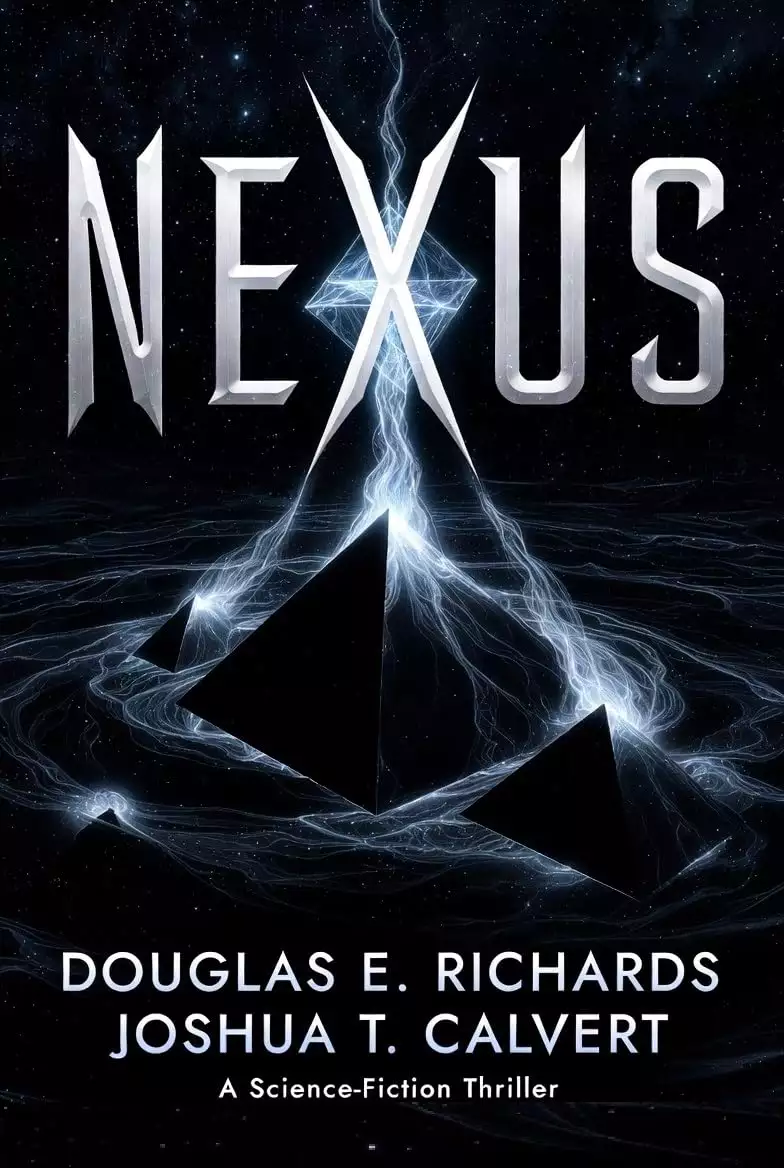
Nexus: A Science-Fiction Thriller
- eBook
- Paperback
- Book info
- Sample
- Media
- Author updates
- Lists
Synopsis
Multimillion-copy bestselling authors Douglas E. Richards and Joshua T. Calvert deliver a mind-bending near-future thriller that fuses cutting-edge physics with the deepest secrets of ancient Egypt.
When physicist Lukas Heuer discovers three anomalous pyramid-shaped objects in deep space, hurtling toward Earth, he knows humanity's days are numbered. Because the objects are so massive, if he and a small group of scientists can't unravel their purpose and origin, their gravitational pull will tear Earth to rubble—before they even get close.
Half a world away, archaeologist Mira Najafi discovers a hidden passage in the Great Pyramid containing an ancient drawing of three black pyramids against a blue sky—a clue her vanished father left for her fifteen years ago, the last trace of the man she never stopped searching for.
Two seemingly unrelated discoveries. One impossible convergence.
As Lukas and Mira race toward the same cosmic nexus, they uncover a presence that has been watching humanity for millennia—a presence now awakening in our solar system. Because these physics-defying objects aren't just arriving.
They're returning.
What follows is a desperate mission to the edge of human understanding: a journey that will force a handful of scientists and explorers to confront the limits of physics, consciousness, and reality itself.
Because the pyramids aren't just objects. They're keys—and the door they open may change humanity forever . . . or erase it entirely.
Nexus is a high-concept, high-stakes thriller that will leave you questioning the nature of reality, and what it really means to be awake.
Release date: February 1, 2026
Print pages: 349
* BingeBooks earns revenue from qualifying purchases as an Amazon Associate as well as from other retail partners.
Reader buzz
 Please log in to recommend or discuss...
Author updates
Nexus: A Science-Fiction Thriller
Douglas E. Richards
Chapter 1
Night had settled like a cosmic shroud over the forests of Livingston, Louisiana, while Dr.
Lukas Heuer was still sitting in front of the monitors. The bluish light from the screens cast pale
shadows on his sleep-deprived face, drawing deep furrows around his eyes—maps of a life
devoted to the mysteries of the universe. He now carried 44 years on his shoulders, and in the
last few months, each of those years seemed to have doubled in weight.
The control rooms of the LIGO observatory lay deserted. It was Friday evening. The others
had hurried home to their families, their loved ones, their warm living rooms, and shared joy
over good conversation, baseball, or barbecues—the modern equivalents of campfires.
Home. A concept that was becoming more and more of an abstract equation for Lukas,
unsolvable in the many variables of loneliness that his mind had recently been forced to explore.
His much-too-large apartment near the campus was no longer a home, but merely a place where
memories of Lisa lurked.
Four months had passed since he and his wife had separated. Four months during which he
had desperately tried to fill the void of her absence with work.
“You can’t be serious, Lukas,” she had said shortly before she left, her voice a pattern of
disappointment and resignation. “You’re like a ghost. Present and yet not there. Your passion for
the stars is too great for me to compete with.”
He let his gaze wander around his temporary office. Plain white walls, not a single picture.
A desk piled high with trade journals like tectonic plates. Three monitors constantly spitting out
the same data. The only personal touch was a small German flag stuck to his computer screen—a
subtle reminder of his origins amid the fascinating yet often painful strangeness of America.
Nevertheless, this was where he wanted to be—where he had to be: the LIGO-Virgo-
KAGRA—the global gravitational-wave network.
Lukas rubbed his tired eyes and took a sip of his now cold coffee. He grimaced. At that
moment, he missed German coffee, if such a thing existed, and he missed the little cafés in
Göttingen where he had grown up, where his father, a mathematics professor, had first
introduced him to the secrets of numbers—those universal symbols that represented both the
language of science and the cosmic order.
With sluggish movements, Lukas opened a browser to scroll through the news reports. He
didn’t do this because he was really interested in current events, but to drown out the silence that
otherwise threatened to engulf him like a black hole. In the distance, a car rushed by, a fleeting
sound in the quiet of the night.
Then a notification popped up, imposing itself pompously over a news article about a trade
war. A soft beep sounded from the speakers. Lukas glanced at the short message.
The interferometer had detected something, a cosmic pulse in the digital arteries of the
system. He was instantly alert.
His heartbeat quickened almost imperceptibly. Gravitational wave detections were no longer
a rarity, but each one was a window into the cosmic abyss, a moment when the boundary
between the known and the incomprehensible became permeable for a fraction of a second. He
was accordingly excited as he clicked on the notification and opened the data packet.
A 3-dimensional spectrogram appeared on the main screen: the vertical axis represented the
frequency of the waves, the horizontal axis represented time, and the color intensity represented
the amplitude—the strength of the signal, or the volume of the cosmic whisper, so to speak.
What Lukas saw made him freeze.
The typical signature of a gravitational wave originating from merging black holes or
neutron stars resembled a so-called “chirp”—a signal that rose in frequency and amplitude like a
cosmic bird singing its short, intense song into the void. But what pulsed on his screen did not
follow any known pattern. It was rhythmic, almost structured—a cosmic heartbeat with
mathematical precision.
“That can’t be,” he muttered, hastily typing in a series of commands to check the system’s
calibration.
The signal strength was enormous, comparable to that of a neutron star in the immediate
cosmic vicinity. But the signal oscillated in a precise rhythm that seemed to defy any natural
explanation, as if the universe itself were opening a Morse-code channel.
A mistake, he thought instinctively.
It had to be a mistake. Maybe a malfunction in the detector, an earthquake, unusual seismic
activity that was interfering with the sensitive instruments, or dirty mirrors. The scientific
method demanded skepticism, especially in the face of the extraordinary, and his skepticism
grew with every second he stared at the data.
Lukas launched the standard error detection protocols, letting the system search for
anomalies in the environmental sensors, for temperature fluctuations, for minimal vibrations that
could distort the signal.
The code danced across the screen.
Nothing. The system reported no irregularities.
“Come on,” he whispered, running his hand through his uncut hair. “Show me where the
mistake is.”
He began triangulating the data, using measurements from all the detectors connected to the
network to locate the source of the gravitational waves. He even called up the seismic data from
the earthquake monitoring stations to see if there could have been any tremors anywhere that
might have reached Livingston, however slight.
The hours passed. Midnight came and went. The office air conditioner hummed its
monotonous melody as Lukas sank into a whirlpool of calculations and checks.
At around three in the morning, he stared in disbelief at the result of his hours of analysis:
the source location did not point to a distant galaxy, not even to a cosmically close event horizon
dozens or hundreds of light-years away. It pointed to a spot within the solar system.
Which, of course, was outright impossible. There were no neutron stars or colliding black
holes here. Still, the measurement data was certain: it came from the immediate vicinity. The
data pointed to the solar system.
To Mars’s orbit, to be precise.
“Impossible!” he said aloud into the empty silence of his office, as if he needed the sound of
his own voice to emphasize the absurdity of the result, as if words alone could force reality back
into familiar channels.
Gravitational waves of this magnitude could only be generated by massive cosmic
events—by the collision of black holes, by neutron stars merging in their final death dance.
Objects with the mass of a million Earths, compressed to the size of cities. Nothing in the solar
system except the Sun had anywhere near the mass or density required to ripple space-time in
this way.
And yet the data clearly pointed to Mars’s orbit. Not even to a single point, Lukas realized
with growing amazement, but to three distinct sources that seemed to be arranged in an exact
triangle—a nexus of perfection that, in the chaotic symphony of the cosmos, screamed of
intelligence.
He leaned back in his chair, feeling his heartbeat hammering uncomfortably against his ribs.
If this were real, then he had just discovered something that would shake the very foundations of
physics. Something that couldn’t be. Something that was impossible. An anomaly that called the
entire scientific paradigm into question—or something that . . .
He didn’t dare finish the thought.
Instead, his hand wandered to the phone, then paused in midair. He curled his fingers until
they cracked, then opened them again.
Who should he call? The lab director? NASA? To say what? That he might have discovered
three neutron stars in Mars’s orbit? They would declare him insane. Or worse, incompetent, a
scientific fossil who had lost touch with reality because he was drowning in heartbreak.
Science was a ruthless field, a Darwinian ecosystem of ideas. One false claim, one
premature alarm, and the career he had sacrificed his life and marriage for would be destroyed.
No, he needed more data to avoid making a fool of himself. Independent confirmation, a
second window to the truth, which he had to open this weekend before everyone returned to the
office on Monday—because in the unlikely event that this wasn’t a measurement error, he wasn’t
so selfless as to be willing to let someone else take full credit for what could well be the greatest
discovery in history.
But how?
He thought of Carlos Mendoza—his colleague and friend at the European Southern
Observatory in Chile. Carlos worked on the Very Large Telescope, one of the most powerful
optical telescopes in the world. If these alleged objects that LIGO claimed to have
measured—whatever they were—actually existed, then they should also be visible in the
electromagnetic spectrum. That would yield a second face of the cosmic enigma, a second piece
of evidence. Lukas glanced at his watch to assess his chances of success in such a short time.
It was early evening in Chile. If he flew there immediately, he could arrive the next day.
Saturday. He would have to fly back on Sunday at the latest and be back in the office. No one
would go to the observatory or here to LIGO before Monday. No one would notice his absence,
and no other researcher was likely to see the data he had seen—unless a recently divorced
colleague somewhere in Italy or Japan was also afraid of his own apartment.
With trembling fingers, he booked a flight to Santiago, Chile. The first available connection:
6:30 a.m. via New Orleans. In three hours. Just enough time to drive to his apartment, pack a
bag, and rush to the airport. He could just call, but that wouldn’t convince Carlos to drive up to
the observatory for him. It had to be in person. This was too big a favor—and too crazy—for him
to ask over the phone.
When Lukas rose, he noticed that his knees had gone weak, as if the potential weight of his
discovery was pressing down on him. Exhaustion left its heavy mark on his already worn
features, but his mind was wide awake, electrified by the possibility that he was on the verge of a
discovery that could change everything.
He glanced one last time at the monitors, where the mysterious signals were still pulsing, as
if trying to convince him that they weren’t just his imagination; look, we are real.
Lukas shuddered.
In the darkness of his office, only the bluish-shimmering screens remained as he pulled his
jacket off the chair and hurried out to his car. Before settling into the driver’s seat, he paused
briefly and looked up. The sky over Louisiana was clear, the stars twinkling like distant beacons,
sparkling beautifully and numerous. Somewhere out there, something was waiting for him, even
though he clung to his doubts like a drowning man. This was something that couldn’t be.
Something that made space and time itself vibrate.
Lukas Heuer got in his car and drove through the dark streets, praying that no one would
happen to come into the office until he could prove, or disprove, what he thought he had found.
Chapter 2
The air in the depths of the Pyramid of Cheops carried the heavy breath of past millennia.
Dr. Mira Najafi wiped a bead of sweat from her forehead with the back of her hand as she
stepped with her head bowed through the narrow, low passageway that countless archaeologists
had traversed before her. But behind these familiar paths lay secrets that had remained
undiscovered even after centuries of research.
“Pay attention to the markings in the limestone,” she instructed the small group of doctoral
students who were close behind her. “Even tiny carvings can be significant. The ancient
Egyptians speak to us not only through their hieroglyphs, but also through the language of
architecture itself.”
Her voice sounded distant even to her own ears, as if it belonged to someone else. At 37, she
was one of the youngest project leaders ever to head an expedition to the Pyramid of Cheops, an
honor that gave her less pleasure today than she had once imagined. In her right hand, she
clutched a small notebook bound in worn brown leather, its pages curled from frequent use.
“But—” she continued, “and this is where the trained eye of experience comes into
play—not everything is original. Over the centuries, particularly skilled tomb raiders and looters
have been able to cover their tracks extremely well in some cases. Lime-plaster and clay, or lime-
plaster and cellulose, are enough to make it look deceptively real and feel the same. What’s
more, both were readily available very early on. So we always have to check whether we’re
being fooled by past crooks.”
The soft light of their LED lamps revealed the astonishing precision of the stone blocks,
whose joints were still only slightly wider than the edge of a credit card, even after thousands of
years. Mira stopped and pointed to a series of barely visible markings on the wall.
She gently touched the stone, a fleeting connection between the present and the past. “Also
note the discoloration—it may indicate chemical reactions caused by small air pockets or
moisture, which in turn may indicate hidden cavities.”
Of course, she was thinking of the discovery of the chamber known as ScanPyramids North
Face Corridor, a breakthrough in 2023 that had changed everything. After a century without the
discovery of new chambers, an international team had used muon tomography to finally discover
one—a corridor about 30 feet in length, 6.6 feet wide, and 6.6 feet high, hidden behind walls of
solid limestone. The news made headlines around the world and opened the door to a new era of
pyramid research—as well as the wallets of financial backers.
“Professor Najafi?” A young woman with short, dark hair—Leila, if she remembered
correctly—raised her hand tentatively. “Shouldn’t we wait until Dr. Abdelrahman is back with
the ground-penetrating radar? The preliminary scans have shown unusual density differences in
this area.”
Mira blinked, suddenly torn from her thoughts. “Of course, Leila. Good point.” She forced a
smile. “We’ll proceed methodically. Science is a game of patience, not a race.”
In front of them, the passage opened into one of the side corridors they had already
explored, one of many branches in the complex labyrinth of internal structures. As she spoke, her
thumb unconsciously stroked the worn leather cover of the notebook like a talisman that gave her
security but also kept drawing her attention back to it.
Mira licked her lips and led her group back to the temporary base camp they had set up in
the Great Gallery, the impressive, nearly 30-foot-high corridor that led to the King’s Chamber.
The rest of her team from Yale University, the institution that had been at the forefront of
Egyptological research for more than a century, was already waiting there. The camp blended
state-of-the-art equipment with the pyramid’s ancient grandeur.
Professor David Markowitz, her mentor and sponsor, had handed her the reins of the project
two months earlier, fully aware that her motivation went beyond pure science. Yale had provided
generous funding after the sensational discoveries of 2023 had electrified the scientific
community. The suspicion that dozens of additional chambers and cavities could be hidden in the
pyramid had fired the imagination of researchers and financiers alike. But with the leap of faith
came an unspoken demand: she had to deliver.
“Let’s go through the new data,” she said, pointing to the makeshift work tables on which
computers and scientific instruments were set up—modern technology in the belly of a 4,500-
year-old monument.
Dr. Ahmed Abdelrahman, an Egyptian colleague from the Cairo Museum, nodded to her as
she approached. His screen showed a 3-dimensional model of the interior of the pyramid that had
been mapped so far, interspersed with colored markings indicating potential anomalies.
“We’ve scanned the northeast quadrant with ground-penetrating radar,” he explained
solemnly, looking at the students. “The scans reveal promising anomalies in density here and
here.”
The students gathered around the screen, excited by the possibility of new discoveries. Mira
looked at the displays with professional interest, but her mind kept wandering back to the private
notes in the small leather book in her hand.
“At this point,” continued Abdelrahman, zooming in on a specific area, “we found an
unusual reflection signature. The density doesn’t change abruptly like it would in a normal
cavity, but gradually. That could indicate a passage that was deliberately filled in.
“In addition,” he continued, “we have the latest data from the muon detectors. He called up
a new visualization showing the density of muon penetration—brighter areas where more
particles passed through, darker areas where the massive stone structure blocked them. “The
main cavity from 2023 is clearly visible here.” He pointed to a long, bright area above the Grand
Gallery. “But these smaller signatures here and here are new and correlate with our radar
results.”
“Okay, then,” said Mira. “Let’s split into three groups. Team one will check the anomaly in
the northeastern area with me. Team two, led by Dr. Abdelrahman, will investigate the western
corridor with the new infrared scanners. Team three will document the hieroglyphs in the newly
discovered antechamber. Pay particular attention to repetitions of the ankh symbol in connection
with astronomical signs—this was a recurring motif in the previous chambers.”
The division of tasks was quick and routine. Mira led her group through the Great Gallery,
whose sloping floor seemed like a path to another dimension. The lights of their headlamps
danced on the walls like fleeting thoughts as they advanced in silence, each lost in awe of this
place that had survived for millennia.
After reaching the area that the radar scans had marked as unusual, the methodical work of
investigation began. “The pyramid is more than simply a structure,” said Mira after the group
had been studying sensor readouts for some time. “It is a repository of knowledge, a stone library
whose language we are only just beginning to decipher.”
After an hour more of methodical work, she was overcome by the familiar uneasiness that
had accompanied her since the beginning of this expedition.
“Keep mapping,” she said to her team as the hairs on the back of her neck stood on end. She
felt strangely watched. But maybe it was just guilt. “I’ll check the eastern side corridor, which
showed a slight anomaly on the muon scans. Jason, you take the lead. Document every inch and
send the data directly to my tablet.”
As soon as she was out of sight, she slowed down. She listened briefly to make sure no one
was following her, then pulled a small, homemade device out of her bag. No larger than a
smartphone, it was an extremely sensitive anemometer, capable of registering even the slightest
air movements. Movements that could indicate hidden openings too narrow for conventional
instruments to detect. She had paid a small fortune to fund its development.
She opened the leather book and turned to a page with a hand-drawn map of the pyramid,
supplemented by cryptic notes in her father’s distinctive handwriting. Dr. Dariush Najafi had
disappeared from this very spot 15 years ago, leaving behind his daughter and wife without
explanation, without saying goodbye—a man who had dedicated his life to researching ancient
Egypt, suddenly wiped out like a footprint in the sand.
He would never have left her voluntarily; she was sure of that.
Mira looked around when she felt herself being watched again, but there was no one else
here, and she didn’t even hear the muffled echoes of her students.
She looked at the map again and tried for the hundredth time to decipher its secrets.
The official investigation had gotten nowhere, intimating that her father had either met with
foul play or had wanted to ditch his family and begin a new life. Mira didn’t believe either. Her
father had been too experienced, too cautious, to let himself fall into a trap, natural or man-made.
And he had loved his family beyond all else. Besides, the way his personal records had
disappeared, leaving behind only this one notebook, was highly suspicious.
All of this pointed to something bigger. Somehow, she was sure of it.
The pages of the book were filled with precise drawings, mathematical calculations, and
cryptic references to astronomical constellations. Her father had studied the “precession of the
equinoxes” in particular, the slow, cyclical process by which the Earth’s axis described a
complete circle in the sky—a cycle that lasted about 25,920 years, the “Great Cycle,” as he
called it.
She followed a narrow passageway that led away from the main routes. Here, the air was
even thicker, the dust of millennia floating like a fine mist in the light of her headlamp. The
anemometer in her hand showed no significant readings as she slowly moved it along the wall,
inch by inch, in a ritual she had repeated dozens of times over the past few weeks.
At one point, she stopped and looked at a series of barely visible markings in the stone. To
the untrained eye, they might have appeared to be natural irregularities, but Mira recognized a
pattern—a stylized star surrounded by three small triangles. She had seen the same symbol in her
father’s notes, accompanied by complex calculations relating to the hour stars, the celestial
bodies that the ancient Egyptians had used to measure time.
Mira leaned her forehead against the cool stone, briefly overcome by exhaustion. After two
months of intensive research, she was no closer to finding her father. She had only one month
left before her funding ran out and the research time would be handed over to other teams.
Her thoughts wandered back to the last days with her father. He had undoubtedly been
different, distant, immersed in ancient texts and astronomical calculations. “It’s all connected,
Mira,” he had said to her one night, his eyes feverish. “The stars, the pyramids, the cycles of
time—a pattern just waiting to be deciphered.”
At the time, she had dismissed his words as the usual enthusiasm of a passionate scientist.
Today, she wondered if he had actually discovered something—something so significant that it
had cost him his life.
She sank to the floor, the notebook on her bent knees. The last page her father had written on
contained a series of numbers and astronomical symbols, next to a sketch of a constellation she
couldn’t identify. Below it was a single sentence in Farsi, her mother tongue: “They are not
returning, they are still here.”
What did he mean by that? Who was still here? And what was the connection to the Great
Cycle of Precession?
Mira closed her eyes for a moment and stubbornly blocked out the thought that he might
have gone mad. In the silence of the pyramid, surrounded by stones that had seen thousands of
years of human history, she suddenly felt small and insignificant.
Her father had discovered a secret here, something that had torn him away from his
family—or had violently separated him from them.
She remembered his laughter, his warm hand holding hers as she ran through the museums
of Boston with him when she was a little girl. He had explained the hieroglyphics to her, taught
her to decipher the mysterious symbols, told her stories of pharaohs and gods, of forgotten cities
and ancient wisdom. He would never have left her of his own free will—not without a good
reason.
She opened her eyes, filled with new determination. Somewhere in this vast stone complex,
the answer lay hidden. She would find it, whatever the cost.
As she stood up, her gaze fell on the wall opposite. Something on the surface of the stone
caught her attention—not an obvious inscription or mark, but a subtle irregularity in the masonry,
barely perceptible in the dim light, so marginal that hardly anyone would have noticed it.
She stepped closer and ran her fingers over the rough limestone. There, almost invisible to
the untrained eye—even her own just a moment ago—was a symbol carved into the stone: three
small triangles arranged in a specific formation that she recognized from her father’s notes.
The small digital pointer of the anemometer in her hand suddenly moved—almost
imperceptibly. She didn’t feel anything on her fingers or skin, but the sensitive instrument had
detected a hint of movement, a tiny stream of air passing through an invisible gap.
Mira held her breath and checked the spot again.
There it was again!
After all this time, all the methodical searching, she had finally discovered a clue. Not a
random anomaly in the data, but a sign, placed there by human hands—perhaps her own father’s.
The triangles were located directly beneath the tiny air current.
With trembling fingers, she touched the carved symbol, pressing lightly against the ancient
stone as the anemometer continued to register the subtle movement of air—the whispered
promise of a hidden truth.
Chapter 3
The Boeing 787 lifted gently off the runway at Louis Armstrong International Airport in
New Orleans. Lukas watched as the lights of the city below him merged into a glowing texture, a
web of lights from the bustling civilization that never seemed to rest. He had barely slept in the
last 24 hours, and yet he felt a strange clarity in his thoughts.
Almost ten hours flying time to Santiago. Ten hours in which his discovery hung
unconfirmed, neither true nor false, like the proverbial cat in Schrödinger’s box of uncertainty.
As the plane reached cruising altitude, Lukas leaned his head against the small window.
The ocean below him was a black void, broken only occasionally by the silver glow of
moonlight on the waves. The night was cloudless, and above him the stars shone with cold
clarity, indifferent to the questions he threw at them. What if he had made a mistake, after all?
What if his sleep-deprived eyes had seen patterns where there were none?
A lonely man longing for meaning, for a reason to escape the emptiness of his life.
He closed his eyes, trying to find the sleep he so desperately needed, but his mind kept
circling around the data he had seen. Three signal sources on Mars’s orbit. Three objects with the
gravitational signature of small neutron stars. Not one impossibility, but three.
As the first light of day touched the horizon—after hours of brooding and self-doubt—the
plane finally landed in Santiago, nestled among the mighty peaks of the Andes. Lukas felt
strangely detached, as if the journey had catapulted him not only across the globe, but out of his
own reality.
He had called before he left to arrange for the fastest rental car money could buy to be
waiting for him, and just a handful of minutes after landing, he was sitting in a dark blue Audi
SQ3, racing out of the Chilean capital toward the Atacama Desert. The European Southern
Observatory was located in La Silla, almost 300 miles north of Santiago—a journey through one
of the driest and most inhospitable landscapes on Earth, but at least traffic was minimal.
Lukas didn’t slow down. The landscape on either side of the road flew past him, a
kaleidoscope of golden brown rocks and pale green, sparse vegetation. The sky above him was
so intensely blue that it almost hurt to look at it directly—a blue that only existed in regions
where the air was so clear that it seemed almost nonexistent.
He streaked over the highway at nearly 100 miles per hour, having arranged to meet with
Carlos before he had left. His colleague was one of the few people he would call a friend—a
brilliant astronomer with a talent for optical telescoping who had been working at the VLT in
Chile for three years.
He had told Carlos that he’d booked a flight to Chile and would be arriving that morning,
and convinced his friend to let him access the telescope, given that on the weekend it would
normally lie dormant.
Not that Carlos hadn’t objected. Vigorously. It was a transgression that could easily get him
fired from a job he loved. Lukas had told him he couldn’t explain over the phone, but that it was
vitally important or he wouldn’t have made the request.
Nobel Prize level important. A phrase that had certainly gotten Carlos’s attention.
The last few miles to La Silla led along a lonely mountain road that wound its way up the
slope in tight curves. The landscape became barren, the air thinner.
As he took the last bend, the observatory appeared before him, a cluster of white domes on
the summit of the mountain, glistening in the sunlight like giant mushrooms sprouting from the
dry ground. The European Southern Observatory in La Silla was one of the first large
observatories to be built in Chile, a pioneer of modern astronomy. Its strategic location in the
Atacama Desert, far from light pollution and atmospheric disturbances, and an average of 300
clear nights per year made it one of the best sites for astronomical observations on Earth. Lukas
parked the car in front of the main building and got out. The sudden silence after the long drive
was almost palpable.
The air was dry and cool, filled with the scent of desert dust. He looked around and saw an
old pickup truck parked at the edge of the parking lot. Next to it, Carlos Mendoza was leaning
against the hood, his arms crossed in front of his chest, sunglasses on his nose.
“You look like you’ve seen the devil, my friend,” said Carlos as Lukas approached him.
Carlos shook his friend’s hand warmly and then pulled him in for a quick hug. “What the hell is
going on?” he said, arching an eyebrow. “Since your call, I’ve been super stressed out about
letting you in. But also highly . . . intrigued. Given you’ve flown halfway around the world for
this, I tend to take your word that it’s important.”
Lukas nodded toward the entrance to the telescope and swallowed hard. “I guess we’ll find
out.”
They entered the main building, and Carlos led him through a long, air-conditioned corridor.
“You got lucky,” said Carlos with a rolling Spanish accent. “The New Technology Telescope
isn’t scheduled for observations today. Just being calibrated.”
With its main mirror measuring 10 feet in diameter, the NTT was one of the smaller
telescopes at the observatory, but it had adaptive optics that could compensate for atmospheric
disturbances and was ideal for short-term observations.
They entered the control room, a windowless space filled with monitors and computer
terminals. Carlos sank into one of the swivel chairs before booting up the computers. “What are
we looking for?”
Lukas took a deep breath. The moment of truth. He took a USB stick out of his pocket,
plugged it into the computer, and opened a file with the LIGO coordinates after Carlos gestured
that he could go ahead.
“These 3 points,” he said, pointing to the screen. “They’re near the orbit of Mars.”
“Uh, cool. And what exactly do we expect to find there?”
“I don’t know. But last night, LIGO recorded gravitational waves from these positions.
Gravitational waves, Carlos. From Mars’s orbit.”
Carlos snorted. “Then your equipment is malfunctioning, my friend. Instead of flying here,
you should have searched the web for a LIGO repairman. My cousin works on air-conditioners.
Do you think he could help?” he said with a wry smile.
“Very funny, Carlos. Because when data shows me that three black holes, or three neutron
stars, have suddenly appeared near Mars, I don’t question it at all. Just another Friday, right? No
need to check the equipment and readings, right?”
Carlos winced. “Okay,” he allowed. “I suppose you did check it out.”
“You think? Exhaustively. Many, many times. The equipment and the data.”
“Which is why you’re here.”
“Exactly.”
Carlos looked at him for a moment, then turned to the computer. “These coordinates are
accurate?”
“As accurate as LIGO could determine.”
With practiced movements, Carlos entered the coordinates into the telescope’s control
program.
An image of the telescope dome appeared on one of the side monitors, slowly opening as the
massive optics inside aligned with the specified section of the sky.
“It’ll take a while,” said Carlos. “The NTT uses adaptive optics to correct distortions caused
by turbulence in the Earth’s atmosphere in real time. It uses tiny actuators to almost
microscopically change the shape of the mirror—a technological marvel that has revolutionized
the quality of terrestrial telescopes. And it can not only take images, but perform a spectroscopic
analysis.”
A star map of the target area now appeared on one of the main monitors. The Martian orbit
was empty at that moment, as Mars was currently on the opposite side of the Sun.
“If there’s anything there, we should be able to see it,” said Carlos. “Even relatively small
objects reflect sunlight.”
Lukas nodded, the tension making it difficult to breathe. The next two hours passed in a state
of tense anticipation. Carlos worked on the controls, adjusted the telescope, took the first test
images, and refined the alignment.
Lukas stared at the monitors, searching for even the slightest anomaly. His tension grew into
an uncomfortable lump in his throat, and he began to pace back and forth like a caged tiger.
Then came the disappointment: the first images showed nothing but the eternal emptiness of
space, interspersed with distant stars glittering like diamonds on black velvet.
“We need to increase the exposure time,” muttered Carlos. He raised his eyebrows. “On the
other hand, if we really are dealing with a black hole—which we’re not, because that would be
loco—we could gather light for eternity and never see it. We’d have to look for gravitational
lensing, and so on. You know, in this fantasy reality of yours.”
An hour later, Carlos shook his head. “Still nothing. Are you sure the coordinates are right?”
Lukas felt a cold hand wrap around his heart. “Positive. Let’s switch to a different spectral
range,” he suggested, feeling like he might vomit. Either there was a possible anomaly out there
that threatened the extinction of humanity, or he had lost his mind. Not two great choices. “Let’s
look for it in the infrared range.”
Carlos nodded and reprogrammed the instrument. Another half hour passed as the telescope
gathered new data. Then the computer began processing the images, algorithms filtering out
noise, amplifying weak signals, combining different images into a single image.
And then they saw it.
Three faint but unmistakable structures appeared on the main monitor, three seemingly
equilateral triangles, at first glance slightly different in size. They reflected hardly any light, were
almost black, absorbed almost all the radiation that hit them, but they emitted heat.
“These aren’t natural bodies,” whispered Carlos, his voice suddenly hoarse. “Dios mío!
Lukas, what is that?”
No, not natural bodies. The three objects had a precise triangular shape, with sharp edges
and smooth surfaces, as far as the telescope image showed. Geometric perfection where nature
had created only chaos and organic irregularity.
Carlos enlarged one of the objects and the image became sharper. The triangle seemed to be
made of a material that was blacker than the darkness of the surrounding space, a black that not
only barely reflected light, but seemed to swallow it.
“What the hell are those things?” muttered Carlos, his accent now much stronger.
Lukas had no answer. He slumped powerlessly into his chair and rolled back a little.
Thoughts raced through his head, desperately trying to squeeze the impossible into a framework
of comprehensibility. The triangular objects in Mars’s orbit looked like pyramids. Pyramids!
Three structures that generated gravitational waves, which could only come from objects with
the density of neutron stars. Three obviously artificial constructs, where nothing artificial should
be.
Lukas felt a chill run down his spine. It was time to face what he had studiously avoided
facing since the start. If these were truly neutron-star-mass objects traveling near Mars’s orbit,
the consequences would be apocalyptic. The gravitational tug-of-war would have already yanked
Mars, Earth and the other planets out of their stable orbits. Tides would be monstrous,
earthquakes constant, with the entire inner system spiraling toward chaos.
Lukas wasn’t always that observant, but he had to believe that the Earth being yanked from
its orbit was something he would have noticed.
He quickly shook these thoughts from his head once again. He would take the data as it
came and not get mired down in preconceptions—even if dictated by the laws of physics. The
presence of these triangular objects was impossible, and it wasn’t entirely surprising that one
impossibility might lead to others.
He couldn’t help thinking of extraterrestrial objects. Spaceships, perhaps? Because what else
could it be?
The feeling that this couldn’t be reality, that what they were seeing, mere data on a screen,
couldn’t be real, was the strangest thing he had ever felt.
But it didn’t change what they were seeing. At least he now had a confirmation—and a
witness. Or perhaps losing one’s mind was infectious.
“We need to collect more data,” said Carlos, his voice now calm, the scientist in him
regaining control. “Spectral analysis, precise movement parameters, everything.”
Lukas hardly listened to him. He had stood up, his legs feeling strangely wobbly, his gaze
still fixed on the three black pyramids staring back at him from the screen like a cosmic
indictment.
The images were generated by the computer and were not live footage in the sense that a
camera would have captured them, but the technology was proven.
“I need to make a call,” he said, his voice sounding strange to his own ears.
Carlos looked at him, his face a mixture of excitement and confusion. “Who do you want to
call?”
Lukas looked at the images on the monitor, at the three perfect pyramids that, cosmically
speaking, stood directly in front of humanity’s front door like heralds of an unknown power.
“Everyone,” he said, swallowing. “Everyone.” ...
We hope you are enjoying the book so far. To continue reading...
