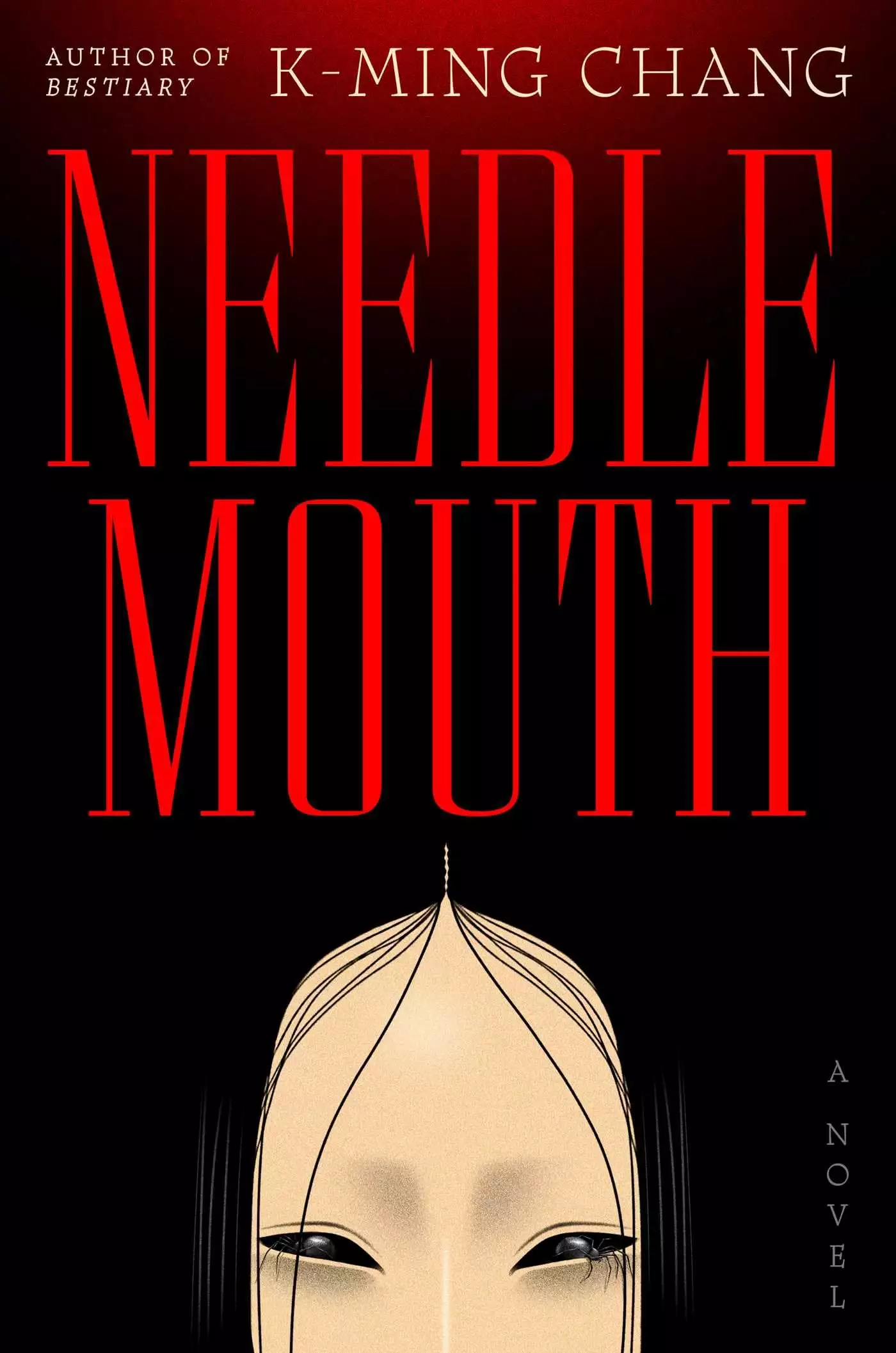
From the award-winning author of Bestiary, three cousins are forced to complete an impossible and violent task set by a vengeful demon.
Cousins Cindy, Yangyang, and Mandy’s hot, tedious summer unfolds in their grandmother’s hauntingly familiar house. Mandy, the eldest, seeks connection online and exchanges emails with a stranger. Yangyang, the youngest, retreats into her own imagination in search of meaning. But every morning Cindy wakes with strange objects in her mouth: a button, a berry, a coin.
One night, a starved figure with a mouth the size of a needle-tip appears at Cindy’s bedside. She is hunger-afflicted, a demon with no descendants to feed from: she is Needlemouth. Part vampire, part hungry ghost, Needlemouth forces the girls into a grim task to end a man’s life.
Cindy, Yangyang, and Mindy are plunged in and out of the demon realm, where they are called to break out of the indifference and numbness of their claustrophobic worlds, and where they are met with the most rageful and resistant parts of themselves. In a quest to satisfy the demon’s hunger, they unravel their shared grief and reckon with the cyclical violence that shaped their family. For readers of Akwaeke Emezi and Carmen Maria Machado, K-Ming Chang has crafted a reimagined coming of age novel that asks: What does it mean to become the monster instead of slaying it?
Release date:
October 20, 2026
Publisher:
Simon & Schuster
Print pages:
288
* BingeBooks earns revenue from qualifying purchases as an Amazon Associate as well as from other retail partners.
1. Cindy Cindy Outside, we play House. My cousin Mandy, my cousin Yangyang, and me. We invite our neighbor Xiaocai to join us in the yard, which is nothing more than a tilted kumquat tree and yellowed weeds. It is morning, and my aunts have left for the factory. Their departures describe them perfectly: Cold-Blooded Ayi—so named because her blood is cold and can only be heated to a human temperature with the consumption of soups, period dramas after work, and killing a particularly acrobatic fly on the first try—insists on kissing Mandy on the cheek before she leaves, and today she pins the kiss with such force that a blood vessel breaks. Aunt Elizabeth, Yangyang’s mother, never kisses anyone or anything, not even the rim of her cup when she drinks. Instead, she tilts the water into her mouth so that it unfurls like a ribbon into her throat. When Aunt Elizabeth leaves for the factory, she slips out the door silently, and Yangyang says she used to wake up early and wait by the door, hoping to catch her mother mid-flight, but she would always fall asleep on the threshold. By the time she woke, her mother was gone. “My mother has been gone since I was born,” Yangyang says. “Even when I was inside her, she was absent. What carried me was a basket of light. I will try my best not to burden her in this life.”
Aunt Elizabeth insists this isn’t her house, this is Ama’s house, and she lives here temporarily until she can get back on her feet and leave. Cold-Blooded Ayi scoffs and says, What feet, you’ve barely got a spine, and Aunt Elizabeth says she never meant to stay so long. Cold-Blooded Ayi rolls her eyes, but I can tell she is relieved not to live alone in Ama’s house. “What this house needs is a man,” Cold-Blooded Ayi says. “Don’t you know the saying? Three women together produces one soap opera.”
But she loves soap operas, especially when the emperor is forced to choose between his mother and his beloved concubine. When he chooses the concubine, Cold-Blooded Ayi throws her slippers at the TV and says, “Never happens! A man is first come, first served. He loves whoever served him first.” When he chooses his mother, Cold-Blooded Ayi flings an orange peel at the TV and says, “Never happens! A man can’t fuck his mother, and he always follows his prick.”
Aunt Elizabeth hates soap operas and shuts them off mid-episode, insisting that they’ll give us girls nightmares, what with all the ritual suicides and the incessant sobbing, but Cold-Blooded Ayi says it’s better to be heartbroken by a man on TV than one in real life, and Mandy says she agrees. All the soap opera storylines are so cyclical and repetitive, I plug my ears with wads of tissue paper to avoid living the same day over and over again. Every season, they kill off the characters one by one so that the actors can come back reborn, this time playing their own descendants. What’s the point in dying just to return to the same story? At night, I pose this question to ghosts. What’s the point of having a daughter if she’s going to be fed to the same life?
Cold-Blooded Ayi and Aunt Elizabeth say one day, when we have husbands ourselves, we’ll understand what they mean, and we’ll know men can’t help what they want, any more than animals can control their desires. It’s up to us to be civilized, to take care of them. All they want is sex and food. Give it to them, or you only have yourself to blame when they stray.
“What kind of animal?” Yangyang always wants to know. Taking care of a crab is different from a snake is different from a chicken is different from an eagle. But in their lack of specificity is the full spectrum of possibility, the scroll of unending death. There is nothing more terrifying to me than the omission of detail.
At night, Aunt Elizabeth and Cold-Blooded Ayi take turns coming to my bedside. As if they know I’m empty, they siphon their secrets into me: “I love my sister, you know that,” Cold-Blooded Ayi says. “And it’s her business, but all her failed marriages, you know it’s because she never gives enough, and her daughter is just the same, you know how Yangyang is, so cold and withholding, we all know where she gets that from, now it’s too late for her, no one wants a woman with a child, weighed down, and she knows it, and she takes it out on me, she barely speaks to me, why is she trying to punish me, to blame me for her own mistakes, I try to be kind to her, I try to give her honest advice, I tell her when something’s broken it’s your duty to stay and fix it, but all she wants to do is run away, run away from this house, do you ever feel the same way, do you ever just think one day, I’m going to run headlong into traffic and finally own nothing and belong to nothing, not even time? Do you ever just want to kill? But you only have yourself to kill?”
Other nights, Aunt Elizabeth comes to my bedside and says, “You know I’m not a gossip, I don’t pry into other people’s business, but I wonder sometimes, what happened to my sister, what happened to that child I used to know who would kill her littermates just to wrestle the nipple into her own mouth, who would grow at the cost of starving everything else around her, so selfish and merciless? These days we’re the same, exhausted, and her exhaustion exhausts me. She doesn’t even fight me anymore. I wonder sometimes, is it worse to die or to accept your life? But it doesn’t matter now. If you suffer in this life, you will be rewarded in the next.”
Hearing this, I shiver. In my next life, will I remember this one? Is it a mercy or a curse to forget, to begin every day blank?
Because I want to feel included, because every morning is like a new episode of a soap opera, lacking continuity, every doorway leading back to the same room, I listen. I covet everything they confide in me, even as I know they didn’t birth me. I’m not their daughter; I dangle from them diagonally, a useless appendage. Like that fleshy pendulum at the back of my throat, that pink pearl of meat with no purpose except to form a drop that never falls. I once plunged a pair of scissors into my mouth and tried to snip it off, clutching the orb gently between my blades, but just as I was about to sever it, Mandy came and yanked the scissors from my hands. All I did was nick it, spraying the roof of my mouth with blood. “What are you trying to do?” she said.
“Testing what parts of me I can live without,” I said. Our aunts would approve; they say deprivation is our strength. Though Mandy believed she triumphed over me that day, I swallowed my blood with glee. At least when I bleed, something of me runs free.
In the meantime, we must rehearse for having husbands. That’s what we do in the yard with Xiaocai. I feel a deep relief stepping out of the house. Out of the house, we are all equally exiled. Out of the house, there are no mirrors, no reminders that my face is not my own, that there is something that enters me at night and tracks mud into my mouth.
But Mandy wants to play House outside. I want to tell her she lacks imagination, but it’s my own mind that’s dammed. In the shadow of the kumquat tree, Mandy stands with her hands on her hips and puts us each in our place. To play House, there must be a Father, a Mother, a Son, a Daughter, and a Pet. Sometimes there can be another daughter, called a Sister, or another son, called a Brother.
Xiaocai sits cross-legged in Mandy’s shadow, and Yangyang circles the trunk aimlessly, but I am afraid to come near the roots of the tree, which writhe in the heat like the tentacles of a beast. I am afraid it will wrap its limbs around my waist and yank me into the dirt, absorb me into the trunk of the tree, take for its nourishment another nameless something.
Mandy says she’ll be the Father, and Xiaocai the Mother, and Yangyang the Daughter because she’s the littlest, and I am the Pet, which is sometimes a dog, sometimes a fish, sometimes a tortoise. I ask why I’m always the animal, and Mandy says it’s because I don’t speak and I don’t remember when I’m hit.
Xiaocai rises from the dirt. She’s the same age as me, wedged between two brothers, the same way I’m shelved between Mandy and Yangyang, but unlike me, she always protests. She says, I want to play another game. I want to make things out of mud. She produces a comic book from her waistband, the pages sticking together like a sick dog’s ears. It’s about Wonder Woman, she explains, who was formed from clay, molded by her mother’s hands, and animated by a slap of lightning. The lightning routed through her clay body like an artery, charging her limbs and heart, giving her life.
Even Mandy is impressed. She says we are the same miracle. No human men were involved in our making. We, too, were fathered bloodlessly. We were threaded to life by a cord of light. We are simultaneously earth and flesh, sewn to the sky and to our mothers.
But when she says this, coldness courses through me.
Where is my mother? Mandy has Cold-Blooded Ayi, who kisses her cheeks and tells her never to get married and have children, that it will indebt her every day of her life. Yangyang has Aunt Elizabeth, who says nothing at all, but whose bone-bright eyes riot against her own silence. What about mine?
“You ask the same thing every day,” Mandy says. “You’re like one of those pathetic little girls who cries when she gets dropped off at school. Your mother is home. At your house. This is Ama’s house. You only live here with us during the summers. Every summer. Lucky you. I have to share a room with Yangyang all year, and you get to go home all to your own. Out of all of us, you’re the only one with a real House. A Father, a Mother, a Brother. All you’re missing is the Pet. You can be the Pet. You’re as dumb as one.”
Where is my House? Mandy says I come from one, but I don’t remember where it is or how I got here. I come to this house every summer, but I don’t remember any other summers, only the colors of the bruises we accrued, the seasons of their healing, gasping green to fertile purple. And I don’t remember the house I came from, the one she claims is mine. It must be true, then: Some people are made of mud, not blood. I am clay the way a mountain is clay. Solid all the way through, housing a silence so saturated it makes me gag.
Mandy sighs. She claps her hands at us and says the game must begin or we won’t get to the births of our babies. When Xiaocai says she’ll only play if she’s the Father, Mandy relents and rolls her eyes again. We stand together in a cluster beneath Ama’s kumquat tree, which wishes it had not outlived her. Beneath the branches, Yangyang officiates the wedding that will allow Mandy and Xiaocai to marry and begin their real life together. Mandy pushes me to the soil and says I’m the Pet, I have to be on all fours, I have to watch from my knees. Animals are incapable of saying no. I am startled by the anarchic heat of her hands. Mine are always cold. Cold hands, warm heart, my aunts always say.
Xiaocai and Mandy become husband and wife, father and mother. They kiss their foreheads together, sealing their sweat. For a brief moment, witnessing their union, I am shattered by panic. I look at my hands. I feel the contours of my face, plunging my fingers into my mouth, reassuring myself that it is human. “Good kitty,” Mandy says to me, and I realize that I don’t know whether a cat’s mouth feels any different from mine.
I kneel in the soil, looking up at Xiaocai and Yangyang and Mandy, human members of a family, and all I can do is mew uselessly, gnaw my tongue, drool a silver wool. I clap to celebrate their wedding, but my palms smack together and pry apart soundlessly, like earthworms severed in half, another game Mandy taught us to play, insisting that the earthworms would grow back whole, regenerating their original length when we buried them back in the mud. But I always suspected otherwise. I always knew they were dead even before we bit into their jelly bellies and spat them out like the tongues of beasts. What killed them was surfacing.
Xiaocai and Mandy sit across from each other at the dinner table. Yangyang is the dinner table. Now she’s on all fours like me, but I’m the only animal in this family. The table is allowed to speak, because it’s Yangyang.
Xiaocai pats my head and says, “Good kitty.” I am filled with relief: Today I know what I am. I curl up beneath Yangyang’s belly, watching her arms shudder and strain as Xiaocai leans her whole weight on the dinner table, her shadow thrown over Yangyang’s back. It is Xiaocai’s right to bully the table to its knees. The husband eats before the wife. I remember this, but I cannot remember my own mother’s face. Yangyang shovels her hands into the dirt, rooting herself deeper to support the weight of Father’s hunger. But she yelps suddenly, rising and bucking off Xiaocai. Sitting back on her heels, Yangyang grips her wrist, turning it in the light.
Skewered through her palm is a needle, bone-pale. Mandy quits being a wife and shuffles close, wrenching the needle out of Yangyang’s hand, uncorking a trickle of black blood. Yangyang cries out and clenches her fist, trying to shut the blood up.
Mandy squints into the eye of the needle, threading her gaze through. It squints back at her, strangling her view. Its tip glistens, dispensing all the world’s dew. The needle is whole, so it’s not one of my aunts’ needles. My aunts work at a factory where the needles always shatter, so thick is the fabric they are tasked to make whole. Mandy stares down at it, disconcerted, and only then do I realize: It’s the needle from this morning, the one that hatched from my mouth. Its shaft is rusty with my blood.
I reach for it, but Mandy closes her fist around it. She looks at me and says, “Did you plant this here? Did you bury the needle in this dirt?”
I shake my head. I remind her that she’s the one who took it from me. Did she forget where she hid it? I am comforted by this thought: I am not the only one with holes in my memory. But Mandy narrows her eyes, tucking her fist behind her back. “It’s followed me outside,” she whispers. The game is over, she announces to us, the House has been burned, and all the members of the House have been slaughtered, our ashes scattered. The end. Time to go home now. Xiaocai looks disappointed. She hasn’t yet gone on her honeymoon. “Slaughtered how? Slaughtered by who?” she says.
“I killed all of you and then I killed myself. It happens all the time on the news, fathers who do that,” Mandy says.
“But I’m the father, not you,” Xiaocai says.
“Shut up,” Mandy says. “You’re dead. I’ve already killed you.” She crouches in the dirt and digs us each a shallow grave, in honor of our slain selves, and then she ushers us into the house.
That night, Mandy kneels on my chest. With strips of fabric from her mother’s scrap bag, she binds my wrists to the bedposts, tells me I’m too weak to escape this. “There,” she says, securing a knot at each pulse point, strangling my wrists bloodless. My fingers shrivel and turn purple, but Mandy says this is the cost of my safety.
“This will prove that you’re sleepwalking and putting things in your own mouth.”
“I’m not a back sleeper,” I say. “Can’t you loosen the ties so I can turn on my side?”
Mandy looks pensive. “You’re right,” she says. “I should tie you to the bed face-down.” But the knots at my wrists are so tight that she is unable to coax them open, not even with the tenacity of her teeth. She snarls and lunges forward, crushing my chest, her teeth snapping in my face before swerving toward my restraints. I can feel the tips of her teeth skimming my cheek, the points of her canines hot as sunlight. When she withdraws, sitting on my chest, she growls at me, daring me to flinch. But all I do is stare up at her, fascinated by her face, how quickly it can cave in on itself, exposing her hideousness. Like turning over a log and revealing on its underside a carnival of fungi, a mirthful party of maggots. Her ugliness is astonishing, breathtaking.
Defend yourself, Mandy seems to say. She stares down at me with a mixture of pity and disdain. In the mirror of her eyes, I see myself: utterly still, bound to the bed, expressionless.
At last, she gives up. She rolls off my chest and collapses beside me, sighing. I turn my head to look at her, glad that she is beside me, though she and Yangyang drift away from me in the night, unable to feign in their sleep what they can in waking life: bearing my presence. At least now I am knotted to the bed. Now I am not so easily exiled.
I fall asleep looking at Mandy’s face. She turns her back to me, claiming that my gaze is gouging her, but I am tethered to her tighter than the fabric around my wrists. She binds me to her spite. If I cannot have her love, then her spite is just as precious.
When I wake up, there is a bird in my mouth. I gag and hack, and it flies out of my throat, wings soaked but beating desperately, levitating for a moment above my face. Its feathers are gilded in mucus. Its nostrils sealed with saliva. It plummets to my pillow, writhing beside me. I purse my lips and blow on its wings, hoping to whisk away the spit, but it shies from my face, launching itself into the air once more. It careens toward the doorway and disappears, and it is then that I realize my hands are free. Someone has undone me.
I sit up in bed. There is something buried in my chest, lodged lower than the bird, and when I reach into my mouth, seared by the heat of my own breath, I feel the frayed hem of fabric. I tug it out of my throat, gagging as I unravel a length of soggy cloth. It unfurls and unfurls, seemingly endless, longer than a beam of light reaching us from the moon. I am a faucet of fabric. It spouts out of me, lengths of satin like filthy seawater, and when I am done vomiting, there is a resounding hollowness in my belly.
The fabric coils in my lap like spilled intestines. They are the remains of my restraints. I must have swallowed them in my sleep. I toss them off the bed and rise. My wrists are sore and gleaming, wearing the blue bangles of bruises. In the dense darkness of the doorway, the bird flickers. It flies across the hallway, straight and purposeful as a blade, but another door blocks its way. It ricochets off and flutters to the floor. I approach its crumpled body, its snapped neck, its head flung back. But its beak is open, gasping, and its chest rises and falls. It is alive. I take a step forward and crush it further, shatter its ribs into fine powder. The body fills with snow. I am so cold.
The door is smeared with blood. I press my palm to it, spreading it like a dark gloss, burnishing the wood. The door creaks open, and behind it is a room I have never entered. A room I have never noticed. The darkness inside is thinning, smudged to silver by the moon’s filthy thumb. A small window like a picture frame, just big enough for a face. I lick my fingers. The blood is sweet and pungent, fermented in silence. I am suddenly hungry.
I step toward the bed. The sheets are floral and recently disturbed, a faint sweat stain souring the clean white pillows. A desolate dresser, the top of it scarred like a cutting board. Someone has taken a blade to it. A yellowing at the edges of my vision. A field of bloodied flowers growing from the bed. The floor is stripped, the carpet torn out by the teeth of a frantic beast. From one of the floorboards juts a rusted nail, and I step forward to impale my heel on it.
But something yanks me back and pummels the air from my belly: It is Yangyang, hissing in my ear, one arm around my neck, the other around my waist. She wrestles me back into the hall as if I were a fugitive animal. The dead bird she kicks aside with a shudder of disgust.
She lets me go. When I turn to face her, she asks me quietly, so that we do not wake the aunts, what I am doing in this room.
We hope you are enjoying the book so far. To continue reading...

 Please log in to recommend or discuss...
