For weeks she has been saying it will be their special day. One last, perfect day with her children before she returns to work after maternity leave. What’s the worst that can happen?
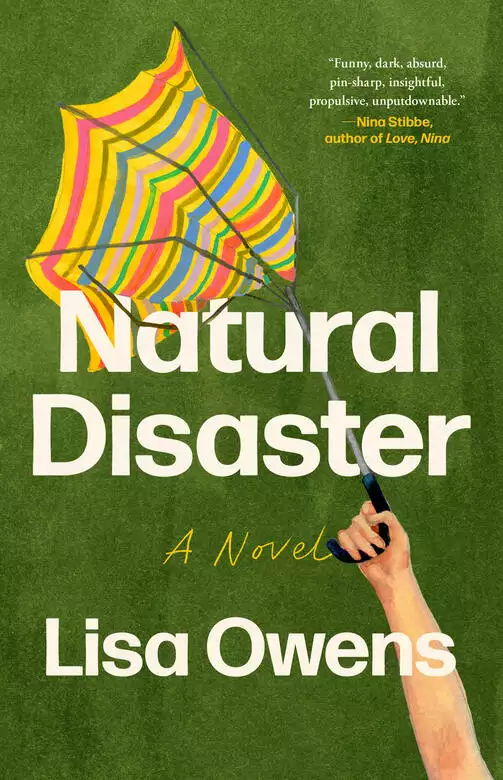
Unfolding across 24 hours, Natural Disaster is a propulsive, funny and sharply observed novel about the absurd, frustrating, hilarious, precarious, bittersweet, sometimes astonishing challenge—literal, existential—of being a woman, a mother, a wife, a person for one single, entire day.
A high-octane Mrs. Dalloway for our hectic times, Natural Disaster is “a thunderously good novel—the kind that makes you rock with laughter, shed a genuine tear, and immediately think of which friends you’re going to lend it to first.” (Nathan Filer, author of The Shock of the Fall)
Release date:
July 7, 2026
Publisher:
Little, Brown and Company
Print pages:
208
* BingeBooks earns revenue from qualifying purchases as an Amazon Associate as well as from other retail partners.
For weeks she has been saying it will be their special day – building it up, using it, guiltily, as leverage in situations where she needs Felix’s cooperation. Their special day, her last of maternity leave before she returns to work, before Rudy starts in the Baby Room, and Felix ups his Daisy Room days from three to five.
It could easily have been a non-event. A couple of her friends – fellow working mothers – had laughed at her sentimentality, urging her to send them both to nursery a day early, take this time for herself. Get a manicure, a massage, why not both? She’s earned it. But this feels unthinkable, deceitful – to the children, to her work, to herself, to women, to her husband, even the concept of the modern nuclear family. She feels it would be like saying she is owed something, or that what she has (an undeniable abundance of gifts) is a burden. No, the proper thing to do is to honour the day for what it is: her last of hermetic, full-time parenting, before the cares and inconveniences of the real world leech in.
Her husband is abroad, attending a health tech conference in Barcelona. His presence there is apparently critical to the expansion of the start-up he co-founded, so she will be managing her transition back to working life alone. The clash of these events has laid bare a dynamic long sublimated in their relationship: for her, it posed a direct, impossible conflict, whereas he seemed to view it as regrettable but incidental, like commiserating over a traffic pile-up on the motorway while sailing unimpeded in the opposite direction.
‘It’ll be fine!’ she keeps saying to him, briskly, whenever he apologises for being away. Though his remorse is gratifying, she can’t submit to a version of events where she falls to pieces without him.
She first proposed the special day while Rudy was napping. Hoping to get some laundry done, she’d set Felix up at the kitchen table with a step-by-step animal drawing book.
‘Horses are hard, even for grown-ups,’ she said when he turned straight to the ‘Challenge Yourself’ section at the back. ‘Why don’t we start with a sheep?’ Moments later, he flung the pencil across the room, flipped the book over and hurled a screwed-up page of half-horses at her. This was when – fearful his howls of rage and frustration would wake Rudy – she had pitched it.
‘Legoland!’ he said, instantly brightening, and she’d had to energetically row back.
‘I was thinking more along the lines of soft play.’
‘Soft play isn’t special!’
‘Or the park?’
‘We always go to the park.’
But ‘always’ is exactly the point. She wants this day to serve as a time capsule for all their days before; to distil and preserve the precious sweetness that usually, if she’s being honest, completely evades her in the moment. She has a half-formed idea of a sort of farewell tour, contentedly trundling round their greatest hits: library, town hall steps, the nice café that does decent coffee and is manageable with two small children at different developmental stages, the duck pond, the playground. She has promised herself she won’t look at her phone while pushing them on the swings, or ravenously seek out conversation with other adults, or discourage Felix from a romance with an unwieldy stick, or stop Rudy from squatting and dabbling in puddles, or hover with tissues trying to wipe their noses… won’t, in other words, succumb to any of the many bad habits and neuroses she has accumulated to date in her mothering career.
It’s difficult to communicate all this to Felix, whose personal ‘best day ever’ (a Winter Wonderland and Hamleys double-header the Saturday before Christmas) coincided with one of her personal worst. Of course, he would opt for the relentless stimulation of a theme park, the same way he and his peers gravitate towards the noisiest light-up toy or most elaborate ice cream – but isn’t part of her job to protect him from such excess? To model for him that small things can be special too? Isn’t the sole message underpinning the various parenting blogs she consults at night after the children are in bed that the only thing kids really want is authentic connection with their primary caregivers?
So, she has remained vague about their plans since broaching the subject – hard to do with a details-oriented guy like Felix – trying instead to focus on the feelings side of things. The day will be special because they will be together, the Three Musketeers (she is careful not to use this name when her husband is around), and even though things are about to change, because she is going back to work, she will always, always cherish this time she had with him and Rudy; less time together doesn’t mean she loves them any less, and if he ever has any worries about… at some point during these monologues Felix invariably becomes engaged in the kind of annoying but harmless activity she is fundamentally incapable of letting pass without comment (turning a switch on and off, or purposely dribbling water back into his glass), and she invariably feels hurt that her thoughtful expressions of care have been so blithely torpedoed, but arrives each time at the same conclusion: the reason Felix is able to disengage like this is because he’s already so saturated in love that these overtures are surplus to requirements.
This morning – their last, special morning – Rudy wakes at 4.45, which means Felix does too, which means all Three Musketeers are in the kitchen by 5 a.m.
‘What would you like for breakfast, Effie? I was thinking we could…’, she pauses suspensefully, ‘make pancakes!’
‘Nah.’
‘Chocolate chip pancakes?’ she says, hearing her desperation, but persisting because three days ago she’d googled ‘child friendly pancake recipe chocolate chip’, assiduously sorted through the results, added the ingredients from the best reviewed one to the shopping list and, furthermore, impulsively spent £15 on the fruits of another Google search: ‘mini heart-shaped pancake pan’.
‘Coco Pops,’ Felix says, adding darkly, as one who has been caught out before, ‘dry Coco Pops’. That she has become the kind of mother to regularly feed her four year old Coco Pops – not as a treat, and minus the calcium-rich consolation of milk – is something she can’t confront without inviting a full mental pile-on, and she’s pretty sure today is not the day to succumb to the slag heap of her own shortcomings. She rattles out the cereal for Felix and sets about preparing porridge for herself and Rudy – good old Rudy, who still gobbles down batch-cooked lentil shepherd’s pie from the baby-led weaning cookbook, bleating maw, maw? while worriedly furrowing his shepherd’s pie-smeared brow and opening and closing his shepherd’s pie-caked fingers – but in fact, this same faithful Rudy is pointing at Felix’s bowl, making insistent, straining noises of discontent, so she gracelessly dumps a handful from the packet onto his high-chair tray, inducing both boys to study her warily, and Rudy to start whimpering and reaching out for her, meaning the porridge-making happens with him on her hip, gnawing on a saliva-soaked clutch of Coco Pops, several of which end up glued to her pyjama top.
How on earth will he manage tomorrow? How will she? When it was Felix’s turn to be left at nursery three years ago, she had attended the same kind of settling-in sessions she’d completed with Rudy last week: sitting on a tiny chair at gradually increasing distances, building up to a fifteen-minute stint alone in the reception area. Then she was called back in and proudly led to the carpet where Felix sat in the lap of a beaming young woman, pushing blocks through a shape sorter. Perfect! But on the day – the day when it counted and she was relying on the childcare – Felix had of course grasped what was really happening, that this was not a brief play session with one-to-one adult attention, but wholesale, cold-blooded abandonment by his first and greatest love, and he had clung to every possible handful of her: clothes, hair, skin, crying in a new way she hadn’t heard before, and the Baby Room leader, literally prising him off her, had said, ‘Just leave, Mum, it’s for the best, he’ll forget about you in no time.’ His screams pursued her down the corridor, through the reception area, all along the street – she swore she could hear him as far as the train station – and despite having stopped breastfeeding several months earlier, standing on the platform as the train pulled in, she felt the unmistakable sting of her milk letting down.
For weeks, each morning was like this: desperate clinging, wretched separation, shattering screams, guilty, tearful relief on the train, and though the staff claimed he calmed down within minutes, when she pored over the photos they uploaded to the parent portal of Felix sitting in a plastic overall at snack time (‘The children use the spoon to serve the fruit to themselves’), he always looked so wary and bewildered, little feet set together neatly and primly in little trainers, that she wondered whether the screaming might in fact be better.
After breakfast, it’s still only 5.30. She is stunned to realise she has no idea how to fill the three or so hours until they can reasonably leave the house. This aspect of parenthood is one she can’t ever seem to get a handle on: how torturously slowly time passes, how punishingly few ways there are to fill it, how lacking she is in imagination and resources, how newly surprised she is by this fact almost daily. It does not seem to be so for other parents, whose children happily play with Lego or trains or magnetic tiles for hours. Is ‘for hours’ just a figure of speech? Do they maybe mean ten minutes? And if so… do they mean ten whole minutes? Do these other children really not require their grown-up’s singular focus almost every minute of their waking lives? She has a suspicion that she is the problem, simultaneously a pushover (too eager to meet every request of her to prove she is loving and capable) and a cold, hard block of stone (resentful and exhausted by the relentlessness of these asks, which renders her meeting of them existentially compromised, creating a feedback loop where the children feel they never get enough of her, leading to ever greater, more insistent demands, and…)
What if there’s a middle ground? She went to see a therapist for a few sessions, several months after Rudy was born, when she was at her most tired and strung out. It was a logistical nightmare even to get the childcare to allow her to go, which was the reason she had given for stopping, though another reason she didn’t give was that the therapist, who sat comfortably with her hands on her thighs as though perpetually about to embark on a relaxation exercise, was so fond of this notion concerning the middle ground. The therapist said it in response to her problems with parenting and marital tensions and the state of the house and her relationship to her career, but what the therapist couldn’t grasp – or what she could not adequately communicate to the therapist – was that the middle ground is itself the problem, she lives on the middle ground, a perilously high and narrow path winding between the abysses of opposing extremes: too much/not enough, smothering/negligent, pushover/cold block of stone. Staying on the middle ground is a balancing act requiring constant vigilance and endless micro-adjustments. The tyranny of the middle ground is why she had tried therapy! The middle ground is the reason she’s so tired.
Daunted by the prospect of the many hours ahead, she starts pulling things out of cupboards, half-remembering ideas she’s come across online – poking dried spaghetti through colander holes, pouring rice into different containers, filling a mixing bowl with soapy water to wash the toy cars – but each activity is over in moments, with one or other, if not both, of the boys needing her urgent intervention at all times. The spaghetti keeps snapping, the rice goes everywhere, the soapy water drenches Felix’s pyjamas – actually a blessing since it gives her the genius idea to put both children in the bath, a guaranteed quarter-hour of, not peace (never peace!), but something not a million miles from something approaching equilibrium, at least until a skirmish over one of several identical rubber ducks erupts and she has to scoop an incensed Rudy out to stop Felix from repeatedly thumping him on the head. By rights it’s Felix as the aggressor who should be removed, but Rudy is still a liability in the water, so fairness must lose out to physical safety since Felix is not holding back with regards to Rudy’s skull – the word ‘fontanelle’ presents itself from the birthing classes era and she wonders, wincingly, if it’s even fully closed yet? This head thumping is the favoured act of thuggery among Felix’s nursery peers, if the anonymised reports she gets at pick-up are anything to go by – ‘Felix struck another child on the head’ or ‘another child struck Felix on the head’ – reports instantly de-anonymised by Felix: ‘It was Zoe/Marcus/Eli’, usually in front of Zoe/Marcus/Eli’s parents, who, depending on their child’s status on the victim–perp binary, either mask their horror or passionately externalise their shame.
‘I can’t let you do that.’
Felix is now leaning out of the bath, still trying to pound Rudy, who she’s trying to dry on the mat, supporting with one arm because he isn’t yet able to stand up alone, stopping every few seconds to catch Felix’s arm mid-air with her drying hand, repeating ‘I can’t let you do that’, like all the blogs and books and podcasts say you’re meant to, in a firm but neutral tone, but these resources never seem to account for the fact that the adult seeking help online is not a neutral third party, they have skin in the game, tethers whose ends are very close to being reached; these flashpoints are happening because the supposed grown-up is right on the edge, and so, yes, when she is scrolling through in the calm, warm light of her bedroom after the boys are asleep, she can appreciate they aren’t being purposely malevolent, they are seeking reassurance that she isn’t going to collapse, but in the crucial moment when it’s happening, she does think she might collapse if this doesn’t stop, and so she shouts, ‘I’ve had ENOUGH!’ and seizes Rudy, depositing him, not wholly gently, in his cot, where he, after a brief spell of shocked silence, starts to cry, harmonising with Felix’s contrite sobbing from the bath: ‘I’m sowwy Mummy, I’m so sowwy, I’m weally sowwy Mummy, I’m sowwy.’
Once both boys are dry and dressed, after she has cuddled them and apologised grovellingly for losing it, and Felix has solemnly forgiven her, and Rudy has smushed his skull – robust enough after all – against hers with an intensity she reads as forgiveness, she decides to take control of the situation by putting on the TV. She needs to shower, and though Rudy is too young to properly engage with anything resembling a narrative, he is fortunately, for these purposes, captivated by any kind of screen. She can’t leave them in front of the actual TV because they rarely tolerate being alone in another room without her – certainly not when it would be convenient to do so – so she balances her laptop on the closed lid of the toilet and settles the boys on the bathroom floor as far away as the limited space will allow, washing herself to the soundtrack of Hey Duggee, buffing a little porthole in the steamed-up shower door to look at her children’s faces – beautiful, round, rapt, radiant, and definitely much closer to the screen than the distance she originally insisted upon.
When she steps out, both boys look at her with frank, uncritical wonder: at her breasts, soft stomach, the hair between her legs, their mouths open, eyes roving. She wants to reach for her towel, wrap it tightly around her, but lately has been trying to stifle this impulse. She can’t recall ever seeing her own mother’s body unclothed: in swimming pool or shop changing rooms, her mother would insinuate herself expertly in and out of garments using a sophisticated layering technique, wit. . .
We hope you are enjoying the book so far. To continue reading...

 Please log in to recommend or discuss...
