
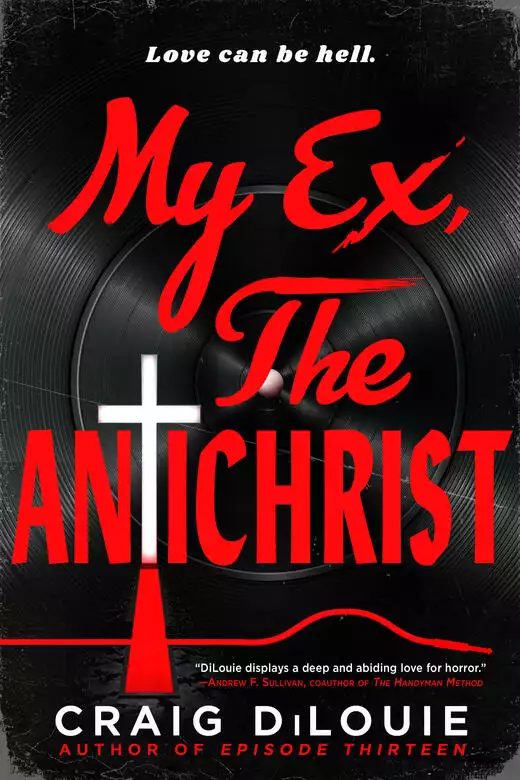
My Ex, the Antichrist
- eBook
- Paperback
- Book info
- Sample
- Media
- Author updates
- Lists
Synopsis
1998: A punk band is formed by Lily Lawlor and Drake Morgan. Drake inspires faith in some. Fear in others. Lily is a believer.
1999: A Battle of the Bands ends in a shocking death, and a riot that claims the lives of three teenagers.
2009: At the height of her stardom, Lily walks into a police station and confesses to murder.
Now: The band has refused to talk to the press about the night of the riot, Lily’s confession, or anything else. It's been over a decade, but Lily has finally agreed to an interview. And the band is following her lead.
What follows is a story of prophecy, death, and apocalypse. A story about love and love lost. A story about the antichrist. Maybe it’s all true. Maybe none if it is.
Either way, this is their story. And they’re sticking to it.
Release date: July 1, 2025
Publisher: Orbit
Print pages: 368
* BingeBooks earns revenue from qualifying purchases as an Amazon Associate as well as from other retail partners.
Reader buzz
 Please log in to recommend or discuss...
Author updates
My Ex, the Antichrist
Craig DiLouie
In 2010, the party came to a crashing halt.
LILY LAWLESS (singer / lead guitarist, the Shivers): I should warn you, this story has some religion in it.
No, I’m not religious. It’s not that I’m atheist or agnostic or anything. Far from it. When it comes to God’s existence, I’m actually a true believer. In fact, I’m one of the very few people on the planet who knows with absolute certainty that a supreme being is out there pulling strings and keeping score.
I know this because I dated the Devil.
What I did back in 1999, I paid for the only way I knew how. In my old religion, it’s called imperfect contrition. It’s when you’re sorry for sinning but not because you fear God. Otherwise, I can’t say where I stand with the big man upstairs after I messed with his grand plan. Being all-knowing, I’m pretty sure he knows what I think of him after everything that happened and what’s still to come.
I see you not reacting. You’ve got a great poker face. I can’t tell what you’re thinking, but I can guess.
Hey, you asked for it. The secrets we kept for twenty years.
The truth is rarely pretty. Sometimes it can be quite ugly. Every now and then, it sounds completely crazy.
If you want to keep going with me on this, you’re going to get both.
LUCAS KELLY (manager, the Shivers): Lily Lawless knew how to put the teen experience into song and light up an audience. Inspire fifty thousand people to hop and scream her lyrics back at her at a concert.
With her carefree punk image, you’d never guess she was one of the hardest-working, most professional women in rock and roll.
I’ve seen artists rise and fall. The ones who let the fame go to their heads. The ones who fall off their crutches of drugs and booze and face-plant. The ones whose creativity goes to rot and wind up playing way past their expiration date.
Lily proved a different animal. She lived for rock. She didn’t make it a lifestyle. She didn’t confuse the real thing with the fantasy.
She never quit.
Every album better than the last, the albums releasing like clockwork, the music resonating on enduring themes of teenage longing, angst, and a desire to never grow up. At least one song in constant rotation at the top alt radio stations. The endless touring, cities and countries and continents.
One thing I’ve learned: Someone goes at that speed for that long after reaching the top, it isn’t about the chase anymore. They’re usually running from something.
She ran straight into a wall.
LILY: The night I lost my shit, I was limbering up before our concert at the Bell Centre in Montreal, though back then it was called the Molson Centre. One of the last shows on an eight-month, thirty-city concert tour promoting Basket Case.
The warm-up routine: You stretch and flex your fingers. You do some taps and rolls. You run through scales and arpeggios. Then you get on stage and play the song that you’ve played a thousand times before, on body memory.
Only, I couldn’t find my collar.
You might recall that at my shows, I’d wear a party dress or a long tee or my old school uniform but always a spiky leather collar. Over the years, that crappy little collar became a signature look, though it was more than that. It hid something I wanted hidden. I couldn’t perform without it.
I stormed around the green room, ransacking it. The band stared at me in wide-eyed silence as empty beer cans and bong water splashed across the floor. Some girls from Chick Whiz, who were opening for us, laughed and smoked in the hall. I started yelling at them, and that’s when my voice crapped out.
Every part of me suddenly hurt. My back out of whack from shouldering my Gibson for too long. My throat scratchy and hoarse. My fingers rubbed to calloused marble by the strings. My brain turned to mush. My body shaking.
The next thing I knew, I broke down crying. An all-out panic attack.
All those years, I’d never missed a chance to perform. Years that now seemed to avalanche on top of me. A decade-long blur of nonstop planes and hotels and buses and dressing rooms and stadiums packed with screaming teens.
I wanted to tear my skin off.
Lucas helped me find my collar, which I’d somehow managed to hide from myself. A rock doc showed up and shot my ass full of vitamin B12. Then he made me say Ahhhh while he injected cortisone directly into my inflamed vocal cords so I could sing. My heart raced at the edge of seizure.
Mascara streaked down my face like black tears as I took the stage. The fans loved the look. It became a hashtag. They thought it was part of the act.
LUCAS KELLY: Lily played that show with a ferocity I hadn’t seen in years. I had no idea it would be her last.
“I think I need a break,” she told me after it was over. “Can I take a break?”
The Lily I knew didn’t take breaks. And she never asked my permission to do anything. This was new. But having witnessed her pre-show freakout, I understood.
I asked her what she meant by a “break,” and she told me she didn’t know. I asked if she could finish the tour, and she said she didn’t know that either.
I had a business to run. Lily was a golden goose. Canceling Cincinnati and Chicago would cost us money and set the venues and fans to rampaging.
You get clients that think they can do better than you. You get clients that wind up hooked on whatever drug keeps them up or helps them come down, sometimes both. You get clients that hate each other’s guts over creative differences and want you right in the middle of that shit, picking sides.
But some clients, you like them. You start to think they’re your friends. Then they are. I could tell what happened before the show wasn’t a stumble but a crash. Lily had reached a breaking point. She needed this.
I told her to go for it. Go take her break and rest up. I’d handle the details. I said, “Lady, take all the time you need.”
She’d have to be the one to break it to the band, though.
LILY: I braced myself to tell Ramona, Malcolm, and Eric that I was ending the tour to take a breather. I expected them to throw bottles or at least smash a guitar, you know, the kind of mayhem you expect pissed-off rockers to do.
We had rules, see. Don’t talk about Drake, that was one. Protect each other. Always make the music our way.
And most important: Never, ever give up.
Now here I was, breaking the big one.
They didn’t say much at all. At first, they just stared in disbelief, which was somehow worse than their throwing a fit. They sagged. Tears glistened on faces that suddenly struck me as looking older than they were.
Eric said, “Okay, Lil. We’ll take a break.”
Malcolm said, “Good.”
They didn’t look pissed. They were actually relieved.
“Thank God,” said Ramona. She walked straight out the door.
I said, “I didn’t know. Shit. I’m sorry.”
All this time, I thought they’d shared my passion for the music. And if not, they’d kept going because they had their own crosses to bear. Right then, I wondered if they were still at it after all these years because of me.
Malcolm said, “Now we’re even.” Confirming it.
LUCAS KELLY: Lily said she wanted to go home to Bethlehem. I thought, Okay, that’s cool. I thought, This could be a good thing.
All along, I imagined she’d been running away from home. I’d sensed some bad blood there. I thought maybe she’d finally have a showdown with her demons, work out some shit, and storm back into the studio after a few months.
It wasn’t until later I learned that what she’d been running from wasn’t the kind of thing you could ever escape.
LILY: The prodigal child goes home to learn not much has changed, both the good and the bad. Sometimes you know all this, but you go anyway. You need to go home. You just do. So you go, and then you remember why you split.
Mom and Dad wanted a big family, but they couldn’t make a child. Then I came along, their miracle baby. Growing up, I received all the attention, which had been good until I reached an age where it became stifling.
Like my band, they had rules too, and a lot more of them. The big kind: how I should behave, what I wore, who I could have as friends. While I lived with them, they had my whole life locked down and planned out.
I hadn’t been back in a decade, the kind of time where you blink and go, Wow, has it really been that long? To my surprise, I found my old room almost exactly as I’d left it, a little museum of my angsty and yearning teen years. Mom had always prayed I’d come home and kept the proverbial candle burning in the window.
I reached under my mattress and smiled at the still-familiar feel of my old stash of music magazines, Spin and Pulse! and Rolling Stone. I slid them out and relived my teen yearnings gazing at my guitar heroes, snarling Joan Jett and dreamy Kristin Hersh and all the other rock goddesses.
Safe and warm under my parents’ thick wings, I slept an entire day. Dinner was Irish comfort food: shepherd’s pie. Everything here was the same. Stable, predictable, reliable. I needed this. A hard reset.
The only problem was, everything remained the same, including Dad telling me how to live. Over dinner, he said the rock-star thing had been fun, but maybe it was time to start living a real life.
Go back to school and finish my accounting degree. Find a stable job and marry a nice man and have children. Making it sound like I might just be ready to stop fooling around and finally grow up.
Mom said, “Grandchildren would be nice.” Another candle in the window.
Okay, Dad wasn’t entirely wrong.
The long blur of my twenties was almost behind me. To put it bluntly, I’d grown a bit long in the tooth to be a rock star.
My generation had traded their skateboards for laptops and cash registers. For ten years, I’d lived the life of a rocker, but it didn’t feel all that free anymore. Half of it was image, the rest answering to an endless parade of managers, agents, video directors, engineers, and suits.
Everyone looking out for me, though no one did, not really. That was my job.
At some point, I’d have to question if there was life after rock. Whether I should interpret my hitting the wall as some kind of omen that I needed a big change.
Yeah, fine. I just didn’t want to hear it from him.
The father who never let me date, take risks, have fun, even choose my own career—which is, that’s right, how I ended up pursuing an accounting degree. My teen years divided between oppressive days at a Catholic school for girls and suffocating nights at home.
I remembered how I’d announce that I was going upstairs to do homework but instead practice my guitar until my fingers bled like stigmata and I’d finally mastered a Clapton riff. How I lied after my guitar was discovered by claiming it was for a school project. How I’d tell my parents I was going to the library and instead skip over to the skate park to watch the cute skater boys fly around.
The prodigal child returns and falls right back into old patterns. Hearing Dad tell me what to do made me want to do the exact opposite, but I hadn’t come home for this. I’d come to reset and think and plan, not simply react.
I said, “I think I’ll go check out the old library.”
Dad knew I was avoiding. He said, “That’s what you do, Lillian.”
As for me, I was getting angry again. I had to get out of here.
He said, “You don’t finish. You run away.”
Before we ended up in a repeat of the blowout my leaving home ten years earlier had caused, I did just that. I bolted.
DANNY RODRIGUEZ (A&R representative, Echo Harbor Records): Lily Lawless still ranks as the most stubborn woman I ever met. And the easiest artist I ever managed. She made me nervous.
Artists and Repertoire, that’s what A&R stands for. To America’s musicians, I was the devil at the crossroads selling you a crack at fame and fortune in return for every ounce of creative juice you’ve got.
That was the fun part of the job, scouting and signing and then coaching a band into a professional team that packs the right sound and style and swagger. A lot of it, though, is babysitting.
You blow smoke up asses to inspire confidence. You provide. You are cheerleader, priest, psychiatrist, sometimes legal aid. Whatever a band needs to keep the party rocking. Anything to keep it confident, playing hard, and bringing in the bucks today, right now, always right now, before the party ends.
And boy, did the Shivers need hand-holding. The keyboardist and his megalomania, the drummer a bona fide kleptomaniac, the bassist falling into bouts of depression and compulsive eating. Compared to them, juggling the odd coke fiend and assault charge seemed simple.
As if to balance it all out, Lily didn’t want anything at all from me aside from making sure Echo Harbor kept its basic promises.
You’d think that’d be cool, right? You’d say, well, that’s less work for you, one less problem to worry about. Just keep your promises and you’re fine.
It kept me up nights.
Lily Lawless was the frontwoman. She was the Shivers. Long before, word had come down from on high to keep her happy. If Lily didn’t like how things were going, see, she might sign with another label.
Music is a people business, and it’s based on trust. Sometimes you have to put in the extra effort to convince an artist she needs you.
The harder I tried, though, the more contrary she got.
I’d tell her how well the last album did in terms of sales and that the Shivers should maybe stick to the same groove to be safe. She’d completely mix things up for the next record by adding some ska in the vein of Operation Ivy and a cover of a goddamn k.d. lang cowboy punk song. I’d tell her Phoenix had never been a great market, and she’d insist it be the very first stop on the tour.
Seriously! I’d call Lily, she’d hear me out, and then she’d do her own thing. She made me crazy because she didn’t make sense.
Every day was opposite day, dealing with her.
LILY: The prodigal child returns to her past to discover who she is now. Sometimes you leave for so long that home is no longer really home for you but instead just a collection of feelings and memories. The old places look the same but different, though they never really change.
Unlike many of the kids who listened to our music, I didn’t grow up in suburbia or some dying small town. I was raised in blue-collar Bethlehem, one of three sprawling cities dominating the Lehigh Valley on the state’s eastern side.
Named for Jesus’s Judean birthplace, it got nicknamed “Christmas City USA” during the Great Depression. Bethlehem Steel operated here, supplying materials to build everything from warships during World War II to New York City skyscrapers, before the company shuttered the plant in ’95 and everything changed.
I now explored and reclaimed the old neighborhood from memory. The tobacco shop a few blocks down had folded, replaced by a boutique clothing store. The record shop I used to frequent still stood next to it, however. I’d bought my first vinyl there with babysitting money, Dookie by Green Day.
The shop’s window appeared bright and yellow and welcoming in the chilly night. A handful of kids riffled the CDs and records, seeking their separate paths to salvation or simply a little musical self-medication. The scene made me smile.
Then I spotted my snarling face on a poster in the window. Exactly what I’d come home to escape from. I kept on walking.
At Johnny Ray’s Music a few doors down, I admired the guitars and gear in the window display. I’d bought my first axe here, a secondhand Fender acoustic with the original hard-shell case.
I didn’t go inside this old haunt either. The walking was doing me good, a journey that offered its own destination. For once, I headed nowhere, even if it was all familiar. As always when a tour ended, the world seemed to keep rushing around me. But the ground under my feet had started to feel a little more solid, which struck me as progress.
And I thought, Screw having a real life.
I had one more good album in me. Dozens of performances in communion with an audience. All those beautiful moments of raw power on stage, letting it all hang out under blinding white light, bouncing and thrashing, hair dripping sweat.
Perhaps more than one album.
Shit, maybe I’d never quit my dream. Maybe I’d live forever free and young. I’d be like Ozzy Osbourne and the Who, signing off in a blazing farewell tour only to come roaring back for another encore a few years later.
Maybe I hadn’t come home to escape so much as remember why I kept going.
DANNY RODRIGUEZ: When I heard what she’d done after going home to Pennsylvania and that the band was falling apart, the executives yanked me into the home office for a grilling. What did I know. Who did I call. Did I do enough. Why won’t she let us give her legal help. Did I realize what this disaster would cost the company. Did I understand this might just kill the gold record goose.
It was a nightmare.
LILY: I found myself rolling by Holy Ghost Church. One part of my childhood from which I expected zero change, and it did not disappoint. The lights blazed inside, illuminating tall arched stained-glass windows depicting familiar scenes of ministry and suffering.
I hadn’t been here in over ten years. Hadn’t set foot in any church, actually. My relationship with God is complicated. My relationship with religion is toxic. My last visit to a church had exploded in surreal horror. The last time I’d been face-to-face with a member of the clergy, he’d tried to kill me.
Then I heard the music.
An angelic alto, singing to an organ melody. Choir practice. I’m a born sucker for music. Rock, grunge, country, whatever. Even choral hymns. It doesn’t matter where the light comes from. If it’s bright, it’s bright, and I’m a born moth.
Despite the growing knot in my gut, I figured I’d go inside for a peek.
The smells and brooding atmosphere triggered long-buried feelings of dread, boredom, tension, and a little spark of wonder. This too felt like a homecoming. You know what they say. Once a Catholic, always a Catholic.
First Communion and a whole lot of Sunday mornings spent internalizing even the odd errant thought as deeply wrong and requiring penance. Endless incantations to ask for forgiveness for being born with sin.
I pushed all that aside to receive the music, the most profound and direct form of worship I’ve ever known. Sound that provoked God’s attention. Sound that to me was God itself.
And what music. The boy could sing.
It reminded me of a part of life that I’d lost. Communing with something bigger than myself. That beautiful sensation of connecting to everything and catching a tiny glimpse of what it must feel like to be God. Surrendering to it. If God is love and joy, then singing with love and joy makes you divine. Worshipping from the heart, not the head.
It reminded me of Drake.
EXCERPT FROM “A LILY AMONG THORNS: THE SHIVERS’ FRONTWOMAN TALKS PUNK AND POP FOR THE MILLENNIAL GENERATION,” INSTRUMENTAL, 9/2006
Alicia Parker (writer): You were one of the first women to break into the pop-punk scene. What was that like?
Lily Lawless: The labels wanted to see more girls coming to the shows and buying records. They were into it. The male bands we played alongside were fairly welcoming, you know, aside from the usual juvenile stuff. Some of the female musicians were honestly tougher to be around, as a feeling of tokenization created intense competition of who’d get to be that one girl doing pop-punk.
Alicia Parker: Some say you trailblazed for artists like Avril Lavigne. Bustle recently labeled her the reigning queen of pop-punk. How does that make you feel, given what you achieved?
Lily Lawless: I love Avril’s music. Otherwise, I’m working too hard to pay attention to who says what.
Alicia Parker: Some punkinistas would say you aren’t punk rock at all. They say the Shivers sold out. It’s an old rift as punk continued to go mainstream, vexing bands like Green Day—
Lily Lawless: We play a genre of punk music, but I never claimed to be a spokesperson or role model for the punk scene. I’m a musician who plays music and then wants that music to be heard by the largest audience possible. I’ve always been that girl. Everyone is invited to the party, not just the cool kids.
Alicia Parker: They also say the Shivers strayed too far from its roots.
Lily Lawless: Real punk isn’t purity tests and just “Don’t tread on me.” It’s a call for change with the understanding that the more certain things change, the more they stay the same. It’s a call to keep trying. Our music is us struggling to evolve.
Alicia Parker: And evolve you did. In its early days, the Shivers had a different sound. How would you describe it?
Lily Lawless: Ramona—our drummer—used to call it demon disco. Our first songs were about telling people to be free. After that, we decided to free ourselves.
Alicia Parker: Drake Morgan was the lead guitarist then. Back in ’99, before he formed Universal Priest. I’ve heard some wild stories, urban legends.
Lily Lawless: If you know that, then you know we don’t talk about him.
Alicia Parker: From what you’re saying, it sounds like Drake controlled—
Lily Lawless: No comment.
Alicia Parker: Let’s shift gears then. By all accounts, Drake was your lover. Ever since, you haven’t had a serious—
Lily Lawless: This interview’s over. Is that punk rock enough for you?
LILY: Led by a young priest in a black cassock, the choir practiced in the chancel. They sang the chorus, and then the boy swung back into his lilting solo. Singing about the Lamb of God, whose obedient sacrifice results in victory over death.
My mind flashed to Julian bolting out of Our Lady of Victory with a rocket launcher on his shoulder, with all hell at his heels. Before I could get sucked down that particular memory hole, I focused on the boy.
He was as beautiful as his singing. Nine or ten years old, face shining with innocence and youth. The light from a stained-glass crucifixion formed a halo behind longish hair angelically winged from prior wearing of a baseball cap.
The choir started another hymn. And the boy sang:
O Jesus, Thou the beauty art
Of angel worlds above;
Thy Name is music to the heart,
Enchanting it with love—
The boy froze. The choir faltered.
He now stared at me, his face a mask of fear. He actually looked terrified.
Slowly, everyone turned to give me a stink-eye stare.
The prodigal child returns, and what is lost is found. The criminal returns to the scene of the crime hoping to undo what she’s done. Hoping to make things right.
I went back outside.
And walked straight to the police station, where I confessed to a terrible crime that had happened in 1999 but even now feels like only yesterday.
See, in all those years of music and roaming, I’d learned something. A truth that trumps what you desire and what you dream.
Just because you choose to live free doesn’t mean you get to live free of responsibility.
The year 1999 saw President Bill Clinton acquitted in the Senate, the Dow Jones topping 10,000 for the first time, and the Columbine High School massacre.
Shakespeare in Love won Best Picture at the Oscars. The music downloading service Napster went online. Woodstock ’99 ended in disaster.
Europe and Asia witnessed a total solar eclipse. Everywhere, people worried about the Y2K bug threatening a global collapse of computer systems that might crash civilization.
In Bethlehem, Pennsylvania, a first-year Lehigh University accounting student named Lily Lawlor dropped out to start the Shivers with Drake Morgan. Concerning Drake, no official records exist, suggesting he lived under an assumed name.
LILY: When I first met Drake, he said, “Follow me and live free.”
It wasn’t until way later that I realized this was an oxymoron.
Drake. My man Drake. Mandrake.
Our silly private joke.
Eat a little mandrake, and it can work as a strong sedative, narcotic, and hallucinogen. Eat a lot, and it can kill you.
That was my Drake, intoxicating and dangerous.
My devil in black jeans.
With him, it was always complicated. A man of endless contradictions.
He was my first love. My first serious betrayal. He opened my eyes. He tricked me into seeing the wrong things. He took me out of my cage only to put me in a far different but just as real kind.
In the end, I pitied him. The man who lived free of all convention, though he turned out to be as trapped as everyone else. More so, in fact. In the end, I ended up being the one to free him.
The greatest thing I ever did. My biggest regret.
Freedom isn’t free. Drake taught me that a long time ago.
DR. EDWIN WOODWARD (professor of religion studies, Lehigh University): The Antichrist is a fascinating biblical concept. It’s one of my favorite subjects because it is so open to interpretation. A few relevant passages can be found in 1 John, 2 Thessalonians, and Revelation.
Some regard the Antichrist as purely symbolic, representing rejection or opposition to Christ. Others believe it is various political leaders, with notable examples being Emperor Nero, Pope Innocent III, and Adolf Hitler. St. . .
We hope you are enjoying the book so far. To continue reading...
