The indomitable Miss Cocks and Ethel Bromley return for Book Two in the bestselling and charmingly cosy Petticoat Police Mystery Series, inspired by one of Australia's first policewomen.
Adelaide, September 1917. Six months after solving the Dora Black case, Kate Cocks and Ethel Bromley are back walking the beat. The city is unsettled. Winter won't leave. Soldiers are returning from the Front with broken bodies and troubled souls. And now a powerful board governor has been found dead in the Art Gallery - dumped beneath a scandalous nude painting that has attracted both pious outrage and record crowds.
When Ethel receives an anonymous tip, she's elated at being seconded to the Detective Branch. The murder goes to the heart of Adelaide's elite, where this society girl is in her element. Miss Cocks is left grappling with six o'clock swills, shadows in alleyways and a brutal assault on a schoolgirl. She needs Ethel to catch her killer, and quickly. Alas, murder in Adelaide is never a simple affair . . .
Inspired by the true story of Australia's pioneering policewoman, Kate Cocks.
Praise for The Death of Dora Black: 'An outstanding debut - funny, poignant, historically fascinating, and an absorbingly good crime read' PIP WILLIAMS
'The perfect cosy read. How refreshing to read historical crime fiction set in Adelaide during the Great War and focused on women' ANGELA SAVAGE
'Will have you engrossed and addictively flipping those pages' DAILY TELEGRAPH
'Armchair detectives will love this debut novel' WOMAN'S DAY
Release date:
September 30, 2025
Publisher:
Hachette Australia
Print pages:
320
* BingeBooks earns revenue from qualifying purchases as an Amazon Associate as well as from other retail partners.
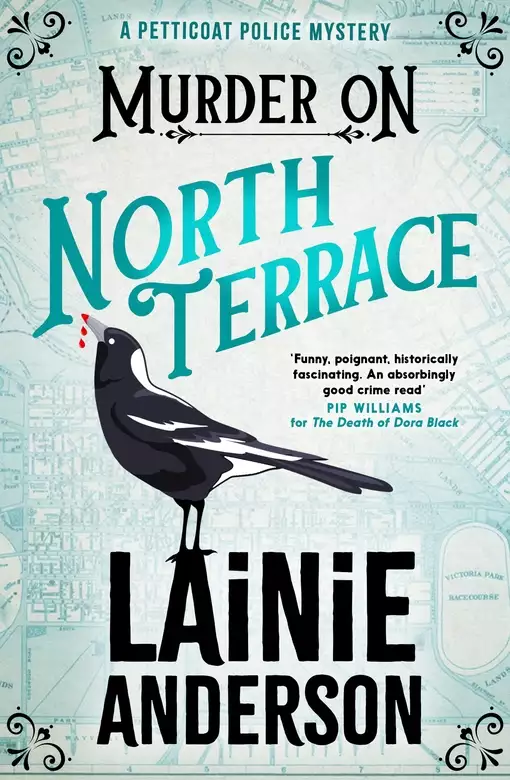
Murder on North Terrace: A Petticoat Police Mystery
Lainie Anderson
Gertie Stafford smelled the blood before she saw the body.
At first she ignored the familiar metallic scent. She cast her gaze about, locked eyes with the portrait of some stern old chap who’d made himself great in South Australia, and decided that her mind was playing tricks after a decade of mopping around corpses in the city morgue.
Running her feather duster over the smooth brow and rounded jowls of a marble Queen Victoria, Gertie felt her second-day nerves start to calm. The empty Art Gallery was silent at 5 am, but for the soft snores of old Mr Opie. He’d let her in the front door, switched on the electric lights and promptly fallen asleep at his custodian’s desk. The lighting was soft, and the space was so still and rich it made her heart full.
The walls were a shade of deep red. The pressed metal ceilings and tall archways connecting the long, thin galleries were lime white. And on every wall, paintings revealed steely-eyed men and rosy-cheeked women and forests and flowers and fruit and sailing boats and the most magnificent golden-haloed Madonna, adoring the baby Jesus on her lap.
Baby Jesus, with his damp blond curls and pale, almost translucent skin, looked a little like Gertie’s boy, Tommy. The painting made her think how sick he’d been with croup these past weeks, and how scared she’d been of losing him on that one awful, fever-filled night. Gertie flitted her duster around the collar of the explorer Captain Sturt and marvelled at her good fortune: Tommy over the worst of it and now this new job – five extra shillings a week in her pay, and not a bloodless cadaver or bucket of stomach entrails in sight.
After dusting a marble statue of a woman sitting in deep thought (Ha! she thought, as if there’s ever time for that), Gertie took out a damp cloth. She was about to wipe over the surrounding wooden bench seats when she smelled it again: the rusty tang of blood.
Perplexed now, she strode toward the rear of the gallery, glancing into corners and across the cream linoleum, checking for anything unusual or out of place. Ahead, a six-foot display cabinet of oriental objects blocked the view to the final room.
An animal, perhaps? she thought, trying to rationalise the smell. Something meant for the museum collection next door?
Rounding the display cabinet, Gertie’s eyes locked on a strange, perfectly square painting positioned in the very centre of the back wall of the gallery. In the foreground of the artwork was a naked woman with an outstretched arm; a woman so obscenely human in her feminine skin it made Gertie blush.
On the floor beneath the painting, surrounded by a great pool of dried blood, was a grey-haired man with a wide gash to his throat. His eyes were open and staring heavenward, almost as if bewitched.
Miss Cocks stood motionless in the darkened street, her umbrella low over her head to ward off the persistent drizzle. She wasn’t often awake in the early hours – nightly patrols put paid to that – so when a magpie began its gentle warble to welcome the dawn, she felt grateful to hear it. Sing loud, sir, sing free, she mused. Dark and cheerless is the morn, unaccompanied by Thee. Breathing in the heavenly eucalyptus scent of the gnarled gum tree beside her, she tightened her grip on her five-foot cane and renewed her focus on the truck she could just make out in the driveway.
Down the street, a hallway light came on, a door opened and a man emerged, taking care not to slam the flywire screen behind him. Miss Cocks retreated behind the gum tree as he cycled past a few moments later, heading for The Parade. She would have expected more lights to be on by six o’clock on a Tuesday morning, but Adelaide was weary. Standing in the drizzle, Miss Cocks could feel the weight of the city on her shoulders. The winter just gone. The third anniversary of war. Another shipment of 150 brave South Australian sons about to be sacrificed to the horrors of France.
A dog barked, and then another. The magpie broadened his range. Daybreak began to outline the sleeping houses around her, brick villas and modest bungalows on quarter-acre blocks, with tidy gardens and immature trees. Beulah Park – one of Adelaide’s newer suburbs, creeping east toward the hills. Cheap blocks for the working man who aspired to something more.
The villa over which Miss Cocks stood watch certainly had something more. A salesman’s lorry – not an altogether common sight in the residential suburbs of Adelaide in 1917. Most hawkers still made do with horse and cart, or a donkey with wicker baskets strapped to its flanks. Mr Brookman’s business was clearly doing well. A working man, aspiring and acquiring. As the sky brightened, Miss Cocks could make out the truck’s steel cab, and a dark canvas stretched over a high frame on the tray. The truck’s contents weren’t altogether common either.
Padlocked inside – if the neighbour was to be believed – was Mr Brookman’s wife.
Miss Cocks moved a little further behind the gum tree, out of sight of the Brookmans’ front door. What kind of man padlocked his wife inside his lorry each night at bedtime? A frightened man? An angry man? Jealous? Of course. And what kind of neighbours turned a blind eye, pretending across the fence and in the street and at the corner store that everything was normal? Weeks it had been going on, according to Mrs Champion next door. And such a gentle little neighbourhood, too.
In her nearly two years as officer in charge of the Women’s Police Branch, Miss Cocks had seen too much to turn a blind eye. Experience told her that any husband inclined to lock his wife inside a truck was capable of backing the truck right over his dearly beloved, too.
Sometimes, Miss Cocks wondered if Adelaide was a particularly strange and savage place, its citizens especially cruel despite their piety and prim hellos. Then she reminded herself that kindness was never too far away – on every street, in every suburb – so long as you knew where to find it.
From the neighbour’s house, Miss Cocks heard the click of a lock and the sound of a front door opening. She pressed her lips into a thin line. Mrs Champion.
The voice was little more than a whisper. ‘Miss Cocks!’
The elderly woman was crouched behind a bush, holding a small gas lantern and beckoning the policewoman, like the outcome of the Great War depended on it.
At seventy-seven, Esme Champion was a keen bridge player and gladioli grower, Sunday church organist and khaki sock-knitter for the Red Cross. Her waking hours these past ten months, however, had been devoted to her husband, Stanley, who’d been rendered mute and largely bedridden by an operation to remove a three-inch tumour from his throat. Esme suspected Stanley’s light had gone out on hearing their only grandson had been killed while trying to defuse a bomb on the Somme, but she’d done her best to keep his last few months cheery. Her dear husband deserved that.
When Stanley’s suffering finally ended two weeks ago, Esme had cleared their front bedroom of tablets and tonics and towels and bed pans and the little table she’d set up by his bedside. And then she’d found herself sleepless in a bedroom that was awfully cold and empty without her husband of fifty-six years. It was then, in the stillness of each blessedly approaching dawn, that she’d begun to hear something odd in her new neighbours’ yard. A jangling of chain, a folding of heavy tarpaulin and a husband and wife greeting each other like they’d just woken up in bed. Esme was four foot nine and a half, but what she lacked in height she made up for in pluck. She’d crept out on the porch to prove herself right, and then she’d confronted the neighbour on his front lawn. And after Mr Brookman had called her an interfering old bitch, Esme popped on her best church frock and matching mauve hat and caught the next tram to the city.
In truth, Esme had been looking for an excuse to visit 9 Landrowna Terrace ever since the Women’s Police Branch had opened in late 1915, and even more so since the city’s two lady police had received commendations from the police commissioner for solving the murder of Dora Black. She’d read everything that had been written about Miss Cocks in The Register. She’d even visited the Parkside Methodist Church one Sunday to see if she was there (she wasn’t). Most of all, though, Esme was sick of Gladys Arbuckle from bridge inferring a kind of superior association with Miss Cocks, because Gladys had once stopped the policewoman in the street to ask advice about a granddaughter who swore like a merchant seaman. (‘Soap’ was the advice, of course, to wash the girl’s mouth out. She needn’t have bothered Miss Cocks about that.)
When Esme arrived at Landrowna Terrace, she’d been surprised at how small the office was, and how crowded. And when Miss Cocks had thanked her most sincerely for not turning a blind eye to a fellow woman in distress, Esme thought it was perhaps the proudest moment of her life, but for her wedding day and the birth of her three children. It certainly surpassed her blue-ribbon win for ‘Gladioli, bunch of five’ at the Royal Livestock Show in 1913. She could barely contain herself on the tram ride home, and dearly, desperately wished Stanley was alive so she could tell him all about it.
‘Miss Cocks! Scones?’ whispered Mrs Champion as the policewoman took a few quick strides toward her. ‘Fresh scones?’
‘Mrs Champion,’ Miss Cocks murmured. ‘Please go inside.’
‘Yes, of course!’ Mrs Champion said in a hurried, hushed voice, sneaking a peek at the lorry as she thrust out a small wicker basket smelling of hot buttered scones.
‘Now!’ ordered Miss Cocks, ignoring the basket. ‘Mrs Champion, please.’ Then she took a deep breath and added, ‘I’ll call by later if I have time.’
‘Lovely,’ whispered Mrs Champion, and in the dawn light her soft cheeks glowed. Purpose – she did miss it. And wait ’til she told the bridge girls. ‘I’ll have the kettle on.’
In an instant she was gone, and Miss Cocks repositioned herself behind the gum tree.
Watching for signs of life inside the house, the policewoman suddenly regretted not bringing along her second-in-command, Ethel Bromley, both to corroborate any evidence and to involve her in something a little different. As evidenced by the constant stream of letters received from South Australian schoolgirls, it was largely assumed the work of the Women’s Police Branch was exhilarating and ever-changing. But the truth was, most days the two women were literally putting one tired foot in front of the other. Multiple times daily they walked the one-and-a-half-mile round trip from Victoria Square to the Adelaide Railway Station to meet and escort any young women arriving unaccompanied and vulnerable from major regional centres or cities interstate. They walked the city parklands or beaches every night to shoo away loitering couples and save immodest girls and young women from themselves, whether they liked it or not. And they walked the suburbs to follow up on mostly petty arguments between housewives, or to calm the fears of mothers as their daughters began to attract (and invite) the attentions of the opposite sex.
Miss Cocks knew Ethel was underutilised – her efforts in solving the Dora Black case six months earlier had proven that. She also knew that Ethel was desperate to do the work of her male counterparts. (‘We’re paid the same,’ Ethel was increasingly fond of saying, ‘and we’ve got the same powers of arrest – so please can’t I arrest someone?’) But as woman police constables, their role was not to investigate crimes and apprehend perpetrators. Their role was one of prevention – to curb immorality and protect women and children from harm.
The hallway light went on in the suspect’s house, and the door opened to reveal a man in his dressing gown, silhouetted against the rectangle of light. Miss Cocks straightened herself as she watched Mr Brookman pull the front door closed behind him and step out into the drizzle to the rear of the truck. He wiped his eyes with his sleeve and fumbled with a wet chain and padlock, which jangled as it came away. Then he raised the flap of the tarpaulin. In the dawn light, Miss Cocks saw a short, stout woman crouching within the truck. She wore a thick dressing gown and clutched a pillow and woollen blanket. Beside her was a thin, rolled-up mattress. The woman smiled at her husband, and he took the blanket and pillow and helped her down from the back of the truck.
It was then that the policewoman approached.
The couple turned, startled. ‘Go inside, Lilith,’ the husband ordered, glaring at the determined-looking woman striding up his driveway.
Confusion flashed across Mrs Brookman’s face. She glanced from her husband to the woman and her five-foot cane.
‘Woman Police Constable Kate Cocks,’ she said in a low, businesslike tone. ‘I wonder if I might ask you a few questions, Mr and Mrs Brookman?’
‘Inside, now!’ the husband growled, shoving the pillow and blanket into the woman’s arms before nudging her toward the front door. Miss Cocks thought they were somewhere in their mid-thirties.
Mr Brookman was a head taller than his wife. His chest was barrelled and his navy dressing gown was tight across his thick upper arms. He had a dark rash of morning stubble on his chin, a scowl on his brow and black chest hairs poking out at his throat. A man’s man, thought Miss Cocks. A bully.
‘I’ll come inside with you, Mrs Brookman, for a chat,’ the policewoman said in a light tone, as if she was an old friend expected for breakfast. Holding her five-foot cane like a staff, she met the husband’s glare. ‘If you could wait on the porch, Mr Brookman. This won’t take long.’
The husband squared his shoulders, the way they always did. His nose had once been broken, and his broad forehead reminded Miss Cocks of a photograph she’d seen in National Geographic of stone statues on Easter Island. She turned her back on him and followed Mrs Brookman into the house, depositing her umbrella on the red-brick tiles under the porch.
In the hallway, Miss Cocks rested her cane against the wall and hung her coat, hat and gloves on the hatstand. She recognised a faint, familiar smell but couldn’t quite place it. The woman had taken a seat in the front drawing room, hugging her white pillow and grey blanket to her chest. The policewoman felt a surge of concern at the nasty sores on the woman’s chin, her dark-ringed eyes and tangled, mousy brown hair.
‘Now, Mrs Brookman,’ Miss Cocks said, taking a seat on the settee and keeping her voice low. ‘I wonder if you could tell me what’s going on?’
Looking around, the policewoman noted that Mrs Brookman kept a spotless home. Surfaces glistened with furniture polish, and the modest curtains, settee cushions and floor rug were all clean and perfectly positioned. There was no sign of children. On the mantelpiece were five gleaming, engraved pewter mugs that appeared to be a man’s trophies, and a single framed photograph of the couple on their wedding day. Mrs Brookman looked far younger in the image, no more than twenty-one, with a simple garland of blossom resting on her shining hair and a small but genuine smile. Beside her was a young Mr Brookman with a self-satisfied pout and a strong arm around her shoulders.
Mrs Brookman looked toward the window, where her husband was visible through the cream netting. He’d taken a seat on the front porch. ‘Is – is my husband coming inside? He’ll be cold. I should be getting his breakfast ready.’
Miss Cocks’ eyes crinkled at the corners as she forced her lips into a thin smile. ‘He’ll be fine for the moment.’ She gestured toward the photo. ‘That’s a lovely photograph. Why don’t we start with how long you’ve been married?’
‘Is my husband in trouble?’ the wife asked. She touched her fingers to her chin.
Miss Cocks looked at her. ‘Do you want him to be?’
‘No!’
‘Has he ever been violent with you, Mrs Brookman?’
‘No!’ She shook her head furiously.
‘Very well,’ said Miss Cocks, studying the woman. Mrs Brookman had a nervous disposition, but she certainly wasn’t the worst case of marital hardship the policewoman had come across. That honour went to a wife who’d been repeatedly trampled by her husband’s four-horse carriage. Mrs Brookman’s eyes were weary but clear, there were no signs of bruising or scratches on her face and hands and she looked to be eating well. ‘But I can’t leave here, dear, without some assurance that you’re not presently in danger. Now, tell me about yourself. I believe you’re new to the area?’
The wife placed the pillow and blanket on the floor in front of her. ‘We moved up from Mount Gambier last summer. Neville was doing more and more business in the city, so it made sense.’
‘And how have you found it – the city?’
‘Oh, you know.’ She stared at her hands in her lap. ‘It can be hard to make friends.’
‘You’ve never had children?’
‘No. But …’ She paused, looking at the policewoman. ‘We’re trying.’
Miss Cocks raised her eyebrows, resisting the urge to suggest conception might be easier if she slept in her husband’s bed instead of his lorry.
‘Neville can be very sweet, really,’ the woman said. ‘He just works such awfully long hours. There hasn’t been a lot of opportunity to … well, to have a baby.’
‘Your husband sells cleaning products, I believe?’
‘Yes. He supplies lots of schools, right around the state now. And still goes door to door.’ She smiled. ‘He’s doing ever so well!’
Miss Cocks nodded. ‘And why are you sleeping in the truck?’
The woman frowned. ‘It’s nothing.’
Outside, Mr Brookman swapped greetings with a passerby.
Miss Cocks let a companionable silence settle in the room.
‘You see, my brother …’ Mrs Brookman said. ‘My brother Vernon is at the Front.’ She swallowed. ‘I was writing to him far too often – every day really – and Neville didn’t think it was fair.’ She stopped, scratching a sore on her chin before clasping her hands in her lap again.
‘Didn’t think what was fair, Mrs Brookman?’
‘Neville thinks I waste too much time writing letters and wishing we were back in Mount Gambier.’ She paused. ‘He’s right, too!’
‘And sleeping in the truck is … ?’
‘My husband’s way of reminding me what life would be like,’ she glanced around the drawing room, ‘without all this.’
‘That doesn’t seem extreme to you, Mrs Brookman?’
The woman picked at her fingernails. ‘Not really. I want to be a better wife.’ She stared at Miss Cocks. ‘Neville says it’s not forever. Just until I learn.’
Miss Cocks frowned. ‘Learn what?’
‘To get on with my life – our life – in Adelaide.’ Her voice was barely audible. ‘I’ve been terribly lonely since leaving Mount Gambier. And I can be sad and sulky sometimes. It’s not fair on Neville. He works terribly hard.’
Miss Cocks glanced at Mr Brookman’s gleaming pewter trophies. ‘Are you absolutely sure you want to stay here, dear?’
The woman looked up, adamant now. ‘I’m perfectly fine, Miss Cocks. No …’ She shook her head. ‘No, I’m happy. I’m very happy.’
Miss Cocks nodded, rising from the settee. ‘Of course. Well, the Women’s Police Branch is in Victoria Square in the city. You’re welcome to pop by any time.’ In the hallway near the hatstand, she began to put on her coat.
Following behind, Mrs Brookman reached out to touch the policewoman’s cane. ‘Speak softly and carry a big stick – you will go far.’
‘Indeed,’ said Miss Cocks, surprise evident on her face. ‘How did you come to know that expression?’
‘We had an American teacher for a time in Mount Gambier. He called himself a Roosevelt acolyte.’
An idea came to Miss Cocks. If she couldn’t remove Mrs Brookman from her domineering husband, she could perhaps surround her with strong, impressionable allies. ‘Rosanna Limbert, the Norwood Lady Mayoress, is always on the lookout for smart-minded women to assist in the administration of her local branch of the Red Cross. Could you spare some time to help, Mrs Brookman?’
‘The mayor’s wife?’ The woman’s eyes widened. ‘I don’t think –’ She dropped her eyes. ‘Neville won’t agree to that.’
‘You leave Mr Brookman to me,’ said Miss Cocks. ‘I’ll have a message delivered to you this afternoon about what time to be there in the morning.’ She held her nose closer to the coats on the hatstand. ‘Moore’s signature vanilla!’ she said triumphantly, finally recognising the faint smell. ‘It is quite lovely, isn’t it?’
‘Pardon?’ Mrs Brookman said. ‘Moore’s what?’
‘Never mind,’ the policewoman said, frowning as she glanced at the closed doors further down the hallway. ‘It’s been a pleasure to meet you, dear. Mrs Limbert and the Norwood Red Cross ladies will be grateful for your assistance.’
Outside, the drizzle had stopped. It was fully light now and the clouds were lifting.
‘I love my wife,’ the husband said as soon as Miss Cocks had closed the door behind her. He rose to face the policewoman, standing almost at eye level.
‘So why then are you locking her inside your lorry, Mr Brookman? Doesn’t seem like an act of love.’
‘That’s none of your business,’ he said.
‘I beg to differ, Mr Brookman. The women police exist to prevent harm against –’
‘You can see I’m not harming her!’
‘Mr Brookman, you’ve been forcing your wife to sleep in a truck for weeks in the bitter cold, while you presumably sleep inside in a nice, warm bed. If that seems reasonable to you now, what will it be next time?’
His jaw was set like a bulldog’s.
A man cycled past; called out, ‘Morning, Nev. Shockin’ weather!’
Mr Brookman held up an open palm and tilted his head to acknowledge the greeting.
Miss Cocks studied the husband’s face, ignoring the brutish stubble and wide brow to focus on the black rings under his eyes. He looked exhausted, like he hadn’t slept in weeks. She thought again of the vanilla scent she’d smelled in the hallway. Miss Cocks was not one to buy perfume, even from her favourite emporium, but she’d lost count of the times she’d detected it on the women of Adelaide. ‘Not sleeping, Mr Brookman?’
‘What?’ He screwed up his nose, scowling again.
‘Lovely big bed all to yourself, and slumber still evading you?’ Her words surprised her. They sounded like something Ethel might say.
He folded his wrestler’s arms across his chest, which suddenly seemed enormous, glancing at her cane as though weighing up whether to grab it.
A small part of Miss Cocks wished he’d give her an excuse to use it. She lowered her voice. ‘Your wife isn’t in the truck to teach her a lesson, is she, Mr Brookman? She’s in the truck so you can carry on an adulterous affair.’
His face didn’t register the slur, but his tone of voice did. It was suddenly thick with scorn. ‘So it’s true. You are a mad hag.’
She allowed herself the slightest look of satisfaction. Few things amused her more than being underestimated, and any man resorting to insults was running out of ideas.
‘Are we finished?’ he spat. ‘I’ve got a business to run.’
She gripped her cane. ‘Not quite. I want to explain one or two things to you, Mr Brookman. First, adultery alone isn’t sufficient grounds for a wife to petition for a divorce under South Australian law. Only men have that privilege.’
He scoffed. ‘Everyone knows that.’
‘Did you also know that by locking your wife inside your truck in the depths of winter, you have added the aggravated enormity of cruelty to her grounds for divorce? Judges are increasingly sympathetic to mistreated women, and I can’t imagine any subsequent, salacious newspaper coverage being ideal – especially for a door-to-door salesman selling cleaning products to housewives.’
His eyes betrayed a flicker of self-doubt. ‘You don’t have a scrap of evidence.’
‘About what – adultery or cruelty?’
He looked away.
‘I might not have evidence of adultery as yet, Mr Brookman. But I’ll tell you what I do have. An administrative role for your clever wife with the Red Cross at the Norwood Town Hall – she’ll be starting with the rather inspiring mayor’s wife tomorrow. She’ll soon be coming home with all sorts of new ideas.’
‘What? You can’t just –’
‘And I have an exceptionally good relationship with the Minister for Education. If I ever hear that you’ve so much as raised your voice to that woman – and believe me, I wil. . .
We hope you are enjoying the book so far. To continue reading...
Murder on North Terrace: A Petticoat Police Mystery

 Please log in to recommend or discuss...
