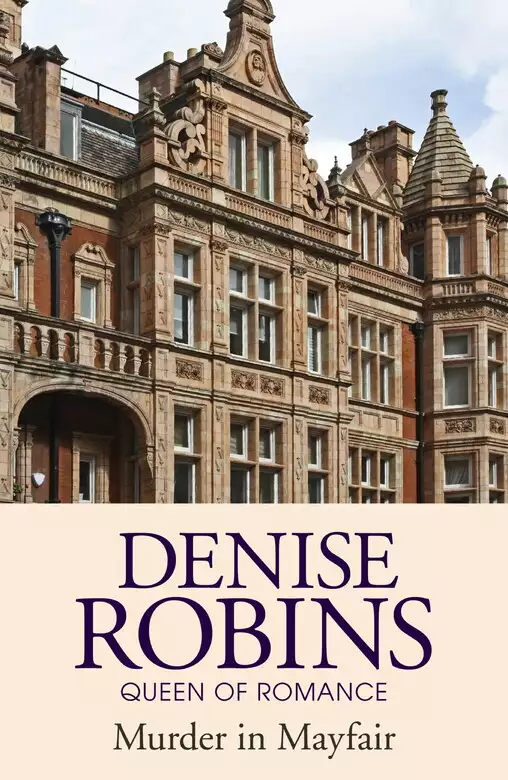
There is only one thing in the world that they brilliant young musician, Jacques Clavel, wants; to marry his beautiful English sweetheart Mary Lessington. But his hopes are shattered and his heart broken when, against her will, Mary is forced to marry the wealthy Earl of Ventyre! In his despair Jacques vows to dedicate the rest of his life to music until, after ten long years, it seems that at last his dream may come true. But Jacques has not bargained for Auriol Crannock, a woman of unparalleled greed, jealousy and evil, a woman who is determined to possess Jacques ? and keep him away from his beloved Mary ? whatever the cost. So, when Auriol is found brutally murdered in her Mayfair flat, the evidence seems conclusive?
Release date:
February 27, 2014
Publisher:
Hodder & Stoughton
Print pages:
400
* BingeBooks earns revenue from qualifying purchases as an Amazon Associate as well as from other retail partners.
They had danced together all night, waltzing most of the time, the dreamy enchanting Lehar melodies intoxicating them as did their close contact with each other.
All night they danced, untiring; young ardent lovers, students of music in Dresden.
In the Biergarten there were many other couples. The night was gay with the hum of voices and of laughter, the chink of glasses, tankards foamy with lager, huge cups of coffee crested with thick whipped cream. There were other lovers dancing or sitting close together under the green trees, looking up at the luminous stars. From them came the low laughter that is for love’s sake or the gleam of tears that spring from love’s emotion.
But for the two students, music in their hearts, music and love drenching them, there was nothing, nobody else in the world this night but themselves.
They danced on and on, enchanted with each other, the slim fingers of the young man twined with the little white and delicate ones of the girl, her red-gold head against his black one, warm cheek pressed upon cheek; all the passion and beauty of life rendering them dumb while they moved.
At length, when the stars were paling, the lights went out, and sleep descended upon one of the loveliest cities in Germany, the lovers danced no more, and walked together out of the Biergarten into the quiet streets.
The boy wrapped a coat around the slender figure of the girl and looked down at her tenderly.
‘You must not catch cold, my lovely one.’
‘Jacques,’ she said, looking up at him with eyes that reflected the stars and were as blue as the morning sky would be when the dawn broke, ‘I’m afraid we shall get into trouble for this.’
‘With Techi?’ Jacques Clavel shrugged his shoulders. ‘I do not doubt! There will be a terrible scene in the morning, but is it not worth it for us to have spent this evening alone together?’
‘It was worth it,’ said Mary Lessington. ‘But –’
He looked down at her small troubled face. It was pale, and as lovely as a flower in the moonlight.
‘Always “buts” with you, my sweet Mary.’
‘Because it’s different for me, Jacques. You’re alone in the world. I have my mother –’
Jacques Clavel opened his lips to say something very unflattering about Mary’s mother, but wisely refrained. Oh, that woman, that hateful woman! She was the granite wall between him and his love; the gulf between him and his heart’s desire; the dragon, spitting forth fire ever guarding poor Mary.
Jacques Clavel was fully aware of his own charm, and of the attraction that lay in his handsome eyes for most women. But Mrs Lessington, a narrow-minded woman with ambitions, he could not move. She disliked him, and showed her dislike. He was a struggling French student and her Mary was a nicely brought up English girl with beauty – a beauty that Mrs Lessington meant to put upon the marriage market at a high value. There was to be no giving way to a youthful infatuation, no Latin Quarter. Unfortunately for Mary, she was transparent – too honest to be able to hide from her mother the passion that had sprung to light in her young heart for Jacques Clavel, who was studying music under Techititsky, the famous Russian who was a professor at the Dresden School of music.
Since that discovery, Mrs Lessington had nagged Mary into a state of hysteria. There had been a series of stolen meetings, wild promises, forlorn hopes, and finally – tonight.
Tonight Mary and Jacques were supposed to be attending a symphony lecture given by old Techi. But they had played truant and stolen away together to dance. It had been glorious. They were more in love with each other than ever. And Jacques more than ever was determined to break down Mrs Lessington’s resolutions and become Mary’s acknowledged lover.
But Mary was not like Jacques. She was much more hidebound by the convention of her upbringing, the Roman Catholic religion, and a sense of duty which sometimes drove Jacques to distraction.
Now that this wonderful evening was over she was unhappy and afraid.
‘Mother is sure to find out about tonight, and she’ll make life unbearable for me.’
‘If she would only make it sufficiently unbearable, you would leave her and come to me,’ said Jacques.
She looked up at him wistfully. He was so handsome and so impetuous. Every warm human instinct in her clamoured for him. Of course, her mother said that he was a wild Bohemian Frenchman without social standing, that he wore his hair too long and was too ardent to be respectable, and that never, never would he be received by any of her relations in Belgravia or up in Scotland. But to Mary, aged nineteen, and with romance tugging at her heartstrings, Jacques Clavel was the prince of her dreams. A prince with sculptured features, an ivory skin, and dark heavy-lidded eyes which could sparkle with gaiety or grow soft with love. Brilliant, clever eyes. He was clever; Mary knew it. Old Techi had acknowledged him to be the most promising student of the day. When Jacques played, it made one’s eyes close and one’s heart almost stop beating, so beautiful was his touch, so perfect his interpretation. Mary herself had talent, and was no mean musician. Her father had recognised that fact before he died, and it had been his wish that she should come to Germany to study, a wish which Mrs Lessington would have preferred not to carry out. She would much rather have kept Mary securely in London and married her quickly to a title. But Mary knew that whereas she had talent, Jacques had genius. Jacques would be great one day. Not only Techi, but many others who knew, said so. And Jacques himself was always telling her that he would be great for her.
If only her mother was not there in the background to thwart every wish, and prevent her from doing any of the things she really wanted to do!
‘Listen, ma mie,’ said Jacques, bending his head to the red-gold one of his beloved. ‘We can’t go on like this. I can’t live without you, and, if you feel the same, then we must run away together.’
‘That,’ said Mary, ‘is absolutely impossible!’
Jacques Clavel’s eyes opened wide.
To him nothing was impossible. All things could be achieved when one was young, and in love, and there was music, and just enough to eat and drink.
Thus he argued with his Mary. She wanted to believe all he said and do as he wished. She wanted to throw herself into his arms and beg him to take her away now, quickly, before she faced her mother again. But that word which had been flung at her so often recently, danced in front of her mockingly. Duty! DUTY!
‘It is your duty to give up seeing this young man,’ Mrs Lessington had told her last night. ‘And, what is more, you are under age and you cannot defy me. There should, of course, be no question of defiance. Your father is dead, and you are all that I have left. It is your duty to stay with me. I will never consent to your marriage with this impossible student. Never … never!’
Futile to argue with her that Jacques was a genius and would one day be one of the most famous pianists in the world. Futile to protest that he was well known and respected in the circle in which he moved, and that Techititsky himself had the utmost regard for Clavel. And it was more than Mary could do to fly with her lover in the teeth of such opposition.
‘But, Mary, surely you’re not going to let your mother separate us?’ Jacques protested.
She answered:
‘No. Not if I can help it. I’ll always love you, Jacques. Always. I could never love anybody as I do you, but …’
‘“But” again,’ said Jacques, and clicked his tongue and rolled his eyes heavenwards in a very French manner indeed.
‘I must go now,’ she said.
‘Always it seems to be we say good-bye.’
‘I know,’ she whispered.
He saw tears winking on her long lashes like tiny diamonds. In an ecstasy of love and tenderness he kissed them away. He covered her face with kisses.
‘Je t’adore,’ he said again and again. ‘Without you life means nothing. Even my music means nothing. When I play, I play for you and to you. Mary, you must never desert me.’
She trembled in his arms. She heard another voice, not only that of her mother, but of the priest who was her confessor and to whom her mother had been talking.
‘It is your duty, my child,’ he had said, ‘to obey your mother and not give way to these passions. They must be controlled. And, even supposing that young Clavel was acceptable from your mother’s point of view, he is not of our religion, therefore would not be acceptable to Mother Church.’
She wondered miserably why she owed duty to everybody save herself. But she was young and gentle and without that touch of hardness which would be necessary in a girl if she was to stand up to Mrs Lessington – and a Jesuit.
She allowed Jacques to hold and caress her a moment longer, then broke away from him and took her departure. He could only see her as far as the corner of the street. She was so afraid that her mother might be standing at the window waiting for her, and would see her with Jacques.
Clavel let her go with a feeling of great uneasiness. Even when his lips were still warm from her kisses and the air was still fragrant from her perfume, he was afraid that she was a spirit from another world, a spirit that would vanish, never again to materialise.
He walked back to his lodgings just before the dawn, forming a dozen resolutions and schemes. He must find some way of persuading Mary to elope with him. He must possess that white and gold beauty, not for an hour, but for ever. There was something in the mere touch of her hand which electrified him as no other woman’s touch had ever done. He had known love before in the manner of the young sophisticated Parisian, but never love like this, which seemed to spring from the very foundation of his being. And it was not only physical. Mary was lovely, but she was sweet and good, and he adored her for these things: for the musician in her which responded to him, for her enchanting moments of gaiety when they laughed together, for the Mary that his love made her once he got her away from that terrible old mother of hers!
‘Tomorrow,’ he told himself, ‘I will brave even that creature, her mother. I will go to her and tell her that she must not forbid me to see Mary; that I, Jacques Clavel, will marry her and no other woman in the world!’
He slept only a few hours. He must be at the Academy of Music shortly after nine. In the morning, while he dressed he grimaced a little at the thought of the row with old Techi, who would be furious with him for not attending his lecture.
But what did it matter? Never while he lived would he forget the hours during which he danced with Mary in his arms.
Every morning regularly he met Mary on the steps of the Academy, and they went into the lectures together. But this morning she was not there. Jacques, carrying his music, waited a few moments anxiously. The summer morning was fair and warm. Dresden lay sparkling under the sunshine. Jacques felt glad to be alive. But he wanted Mary. It was always like that now. Life was never complete without her. Perhaps she was tired, poor darling, and had overslept. Perhaps that dragon was so angry about last night that she was refusing to let her come to work this morning at all. A horrible thought!
At length Jacques could wait no longer. It was time for his lesson. So he hurried inside to the music-room, where the white-haired professor walked impatiently up and down.
Jacques greeted him a trifle dubiously, and was not surprised when the Russian lifted his head and broke into a furious onslaught.
‘So!’ he said. ‘So, Clavel, my poor lecture last night was less to you than cheap music and Biergarten.’
Jacques tried to apologise, to explain about Mary, to excuse himself. But Techititsky would not listen. He flung his arms above his head and said violently:
‘I will hear none of it. You are a student here, and you wish to become a great musician. Do you think you will ever learn to play if you spend your nights frivolling, and finding a woman’s foolish chatter more acceptable than the words which I speak of a Beethoven Symphony? Mon Dieu!’
It was a wretched morning altogether. The professor remained in a towering rage. The lesson was a failure. Jacques played abominably, and knew that his thoughts were with Mary rather than with the Bach Toccata and Fugue which he was studying. He knew that old Techi would forgive, and before the end of the day would embrace him like a father, for he was the old man’s favourite pupil. But what mattered was that Mary did not come. She did not come all day.
Late that afternoon, by the time Jacques was finished with his studies, he was like one demented. Hatless, soft tie flying, pale handsome face anguished, young Clavel rushed straight from the Academy of Music to the rooms in which the Lessingtons lodged in the Alstadts.
He must see Mary or die.
He did not see Mary and neither did he die. But that starlit summer’s night found him in his room, sitting before his piano, which was closed, his face buried on folded arms. In his clenched hands was a note: the note which Mary had left for him, every word of which had entered his heart like a knife:
‘By the time you get this I shall be on my way to Italy. My mother has arranged for me to continue my studies in Florence because she is determined that you and I should not meet again. Oh, Jacques, believe that I love you and do not reproach me too bitterly. But I must do as she says. It is my duty.’ (At that word Jacques had almost screamed.) ‘I will not endure total separation. If you still love me, write to me and I will write to you. Good-bye. I will always love you, my darling Jacques.
‘Your Mary.
‘PS.–We are going to the Hotel Principio, Florence.’
When he had first read the letter, Jacques had rushed straig. . .
We hope you are enjoying the book so far. To continue reading...

 Please log in to recommend or discuss...
