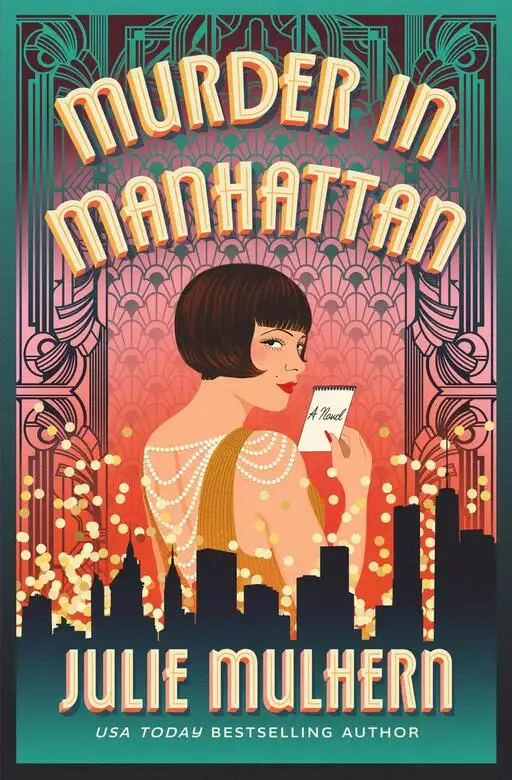
Inspired by one of the first real-life female columnists at the New Yorker, this enticing historical mystery follows Freddie Archer as she solves crimes while reporting on the glamorous world of the rich and famous in 1920s Manhattan.
Freddie Archer is the epitome of the 1920s flapper, stylish, newly empowered, and always up for a good time. After all, spending her evenings at shows and in speakeasies is her job while writing Gotham Magazine’s popular nightlife column under the pseudonym “A Touch of Rouge.” But lately her brilliant evenings are being shadowed by death.
When Freddie spots a familiar, couture-clad woman fleeing a murder scene, she does just what NYC Detective Sullivan told her not to do. She gives chase, entangling herself in the underworld of brothels, mob bosses, theatre, and high fashion. With a chance at true love, professional respect, and a hand in the next big Groucho Marx production, Freddie must unravel the mystery before the killer closes in on her.
Release date:
December 9, 2025
Publisher:
Grand Central Publishing
Print pages:
368
* BingeBooks earns revenue from qualifying purchases as an Amazon Associate as well as from other retail partners.
When I tell you the weather is hot, I’m hardly reporting news. Nor is it news when I say our fair city bears a striking resemblance to the place where my last young-man-about-town’s dear mother said I would be going when I toddle off this mortal coil.
When my invitation to the North Shore for last weekend fell through, I had no choice but to embrace the rising mercury.
Embrace I did—the weight of overheated air, the cloying scent of wilting flowers pinned to pretty girls’ shoulders, the sheen of sweat on orchestral brows, and butter-and-egg men thick on the ground. Imagine my surprise when Zelda and Scott Fitzgerald floated into the evening’s boîte on a cloud of gin and Tabac Blond. Scott, who claimed a meeting with his publisher kept him in this sweat box masquerading as a city, suggested a change of venue and nothing would do but piling into a taxi and motoring to the Biltmore Cascades. Who was I to argue? What could be cooler than a rooftop garden? Besides, sometimes a girl needs caviar.
Roses and out-of-town visitors bloomed in profusion. Nestled in the bower, the latest favorite guest of every hostess on the Upper East Side charmed members of the fairer sex. One wonders how the much-in-demand Jake Haskell found time to dine alfresco.
Afterward, a visit to Tex Guinan’s club of the moment. Tex, in her usual good humor, was unfazed by the showgirls who deemed the mercury too high for their costumes. The men, in particular, enjoyed the floor show. One man with the look of a dyspeptic county judge was so taken by a flamboyant redhead with obvious assets, he failed to notice his necktie marinating in his drink. As far as this correspondent knows, he may yet be there. Drooling still…
A Touch of Rouge
Freddie Archer adjusted the cool cloth draped across her forehead and eyes—not that the cloth was terribly cool. Nothing stayed cool in this heat. It was hardly morning—barely nine o’clock if the sounds outside her office were any indication—and already the day was stifling.
“Freddie Are you decent?”
The gentle utterance of her name was accompanied by the sound of the door opening. Such were the dangers of sleeping on the divan in her office—someone was bound to disturb her. In this case, someone was her secretary, Annie.
“I am dying.” Given the knitting needle lodged in her brain, the declaration wasn’t remotely dramatic.
“Sorry to hear that.” The unseasonable heat had curdled whatever milk of human kindness Annie had once possessed. The lack of genuine sympathy was positively galling.
Why hadn’t she held out for a secretary with a nurturing soul?
“I brought you a bottle of aspirin and a glass of water.”
Maybe Annie wasn’t completely lacking in compassion.
Freddie lifted onto her elbows. That accomplished, she pushed herself to sitting and lifted the cloth hiding her eyes. The office was brighter than the gleam in a chorus girl’s eyes when a rich man came calling. Why must the sun shine with such verve in the morning? She closed her eyelids, but the light burned a red halo in the darkness.
“Here.” Annie pressed a glass into her left hand. “Two or three?”
“Four.” Freddie held out her empty right palm.
Annie shook the tablets from the bottle, then her footsteps crossed to the window. The sound of blinds being closed was lovelier than a symphony. “You have messages.”
“Do I?” Freddie tossed the pills into her mouth and washed them down with a swig of water.
“The writer of A Touch of Rouge has messages,” Annie amended. “There’s a reader who takes umbrage with your description of the Fox and Hound as a club best reserved for those chasing the dragon.”
“There’s an opium den in the back room.”
“Also, the police are here to see you.”
“The police?” Freddie opened her eyes and surveyed her now dim office. Her shoes were abandoned near the door. A single silk stocking was draped over the back of a chair facing her desk. The other stocking circled her ankle. Last night’s frock was a pool of crumpled silk next to the divan. An open beaded clutch rested atop the dress. “Whatever they want, I didn’t do it.” She spoke with assurance she did not possess.
“Do what?”
“Anything. Drink in a speakeasy. Dance on top of a patrol car. Go for a late-night dip in the fountain outside the Plaza Hotel.” She’d done that and more. Many times.
“He’s a detective.”
“A detective?”
“I thought you’d want to see him before Gus arrives.”
Freddie rested her throbbing head against the back of the divan. While the stories of her antics earned her an enormous readership, the antics themselves shocked her boss to the bottom of his born-in-Iowa soul. Gus would frown upon a morning visit from the constabulary. “I suppose I’d better see him.” She raked her fingers through her bobbed hair and kicked the stocking from her ankle. “How bad do I look?”
“Like something the cat spat up.” Annie bent and picked up the stocking.
If Freddie bent like that, her brains would leak out of her ears.
“A detective, you say?” What could a detective want? Freddie scrubbed her face with the damp cloth. The white linen came away smudged with the remnants of last evening’s mascara, rouge, and powder. Her lipstick had long since decamped—she’d wager it was on a young man’s collar. “Do I have anything to wear?”
Annie opened the narrow wardrobe in the corner of the office, pulled out a deceptively simple crêpe de chine dress, and held its hanger aloft. “This?”
“Perfect.” Freddie glanced down at her bare legs. “I don’t think I can manage stockings.” The mere thought of reaching for her toes made her stomach flip like a Ringling Brothers’ trapeze act. But no stockings meant she wouldn’t be able to leave the cover of her desk. So be it. “Do you have a comb?”
“Of course.”
“A lipstick?”
“Of course.”
“What’s his name?” Freddie stood. Just stood. She could do no more—her stomach and head needed time to adjust to their new fully upright positions.
Annie chose not to answer her question. “Finish your water, and I’ll get you some more.”
Freddie drained the glass. “I need coffee.”
“You need to write your column then go home for a long nap.”
“The new column is written.” She pointed at her desk, an oasis of calm in the disorderly room. Pad of paper. Pencils in a cup. Typewriter. A stack of letters from readers who either loved A Touch of Rouge for her breezy writing style or hated her for glamorizing nightclubs. And neatly stacked pages waiting for Annie to take them to an editor. “As for a nap, that sounds positively luxurious. Too bad there’s a detective here.”
“His name is Mike. Mike Sullivan.” Was that a touch of pink on Annie’s austere cheeks?
“Mike, you say?” Freddie ventured a step—a small one. Somewhat surprisingly, the floor did not open and swallow her whole. She took a second step. A third shuffle forward carried her to the mirror hanging on the back of the office door. There, she gasped. Even in the blessedly dim light, the woman in the mirror looked positively haggard. “I’ll need some powder, too.”
“What did you do last night?” Annie held out a comb.
“Nothing nearly as exciting as last week. I didn’t encounter the Fitzgeralds. I didn’t hop in a fountain. Nope. Last night was nothing special. Dinner at the Colony, a show in Harlem, dancing at Corona de Oro.” Freddie ran the comb’s teeth through her tangled hair. “It’s all there in my new column.”
Annie, who was a huge fan of Scott’s short stories, harumphed. Freddie suspected Annie was also a secret fan of Scott and Zelda’s escapades, not that she would ever admit it.
“Nick Peters was there. Apparently, he’s in the city working on his new show.” She tried—tried—to keep her tone casual as she tugged at a snarl.
Annie wasn’t fooled. “You spoke to him?”
“We were very civilized.” Had being civilized hurt him as much as it hurt her? “He was there with his leading lady.” Why were all leading ladies impossibly beautiful? Last night’s had been a honey blonde with rounded cheeks and bowed lips painted a brilliant cherry red. Freddie had hated her on sight. On good days, Freddie could best be described as pretty—such an anemic, little word. She didn’t need a second glance in the mirror to know today was not a good day.
Annie reclaimed the comb and put the frock in Freddie’s hands.
The dress whispered over her shoulders. She smoothed the fabric over her slip and patted a stray hair into place. “I believe I’ll take you up on that second glass of water.” She kept her voice light and airy, as if spotting Nick dancing with another woman hadn’t left her breathless. And thirsty. For copious amounts of champagne. She wasn’t carrying a torch for him. She absolutely was not. But it was galling how quickly he’d moved on.
“Of course.” Bless Annie for pretending not to see the cracks in the façade.
The price for all that champagne was this—a painful morning. “And coffee.”
Annie collected the stocking hanging from the chair. “Of course.”
“Are there any shoes in that wardrobe?” Last night’s black satin pumps and today’s crêpe de chine dress would be ridiculous together.
“No.”
“I’ll go barefoot.”
Annie’s brows rose.
“I’m not stepping out from behind my desk. Your Detective Sullivan will never know.”
“He’s not my detective.” Annie’s voice was a shade too sharp.
“Yet.”
Annie flushed a deep pink.
“Give me a minute or two to fix the wreckage”—Freddie circled her hand in front of her face—“then bring him in.”
Five minutes later, a ginger-haired man the size of a rhinoceros settled into the chair across from her.
The chair groaned.
Freddie forced a smile. “How may I help you, Detective?”
“I read your last column, Miss Archer.” Detective Sullivan, with his size, open features, and maleness, did not resemble her usual reader.
“Oh?”
He held out last Saturday’s magazine, carefully folded to her column. “You were at the Biltmore Cascades with the Fitzgeralds.”
“Are they in trouble again?” What had they done now? Freddie rested her arms against the desk. “They mean well. They do!” Zelda had a tendency to get caught up in wild moments and forget she was an adult. And Scott egged her on. Either too drunk, too enamored, or too desperate for material for a short story to care that Zelda had flashed a wide-eyed beat cop walking Fifth Avenue.
“They’re not in trouble.”
Well, that was a relief. She leaned back and considered Detective Sullivan’s bright blue eyes. “Who is?”
“Who is what?”
“In trouble. Someone must be, or you wouldn’t be here.”
“How do you know Jake Haskell?”
Jake Haskell. “Tall. Blond hair. Midwestern accent. Divot in his chin. And”—she tapped a finger on the center of her own divotless chin—“terrible taste in neckties.”
“How do you know him?” Detective Sullivan fixed his gaze on her.
The intensity of that gaze made her feel like a butterfly pinned to a board. Freddie shifted in her chair. “I don’t know him. Not really. I met him at a party.”
“But you put him in your column?”
“Say what you will about New York, but with this heat, the city is most attractive to those who can leave. While I don’t begrudge anyone a single breath of ocean-cooled breeze, half the city has gone missing. That means finding warm bodies for the column is a challenge.” A bead of sweat formed between her breasts and trickled down her torso. Freddie ignored the tickle of perspiration and waved a languid hand at the closed blinds. “By the end of August, I expect I’ll be writing about shoeshine boys.”
“Who introduced you?”
So many questions. Freddie snuck past the ice pick lodged in her brain and searched her memories. The night blessedly cool. The stars impossibly bright. She’d danced on a veranda overlooking the ocean. “John. John Burcham introduced us.”
Detective Sullivan pulled a small notepad from his jacket and made a note. “Who is John Burcham?”
“A reporter. A friend of my brother’s.”
“Was your brother there that night?”
“No.” That was all he was getting. She didn’t talk about Gray. Ever.
“When did you meet Mr. Haskell?”
“I think we met in May.” The breeze had made her shiver. What she wouldn’t give for a shiver now. “Definitely May. Early in the month.”
“And you didn’t see him again till the other night at the Cascades?”
“I might have.” Haskell was a bootlegger—a bootlegger who brought bottles of scotch as hostess gifts to cocktail parties. Real scotch. From Scotland. Not the brown-tinted bathtub swill some speakeasies passed off. As such, Haskell was a sought-after guest—it was that popularity that had earned him a mention in last week’s column. But Freddie wasn’t about to tell a police detective about Jake Haskell’s bottles of scotch. The admission would land too many friends in the soup.
“You’re aware of Haskell’s profession?”
When, oh when, would the aspirin kick in? “His profession?”
“You’re aware Haskell was a bootlegger?”
“I might have heard something to that effect.” A nice, safe response. “Did he retire?”
“Retire?”
“You said he was a bootlegger. Was.”
“He didn’t retire. He died.”
The gasp that escaped her said almost everything—what a pity, and how awful, and he was much too young. “How?”
“He was murdered.”
The air in her office stilled, and her lips struggled to form a simple word. “Murdered?” Maybe the fault was not on her lips but in her throat. The one word emerged as a strangled plea.
Detective Sullivan’s eyes searched her face. Thoroughly. What was he looking for? Surely he couldn’t suspect her? “He was shot.”
“Shot?” Yet another strangled word. “Who shot him?”
“We’re hoping you could help us with that.”
“Me?” She crossed her hands over her chest and winced as the ice pick in her brain bored another inch toward the center of her gray matter. “I barely knew the man. How could I help?”
“Who was at the Cascades the night you dined with the Fitzgeralds?”
“No one.”
“No one? You mean it was empty?”
“Of course not. But there was no one there to write about—a crowd of out-of-towners—”
“You can tell someone is from out of town just by looking?”
“Can’t you? There you are.” The last she directed to Annie, who stood in the doorway with a tray.
“I brought coffee.” She’d also taken time to comb her hair and powder her nose.
“Bless you.”
“And Danish.”
“You’re an angel.” The Danish was for Detective Sullivan. Annie never brought pastry when Freddie was alone. “Isn’t she an angel, Detective?”
Sullivan flushed and pulled at his collar.
Annie stepped into the office and put the tray on the desk. “Do you take cream or sugar, Detective?”
“Sugar, please.”
“One lump or two?”
“One.” The detective returned his notepad to his jacket and watched Annie use tiny silver tongs (where on earth had she found those?) to plunk a sugar cube into his coffee.
“Here you are.” She held out the cup.
Their fingers brushed, and the cup rattled against its saucer. The two made calves’ eyes at each other for a long second.
Detective Sullivan finally accepted the coffee. In his enormous hand, the cup looked as if it belonged to a child’s tea service.
Annie, whose cheeks were flushed a becoming shade of rose, abruptly turned to Freddie. “Black?”
“Please.” She always drank her coffee black. If one was going to drink calories, there’d better be liquor involved.
Annie poured a cup and handed it to her.
Freddie took a grateful sip. “Where were we, Detective?”
“You were telling me who was at the Cascades.”
“That’s right.” Freddie closed her eyes and pictured the rooftop dining room—tables covered with crisp white linen, tuxedoed waiters, the pleasant hum of genteel conversations, the less pleasant sounds of the streets rising up to them. She went often enough that one night melted into another. “Haskell was there at a table for two.”
“Who was he with?”
“A woman.”
“What did she look like?”
“Silk dress—sky blue with crystal beadwork—quite stylish. Ropes and ropes of pearls. Light brown hair—bobbed. Pretty in a kittenish way.” Freddie opened her eyes in time to see Detective Sullivan lean toward her, an avid expression on his freckled face.
“Kittenish?” he asked. “Do you know her?”
“Never set eyes on her before.”
He slumped. “Would you recognize her if you saw her again?”
She was good with faces. And names. Skills that came in handy when writing a weekly feature on the places to see and be seen in New York. “I’d definitely recognize the dress and the pearls. Why all these questions?”
“The woman might know something that can help us catch Haskell’s killer.”
Freddie stared at the giant across from her. He still held the cup and saucer, and they still looked like a little girl’s toys in his meaty hands.
He stared back at her. “I need your help.”
“My help?”
“She’d be happy to help.” Annie, who’d forgotten to leave after serving the coffee, wore the slightly stunned expression of a woman who’d met the man of her dreams.
Freddie lifted her brow and stared at her secretary. “I would?”
The detective rubbed his chin. “I’ve talked to everyone we can find who was at the Cascades that night. You’re the first person who could give me a decent description of the woman Haskell was there with.”
“What could I possibly do?”
“Let me know if you see her again.”
Freddie put her cup down on the corner of her desk. “You mean search her out at clubs?”
“No!” Detective Sullivan held up his hands and shook his massive head. “Absolutely not. If you see her, you let me know. Nothing more.”
Freddie stared at her lap and pressed two fingers against each of her temples. God save her from this headache and from men who wanted women to be nothing more than pretty—and, in this case, talking—accessories. “If I spot her, it will likely be in the middle of the night.” She raised her gaze. “Are you in your office then?”
A cloud passed over Detective Sullivan’s face. She’d presented him with an unforeseen wrinkle. “I’d still like to know where you see her. Like I said, she might know something about the murder.”
“This sounds too dangerous.” Annie’s voice fluttered like a chiffon hemline.
A second cloud passed over the detective’s visage, this one darker than the first. His face cleared, and he spoke to Annie. “Miss Archer will be perfectly safe as long as she doesn’t approach the woman.”
Annie’s forehead wrinkled. “You’re sure?”
“This mystery woman is just a witness. If a female decides to kill, she doesn’t do it with a gun.”
The detective was dead wrong. If she ever decided to kill someone—say, someone like Nick—she’d use a gun. She even knew exactly where she’d shoot him.
“If you see her, you’ll call me?” Detective Sullivan held out his card.
“Call you”—she glanced at the number on the card—“and do nothing else.”
“I would never ask a lady such as yourself to do anything remotely dangerous.”
Annie sighed as if she actually saw the gauntlet Detective Sullivan had thrown on Freddie’s desk. “She’ll call you if she sees her. She won’t approach her. She won’t follow her. She won’t speak to her.” Annie might be directing her words at the detective, but she was speaking to Freddie. “I’ll see you out, Detective.”
Freddie stood and extended her hand.
Detective Sullivan hauled himself from his chair and shook her hand. “Thank you for your assistance, Miss Archer. Remember, if you see the woman, call me. Do not interact with her.”
Annie closed the office door on the detective’s broad back and whirled around. “Don’t.”
“Don’t what?”
She held up a restraining finger and jabbed at the air. “I know you. You’d run into a burning building if a man told you not to. Please, don’t go looking for that woman. Do not.”
“This is New York. The chances of seeing her again are slim.” Not exactly true. Despite more than five million people in the city, she still ran into Nick with disturbing regularity.
“If by some miracle, you do see her, call the detective. Nothing more.”
“What else would I do?”
They both knew the answer to that question.
Was there a paean to napping? If not, someone needed to write one. She could write one.
“Sleep that knits up the raveled sleeve of care.” One suspects that Will Shakespeare was no stranger to afternoon naps. He called sleep a balm and a nourisher in life’s feast. One can be certain that he put down his pen of an afternoon to catch forty winks.
This writer is no bard, more a scribbler of bon mots and random witticisms, but a good nap inspires eloquence. Perhaps that was Shakespeare’s secret. After all, is there anything better than a soft pillow, sweet dreams, and waking to the knowledge that one has snoozed through the afternoon heat?
Hardly the sort of thing the magazine would publish.
Freddie stretched, and yawned, and stretched again. Mercifully, the ice pick in her brain had shrunk to a mere embroidery needle, and her stomach no longer felt like a dinghy tossed on rough seas.
She luxuriated in one last full-body stretch and then pushed herself out of bed, stumbled into the bathroom, and turned on the taps.
A long soak in the bath finished what the nap had started. She was a new woman, ready to conquer worlds—or at least Manhattan. The silver chiffon frock suited her mood and weighed no more than a whisper. The shoes she’d picked up at B. Altman’s. Hair. Makeup. That darling evening bag from the clever little shop on Madison. She was ready for almost anything.
Freddie traipsed down the hall and summoned the elevator with a quick jab of her finger.
When the doors slid open, she stepped inside and trilled, “Good evening, Ernest.”
“Good evening, Miss Archer.” Ernest didn’t approve of her. And while he was always polite, she never failed to detect censure lurking in his tone. Young ladies should not live alone. Young ladies should not go out every evening. Young ladies should behave like ladies.
The exact same opinions her mother expressed—out loud—on a daily basis.
At least Ernest didn’t remind her of her advancing age by urging her to find a husband while she was still young.
The doors slid open, and Freddie practically skipped into the lobby. Ernest’s opinions didn’t matter. Nor did Marjorie Archer’s. Not tonight. Tonight New York was a magical place—a mystical Eden filled with wild, soft summer darkness. An enchanted realm where the night’s sins disappeared with the dawn. A modern-day Xanadu where anything might happen.
“Good evening, Miss Archer.” Unlike Ernest, the doorman kept his tone censure-free.
“Good evening, Bert. I’ll need a taxi, please.”
“One moment, miss.” Bert stepped outside, and his shrill whistle sliced through the velvet night.
A cab rolled t. . .
We hope you are enjoying the book so far. To continue reading...

 Please log in to recommend or discuss...
