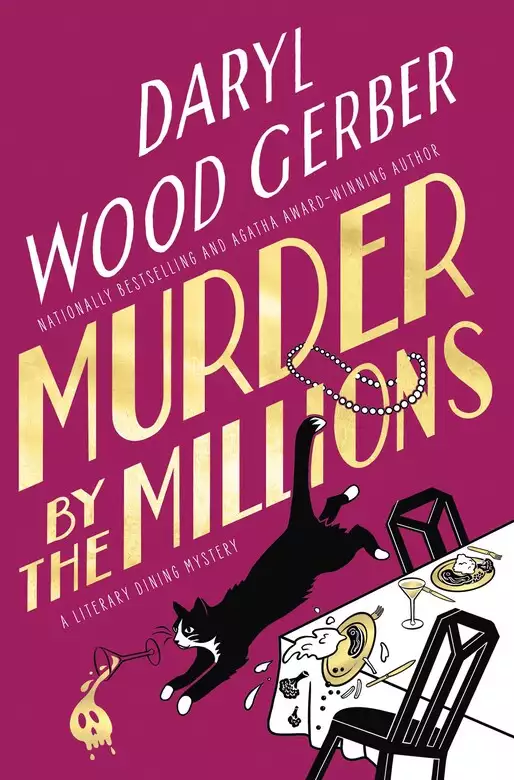
In the beautiful mountain community of Asheville, North Carolina, caterer and personal chef Allie Catt serves up mouthwatering, literary-themed dinner parties inspired by her clients’ favorite books. Her next event is sure to be a roaring success—if a murderer isn’t a killjoy . . .
If it were true that the best thing a girl can be in this world is a fool, then Allie Catt would be out of luck. Fortunately, Allie’s business is a smashing success. And following her Pride and Prejudice event, grander plans await . . .
Feast for the Eyes bookstore manager and Allie’s best friend, Tegan, is hosting a book club soiree and wants it to be a glittering affair based on F. Scott Fitzgerald’s iconic Jazz Age-set novel, The Great Gatsby. Soon, Art Deco table settings and visions of flappers are dancing the Charleston in their heads. Even Tegan’s prickly sister, Vanna, is on board. And surely, Allie’s tuxedo cat, Darcy, thinks it’s the cat’s meow. Amid the planning, charismatic developer Jason Gardner arrives in town to buy some historic buildings on Main Street. He, too, has plans: to create a modern mall. Allie is more than concerned. She even wants to protest. But when Jason invites her to cater a lavish party, she finds him surprisingly likable. Then she’s summoned to his estate for a meeting—and finds him dead.
Once again Allie’s landed in the middle of a crime scene.
Release date:
October 28, 2025
Publisher:
Kensington Books
Print pages:
336
* BingeBooks earns revenue from qualifying purchases as an Amazon Associate as well as from other retail partners.
I was within and without, simultaneously enchanted and repelled by the inexhaustible variety of life.
—Nick Carraway in F. Scott Fitzgerald’s The Great Gatsby
“Allie, I love The Great Gatsby,” my best friend, Tegan Potts, said as she did a two-step through Feast for the Eyes, the bookshop she’d recently inherited from her aunt Marigold. “Love, love, love it.”
“Glad to hear it.” I’d just finished straightening up the reading nook located at the back left of the store, because the beanbags and comfy armchairs had all been askew. Now I was intent on organizing the items on the pegboard behind the sales counter. That was where we posted notes to one another, like “Out of The Mystery of the Blue Train” or “Need three copies of The Diva Goes Overboard.” Once the issues were handled, the notes were tossed in the trash.
“I love the history.” She skirted the year-round book tree decorated with miniature book ornaments and disappeared down the mystery aisle to pull books from the shelves. Though the bookshop wasn’t huge, her voice became muffled. “And the glamour.”
“What about the story?” I teased.
“The story’s good.”
Though my full-time career was working as a caterer and baker, delivering tasty treats to the good people of Bramblewood, I had inherited a small percentage of the bookstore, so I helped out my pal whenever my baking and deliveries were done. The tragedy of Marigold’s demise still brought tears to my eyes. She had been like a beloved aunt to me. But at least her murderer had been caught and imprisoned—the silver lining in an otherwise sad tale.
Tegan reemerged with a stack of books, which she deposited on the sales counter, already overflowing with others. On Sundays, before the bookshop opened, she was adamant about gathering all the preordered titles.
“The story is excellent when it comes to painting a picture of a tragic hero.” Tegan spread her arms wide, which made the bat wings of her oversized anime shirt expand. She reminded me of a bird about to take flight. A very tiny bird. She was a good three inches shorter than me. “After all, Gatsby brings about his own downfall.”
“True.” I began to tag the books using the list Tegan had prepared. “Fitzgerald tried to portray Gatsby as a perfect person, but his imperfections were clearly evident. And let’s face it, Gatsby shouldn’t have cared for Daisy so much. He shouldn’t have built his whole world around the possibility of her return.”
“But he believed she couldn’t possibly love her husband and would come running back to him because he was so rich.”
A man’s wealth wasn’t a good enough reason for a woman to fall for him. Character mattered, as did kindness.
As if reading my mind, Darcy, my tuxedo cat, emerged from the office, which abutted the storage room, leaped onto the shop’s desk beneath the pegboard, and swished his tail.
“Yes, my sweet boy. A man must also be a lover of animals.” I kissed his nose.
At first, when I’d started bringing him to Feast for the Eyes, he had been shy and had remained in the office. Other than liking me and a few of my friends, he wasn’t much of a people person. However, lately, he had grown bolder and made occasional appearances. His movement stirred the screen saver on the tabletop computer, and it came alive with magical swirling books.
I tickled him beneath his chin, and appeased, he bounded off the counter, trotted to an endcap and, using it as stairs, bounded to the top of the bookshelf closest to the front door for a snooze. I caught a glimpse of myself in the office window—the slats were drawn—and I frowned. My curly red hair was a mess. The scoop collar of my white T-shirt was uneven. I righted it and patted my hair into place.
“The book party for Gatsby is going to be such a success, don’t you think?” Tegan continued.
When Marigold died, Tegan and I landed on the idea of having a book-themed memorial for her. Marigold had loved the classic Pride and Prejudice. At the memorial, we’d served food from the Regency era, and lots of people had worn time-appropriate costumes. Following the memorial, which had been widely attended, we decided we should have book-themed parties a few times a year—and no more memorials, if we could help it. If readers desired, they could wear costumes. I wasn’t a fashion guru. I preferred jeans or leggings and solidcolored T-shirts. However, although sage green was my signature color, for The Great Gatsby event a week from Saturday, I’d selected an emerald-green flapper costume with silver spangles, a sexy V-neck, and shoulder fringe trim. Ooh la la.
“Lots of townsfolk will attend,” Tegan said. “And tourists, too.”
Bramblewood, North Carolina, was a serene community northwest of Asheville, the nearby metropolis, which, in addition to being the brewery capital of the country, boasted the famous inn on Biltmore Estate, a University of North Carolina campus, and a vigorous art scene, one that was rebuilding itself after a horrific hurricane. Our town drew a lot of visitors, but nothing like Asheville. However, the rustic allure of the Blue Ridge Mountains made Bramblewood extra special. Hotels, rental homes, and bed-and-breakfast inns were constantly filled. Most were within walking or biking distance of Main Street, where Feast for the Eyes as well as Dream Cuisine were located.
“Isn’t it amazing the response we’ve gotten?” Tegan went on. “Readers are coming out of the woodwork. I’ve ordered fifty copies of the book. Fifty!”
Tegan and I had been best friends for over twenty-one years, ever since kindergarten. We both loved reading, though she liked fantasy, sci-fi, and comics, while I preferred mysteries and suspense. Her soon-to-be ex-husband also enjoyed fantasy—one of the few reasons they’d stayed together as long as they had.
“I’m telling you, these parties are going to put Dream Cuisine on the map.” She knuckled my arm.
“Ahem.” I cleared my throat mock-haughtily. “My business is already on the map.”
“Sure, sure, but did you have a clue when you gave up becoming a teacher and moved back to Bramblewood to open your business that you would become this big a hit?”
“Well, I’d hoped.”
Though I’d graduated Davidson College eager to introduce young minds to the classics, no teaching jobs were available, so I went to work for a caterer in Charlotte. I’d learned to cook at the tender age of five because my mother and father wanted me to be self-sufficient. The skill helped me get the job. Then when my ex-fiancé dumped me for a younger model, I decided to move home and parlay my cooking skills into a business. Now a number of restaurants and other businesses ordered my baked goods or hired me to cater their soirees. For some souls who were averse to cooking, I provided personal meals.
“How about you?” I asked. “Look at the success you’ve become, going from wannabe librarian to bookshop owner.”
“Which would not have happened if my aunt hadn’t died.”
“Yes, it would have. She was seventy and ready to retire. If fate hadn’t intervened, I’m positive she would have brought you in as her partner. You are the best salesperson I know.” At one time, Tegan had wanted to become a librarian, but when she fell in love with selling books and interacting with customers, she abandoned the dream. “Now let’s talk décor for the party.” I perched on one of the ladder-back chairs by the sales counter. “I’ve discussed it with Reika and Lillian.”
Reika Moore was the president of the Bramblewood Historical Preservation Society and the curator at Bramblewood History Museum. Lillian Bellingham was a contemporary of Tegan’s and mine and the owner of Puttin’ on the Glitz, the high-end clothing boutique next door. In addition to running a top-of-the-line retail business, Lillian donated her time as the costume designer for the community theater. Both Reika and Lillian were regulars at Feast for the Eyes.
“Reika thinks we need to focus on the art nouveau aspect of the era,” I said. “She’s trying to lay her hands on a few items, like gold lamé drapes and tablecloths. She says black and white feathers would be apropos. She’s already rounded up gold candlesticks and Prohibition beverage glasses.”
“Cool.”
“Lillian has acquired strands of pearls and a bunch of flapper costumes and men’s suits, because the theater did Anything Goes two years ago. I picked out one of the dresses already, and I saw another that will be perfect for you. Navy blue and silver, with exquisite floral beading.” I fluttered my fingers in front of my chest.
“Ooh. I love beading.” Like me, Tegan wasn’t a fashion junky, although she did have a tendency to impulse shop when she was in a funk.
“It’s sleeveless, of course.”
“That will be perfect in this heat. Man, has June been hot! It wouldn’t surprise me if we started to see tempers flaring. Bramblewoodians don’t do well with the heat.”
I snickered. Bramblewoodians.What a mouthful, but over the years, all other demonyms had faded away. Bramblewoodite sounded like a bug. Bramblewoodese sounded fussy. Bramblewooders was plain silly.
“Hot, hot, hot,” she repeated.
She was right. The temperatures in the Asheville area were typically moderate. In March the low might be in the mid-thirties. In June we rarely inched above eighty-two degrees. But this week, we were close to ninety. Whew!
“I saw a couple of guys going at it down the street on my way in this morning,” Tegan went on.
“Fistfighting?”
“Finger-pointing.”
“Finger-pointing can be sooo dangerous.” Laughing, I aimed my index finger at her.
She playfully batted it away.
The door to the shop opened, and Vanna Harding, Tegan’s half sister, sashayed in. “Allie!” Vanna didn’t enter a room without making a statement. In her pencil skirt, silk blouse, and stiletto heels, her blond hair swooped into a chignon, she looked ready to go to court. And win. “There you are.”
Six years older than Tegan and me, Vanna had been the premier caterer when I’d moved back to town. As my business ticked up, she got ticked off. However, because she was actually the one who came up with the idea of hosting future literary dining parties, we mended fences. A month ago, when I asked her to help out at Dream Cuisine so I could expand the business, she said yes. Color me surprised!
“I’ve been searching everywhere for you.” Her voice was abrasive and sounded something akin to the bugle call of a whooping crane.
A voice coach could help, I was certain, but far be it from me to suggest it. I’d mentioned the idea to Tegan, but she’d said, “No way will I stick my nose into my sister’s business,” after which she’d clucked like a chicken.
“You look nice,” I said.
Vanna had dusted her eyelids with a sparkly shadow, and her lips were ruby red. I couldn’t remember the last time I’d put on lipstick. I was a lip-gloss kind of girl.
“Thank you.” After her aunt died, Vanna softened a tad. I think she began to realize life was short and she needed friends, in particular her half sister and me. Also, though she had inherited a tidy sum from her aunt and didn’t need money, she had a healthy ego. Partnering with me by providing baked goods to Bramblewood and nearby towns meant she would have a wider reach and could grow her clientele. “Now let’s talk about the email you sent me regarding the menu for the Gatsby party.” She wrinkled her nose and waggled her cell phone.
Uh-oh.
“Why are you so gussied up?” I asked as a diversion.
“I had a meeting.”
Though Vanna and I worked together, she still had her own clients, as did I.
“Ahem.” Vanna cleared her throat. “Anybody home, Allie? The menu?”
Her attitude occasionally rankled me. I fought the urge to hurl a sassy one-liner at her, a defensive tactic I’d acquired while growing up. “Yes.” I smiled. “What about the menu?”
“You’ve got to be kidding.” She consulted her iPhone. “Pineapple upside-down cake? How prosaic.”
“It was big during the Roaring Twenties.” I’d done my research. “Around 1925 the Hawaiian Pineapple Company held a contest, and many entries featured pineapple upside-down cake. Judges from Miss Farmer’s School of Cookery, Good Housekeeping, and McCall’s Magazine chose the winner.”
Tegan added, “Twenty-five hundred of the sixty thousand entries, to be exact!” A history buff and trivia nut, she’d enjoyed doing a deep dive into the era with me.
“What about this one?” Vanna referred to her cell phone. “Tomato soup cake? Ugh. How pedestrian.”
“I know tomato soup is an odd ingredient for a cake, but no one will guess what the secret ingredient is,” I said. “In the late 1920s or early 1930s the Campbell Soup Company created the recipe using their condensed tomato soup. Canned foods were all the rage.”
“Fine.” Vanna made a dismissive gesture. “Next! Deviled eggs. Totally plebeian.”
“Everyone loved them back then,” I said, “especially when Hungarian immigrants helped popularize paprika.”
Vanna sniffed. “And small plates of pasta pomodoro? Pedantic.”
“Gee, Sis, do you know only adjectives starting with the letter p?” Tegan teased.
Vanna’s gaze shot daggers at her. Tegan did not cower. She had pluck in spades.
I said, “All Italian food grew in popularity during that time, because it was considered exotic and cultured. The simplest way for people to enjoy pasta is with a pomodoro sauce.” I loved deglazing tomatoes and adding something as fresh and lively as basil. My mouth was watering contemplating it. “What would you like to serve?” I asked.
“Oysters Rockefeller.”
Tegan snorted. “The oysters will spoil sitting out on a buffet and will make our guests sick.”
“Fine. Then a Waldorf salad made with julienned Granny Smith and Fuji apples, halved red and green grapes, and candied walnuts. I’ll emulsify a mixture of Dijon mustard, olive oil, champagne vinegar, egg yolk, and white truffle oil for the dressing.” She twirled her hand with a flourish.
I bit back a smile. Vanna couldn’t help herself. A perfectly good simple salad, in her opinion, always needed tweaking.
“As for our other business,” Vanna said, pressing on.
Our? She meant mine, thank you. I was including her as a favor.
“We need a larger ghost kitchen.”
“The one we … I … have is fine.” A ghost kitchen, or virtual kitchen, was a place where chefs could cook for delivery or pickup. I rented my modest space on a month-to-month basis. “We’re rarely in it together.”
“We need to double the space.”
I hated how pushy Vanna could be. When she wasn’t partnering with me, she cooked at a well-known restaurant that leased her a corner of its kitchen. “If you help me double the business, we’ll talk.”
She huffed and started for the door but halted when Chloe Kang, the twenty-something junior clerk at the shop, who could be as energetic as a toddler experiencing a sugar high, rushed in.
“Stop the presses!” Chloe yelled. “He’s here. Jason Gardner is here. In town. He’s, like, wow.” She wagged her hands frantically. “You know who I’m talking about, right?”
I shook my head. So did Vanna and Tegan.
“He’s been on magazine covers and everything.” Chloe sounded like she’d been dashed with stardust.
“Is he an actor?” Tegan asked.
“No. He’s not an actor, silly.” Chloe’s almond-shaped eyes sparkled with impishness. “He’s a builder. A really famous builder.”
How famous could he be if none of the rest of us had heard of him?
“He’s purchasing the lots across the street from the Congregational church,” Chloe added.
The Congregational church was the first church built in Bramblewood and the one I used to go to with my grandmother before she passed away. “There are no vacant lots across the street,” I said.
“Not lots lots.” Chloe twirled to place her purse beneath the sales counter and whirled back around, smoothing the skirt of her fluted red dress. “The properties. The houses.”
“Those aren’t for sale.”
“Yes they are, Allie.”
“No. They’re historic landmarks,” I stated. “The preservation society has plans to include them in its tour of the town, once they get the funding to complete the sale. They want to show life as it was when Bramblewood was initially settled.”
“The town council has approved Mr. Gardner’s bid,” Chloe said.
“You’re kidding.” I exchanged a look with Tegan, who raised her shoulders, clueless.
“Mr. Gardner has a few permit hurdles to jump over before the sale is final, of course, but … oh, oh! That’s him.” Chloe bounced on her toes and jutted an arm toward the street. “Outside. There. See him? He’s walking this way. He’s coming into the shop!”
Seconds later a decidedly handsome man pushed through the front door. He reminded me of someone—an actor—but I couldn’t drum up the name. “Are you open for business?” His voice was warm and refined.
“It’s Sunday,” Tegan replied.
“Is that a yes or no?”
“Hello, Mr. Gardner,” Chloe said, waving demurely. “I’m Chloe Kang.”
“Hi.” Jason Gardner had wavy hair, which he had swooped off his face and wore longish, cut above the collar of his brown linen jacket. His jaw was strong, and his eyes, though narrow, held a glint of humor. Two lines, like double parentheses, bracketed the left side of his mouth, hinting that this was the side he favored when he smiled. If not for the furrows between his eyebrows and the way he was nervously fisting and unfurling his left hand, I would think he’d lived a carefree life in his forty-something years. “Yes or no? Open?”
Tegan glanced at me for a response to his question.
“No,” I replied, “we’re not open yet, but we will be after noon. You’re free to browse now and reserve books to purchase then.”
He grinned, confirming my deduction about which way his smile would go. Chloe drew in a quick breath. So did Vanna. Both were clearly smitten.
“You met Chloe,” I continued. “The one in the anime shirt is Tegan Potts. The other is her half sister, Vanna Harding.” I pointed to them. “I’m Allie Catt.”
He let out a laugh. “Really? You’re not pulling my leg?”
“No, and yes, it’s a funny name, but I come by it honestly. Catt, C-a-t-t, is an English name derived from Catford, which initially meant ‘a ford frequented by wildcats.’”
“I’ll bet you heard a lot of jokes growing up.” He sauntered toward the thriller and mystery section of the store.
“Of course. Here’s one. Knock, knock.”
“Who’s there?”
“Fur.”
“Fur who?”
“Fur heaven’s sake, open the door.”
“You poor kid,” he said.
I supposed to him I was a kid. I was a good fifteen to twenty years younger.
He pulled a hardcover off an endcap and opened the book to read the blurb on the jacket.
I said, “I heard you’re planning on buying property here.”
“To build a mall,” Chloe chimed.
I gawked at her. Why hadn’t she led with that? A mall? In Bramblewood? We took pride in the fact all our stores were independent concerns. Our streets were lined with antique shops, jewelry shops, novelty shops, and more. Even the cafés, restaurants, and inns were small and intimate. We did not need a mall. Shoot.
“Malls are classless,” Tegan declared.
Vanna hushed her.
“But they are.”
Jason arched an eyebrow.
“Tegan isn’t wrong,” I said. “Malls attract people who are looking for bargains, not people who are interested in the history or the serenity of the town.”
“They’re also places where some people are looking to meet other people,” Vanna argued.
“She’s right.” Jason replaced the book, loosened the knot of his paisley tie, and shoved a hand into the pocket of his trousers.
I nearly shouted, Ryan Gosling! That was who he reminded me of. The famous film star posing for the front cover of People magazine couldn’t have come across more casual yet stunning.
“I assure you it will be classy,” he said.
One couldn’t rely on assurances, I mused. Personal history had taught me so.
“It’ll be a mecca,” he went on enthusiastically. “Like its own Main Street, and in keeping with the architectural style of the town. It will be located at the west end of Main Street, where everyone enters town.”
“Or leaves,” I said. “Our roads go both ways.”
“It’ll bring quality tourism, I assure you.”
“We get plenty of excellent tourists,” I countered.
“I’m sure you do.”
“How long do you intend to be in town?” I asked. “Will you build the mall and split? Or do you plan to stick around and make sure it maintains its level of supposed quality?” I made air quotes to highlight the word quality.
“I intend to establish roots here.” He pulled his hand free from the pocket and strolled toward us with a self-assured gait. “I’m having a summer party soon to show my designs for the mall. I’ll be inviting lots of people. Why don’t you all come? It’ll be at the estate I’m renting.”
“Which estate?” Chloe asked, starry-eyed.
“The Sugarbaker estate.”
The Sugarbaker estate was a gorgeous spread built in the nineteen hundreds and owned by Thomas Sugarbaker, one of Bramblewood’s greatest philanthropists and a patron of the arts. Annually the art guild would stage the house and open it for tours. All proceeds went to funding budding artists’ careers. In addition to the grand house, the grounds featured an open-air pavilion, an elaborate swimming pool, and miles of walking trails. The babble of Bramblewood Creek could be heard from the back porch.
“Once I pin down the time and date,” Jason said, “I’ll let you know. First, I need to hire a caterer for the soiree.”
“Allie’s a caterer,” Tegan said. “Hire her. Here’s her card.” She seemed to whip one out of thin air.
I shot her a look.
“Allie and I are partners,” Vanna said, digging in her purse for a business card. “We’d love to give you ideas for your event.”
“She’s Allie’s sometimes partner,” Tegan countered. “Not full-time partner.”
“Full-time for now,” Vanna said with a grunt, still struggling to produce her business card as she stepped toward Jason.
Chloe said, “I’d love to help with the party, if you need me.”
Rushing around the sales counter, she caught her toe on a runner and tripped into Vanna.
The two pitched forward and collided with the endcap. Display books went flying. The shelf beyond the endcap teetered. Vanna screamed with horror.
Darcy, disturbed from his nap, yowled and leaped off the bookshelf.
“My cat!” I yelled.
Jason tried to catch Darcy. The two got tangled up and fell to the floor.
[His smile] understood you just as far as you wanted to be understood, believed in you as you would like to believe in yourself, and assured you that it had precisely the impression of you that, at your best, you hoped to convey.
—Nick Carraway in F. Scott Fitzgerald’s The Great Gatsby
Unscathed, Darcy scrambled free of Jason’s grasp and bounded through the shop to take refuge in the office.
Chu. . .
We hope you are enjoying the book so far. To continue reading...

 Please log in to recommend or discuss...
