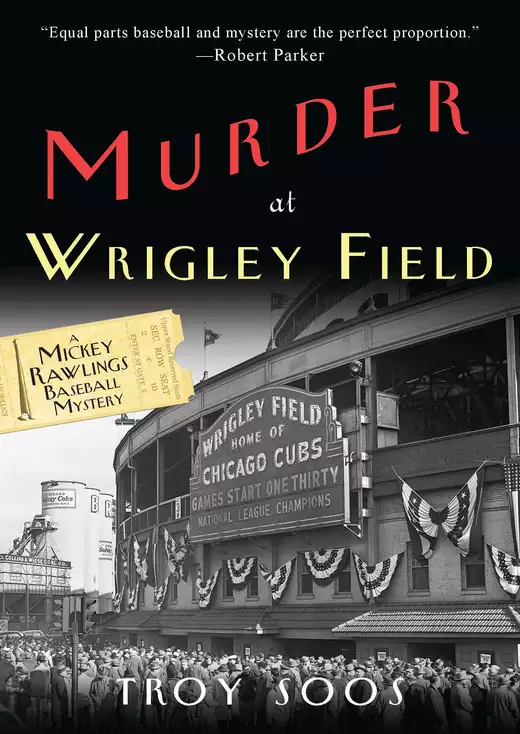
The year is 1918, the place, the North Side of Chicago. Starting for the first-place Cubs and hitting a career high of .274, for the first time in his life, Mickey Rawlings is feeling comfortable enough to buy furniture. But it is a time of mixed blessings; ominous battles are brewing at home and abroad. On the homefront, Major League baseball may be suspended for the duration of the war, anti-German sentiment is running high, and Mickey’s best friend—a rookie named Willie Kaiser—has just been shot right on the diamond. Mickey doesn’t buy the official explanation of “accidental death from a stray bullet.” To him it is beginning to smell like murder. Mickey’s search for answers takes him from silent movies to speakeasies to the stockyards. Troy Soos is celebrated for his skill in recreating an old-time baseball atmosphere and unforgettable real-life characters, and Johnny Heller, as Mickey, captures all the colorful detail.
Release date:
April 25, 2012
Publisher:
Kensington Books
Print pages:
296
* BingeBooks earns revenue from qualifying purchases as an Amazon Associate as well as from other retail partners.
Thirty-six ounces of tight-grained American white ash, painstakingly carved and sanded into a sleek, tapered cylinder thirty-three inches long. The supreme achievement of the woodworker’s craft: a Mickey Rawlings model Louisville Slugger.
“Atten ... tion!”
A baseball bat. An object simple in design, yet with a quiet elegance to its form and a latent power in its core. In the hands of a major-leaguer, it’s a versatile instrument with a dozen uses.
“Present... arms!”
And I knew most of them. I could slip one hand up the barrel to drop a bunt down either foul line or choke up with both fists to poke the ball to right on a hit and run. If a sacrifice fly was needed, I could slide my grip down to the knob and swing from the heels to lift a drive deep enough for a runner to score from third. Deep enough for a fast runner to score, anyway.
“Shoulder... arms!”
I raised my right forearm, lifting the bat to my shoulder. The thick end was cradled in my upturned palm; I could feel nicks where I’d struck it against my spikes to dislodge clods of earth. The handle, stained with sweat and grime from having been squeezed between my fists a thousand times, rested next to my collar bone. And every muscle and bone in my body screamed at me that this was no way to hold a baseball bat.
I never imagined any bat—much less one with my name stamped below the Hillerich & Bradsby imprint—could feel so unnatural to me. But then, the one thing I never expected to do with a baseball bat was use it for a make-believe rifle while I played soldier.
The entire Chicago Cubs team stood in formation, four rows of four players each, in foul territory behind first base. We faced the infield, our backs to the first base dugout. The team was arranged in order of height, with the tallest players in the back. I was in the front row, my toes touching the edge of the chalk foul line.
“Forward... march!”
I promptly stepped forward with my left foot. Willie, next to me on my right, started with his right foot, as did several others. Some didn’t move at all until bumped from behind; then they shuffled clumsily forward to catch up.
As we marched in the direction of second base, the teenaged Army lieutenant in charge of our training chanted in his high-pitched voice, “Left... left... left, right, left...” It took quite a few paces before the footsteps of the Cubs players matched the instructions he squeaked out. We were not a spit and polish kind of squad—despite the fact that we did do an inordinate amount of spitting.
And we would be of little use if Kaiser Wilhelm’s army decided to invade the North Side of Chicago. Hell, we were going to have enough trouble defending Cubs Park from the visiting St. Louis Cardinals.
We were simply putting on a show orchestrated by the baseball owners. It was an attempt to impress Secretary of War Baker, who was threatening to shut down major league baseball. Baker believed that healthy young men belonged on battlefields, not baseball fields. The team owners thought that by marching us around with bats on our shoulders they could convince Uncle Sam we were training for war, not merely playing a game. I thought not even the U. S. government could be that gullible.
There was still some reason to hold out hope for a reprieve though: Baker had already given deferments to actors and opera singers for providing “essential entertainment.” I figured if opera could be considered essential, surely the national pastime was.
As we reached second base, the lieutenant yelped, “Right turn . . . March!”
I spun to my right and collided with Willie turning left. “Your other right, Willie,” I said. I grabbed his shoulder with my free hand and turned him around.
He had a bewildered look on his young face and his cap was askew. It was also too large for his head, making him look like a kid whose mother had bought it for him with the hope that he’d grow into it. “This just ain’t natural,” he protested. “You’re supposed to turn left at second and go to third. Who the hell runs out to centerfield?”
“We’re not practicing triples,” I said. Although he was right: nothing about this felt natural.
We said nothing more, which I’m sure the lieutenant appreciated since we weren’t permitted to speak at all during drills, and scampered to catch up to our teammates marching toward right field.
Any other park would have had an outfield fence to mark the perimeter of the playing field. Except for a high wall that ran from the left field foul pole to left center, that useful feature was omitted in the design of Cubs Park. In right field, bleachers sprouted directly from the grass; only a low railing separated the seats from the field of play. With few fans occupying them, the bleachers looked like a wide squat staircase. It appeared we could march up those steps and walk right into the second-floor windows of the Sheffield Avenue row houses that overlooked the park.
“Company... halt!”
I halted. Fred Merkle ran into my back.
As the Cubs players stumbled into each other trying to maintain some semblance of formation, I decided it was a wise move on the part of the Army not to equip us with real rifles. One of us would have probably ended up getting his nose shot off.
This little patch of Chicago, four acres of ballfield nestled in the juncture of Addison and North Clark streets, was a baseball oasis—a green cathedral in a blue-collar neighborhood.
The field itself was splendid. The turf, a lush mixture of bluegrass and clover, shimmered with life, and the dark earth of the base paths looked fertile enough to grow crops.
After a week of sporadic thunderstorms, the weather was finally cooperating as if nature herself wanted to see a ball-game. Gentle, cooling breezes blew off Lake Michigan. They sent wispy white clouds drifting across a high sun to provide soft shade for the park below.
Taking in the view, one could almost forget that across the Atlantic young men were dying by the thousands in trench warfare. Almost, but not quite.
The war in Europe had taken a toll on baseball that was most evident in the dugouts. The players seated with me on the Cubs bench were far from prime physical specimens, and the Cardinals across the field in the first base dugout weren’t any better. Not since the 1899 Cleveland Spiders had there been a major league baseball team comprised of such wretched-looking ballplayers. This year, with rosters decimated by players leaving for military service, it was the norm. Teams had to fill holes in their lineups with sandlot players too young to fight and old-timers too aged. It was often a challenge for a team simply to field nine players by game time.
It was also a challenge to fill a ballpark with paying customers. Factories were running round-the-clock to produce materials for the war effort, and even on Saturday few people could take an afternoon off to watch a baseball game. Of the eighteen thousand seats in the park, only about two thousand were occupied. There wasn’t enough of a crowd for the fans to feel part of, so they sat in self-conscious silence. The sounds that filled the park came from the streets outside: automobiles with bleating horns on Addison and trains rumbling past the entrance behind home plate.
With the game about to begin, the Cubs’ public address announcer walked to a point between home plate and the pitcher’s mound. Through a megaphone that wasn’t necessary, he gave the St. Louis starting lineup, then began to read off Chicago’s. The crowd listened with indifference until he announced, “Batting third and playing shortstop: Willie Kayser.”
Jeers and boos immediately came from the stands, first scattered and then in unison as individual hecklers pooled their meager courage into one voice. The announcer had intentionally mispronounced Willie’s name, but they knew what it really was.
I looked down the bench at Willie. Willie Kaiser, that is. His head was down and he gave it a slight, sad shake. In the summer of 1918, “Kaiser” was not a popular name. All season long, in a dozen malicious ways, spectators and opponents continually reminded Willie of this fact.
So did the newspapers. A year ago, Willie was working in a meatpacking house and playing amateur ball for the Union Stockyards. Now in his first full season with the Cubs, he had a .322 batting average and the best glove since Honus Wagner. He should have been the sports pages’ biggest story. But the papers chose to avoid putting his hated name in print and rarely mentioned Willie in their coverage of the games. The box scores, which couldn’t omit him entirely, abbreviated him as “WKsr.”
After their outburst of patriotic disapproval at Willie’s surname, the crowd quieted down and remained in a dormant state through five scoreless innings.
Not until the top of the sixth did they come to life, when the Cardinals’ Cliff Heathcote led off the inning with a line drive single over first base that almost took Fred Merkle’s head off. The crowd gasped with one breath at Merkle’s near decapitation.
With Heathcote on first, heavy-hitting Rogers Hornsby stepped up next to face our Hippo Vaughn. Murmurs of anticipation came from the stands. The crowd was thinking base hit.
I was thinking double play. From my second base position I gave a glance at Willie. I could see his thoughts were the same as mine. We’d turned enough twin killings this season that Kaiser-to-Rawlings-to-Merkle was on a pace to beat the record of an earlier Cubs’ double play combination, Tinker-to-Evers-to-Chance.
After Hornsby took a fastball for ball one, Willie picked up the catcher’s sign for the next pitch. He passed it on to me, flashing two fingers from behind the protective shield of his mitt. Curve ball. With Vaughn a lefty and Hornsby right-handed, a curve will break in on him. He should be pulling it. I started to cheat toward second as Vaughn released the ball.
Hornsby ripped it, a hard grounder up the middle. I was off, sprinting back and to my right. The ball skimmed the pitcher’s mound and veered to my side of the bag.
At the last possible instant, I threw my glove out, letting it pull my body along in a low dive. The ball snagged in the palm of my glove at the same time that my belly hit the ground. Skidding face-down on the outfield grass, I couldn’t see second base, but I knew Willie would be there. I flipped the ball over my left shoulder, then twisted around to watch the end of the play.
In one fluid move, Willie caught the ball cleanly, dragged his foot across second base, and transferred the ball to his throwing hand. Then the amazing part: with Hornsby two steps from the base, Willie snapped off a sidearm throw to first that nailed him with time to spare.
There wasn’t another shortstop in baseball who could put that much smoke on the ball. Not many pitchers, either. Although Willie was no more muscular than me, there was explosive strength in his wiry build. As cheers came from the crowd, I thought to myself that I’d give anything to have an arm like that. For just one throw I’d like to know what it felt like to unleash that kind of lightning.
Willie showed no joy in the play though. He trudged back to his position at short, looking as if he’d done nothing more thrilling than change a flat tire.
Jeez, Willie, let yourself have some fun. There’s only one thing that feels better than turning a play like that, and you can’t do it on a baseball field. Not during a game, anyway.
The yells from the stands continued, and people rose from their seats. I thought they wanted Willie to tip his cap in acknowledgment, and I was happy that he was being cheered for a change.
Then I saw that the fans were scrambling for the exits, and the one word they were all shouting became clear: “Fire!”
It took almost an hour to get the game going again. There had been no fire, only lots of acrid black smoke from a couple of smoke bombs in the grandstand seats near first base.
The final four innings were played before an empty stadium, so there was no one to boo our 3–1 loss to St. Louis.
I was the last one into the showers after the game. By the time I finished washing, most of my teammates were getting into their street clothes.
Wearing a towel tied at my waist, I sat down on a wooden stool in front of my locker. Willie Kaiser dressed slowly at the locker next to me, pulling on an ill-fitting suit of faded blue seersucker. His face sagged with worry.
“Hey, Wilhelm, ” a voice called out. “I guess that was some of your German buddies that tried to burn down the park!” It was the nasal bray of Wicket Greene, a washed up infielder. Greene had earned his nickname earlier in the season by consistently giving ground balls free passage through his legs. For the same reason, Willie unseated him as the Cubs’ starting shortstop. Greene retaliated by launching a persecution campaign against the rookie.
Willie ignored Wicket Greene and continued glumly buttoning his shirt.
C’mon, show some gumption, I silently prodded him. Don’t take any guff from Wicket.
Greene continued his goading. “Oughta send ya back to the fatherland is what they oughta do!”
Willie remained silent.
I didn’t. “Shut your mouth, Wicket,” I warned. Greene knew, but didn’t care, that Willie was under my protection. When Willie had come up to the Cubs I was assigned as his roommate. For the first time in my career, I’d been considered a veteran. As such, it was my job to introduce the rookie to life in the big leagues and keep him from getting into trouble. I took my job seriously. Besides, you don’t ride a teammate about his nationality or his religion or what part of the country he’s from. No matter his background, once a fellow joins your team, he’s family.
Greene lumbered over to us. When the Cubs drilled, he marched in the back row with the other six-footers. He stopped on the other side of Willie, folded his arms across his chest, and tried to look menacing. He succeeded only in looking ugly. Greene had thinning black hair combed straight back from a prominent forehead and a receding chin dotted with stubble. Through a tangle of brown teeth he said, “I wasn’t talking to you, Rawlings.”
But I knew he was. We’d gone through this before, and Greene could always get a rise out of me before he’d get one out of Willie. By now, Willie had almost become an excuse for Greene and me to go at each other.
“What’s your problem, Wicket?” I taunted him, rising from my seat. “Riding the bench giving you a headache?”
“Son of a bitch! You think you’re a big deal playing second? I’d rather be a batboy than a second baseman.”
“Too bad you don’t got enough talent to be a batboy.”
Greene’s dark eyes narrowed and he snarled, “I could get your job in a minute if I wanted it.”
“Sure you could, Wicket. Don’t know how you’d run the bases though. All them splinters you been picking up, you got more wood in your ass than in your bat.”
“Well it ain’t second I want. I’m gonna be playing shortstop! Soon as they deport this little krauthead.” He feigned a slap at Willie’s head. Willie didn’t flinch.
“Watch yourself, Wicket,” I warned again. I suddenly realized I was still dripping wet and wearing nothing but a towel. It’s hard to look menacing in a towel. Between that and the fact that he outweighed me by thirty pounds, Greene wasn’t likely to be worried.
Other locker room conversations trailed off into silence. The staccato drip of a leaky shower echoed through the quiet clubhouse. Greene and I each took a half step toward each other while Willie sat silently between us.
Greene leaned forward, trying to intimidate me. It didn’t work. I knew that he moved slow and thought slower. He growled, “What are you, his protector?”
I held back, waiting for Willie to act. C’mon Willie, stand up for yourself. If that right arm of yours can throw an uppercut the way it can throw a baseball, Greene’s gonna be real quiet real fast.
Willie did nothing.
Greene stepped around Willie and poked me in the shoulder. “He need you to protect him? Is that it?”
“No, he don’t need me, but he got me.” I followed that with a hard shove to Greene’s chest, and we started grappling together. Neither of us threw an actual punch—baseball players hardly ever throw good punches.
Fred Merkle yelled, “Break it up!”
Teammates soon pulled Greene and me apart.
Merkle stepped between us. He was a strong, smart fellow with a mournful face. Greene wouldn’t argue with his muscle, and I wouldn’t argue with his wisdom. “Come on now,” Merkle said, looking first at Greene and then at me. “Don’t take the loss so hard. No reason to go squabbling with each other.” He knew the loss had nothing to do with the argument, but he didn’t understand what was really behind it.
Neither did I. All I knew for sure was that I was mad. Irrationally, seething mad. I was angry at Greene, of course. More so at Willie for not standing up for himself. And I was mad at something I couldn’t quite identify: a cruel intolerance, a perverse brand of nationalism that had taken over the country and intruded itself into baseball—my game.
I glanced at Wicket Greene. There was more than anger on his face. There was hatred, pure hatred burning in eyes aimed straight at me.
I knew we’d be going at each other again soon.
When we did, I didn’t want anyone around who could separate us.
Rube’s pink tongue lapped my wrist as I scratched him under his chin. He sat on his haunches, his tail happily thumping the hardwood floor.
“I think his leg’s getting better,” I said. “He seemed to be putting more weight on it when I walked him.” Although it was hard to tell with Rube, the dachshund’s legs being so stubby.
“Mmm,” said Edna in a pleased tone. For her, that nearly amounted to a speech. She wasn’t one to use words when a nod, a smile, or a shrug would do. She didn’t need to. Edna could convey exactly what she meant through the smallest gestures. Her concise means of communication never seemed brusque though; she always nodded, smiled, or shrugged in the nicest ways.
If I could choose only one word to describe Edna Chapman, it would be “nice.” If allowed all the words I wanted, I would be hard pressed to elaborate on that description.
Edna wasn’t beautiful, though she wasn’t bad-looking, either. She had a round, fair face that always looked freshly washed. Her dull blonde hair was pulled back and pinned in a simple bun. High Slavic cheekbones pulled up the corners of her blue eyes, giving them a slightly exotic touch, almost oriental.
Nor was she particularly intriguing. Edna rarely expressed an opinion on anything, and there were few indications that she had any she was keeping to herself.
Edna Chapman was simply a quiet girl who was comfortable to be with.
It was probably just as well that I didn’t find her any more tantalizing than that, for she was Willie Kaiser’s little sister and there were tacit rules about proper conduct with a teammate’s sister. She was his half-sister really, but Willie had made it clear to me that he considered her to be his sister, period.
Edna was bent over, feeding the other dogs. They were all dachshunds, all victims of the hysterical campaign to erase everything Teutonic from American life. People with dachshunds were accused of being German sympathizers. Those with German shepherds were reported as spies. As a consequence, dogs of both breeds were often cast out by fearful owners.
A couple of months ago, Edna had taken in several abandoned dachshunds, giving up her small bedroom to house them. Willie and I had moved her bed and belongings to a sitting room outside their mother’s bedroom upstairs. Edna now had less space and almost no privacy, but she never showed signs of regretting her sacrifice and treated the residents of her former bedroom as welcome guests. Like I said: nice.
A contented rumble came from deep in Rube’s throat.
Edna straightened up. Her figure was more sturdy than shapely and stretched a couple of inches taller than mine. “He likes you,” she said. When Edna did put a few words together, I was always surprised at how childlike her voice sounded. She was a full eighteen years old. Or as Willie kept reminding me, “going on nineteen and not getting any younger.”
“He’s a good dog,” I said, stroking his smooth brown coat.
Rube was my addition to the kennel. I’d found him on Belmont Avenue, cringing against the wall of an apartment building. A big drunk had been kicking the little dog while yelling about “goddamn wiener dogs” and “goddamn Huns.” I’d objected to the drunk’s behavior, and he’d objected to my interference. By the time we’d finished scuffling and punching, I found myself guardian of a dachshund with a busted hind leg. I named him “Rube” after the old Athletics pitcher Rube Waddell. The dog didn’t look anything like Waddell, but he was the first creature I ever got to christen, so I named him after my boyhood hero. Rube took to his name, and to me, as if he fully appreciated the honor.
I couldn’t keep Rube myself since I spent half the season on the road, so Edna gave him a home and I helped her care for the dogs. It was one of two activities we did together. The other was going to the movies every Saturday the Cubs were in town.
“What would you like to see tonight?” I asked, though I could guess what her answer would be.
Sure enough. “Tarzan of the Apes,” was her quick response.
Every Saturday this month we’d gone to the Crystal Theatre on . . .
We hope you are enjoying the book so far. To continue reading...

 Please log in to recommend or discuss...
