
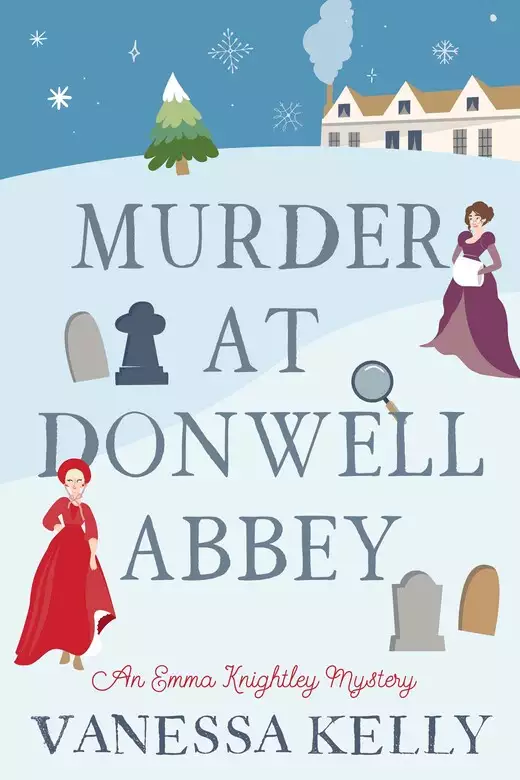
Murder at Donwell Abbey
- eBook
- Paperback
- Audiobook
- Hardcover
- Book info
- Sample
- Media
- Author updates
- Lists
Synopsis
In this latest Regency-era mystery, Jane Austen’s clever Emma Knightley navigates shocking changes in her family—while meeting her match in a deadly adversary . . .
Emma’s spirits are elevated after she and husband George Knightley host a joyful holiday celebration at the Hartfield estate. But it’s instantly a bitter January when her father makes an unexpected announcement—he and Miss Hetty Bates have decided to marry. Not only must Emma relinquish her role as mistress of the household, but also accept the reality that the excitable Miss Bates will become her stepmother . . .
More unwanted news arrives during an extravagant betrothal ball at Donwell Abbey, the grand Knightley estate where Emma and George will soon permanently reside. Nearly every villager in Highbury revels in the dazzling affair—except Emma’s hardworking lady’s maid, Prudence Parr. To Emma’s horror, Prudence is found dead, sprawled across the stones of the library terrace . . .
The woman’s tragic fall is quickly ruled a terrible accident and whispers circulate around personal troubles leading up to her untimely demise. But Emma’s instincts tell her that something far more sinister is at play. Now, Highbury’s matchmaker-turned-sleuth vows to outwit a cunning criminal before an innocent man loses his freedom—or Donwell Abbey plunges into a darker mystery . . .
Release date: November 25, 2025
Publisher: Kensington Books
Print pages: 416
* BingeBooks earns revenue from qualifying purchases as an Amazon Associate as well as from other retail partners.
Reader buzz
 Please log in to recommend or discuss...
Author updates
Murder at Donwell Abbey
Vanessa Kelly
January 1816
Emma Knightley had encountered her share of vexing moments in life. Stumbling across the body of a murder victim last year was certainly one of them. But nothing could have prepared her for this moment. For a few seconds, she wondered if she’d misheard her father’s shocking statement.
Her family had been enjoying a cup of tea, ensconced in Hartfield’s drawing room for their final evening together before the holiday season ended. George had been chatting with John, his brother, while Isabella, Emma’s older sister as well as John’s wife, had been expressing regret that they must return to London after such a charming visit to Highbury with their children. Naturally, their home in London beckoned, as did John’s work at the Inns of Court.
At that point, Father had abruptly made his announcement, one that landed with the force of a cannonball crashing into the drawing room.
Emma finally gathered her wits. “I beg your pardon, Father. I don’t think I heard you—”
“What the devil do you mean you’re going to marry Miss Bates?” John blustered. “Surely you cannot be serious. The woman’s a—”
Emma ruthlessly interrupted her brother-in-law. “What John means, Father, is that perhaps we misunderstood you. You cannot mean that you truly wish to …” She found the words almost too hideous to utter. “You know.”
Father graced her with a beatific smile. “To take that dear lady as my wife? Yes, I certainly do. Miss Bates and I have discussed the matter at great length. Given the nature of our friendship, we feel that marriage is the proper course of action.”
Since Emma found herself unwilling to contemplate what her father meant by the nature of their friendship, she cast a pleading gaze at her husband. George, however, was still regarding his father-in-law with his jaw agape.
Emma cleared her throat to catch his attention before tapping a finger under her jaw. George blinked, and then snapped his mouth shut.
“But, Father,” Isabella plaintively said. “You always maintained that you never wished to marry again. You said no one could ever replace Mama in your heart.”
“No one will ever replace you blessed mother’s memory, my dear girl,” Father gently said. “Indeed, I had quite the job persuading Miss Bates to accept my hand, because she feared she could never measure up to such a fine woman’s legacy.”
“I should think not,” exclaimed John. “Miss Bates is a kind woman, but she’s a blasted chatterbox, not to mention—ouch!”
He glared at George, who was sitting next to him on the sofa. Most likely George had just forcefully jabbed his brother in the leg.
Emma refocused her attention. “Father, I know you and Miss Bates have been a great comfort to each other through difficult times, but is this decision not a trifle … well, impetuous? After all, you know how much you hate change.” She got a flash of inspiration. “And what of Mrs. Bates? Surely Miss Bates would not wish to leave her mother.”
Mrs. Bates was the widow of one of Highbury’s former vicars, and well advanced in years. She and her daughter had lived in a small set of apartments in the village ever since the death of Mr. Bates.
Father nodded. “It’s kind of you to be worried about Mrs. Bates, but such anxieties are unnecessary. She will be moving to Hartfield with Miss Bates.”
Emma swallowed a whimper, while George pressed a finger to his lips. He seemed to have recovered from his shock and was now looking rather amused. She supposed she couldn’t blame him, since the idea of her father marrying Miss Bates was absurd. From a certain point of view, one might even call it comical. But that point of view didn’t happen to be hers.
Then another thought struck with terrible force. Miss Bates would not only become her father’s wife, she would become Emma’s stepmother.
Heaven help me.
Isabella rose and went to their father, taking his hand. “Are you sure, Father? Such a drastic change might greatly affect your health. You and I are not robust, and I cannot fathom what I would do without John to look after me, providing me with everything necessary to my comfort. We go on so quietly in Brunswick Square, with nothing changing from one day to the next—just as you do with Emma and George.”
Although John did take excellent care of his wife, Isabella’s life was hardly quiet. Not as the mother of five young children.
“I understand, my dear,” Father replied. “But Miss Bates and I will take care of each other.”
Emma blinked, rather stung by that statement. “I take care of you, Father. George and I both do so, gladly.”
“You do indeed, my dear. Still, I am such a burden, with all my little oddities. It does weigh on me, on occasion.”
“Nonsense, sir,” said George in a bracing tone. “You are never a burden. Emma loves you, as do I.”
“And why cannot you and Miss Bates simply go on as you have, as the best of friends and companions?” Emma was now a trifle desperate. “She visits almost every day as it is.”
“But that’s just it,” her father replied in a gentle but unyielding tone. “As one gets older, one wishes for companionship with someone of like mind. Miss Bates and I take great comfort in each other’s company, and that is nothing to be sneezed at when one reaches my years.”
Emma sighed. As sweet-tempered as her father was, he had a stubborn streak. It usually manifested in harmless ways, such as his strict admonitions against cake or his never-ending battle against drafts. But experience had taught her that when Father made up his mind, it was all but impossible to change it.
She mustered a smile that likely looked more like a grimace. “I know how her friendship has been a comfort to you.”
He nodded. “Especially in this year past, when life has been so fraught.”
This was an obvious reference to the murder of Mrs. Elton, one of Highbury’s leading citizens. Both Miss Bates and Father had been greatly affected by that dreadful event, and it had drawn them even closer together.
If the poor woman hadn’t come to such an unfortunate end, Emma could almost be cross with Mrs. Elton for having set in motion this domestic cataclysm that was erupting at Hartfield months later.
“And you and George are always so busy—you with Hartfield and your charitable work, and George with Donwell Abbey,” her father added. “But now I will have Miss Bates to keep me company. She will also be a great aid to you in managing Hartfield. Miss Bates is a fine housekeeper in her own right, and can relieve you of much of that burden.”
The notion of Miss Bates taking over the management of Hartfield was so ghastly that Emma was again stunned into silence.
John snorted. “Miss Bates managing Hartfield? That’s the most—”
“I’m sure Miss Bates is more than up to the task,” George firmly cut in. “Especially with Emma’s help.” He cast her a mildly challenging glance. “Is that not so, my dear?”
“Er, yes. Of course,” she managed. “If Father is really sure about this.”
“I am,” Father replied with quiet dignity.
George nodded. “Then please accept my congratulations, sir. We’re very happy for you.”
Emma bit back a sigh. Once George gave his approval, there was no point in prolonging the battle.
She dredged up a smile and rose. “Of course we want you to be happy, dearest. If Miss Bates makes you happy, then I am pleased for you.”
“I’m not,” muttered John.
Emma bent down to give her father a hug. Isabella pulled a slight grimace, but did the same.
“Ridiculous,” John groused.
Emma ignored her dratted brother-in-law as she and Isabella resumed their seats. One frequently had to ignore John’s outbursts.
“Have you and Miss Bates decided on a date?” George asked.
“No,” her father replied. “We must think of Jane and Frank. They must travel a great distance for the wedding, and one would not wish them to do so at such an inclement time of year. Jane is still recovering from her lying-in.”
Good Lord, Jane and Frank!
Emma had not even thought of how the Churchills might react to this unsettling news.
Jane, formerly Jane Fairfax, was the granddaughter of Mrs. Bates and the niece of Miss Bates. Orphaned at an early age, she had been lovingly cared for by the two of them. Jane had eventually gone to live with a school friend whose well-to-do parents had raised her as a second daughter. When she finally returned to Highbury, her intention had been to find a position as a governess. Before that unpleasant prospect had come to fruition, she’d fallen in love with the wealthy Frank Churchill and he with her. They were married a few months before Emma and George, and now resided on the Churchill family estate in Yorkshire.
“Do Jane and Frank know about your plans?” she asked.
Father shook his silver-haired head. “Miss Bates intends to send an express post to Jane first thing in the morning.”
“Then I take it the Westons aren’t privy to the news, either,” said George.
Frank was Mr. Weston’s son by his first wife. Unable to care for his little boy after his wife died, Mr. Weston had made the difficult decision to allow Frank to be adopted and raised by her wealthy relatives, the Churchills. Frank and Mr. Weston, however, now enjoyed an excellent filial relationship.
“Not yet.” Father smiled at Emma. “I was hoping you could tell the Westons the happy news, my dear. I thought you would enjoy doing so. Perhaps first thing in the morning?”
John let out a snort, while George actually had to smother a laugh.
After casting her husband a warning glare, Emma nodded at her father. “Of course.”
If nothing else, Mrs. Weston would provide a sympathetic ear. Having lived for many years at Hartfield as Emma’s governess, she was well aware of her former employer’s disposition. Mrs. Weston would be astounded by this turn of events.
Father beamed at her. “Then it’s all settled. Miss Bates will be so pleased.”
“I’m only sorry John and I won’t be here to give Miss Bates our best wishes, since we leave tomorrow,” Isabella said, making a game attempt at sounding sincere.
Father wrinkled his brow. “I was hoping I could prevail upon you and the children to stay an extra week or so. I know John must get back to London, but surely you will not want to miss the party.”
Isabella and Emma exchanged a perplexed glance.
“What party are you referring to?” Emma asked.
“Did I fail to mention the party?” Father chuckled. “How like me. I’m referring to our betrothal party, naturally. Miss Bates insisted on it, and I didn’t have the heart to deny her. But there mustn’t be any cake, Emma. I hold the line on that point, at least.”
For her father to suggest any sort of large social gathering was unheard of. In fact, it took a great deal of coaxing to persuade him to go even as far as the Westons’ home, Randalls, for a holiday party, or for an outing at Donwell on a sunny day.
“Do you mean something like a dinner party at Hartfield?” she cautiously asked. “I’m sure we can—”
“No, my dear. I mean a proper party, something along the lines of a dance or a ball.”
George’s eyebrows practically shot up into his hairline. “Are you certain you heard Miss Bates correctly, sir? She knows your preferences. Would you not find a dance or a large party inconvenient?”
“I confess that I cannot view such an event without trepidation, but Miss Bates insists on making it a festive occasion. She says it will be a great treat for Highbury after the difficult year we’ve all had.” He fluttered a hand. “With Mrs. Elton, you know. Most distressing for everyone.”
“Especially Mrs. Elton,” John sardonically replied. “But where will you hold this grand event? Surely you don’t wish for all of Highbury to be tromping about Hartfield, dirtying the carpets and causing a grand fuss.”
Emma felt herself go cold at the very idea. “Perhaps you’re thinking of the Crown Inn for a ball? Though I cannot think you would like that very well.”
Father looked horrified. “Emma, inns are such unhealthy, drafty places, especially at this time of year.”
She breathed a sigh of relief. “I so agree. That being the case, I think a nice dinner party at Hartfield—”
“I suppose we could hold a dance at the abbey,” George said, almost to himself.
“What?” Emma exclaimed.
Isabella winced. “Emma, that was right in my ear.”
“I apologize, dear.” Emma glared at her husband. “I was merely surprised.”
“I suppose you could hold it at Donwell,” commented John. “From what George told me, you did manage Mrs. Elton’s funeral reception with quite a large crowd. Smashing success, apparently.”
Emma gazed at him with disbelief. “Funeral receptions are not intended to be smashing successes. And it was a mob scene and an exceedingly troublesome event.”
George smiled at her. “John is correct, though. You managed that affair with great aplomb.”
“Emma, I think George’s idea has great merit,” Father said. “I feel certain Miss Bates would be thrilled with a party at Donwell Abbey.”
“Then we shall be happy to comply.” George gave Emma a pointed look. “Is that not right, my dear?”
Emma took in her father’s hopeful expression. For so many years, the old darling had mourned his wife’s death, retiring from the world to fret about his health and his loved ones. There was no doubt he’d changed in this past year, and for the better. That was obviously down to Miss Bates.
Mentally sighing, she capitulated. “George and I would be happy to host a party for you and Miss Bates at Donwell. When would you like to have it?”
“I thought Saturday, my dear. That should give you ample time to prepare. And that way Isabella will still be here to attend.”
Emma gaped him. “That gives us but six days, and in the middle of winter, too!”
“I’m sure we can manage,” George smoothly interjected. “The roads have been dry, so we can import from Leatherhead any supplies not available in Highbury. It will be fine, my dear.”
With George so obviously in favor of the whole demented project, Emma realized she might as well rip off the bandage and get on with it.
“I’ll call on Miss Bates tomorrow to discuss the arrangements,” she said.
Her father beamed. “There’s no need, since Miss Bates will be visiting Hartfield first thing in the morning. You can have a nice, cozy chat then and make all the plans you like.” He gave Isabella a tentative smile. “And you as well, my dear. I do hope we can persuade you to stay.”
Isabella was spared the need to reply when the clock on the mantle chimed out the hour.
Emma was surprised at the late hour. “Goodness, Father, I really do think you must retire now. Mr. Perry will be cross if you wear yourself out.”
At the alarming prospect of incurring his apothecary’s disapproval, her father responded with alacrity. “Very true, my dear. We should all be abed.”
Emma rose, rang the bell, and then went to her father. “Let me help you up.”
She escorted him to the corridor where Simon, their senior footman, hovered by the door.
“Are you ready to retire, Mr. Woodhouse?” the young man asked.
“I am.” Father gave Emma a smile. “Good night, my dear. Don’t stay up too late.”
After handing her father off to the faithful Simon, she rejoined the group and flopped down in his vacated chair. “This was certainly not how I was expecting the evening to end.”
John crossed to the drinks trolley. “How could you allow this to happen, Emma? Miss Bates as mistress of Hartfield? It’s simply deranged.”
“It’s not as if I planned it,” she defensively replied. “I’d no idea they were anything more than very good friends.”
“And yet, from what George tells me, your father has been giving Miss Bates a singular degree of notice for some months now.”
“But George never suggested that something like this could happen!”
Her husband shrugged. “It never struck me that your father could possibly be amenable to so drastic a change. After all, this is the man who still refers to Mrs. Weston as Miss Taylor.”
John returned to his seat. “I for one do not relish the thought of spending our visits at Hartfield with Miss Bates in charge of domestic matters. It’s a blasted uncomfortable prospect.”
Isabella sighed. “I must agree. In fact, I find it all very daunting. However will we manage it?”
“You’ll manage by staying at Donwell Abbey,” George calmly said.
Startled, Emma peered at him. “We can hardly expect them to stay at the abbey while the rest of us are at Hartfield. It’s in no condition to host anyone.”
“But it will be, once we take up residence there,” he replied.
Her mind couldn’t seem to absorb the words. “I beg your pardon?”
John laughed. “So that’s how it’s to be. Good plan, old man. Surprised I didn’t think of it myself.
“What are you two talking about?” asked Isabella.
“It’s obvious. Now that your father has Miss Bates to look after him and keep him busy, George and Emma can finally move to Donwell. It’s the silver lining to an otherwise ridiculous situation.”
“Hmm,” Emma muttered.
When she and George became betrothed, she’d made it clear that she couldn’t leave her father. He’d always dreaded the prospect of losing her even to a house less than a mile away and to a man he loved as a son. Nor could her father have borne a move from his beloved Hartfield, the only place he truly felt safe.
Thankfully, George had solved the problem by proposing that he and Emma live at Hartfield for as long as necessary. Although getting on in years, her father was no antique nor was he as frail as he supposed himself to be. He could easily live for many more years, which had meant that Hartfield would remain their home for the foreseeable future—or so, at least, Emma had thought.
Her husband cocked an inquiring eyebrow. “What do you think, my dear?”
“I suppose that makes sense,” she cautiously replied. “I’m not sure Miss Bates is up to running Hartfield, but I can easily help her from Donwell.”
Isabella rested a gentle hand on Emma’s knee. “Are you sure, Emma? Donwell is a very fine house, but you’ve resided at Hartfield your entire life.”
Emma smiled at her sister. “As you know, in the natural order of things wives usually move in with their husbands. Besides, I love Donwell, and it’s past time it receive the attention it deserves.”
She truly did love the gracious old abbey. It wouldn’t be easy to whip it into proper shape, but she would relish the challenge.
John regarded her with a sardonic eye. “Even better, you’ll escape having to live with Miss Bates.”
She wrinkled her nose at him, half in reprimand and half in agreement.
“I suppose that settles it,” Isabella said with a sigh. “Goodness, what an evening!”
Emma held up hand. “There’s one more thing I’d like to discuss.”
“What now?” John groaned.
“This party … ball … or dance that we’re supposed to organize in six days. I don’t see how I can do it without help.”
George frowned. “Emma, you will have my help.”
“Of course, but it’s not the same thing.” She cast a pleading eye at her sister. “It requires a woman’s touch.”
And talents.
Her sister gave her a rueful smile. “You wish me to stay.”
“Yes, please. Besides, you know how much Father would enjoy having you and the children at Hartfield for another week. He never wishes you to leave.”
“And what about my wishes?” asked John. “Don’t they enter into it?”
“Of course they do, my love,” Isabella replied in a gentle voice. “But these are very unusual circumstances. Father and Emma need me, and it will only be for another week or so.”
John blew out an exasperated sigh. “Very well, but only a week. Not a day more.”
Isabella simply shrugged.
John stared at her for a few moments before switching his attention to Emma. “Is there anything else? Are we now allowed to retire? I must be on the road, first thing.”
Emma managed a smile. “Of course.”
“Goodness,” she said, after John and Isabella left the room. “What has come over our family? I hardly recognize anyone.”
“Words fail me,” George dryly replied. “You must admit, though, that life has suddenly become quite interesting. One can only imagine how Highbury will react to the news of your father’s betrothal.”
Ugh.
“The gossip will be utterly gruesome,” she said.
It seemed their welcome spell of peace and quiet was coming to a close.
Emma surveyed Donwell Abbey’s large supper room, where spare tables had been commandeered and dressed in crisp linens, then set with long-unused silver and glassware. The crystal glittered in the candlelight, platters were piled high with delicacies, and guests milled about, happily chatting and eating. No one would have guessed that the hosts’ frantic preparations had been completed a mere hour before the first arrivals.
Mrs. Hodges, Donwell’s inestimable housekeeper, studied the room with an anxious gaze. “I hope we don’t run out of punch.”
“I shouldn’t think so. We’re halfway through the evening and still seem to have plenty of it.”
“Wait till that lot dancing in the great hall come in,” Mrs. Hodges sourly noted. “A plague of locusts, they’ll be.”
Mrs. Hodges’s alarmist tendency helped make her an excellent housekeeper. She made sure to prepare for any eventuality, including organizing large parties in less than a week.
“As long as we don’t run out of cider,” said Emma. “It’s been very popular with the gentlemen.”
“Mr. Larkins says we’re in good trim. He held back three half ankers, just in case.”
“Where is Larkins, by the by? I haven’t seen him in over an hour.”
Donwell’s manager was as valuable to the smooth running of the estate as Mrs. Hodges was to the household. Larkins was unflappable, and once set to a task never left it undone. Emma couldn’t think how they’d ever get on without him.
“Mr. Larkins went to the stables to check on the arrangements with the carriages. Then he was going to go back to his cottage. He said he’ll return before the end of the party to help with the cleanup—or if he’s needed before, I’m to send the kitchen boy down to fetch him.”
Larkins dwelled in the steward’s cottage, just outside the gates of the abbey. The separation from the big house suited him, since he had a tendency to prefer solitude. Work was his life, and he only rarely socialized. As far as Emma knew, he’d never once asked George for a holiday to visit friends or family. Even convincing the man to take a day off was something of a chore.
“I envy his peace and quiet,” Emma wryly replied as a gaggle of teachers from Mrs. Goddard’s school squeezed by them, heading for the great hall.
“I do hope Mr. Woodhouse and Miss Bates are pleased, ma’am. Everyone seems to be enjoying themselves.”
“My father would faint dead away if he saw this mob. Thankfully, Donwell’s library is far enough away that the noise shouldn’t bother him.”
Emma had wanted her father safely ensconced and out of the way in the abbey’s comfortable library. There, he could spend most of the evening with Isabella, who also disliked noisy affairs. Mrs. Bates had joined them, and was very likely having a snooze by the cozy, crackling fire.
“I had Prudence bring Mr. Woodhouse and Mrs. Knightley a tray of stewed chicken and biscuits, along with some of Serle’s custards,” said Mrs. Hodges. “Prudence said Mrs. Weston was there as well, keeping them company.”
That was just like dear Mrs. Weston, Emma’s former governess. For her, the comfort of the Woodhouse family would always be a priority.
“It seems that Prudence is working out very well,” Emma commented, referring to the chambermaid. “She helped me dress for the party.”
“That girl has been a godsend, ma’am. Very hardworking and with the sweetest temper—I wish we could hire three more like her.”
Prudence Parr had been hired only three months ago, after the previous maid had moved on to another establishment. If the girl continued to work out so well, Emma thought to promote her to lady’s maid after she and George moved to Donwell.
Mrs. Hodges ran another gaze over the refreshment tables. “Looks like the punch bowl needs refilling. Where is that dratted Harry when you need him?”
Harry Trotman, Donwell’s sole footman, was the bane of Mrs. Hodges’s existence. Though he seemed a pleasant fellow to Emma and George liked him, their housekeeper was not so generous. She rated the young man as only a step or two above lazy.
“I will let you get back to your work, Mrs. Hodges,” Emma said.
The housekeeper sketched a curtsey. “Of course, ma’am.”
Emma smiled. “And if I see Harry, I’ll send him your way.”
Mrs. Hodges huffed and departed for the back of the house.
Emma strolled through the supper room, chatting with guests and receiving well wishes on her father’s behalf—some delivered with an understandable air of incredulity.
George awaited her at the refreshment tables, where he was conversing with Highbury’s curate, Mr. Barlowe, and a nattily dressed young man whom she didn’t recognize.
“There you are, my dear,” said George. “I hope all is well?”
“Apparently so, according to Mrs. Hodges.”
“Mrs. Hodges is a most estimable woman,” Mr. Barlowe earnestly commented. “Only a few days ago, she sent your footman to the vicarage with a bag of potatoes. And they are excellent potatoes, Mr. Knightley, truly excellent. That you manage to keep them in such prime condition during the winter must be counted a miracle. I cannot think how you do it.”
“My dear fellow, I’m sure Mr. Knightley knows his potatoes very well,” said the other man in a humorous tone. “No need to rave on about them.”
Mr. Barlowe flushed at the good-natured jibe and turned an apologetic glance on George. “Forgive me, sir. I only meant to show my appreciation. You and Mrs. Knightley have been exceedingly kind since my arrival.”
Alan Barlowe had come to Highbury but four months previous, as their new clergyman. A slight man of equally slight means, he struck Emma as suffering from a nervous disposition. He fulfilled his duties well enough, but he was not a social person and occasionally blurted out awkward comments. As for his sermons, he droned his way through them as if they were a highly unpleasant exercise. But he seemed diligent, determined to do his duties no matter his personal afflictions.
Emma smiled at the curate. “You can never offend my husband by complimenting anything to do with Donwell. Given half the chance, he will be happy to tell you exactly how he manages to keep his potatoes so fresh.”
“I suspect Mr. Knightley could make even that subject interesting,” said the other young man, giving George a slight bow. “My father speaks very highly of you, sir, and says that your knowledge of estate management is second to none. I wouldn’t know, of course, since I’m utterly hopeless when it comes to such matters.”
That was certainly blunt speaking.
“George, I don’t believe I’ve met this gentleman,” Emma said. “Perhaps you might introduce me?”
Her husband winced. “Forgive me, Emma. I thought you were acquainted with Mr. Plumtree.”
Ah. Now she knew who the man was.
“You’re Squire Plumtree’s son,” she said with a smile. “I’ve met your father on a few occasions, and have heard him speak of you.”
The young man gave another slight bow and cast her a charmingly crooked grin. “It’s a great pleasure, Mrs. Knightley. But I confess I’d rather not hear what my father has to say about me. I’m afraid I’m something of a trial to the poor fellow.”
It seemed an odd thing to say to a stranger, but perhaps she was too harsh. Mr. Plumtree was a good-looking young man with an obviously light-hearted manner. Also in his favor was the fact that he was correctly if very fashionably attired for an evening party.
“We hoped to see Squire Plumtree at our party tonight,” she said.
“He sends his regrets, ma’am. His business, unfortunately, has kept him in London.”
Emma rummaged in her brain. “Your father is a wool merchant, is he not?”
“Indeed.” His smile turned self-deprecating. “It might seem odd for him to be in trade, given that our family has resided at Plumtree Manor for many generations. But my father had an opportunity to invest in the wool industry some years ago and became quite taken with it. He spends much of his time in London, as a result.”
“Many a family now finds it prudent to invest in trade,” George kindly replied. “The wars on the Continent provided ample opportunity to do so.”
“So my father says. I must admit that I’m woefully ignorant in that regard, as well. I’m afraid I don’t share my father’s enthusiasm for trade.”
Mr. Barlowe gave him a sympathetic grimace. “One can hardly blame you. Many of those involved in trade can be quite vulgar in their mannerisms.” He flushed bright red a moment later. “Excepting your father, of course. I’m sure he’s not in the least bit vulgar.”
Mr. Plumtree responded with a polite smile. “Just as you say, dear fellow.”
In the painful silence that followed, Emma became acutely aware of the cheerful din of chatter around them.
“Mr. Plumtree, do you reside at Plumtree Manor?” she asked
We hope you are enjoying the book so far. To continue reading...
