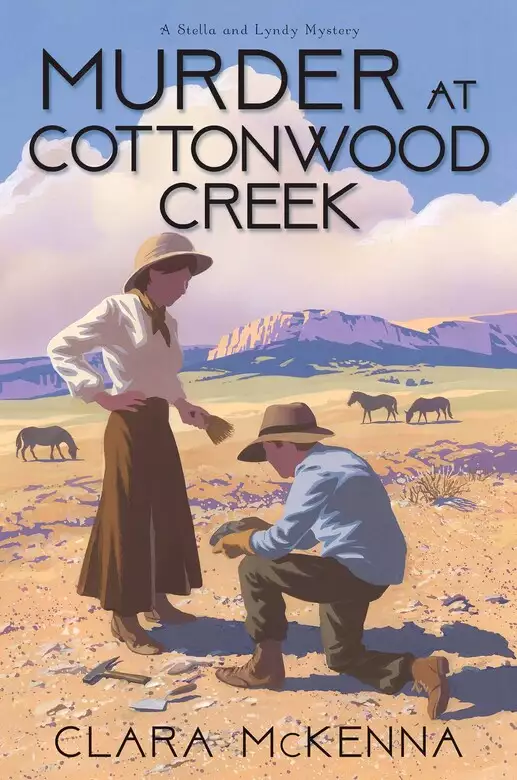
Far from England and their beloved Morrington Hall, Viscount “Lyndy” Lyndhurst and his American wife, heiress and equestrian Stella Kendrick—now Lady Lyndhurst—find fossils and murder in Montana . . .
Led by his passion for paleontology, Lyndy’s father, Lord Atherly, has traveled all the way to Montana, to explore the fossil-rich horse ranch owned by Stella’s mother, Katherine, and her second husband, Ned Smith. Urged by Lady Atherly to look after her husband, Stella and Lyndy follow in his wake. Stella is excited to be reunited with her mother, and Lyndy is eager to experience the real “Wild West.” Both are equally thrilled to participate in a fossil dig.
But when a local man who was guarding the dig site overnight is found the next morning dead in a creek bed, the couple fear his death may not have been an accident—especially when things get wilder still. The paleontologist on the dig has his notebook stolen, several fossil bones disappear, and a second body is found in the research tent.
No one is above suspicion—a rival paleontologist up to some skullduggery, members of their own crew, even Lord Atherly himself. Stella and Lyndy must keep digging to unearth the clues that will expose a killer in their midst—before more bones must be buried . . .
Release date:
November 25, 2025
Publisher:
Kensington Books
Print pages:
304
* BingeBooks earns revenue from qualifying purchases as an Amazon Associate as well as from other retail partners.
Lord Atherly wiped his brow with his sleeve and swatted at the swarm of mosquitoes in one fluid motion. He did it unconsciously, his focus intent on the eroded hillside on the far side of the creek he and young Master Smith were driving beside. In June, the lush, green pastures of the New Forest had given way to the dry badlands of Wyoming, which now were being replaced, tossed aside like a bucket with a hole in the bottom, for these promising, untapped foothills of the Rocky Mountains.
Of course, if they’d found what they sought in Wyoming, not even a herd of wild horses could’ve dragged him away.
Chuckling at his pun, Lord Atherly removed the wide-brimmed felt hat he’d bought in Cheyenne and swatted more vigorously at the buzzing swarm about him. His mirth faded as fruitless days searching for ancient horse fossils came to mind. They’d gone over the same ground as those giants in paleontology Cope and Marsh for weeks and had very little to show for it. Could this hilly, grassland terrain be the expedition’s new beginning, their eagerly anticipated breakthrough? With renewed determination, he shoved his hat back on.
Bracing for another jolt of the wagon, his attention momentarily shifted from the hillside to the stained knees of his trousers, the perspiration and dirt smudge on the back of his hand clutching the side rail. When he joined Gridley’s expedition this summer, he’d insisted on leaving behind his mollycoddled life at Morrington Hall for a few months. He had eaten food cooked on an open fire, smelled of smoke more often than not, did without a valet, and slept like the others in tents of thick canvas that did little to keep out pests or the occasional horizontal rain when storm winds blew sideways. His lady wife would hardly recognize him. He barely recognized himself.
“We’re almost there,” Master Smith, whom those closest to him called Junior, said as their wagon rumbled past a rare stand of shrub brush. For a stream named Cottonwood Creek, it had surprisingly little vegetation taller than the grasses growing along its banks, save for one massive, ancient tree, its roots halfexposed from years of erosion, clinging precariously to the hilltop they were approaching.
The young chap urged the horses to cross at a shallow point in the rushing creek.
Stella’s half-brother was a small but surprisingly muscular boy of twelve who carried a harmonica in his breast pocket and himself with the surefootedness of the numerous pronghorn that covered the prairie. Ready with a smile, his countenance was handsome, open, and guileless. The moment Lord Atherly met the young chap, he recognized the familial resemblance to his daughter-in-law.
And Stella hadn’t even the pleasure of meeting the young chap yet. Happily, that was about to change. As prearranged, Stella and his son and heir, Lyndy, were to visit Stella’s mother once they’d completed tying up their affairs in Kentucky. Of course, the timing was suspect. They could’ve crossed the Atlantic at any time. Most likely Frances had instigated the trip, thinking him incapable of looking after himself. Her concerns were both touching and irritating. Like the woman herself. But whether he had Frances to thank or not, won’t it be splendid?
And yet . . . could he be a bit homesick?
Lord Atherly received the obligatory letters weekly from Frances, keeping him abreast of all that pertained to the running of the estate and nothing more. But that differed little from when he was at home. No kind words of affection, no pining for his return, not even one inquiry into the success of his endeavors. The one constant was his wife’s fretting over Stella and Lyndy’s failure to produce an heir. And in every reply, which was few and far between, Lord Atherly disappointed her by refusing to concern himself about it.
As if fretting over it ever affected the outcome. Besides, the couple hadn’t even been married a year. As usual, Frances was being ridiculous.
As were almost everyone else he had encountered since his arrival. Of course, those on the expedition shared the same passion, and the Smiths were highly accommodating, but these Americans were a breed of their own. They were friendly, informal, and well-meaning—on the whole. But they weren’t ones to listen to him with feigned interest, as a lord of the manor might expect, let alone with rapt attention. And where else would a man spit tobacco into a spittoon while visiting a lady in her parlor? Or brag about the size of his purse or the multitude of his progeny? And who else dare call the eighth Earl of Atherly “snobbish” for his well-bred deportment or “foppish” for his well-tailored attire? No, no matter how much Lord Atherly had assumed Stella’s year with them had prepared him to be surrounded by her fellow countrymen, no matter how much he embraced the wild nature of the former colony, he had few illusions left. Here, he was the odd one out. And yet he was in his element.
Thank you, Stella, my dear, he offered in silent appreciation. Without his daughter-in-law’s inheritance, none of this would be possible.
As cold sprinkles, kicked up by the horses, splashed him, Lord Atherly was not immune to the beauty of the water—the sunlight sparkling on the ripples, the clarity that allowed him to see color and patterns on the fish that darted from their path—but it couldn’t hold his attention. His focus settled on the eroded channel originating from the sprawling roots of the tree.
“Ma said you might want to take a look around here,” Master Smith said, leaping from the wagon. He secured the horses to a heavy tether weight Lord Atherly marveled the youth could wield so easily, and scrambled up the hillside, a shower of pebbles and loose soil raining after him.
“Come on, Lord A.” He urged the older aristocrat with an encouraging and slightly impatient wave of his hand.
Lord Atherly sized up the climb and, feeling equal to the challenge, charged ahead. He’d planned a deliberate, dignified ascent, but one footfall on loose scree a dozen or so yards up, and his hopes were dashed. He’d taken a few steps sideways toward the eroded furrow Master Smith headed toward and, without warning, lost his balance. He flailed his arms about like a ghastly, over-encumbered bird desperate to take flight but to no avail. He fell, his hip striking the hard ground before sliding back the way he’d come. When he finally came to rest, his body had created a furrow of its own.
With a controlled skid, Master Smith descended toward him but stopped abruptly. “Gosh, is that what I think it is?” He pointed, his sun-beaten face keen on something on the ground. “You must’ve unearthed it on your way down.”
Lord Atherly, a moment ago pleased to have simply stopped moving, winced at the boy’s blunt observation of how careless and destructive his descent had been. But eager to look at what he’d disturbed, he struggled to his feet, kneading away the pain in his hip, and gingerly joined the lad.
“Good Lord!”
Ignoring the loud crack above them, the pair, middle-aged British aristocrat and young American chap, bent at the waist, side by side like stage performers taking a bow, peered at a row of teeth and a bit of fossilized bone protruding from the soil.
Then Lord Atherly saw nothing more.
Viscount “Lyndy” Lyndhurst dropped the satchel he’d been carrying for Stella to the platform, barely registering the thud it made as it hit the planks, and tugged at the lapels of his tweed jacket. The town that stretched across and away from him was unlike anything he’d ever seen. Stepping out of the scant shelter afforded by the railway’s wooden awning, he was immediately accosted by the acrid smoke of a blacksmith’s forge. Blinking it away, he surveyed the hodgepodge of unpainted shacks, narrow red brick buildings, and the imposing three-story, pale sandstone hotel sharing the same dusty street, wide enough to accommodate four carriages parked side by side. He felt like a man who’d just stepped onto the moon.
Where the bloody hell are we?
He’d seen garden wall moss older than anything in this burgeoning town. A quaint countryside village with a High Street, this was not. With its grandiose name, Colter City—an homage, he assumed, to John Colter, the famous American frontiersman— the town obviously aspired to be more.
“Have you spotted your mother?”
“Not yet,” was his wife’s optimistic reply.
Bustling about them was a cross-section of humanity Lyndy had only read about. A weathered cowboy strutted past, his spurs jingling with each step. A saddle was flung carelessly over one shoulder while a six-shooter hung at his hip. As he passed, he exchanged a friendly nod, revealing the sharp contrast between his black skin and the shock of gray hair peeking out from under a well-creased Stetson. Just like the Buffalo Soldiers Lyndy had read about. Across the street, a middle-aged man in a well-tailored, silk changshan directed workers unloading a freight wagon with YI XU HUANG & CO. stenciled in white letters on the side. Clutching a clipboard, he licked a pencil and checked off each crate as it passed. On opposite sides of the platform, two travel-worn couples in homespun attire conversed animatedly—one pair, surrounded by stacks of travel trunks, argued in German, while the other, hugging and kissing, spoke rapidly in a tongue as foreign as the landscape.
Mumbling something indecipherable in the way of apology, a chap in chaps and reeking of tobacco bumped into Lyndy’s shoulder, knocking him sideways and realigning his gaze to the seemingly endless panorama of sky and mountains beyond the town. Granted, he and Stella had had plenty of time, three days in fact, to ponder the passing landscape, an ever-widening vista, an ocean of swaying grass unbroken but for the occasional sod hut, meager one-story wooden home, or small collection of hodgepodge businesses and dwellings that constituted a village here. He’d seen pronghorn antelope, the occasional small herd of wild horses, and countless ground squirrels that stood sentinel, even in the searing hot sun, beside one of many burrows in what Stella called “prairie dog towns.” Yet not once did he see the majestic American Buffalo he’d dreamed of, nor the dust storm kicked up by infamous cattle drives. From what Stella had said, and to his utter disappointment, both were consigned to the past. The open range had been fenced in with barbed wire, and the buffalo nearly hunted to extinction.
As their train chugged west, he and Stella had watched the mountain ranges grow, remarking on the magnificence of their jagged, snow-capped peaks, but now, having crossed them, Lyndy still sought words to describe the experience. Not even the Highlands of Scotland could compare. This town sat in the vast valley encircled by their peaks. And here he was, just one more soul in the crowd, dwarfed by a land barely touched by human hands. Lyndy had never felt so small or insignificant in his life.
And yet never so alive. After the cultivated disappointment that was Kentucky, Lyndy couldn’t be more thrilled to step foot into the actual “Wild West.” With his heart pounding and his senses heightened, energy surged through him. He retrieved the satchel and stepped off the platform—right into a pungent pile of horse dung.
Laughing, he was scuffing the bottom of his shoe in the dirt when Stella called him.
Despite her porcelain features being flushed with excitement, her wide-brimmed hat tilted too far to the side, his lovely wife didn’t seem worse for wear. As always, she complemented her surroundings, adding glamor and beauty to even this exotic landscape.
“Lyndy!” Grasping for his hand, she roused him from his musings and vigorously waved the other. “Look!”
Weaving her way through the crowd, enthusiastically waving back, was Stella’s mother, Mrs. Katherine Kendrick Smith, a comely middle-aged woman with a becoming smile to match her daughter’s. Sun-tanned and dressed in a plain cotton shirtwaist, woolen brown skirt, and floppy felt hat, she bore little resemblance to the stylish matron he’d met at his and Stella’s wedding. Beside her strode a small, serious boy, in suspenders and on the cusp of manhood.
“Mama!” Stella shouted, giddy with joy. “Mama! Over here!”
Lyndy happily allowed Stella to lead him through the crowd to meet his mother-in-law halfway.
“Come here, Sweet Pea!” Katherine Smith beckoned her daughter toward her. Stella flung herself into her mother’s arms, the two women clinging to each other like ivy vines on Morrington Hall.
Eyeing the women with a tinge of embarrassment, the lad kicked at pebbles beneath his feet.
“May I introduce myself? I’m Lord Lyndhurst, though friends and family call me Lyndy. As you may suspect, that’s my wife, the Viscountess Lyndhurst, hugging your mother.” Lyndy extended his hand to the lad. “Who might you be?”
“I’m Eugene Smith, Junior. And I’m pleased to meet you, Lyndy.” The lad shook Lyndy’s hand with the seriousness of a man sealing a life-altering deal. “And I don’t mind calling ya that since I suspect we’re kin.”
Each brushing away welled-up tears, the women hesitated a few more moments before pulling apart.
“Eugene Smith? Then that makes you . . .”
“That’s right, Sweet Pea.” Katherine Smith removed the boy’s cap and ruffled his hair. “Your brother.”
“Ma.” The boy squirmed away, out of reach, and readjusted the cap on his head.
“My brother.” Stella whispered the words with reverence as if they had a holy meaning. Perhaps they did.
Unlike Lyndy, who’d shared his childhood with his sister Alice and cousin Owen, Stella had spent much of her life alone. Her mother left when she was young, and her father was distant at best, manipulative and abusive at worst. Instead, Stella had kept company with governesses, nannies, and stable hands.
Now, suddenly, she has a brother.
“Pleased to meet you, sis. You and Lyndy can call me Junior. Everyone does.” The lad held out his hand.
“And you can call me Stella, though not everyone does.” They shared a quick laugh as Stella pumped his hand. “And you probably guessed,” she added, “Lyndy is also Lord Atherly’s son. Where is he?” Stella searched the crowd as if expecting him to materialize on her say-so. “His telegram said he’d meet us.”
“Too enthralled in digging up fossils to remember which day we were to arrive, I suspect,” Lyndy said with a lighthearted jab. At home, Papa was often too engrossed with his fossils to remember to eat.
“What is it, Mama?” Stella asked, a furrow developing between her brows. More sensitive to these things than Lyndy, she must have sensed what Lyndy was only now noticing—a shift in his mother and brother-in-law’s demeanor signaling something wasn’t right. Suddenly, neither would look Lyndy in the eye. “What’s happened?”
“I’m so sorry, Sweet Pea. I’m just so darn excited to see you, but I just don’t know how to say it.”
“Say what, Mama?”
Junior scuffed the ground again. “I did go back for Lord A.”
Lord A? A year spent in Stella’s company, as well as members of her family, still hadn’t prepared Lyndy for how informal Americans were, their lack of hesitation to show affection in public or to divulge personal information to a stranger, their casual use of Christian names—to name a few. He’d even witnessed a grown man, Stella’s uncle, crawling about on all fours playing “horse” with his daughter “riding” his back in the drawing room. But he never thought he’d live to hear his father, the Earl of Atherly, be referred to as Lord A. And from a boy.
Lyndy could almost hear his mother’s scathing retort.
“Where’s Papa?”
Katherine laid a hand on Lyndy’s arm, sorrow and pity shining from the eyes that, not moments ago, had cried in joy. Lyndy flinched. He stepped away the moment she removed her hand as if a little distance could shield him from what she was about to say.
“I’m so sorry, Lyndy, but your father . . .” Katherine Smith bit her lip, shaking her head as if the words wouldn’t come.
“Bloody hell,” Lyndy whispered, removing his hat and shuffling two more steps back. He was desperate to know but loath to hear what she couldn’t seem to say.
It was Junior who, finding a pebble, kicked it without regard to the passersby and exclaimed, “He’s gone, Lyndy. Lord A’s gone missing.”
Franz “Harp” Richter leaned against the wagon, the worn sole of his boot stiff against the wagon spokes, and pulled from his vest pocket the instrument that gave him his nickname. That— and a small satchel containing two cotton twill shirts, an extra pair of matching wool drawers and undershirt, a comb, and the new Bible his mother gave him—were all he’d carried when he’d come alone to this country. He’d built a cabin, a family, a life. But now, the clothes were gone, and the Bible was sold. He was alone in the world again. The mouth harp was all he had left. Its well-polished silver plate flashed blindingly in the sun, but Harp had already closed his eyes to the bustle of the depot traffic. Hired hands loading goods onto freight wagons, porters pushing carts laden with steam trunks, weary passengers eager for their midday meal didn’t slow when he loosely cupped his hands, rough as leather, around the back and sides and began to play. When the jaunty tunes did little to improve his mood, he indulged his melancholy and struck up “Hänschen klein,” a nursery song about a boy who leaves home to see the world. A couple arguing in his native tongue about whether to spend money on a room in town or strike out now for their claim did stop their bickering long enough to appreciate the sad, harmonic melody that evoked the old country. But when he was through, the notes still echoing between the train depot and wagons parked alongside, they picked up where they left off.
Harp gave the new homesteaders six months, maybe less.
If they couldn’t even make such a simple decision before they left the depot, how would they survive drought, blizzards, crop failures, and disease? Harp almost didn’t. Life here was all he’d hoped for when he emigrated from Germany and headed west, looking for the promised land. But he’d been tried by backbreaking work and heartbreaking loss. Would he have come had he known what awaited him? Harp asked himself that every day.
Pocketing his instrument, Harp glanced over his shoulder at the wooden crates lining the bed of the wagon. They weren’t too heavy for him to lift and haul to the freight office, but Terry was supposed to be here to help. Professor Gridley was an easy man to admire and work for, but Harp wouldn’t ever know what he saw in that dummkopf. And why should he care? Harp was just a hired hand at the dig. But he was also a man. While supervising the packing of all these fossil specimens to be shipped to some museum in the East, Terry had scolded Harp like some boy in short pants. What difference did it make that a fossilized bone be packed in this direction or that? And yet there was still no sign of him. If Terry cared so much, where was he?
When the wind shifted, bringing the harsh, tarry smell of creosote from the railroad ties, Harp shoved off the wagon. He lowered the wide brim of his hat to block the sun and searched the crowd again. He spotted the rancher’s boy and wife hugging and kissing a wealthy, young couple. Wasn’t the Englishman expecting his son and daughter-in-law? Harp didn’t know Mrs. Smith well, but her son, Junior, was a fine boy who enjoyed spending his spare time around the camp’s fire. Harp was even teaching the boy how to play the harmonica.
It was too bad about the Englishman. Harp suspected he was more than a little naïve, and now he’d gone missing. That’d be the end of him. Schade! What a shame. Granted, he’d always been a bit aloof, but the Englishman readily shared his fine stock of whiskey, and any man who would drink with his hired help was fine by him.
Unlike Terry, the teetotaler.
Harp slipped the small silver flask from his coat pocket, unscrewed the top, and took a quick swig. The liquid burned as it went down, mimicking the anger flaring in his chest. He took another before pocketing the flask again. With a quick eye to see that the wagon was secure and Maybelle content hitched where she was, Harp strolled over to the German homesteaders still arguing over whether to go or stay, frustrated with their indecision. But then Terry’s ridiculous hat, more fit for an Independence Day festival than fieldwork, caught Harp’s eye. A white pith helmet with a red and blue striped ribbon band, Harp could see it coming out of the Colter Hotel a block away.
“Entscheidet euch oder geht nach hause!” Harp snapped at the homesteaders to make up their minds or go home as he stepped past. Blushing in embarrassment at being understood, the couple scurried toward the hotel, passing Terry in the street.
Not wanting to let the wagon and its cargo out of his sight, Harp went no farther, flagging the professor’s assistant down. “ Hei ! Over here.”
Upon seeing Harp, Terry blanched, as pale as a sun-bleached bone, but instead of joining Harp to help with the unloading, Terry tugged the narrow brim of his hat lower over his forehead and slunk into the alley between the hotel and the Deer Lodge saloon, like a thieving polecat.
“Vhat a vollidiot,” Harp muttered. “Acting as if he didn’t hear me.” Shaking his head, he retrieved his flask and took another sip before returning to the wagon to, yet again, do what must be done—alone.
“What do you mean he’s missing?”
A chill sliced through the warmth still lingering from her mother’s embrace. Stella grasped Lyndy’s hand to comfort him; it was slick with sweat.
From the moment she’d arrived in Kentucky a couple of weeks ago and continuing on the train westward, Stella had been restless and on edge, regretting taking Lady Atherly’s advice to settle the Kentucky estate first and not head straight to Montana the minute she stepped off the ship. Stella wanted to see her mother again. For days, she’d gone through her father’s personal effects and possessions—the paintings, the jewelry, the silver, the stud books—enduring her father’s ghost, as tangible as the white dust covers draping the furniture. The scent of Daddy’s Havana cigars still lingered in the air. All the while she arranged the sale of the house, the horse farm, and all the horses, Stella had envisioned this happy reunion.
Lord Atherly, please be all right.
“We were prospecting this morning when a big ole branch snapped off and dropped onto Lord A’s head.” With much gesturing to emphasize a point, Junior launched into the harrowing tale of Lord Atherly’s subsequent tumble down a creek embankment and Junior’s flight to get help only to return to find Lord Atherly gone.
“We’ve been out looking for him ever since but had to stop to meet you here.” With it being months since she’d seen her and years before that, Stella often dreamed of her mother’s soothing voice. But her mother’s words were anything but reassuring.
“I say, Katherine. Shouldn’t we continue the search as quickly as possible?”
“As soon as we get you and Stella situated, Lyndy.”
“No, we’re helping with the search too, Mama.”
“But you’re greenhorns who don’t know the country.” Junior waved his hand, indicating Stella’s tight-fitting royal blue travel suit. “How do you even get around in that getup? Like Lord A, you’d get hurt or killed out there.”
Stella winced and snuck a glance at Lyndy. He’d blanched at the truth of h. . .
We hope you are enjoying the book so far. To continue reading...

 Please log in to recommend or discuss...
