
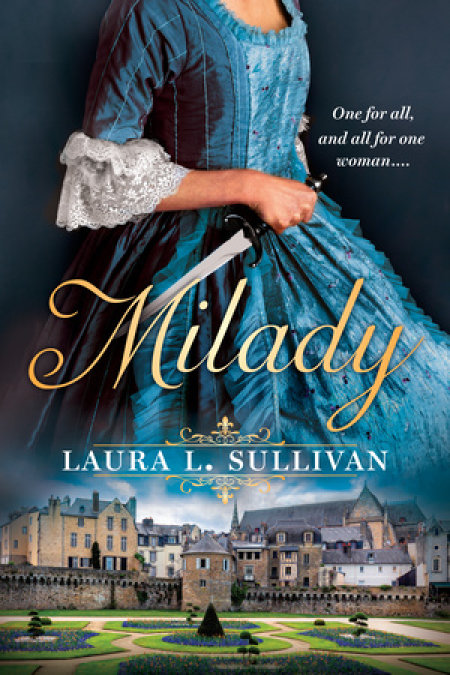
Milady
- eBook
- Paperback
- Audiobook
- Book info
- Sample
- Media
- Author updates
- Lists
Synopsis
From the glittering ballrooms of 17th Century England to the dangerous intrigues of the French court, Laura L. Sullivan brings an unlikely heroine to the table, turning on its head everything we've been told about The Three Musketeers and their ultimate rival.
I've gone by many names, though you most likely know me as Milady de Winter: Villainess. Seductress. A secondary player in someone else's tale.
It's finally time I tell my own story. The truth isn't tidy or convenient, but it's certainly more interesting.
Before you cast judgment, let me start at the beginning, and you shall learn how an innocent girl from the countryside became the most feared woman in all of Europe.
Because we all know history was written by men, and they so often get things wrong.
Release date: July 2, 2019
Publisher: Berkley
Print pages: 384
* BingeBooks earns revenue from qualifying purchases as an Amazon Associate as well as from other retail partners.
Reader buzz
 Please log in to recommend or discuss...
Author updates
Milady
Laura L. Sullivan
Copyright © 2018 Laura L. Sullivan
Prologue
1628
The things a woman has to do to make her way in this world . . .
Mrs. Fox’s whorehouse attracts a peculiar clientele. Oh, to most women, any man who will pay for heartless amours must be a little bit peculiar. We women, you see, are polar creatures, careening wildly from one extreme to another, either wholly romantic or entirely practical. Lovemaking, for us, must either be about devotion or commerce. Never both. We don’t mix the two, although myopic men believe we do.
I have known many prostitutes, and not one of them has ever fallen in love with a client. Few indeed harbor anything but dislike for them, though occasionally a twinge of pity might creep into the most sensitive houri’s heart. Which is not to say that whores don’t fall in love. They do, harder than most. Just not with the men who pay them, no more than a blacksmith will fall in love with his bellows.
Somehow, though, men always believe that their whores secretly love them. They cannot be content simply to pay for pleasure, as they might pay a chef to prepare a sumptuous meal. No, they insist that the woman they rent must feel something. That, they think, is their right, and they feel cheated if their money cannot buy more than physical release. The best of the customers hope their gold will buy affection. These men are at least harmless, if deluded.
Others, however, insist on sharper feelings.
The marquis enjoys what his confreres call le vice anglais. Here, on the outskirts of Paris, the English Mrs. Fox is happy to provide all variations of vice. The English and French are in a constant state of agitation with each other, their royalty alternately bickering and intermarrying, their religious sects quibbling over minutiae they are willing to die over. And yet through peace and war (and war was threatening now at the Huguenot fortress city of La Rochelle), Mrs. Fox found that national relations were always cordial enough to keep her in business. Here, Frenchmen can conquer their traditional English enemy on comfortable feather beds rather than on the battlefield. Or, more often, yield.
For most of her customers like to be on the receiving end, whipped by a beautiful English wanton. Not the marquis. Few of the high-end girls will take him on, and he does not care for the ladies of the street, poxed and desperate. So you can imagine his glee when he spies me among Mrs. Fox’s bevy, an innocent young widow fresh from the English countryside, with hair as golden as ripe wheat at sunset and eyes like English bluebells.
Forewarned of his presence, I hide behind the more experienced girls, but this only serves to attract his attention. My fear acts like oysters and Spanish fly to him. Even through downturned lashes, I can see his breath quicken in excitement.
“Step forward, Charlotte,” the procuress says in her silky voice. “Let the gentleman see you.” I hang back, and she gestures to two of the other whores to guide me forward. “A new girl, not a virgin, true, but fresh to the trade. Her only lover was her husband, mangled in a mill, alas.”
I feel a tear tickle my cheek, but when one of the girls nudges me in the ribs, I look into the marquis’s eyes and manage to twitch a smile at him before dropping a curtsy. “Milord.”
“Yes,” he says ravenously. “Look at that skin. Your husband was a prosperous man, eh? You never had to work, I can tell.” He nods to Mrs. Fox. “She will do. She will do to a nicety.”
When the girl beside me whispers into my ear exactly what he intends to do, though, I balk and pull away from his reaching hand. Behind him, I catch a glimpse of Roger, who sails under the flag of “nephew” but is Mrs. Fox’s young lover and bully boy. He keeps the customers in line . . . and also the girls, if necessary. The marquis follows my terrified eyes, and we both watch as Roger clenches and unclenches his meaty hands, conveying a multitude of meanings. If the marquis gets too rough, that gesture tells me, I’ll step in. But if you refuse to please your first client, these hands will make you hurt in ways the marquis never dreamed of.
And so, I accept my fate. What else can a poor English widow do?
Feigning courage through my trembling, I lead him to a room that smells of, well, the sort of things a brothel is known for. But this isn’t an ordinary pleasure den. There is a propped ladder, a sturdy wooden X, a bench, and the sort of stand usually used to hold saddles. On the wall are paddles, short and thick, and long and slender. A sweating bucket full of birch rods waits in one corner, and a braided cat huddles in another, tossed aside by someone in the throes and forgotten. The walls are painted in roses and peonies, and the other furniture could be found in any middle-class English merchant’s parlor. The floor is oft-scrubbed wood, and the rugs are red.
He gestures to the crossed beams, and I know he means for me to pliantly place my hands in the thongs affixed to their capitals. He is a large man, a soldier and an expert swordsman who could easily move me into whatever position he chose, force the most abject submission. But that I would meekly thread my hands into the restraints myself excites him.
My will is the first thing he will break. After that, my skin.
I move to the X, then pause. “Will you take wine, sir?” I mumble.
“What?” he demands.
“W . . . wine, milord. Mrs. Fox said I . . . should offer you wine.” He laughs as I seek to delay the inevitable by shuffling up to a low table. While I pour a single cup of wine, he smirks, and turns to examine the birch rods.
I don’t spill a drop.
“Thank you, my dear,” he says as he takes the cup, just exactly as if I were a lady worthy of respect and not an English whore he means to thrash bloody. Down it goes, and he wipes his lips on the lace at his sleeve, then gestures me to bondage.
I face the X and slip my hands in. The leather is rough on the tendons of my wrists.
“The other way,” he says.
Slowly, I turn all my softest parts back toward him, and he secures my hands high above my head, spread wide. I assume he’ll buckle them to the tightest hole, but no. I can’t escape, but my hands are held loosely. I can wiggle and struggle. The pulling will chafe my tender wrists raw. Oh, he has done this before!
I’m still clothed. The marquis takes a knife from his belt. Mrs. Fox has factored the cost of my gown into my price, along with the inevitable doctor’s fees.
“Milord, I beg of you, wait a moment.” He pauses. There is no script for this—Mrs. Fox left it to my natural instincts—but if there were, I’m sure I commenced begging exactly on cue. “I am a widow, alone in the world. For the love of God, have mercy on me.”
His weapon is erect as he advances on me. “Alone,” he says. “Helpless. Will you scream, my pretty? If you don’t, I’ll give you ten livres for yourself. We won’t tell Mrs. Fox, eh?” He smiles at me, then a shadow crosses his face as he doubles over. In a moment, he has collected himself. The marquis wouldn’t let a pang of the guts interrupt his pleasure.
The blade touches my throat, just above my high bodice. Other harlots reveal their charms, but I know the thrill for him is that they are hidden, that he is the one who can unveil them. Down the knife presses to cut through my costly fabric, and I feel the honed edge kiss my skin beneath the layers. Did he cut me? I can’t tell, for the knife is so sharp I can’t distinguish pressure from pain. He will not be the first man to mark me.
I hear the breath of parting silk as he slices my gown farther open . . . and he staggers back. His hands clench in a spasm, then open uncontrollably. The knife clatters.
Now? No, too soon. But it will not be long.
“Milord!” I cry out. Whore that he thinks me, he won’t believe I care about his well being. The creature he has tied up only fears anything that might keep the madame from getting her coin. This day will be taken out in my skin one way or another—if he does not pay to flog me, the bawd will flog me for his lack of payment.
He tries to straighten, but then vomits over the red rug.
No matter. The poison in the wine is already deeply into his system. He can purge all he likes; his doom is still clear.
My frightened visage fades, and I stand calmly with my buckled arms widespread high over my head. I am bound and he is free, but only one of us is afraid now.
“You shouldn’t have defied the cardinal,” I say in my low purring voice. “Once, perhaps. Audacity amuses him. But never twice.”
“Gar!” he chokes out, looking at me in confusion.
“Is it a novelty to you, milord, having no control over your own body? I imagine so. You enjoy taking away others’ control. How do you like being helpless and in pain?”
He topples to his side in his own vomit.
“Can you hear me, milord?” I wish he were near enough to kick to attention, because I would particularly like him to hear this last part before he expires. “Cardinal Richelieu sent me to kill you for matters of state, but I have reason enough of my own to be glad to see you wiped from the earth. Your wife did me a kindness once. She was too good for the likes of you. I know the world believes she drowned, and pities you for your tragic loss. But I once saw her swim past the end of the pier at Nice in high waves. She would not perish in a horsepond. Admit that you drowned her, and I will give you the antidote.”
With the last of his strength, he rolls to his fallen knife and makes a pathetic lunge at me. Then with a guttural groan of agony, he stiffens in one last convulsion, and his eyes stare, forever unblinking, at the nothing that is his due.
I sigh. A confession would have been nice, if only so I could laugh as he begged for the antidote to the poison. But no matter.
A bit of simple acrobatics brings my ankle up to my bound hand, where I retrieve a knife—one of many; vital systems must have redundancies—and cut myself free.
Mrs. Fox peeks in the door. “Done already? That was fast.”
“My poisons always are. I would have liked him to linger a bit longer, but his heart was in such palpitations at the thought of violating me that the poison spread more swiftly through his veins than I’d anticipated.” I rub my wrists. Good, there are no welts this time. Other times men have tied me up, I have not been so lucky.
Mrs. Fox looks with distaste at the marquis. “I don’t suppose you’d care to tell me what you used. It could come in handy one day.”
“If you ever tire of Roger?”
She throws her head back and laughs. “When I tire of him, I’ll pension him off like I have the others. No, killing is not for me. You keep your poisons, Milady. I’ll keep men under control with my own methods.”
“They’ve worked well for you so far. Business seems to be going splendidly.”
She nods. “Thanks to your timely loan.”
“What would Paris be without Mrs. Fox?” I ask. “I couldn’t have you going back to England.”
She sighs. “Ah, the fog, the sunless skies. I miss it, times. Do you?”
I narrow my eyes at her. “Being a born Frenchwoman, I am happiest in my mother country.”
She chuckles again. “Of course, of course.”
Damn, but she’s a shrewd woman.
“Care for a cup of wine after your exertions?”
I glance at the emptied cup on the table. “I don’t care much for strong drink. It hides a multitude of sins. Shall I send someone to take care of that?” I gesture to the thing that was the wicked marquis.
“No, Roger will dump him in the river after moonset. You rest easy. No one will even know he was here tonight. So”—her eyes even craftier—“does this sufficiently repay the loan?”
“Hmm . . . how about some of your raspberry tarts? For the road. I won’t overstay my welcome. Then we’ll be square.”
“No, love, stay a bit. It isn’t often I get to talk with someone as witty as you.” She takes my hand, and we walk downstairs to her private parlor, gossiping about her girls, the local magistrate, the price of butter.
Women, you see, can combine affection and commerce with each other, if not in their relations with men.
I might say that my opinion of men is low. But then, my opinion of mankind is fairly poor to begin with. It is only that men generally have more scope for mischief and malice.
At home—the home only four people know about—I strip off clothes that carry the faint stench of brothel and splash my face in the basin. Ah, to wash the world away in a cold cascade! Off comes the kohl from my eyes, the cinnabar from my cheeks, the false flags that give whatever face I want to the wide world. I always have a mask on.
Everywhere except here.
I hear a step behind me and whirl with the instinct of long training. Water beading on my lashes blurs my vision, and I only vaguely make out a large masculine form bearing down on me. In an instant I’m overpowered, my arms pinned, helpless.
Helpless beneath his kisses.
I can hardly breathe. My heart is wild. When at last he releases me, I blink my eyes to clarity and gasp, “Darling!” and wiggle free enough to throw my arms around his neck. Pulling him close, I unbalance us both, and we go down on the carpet in a tangle of limbs and laughter. There’s a quick, violent tussle, and I end up on top, straddling his chest, my hands on the tender pulse of his throat.
I kiss that pulse, his blood thrumming against my lips.
Here, in this house, are all the things those who think they know Milady would say I don’t deserve. A prison cell, the torments of hell are more fitting for one such as me, many believe. My name—my title, rather, for no one knows who I truly am, and even in Paris I have many guises—is whispered in the dark as furtively as some speak of the devil, as if to breathe my name would conjure me up in the flesh. And oh, what flesh! My beauty is part of my legend. Deadly beauty.
But I am not so beautiful as they think, nor yet so deadly. I have some natural gifts, but above all, it is my training and practice that make me what I am today—the cardinal’s creature, the most feared assassin in France.
In comes the third part of our ménage, carrying with her the minuscule fourth. She looks down at our combative posture with wry eyebrows. “Mission successful? As if I have to ask.”
I unstraddle the Comte de Wardes and slip into a linen robe before taking the cooing little bundle from Madame Bonacieux, or however she styles herself at the moment. Another spy, she gained a position as the queen’s seamstress, secured through a false marriage to an elderly, influential merchant. The queen, of course, is charmed with her amusing, insinuating prattle, and tells her practically everything as she is fitted for her embroidered pantaloons. And it all goes to the queen’s enemy, the cardinal.
I look into the cherub’s face, mostly because when he is in the room, I cannot seem to turn elsewhere, such is the strange gravity of motherhood, but also so I don’t have to see the swift pained look that I know will cross my lover’s face at the thought of my mission. We both know, rationally, that such indignities and dangers are part of the job. That does not make it any easier for the heart to bear. I know I am in an ecstasy of nerves whenever he leaves on a mission.
Any small slip, the tiniest betrayal, an accident of chance, might tear all the happiness in this little house asunder.
And now, here comes another chance for fate to have its way with us. Madame Bonacieux has a message from our master. A new assignment.
My lover moves our child onto his lap as I take in the details. It skims by me, mere trivia. That Gascon boy D’Artagnan who appeared out of nowhere and, almost accidentally, thwarted two of the cardinal’s plots already—I am to befriend him. Easy enough. If I cannot make a nineteen-year-old bumpkin my devoted servant, I have lost my touch. Madame Bonacieux, too, had been tasked with seducing him in her own tricksy way, and already has the boy half mad with her feigned kidnappings and royal schemes. But the cardinal always prefers two strings to his bow. It is one of the easier assignments of my career.I breathe a weary breath, almost, but not quite, like a sigh, and ask my friend, “Why?”
“His Eminence is interested in the upstart gadfly, and wants to co-opt him for his own uses. The young man has made fast friends among the king’s Musketeers, and seems to be everywhere. It is he who brought the queen’s diamonds back from Buckingham, saving her honor.”
My son, all apricots and cream, makes a sound very like a snort. When I look over, though, he has only spit up on his father’s chest, a thing that both of them seem to find extravagantly amusing.
“It was a stupid plot to begin with,” I say, peevish, “if a goat from the country could thwart it. But I didn’t mean a small why. I meant a rather larger one.”
The three of us, spies all, fall silent. We had come to the cardinal as vessels, not empty, perhaps, but supremely porous, absorbing all his tales of duty and justice and peace. One strategic death can prevent thousands, he always said, as a daub of mud can save a dike. We do this for the widows, for the children, for the young soldiers.
I have done more for the widows and children out of my own pocket, my own will, than the cardinal has. As I look at the cruel and ravenous world around us, the best that can be said for our job is that without us, it might all be worse.
That is a far cry from making the world better.
In the shorthand of long acquaintance, we repeat a frequent conversation with a mere glance. We know all the arguments. We know we cannot leave.
“We should leave,” I say, the milky scent of my son driving the smell of sex and vomit from my memory, making me weak enough to speak my wish aloud.
The comte nods, but says what we all know. “He wouldn’t let us. He would kill us, and everything we love.”
I would like to argue that we are his best spies and assassins, that we are a match for the cardinal. But the world is not like that. Lions are torn apart by jackals, and desert sand can wear away a colossus. If I was alone, I could risk it. But look at what I have to lose.
I dress, very carefully, donning my clothes like a costume, like weapons. Last of all, I put on my rosary of red and black beads. For one can always use a little extra help.
If you had told me ten years ago that spy work could be tedious, I would have laughed. But any job, performed not with love but of necessity, becomes drudgery. Ferret out this secret, kidnap that prince, forge one missive and steal another . . . it is all so much housekeeping now. However well you scrub the floor, it becomes dirty again. Ten years make excitement dull.
Almost without thought, I catch D’Artagnan’s eye, make him follow me, stage a scene with Lord de Winter (my supposed brother-in-law; I’ve had as many sham husbands as Madame Bonacieux). Predictable as clockwork, the impetuous Gascon challenges de Winter to a duel. Spilled blood sharpens a young man’s appetite. If he wins, he will be so inflamed for me in his victory that he will do my bidding in exchange for promises never fulfilled. If he should be the one pinked by de Winter’s blade, I will play the loving nurse, and twist him to my ends just as easily.
My lover has taken our son to the countryside to roll in clover and no doubt try to befriend and embrace a bee, which will end with a sticky sweet to distract him from the pain, to everyone’s satisfaction but the bee’s. With nothing better to do, I disguise myself as a woman just poor enough to not be robbed, just well-off enough to not be mistaken for a streetwalker, and stroll off to see the duel.
There is quite a crowd behind the Luxembourg tonight. The combatants have brought seconds . . . and thirds . . . and fourths! It is usual to have a comrade to ensure fair play, or to take the duelist’s place should cowardice prevail. But to have three seconds? D’Artagnan’s friends are all in Musketeer uniform. They all negotiate in the shadows, and I see one of the Musketeers lean in to whisper something to de Winter’s man. Once they’ve determined the rules of casualty and mortality, they move into a circle of light cast by their torch-bearing lackeys.
Though I’d never laid eyes on them, I had learned something of D’Artagnan’s friends, those Musketeers with geographic sobriquets that obviously hid something. Portly bon vivant Porthos; lean Aramis with his holy, romantic air.
And then my breath stops as the third Musketeer’s face becomes clear. Taciturn Athos, older than the rest, deadliest of the three even when deeply in his cups, as he often was.
Athos. He took his name from the monastic mountain where all women are forbidden. Even female animals.
I should have known. But how could I? The man I trusted so long ago is dead.
Yet here he stands before me, absently chewing on a bit of braided gold looped on his shoulder, alive. And in that moment, everything I ever felt for him lives again, too. The affection. The betrayal.
Once, I was innocent. Once, when I bore another name, I had a credulous and open heart ready to embrace love. As I watch him, my hand flutters again to my throat. Along the left side, always hidden by a lovelock, is a smooth cicatrice, just barely differing from my own skin in color and texture.
Fury rages in me—fury and fear, one begetting the other. For anger can push someone to rash acts. I want, more than anything, to walk casually up behind him, an unnoticed and unimportant woman, and open his throat, let his blood spill on the thirsty earth. But his friends would end me on the spot. Therein lies the fear. Not of my own death, which has always hovered over me like a kestrel. The fear of losing what I have finally found.
And so, with a wrung and twisted soul, I step back and let Athos fight, let him hide behind his assumed name.
Part 1
Chapter 1
1615
I don’t think my father, Lord Paget, had any idea he had a daughter until I became a woman. I wasn’t useful until then.
My mother had the rearing of me in our country estate near Yorkshire, a grim and beautiful land that filled my days and my dreams. When I recall my natal home, I envision not the banquet hall nor Maman’s sumptuous bedroom, but rather a crenellated speck on the horizon, an anchor in the vastness. We were always outside, Maman and I. She abhorred walls. She told me once that each life has cages enough around it without adding stone and mortar.
She named me Clarice, a prettier version of the old family name, Clarick, which for centuries had been used for boys and girls alike. The Yorkshire folk sometimes called me Lady Clarick when I walked or rode about the countryside. I made no effort to correct them. Nothing changes a Yorkshireman.
When I wasn’t with Maman, I romped with the children of the castle. I knew from whispers that some of them were my half brothers and sisters, from the rare but fecund times Lord Paget visited his lands. We ran together over the moors and dared one another to creep into the caves that riddled the dales. Denys, the falconer’s son, was an especial favorite. A bit older than me, he was hero and rival all at once. He was bolder even than I, and once got lost in a cave for two days.
Though I was allowed to mix freely, Maman kept careful watch to be sure I didn’t pick up their northern accents. She never struck me, never so much as raised her voice at me no matter what mischief I got into, but if I let loose with a dunna or owt or nowt, her eyebrows would dip down and I’d correct myself. She made sure I spoke either rarefied court English, or the elegant French of her own homeland.
By the time my playmates were eight or nine, they were put to work in the fields, the piggery, or household service. When I bemoaned their fate to Maman (with, I must own, a touch of superiority at my own free state), she told me there is nobility in service. Just be sure you only serve the cause of your choice.
For the most part, after that, Maman was my only companion. I still saw Denys, for Maman enjoyed spending time with the old falconer, his father. He was of French birth like herself, and had traveled with her to join the household upon her marriage. Our mews was a pathetic remnant of what it had been in generations past, and our falcons and hawks were old and rarely flew. Still, we were one of the few families below the rank of duke to have a gyrfalcon (though she was half bald and half blind), and we kept the ancient birds comfortable for the honor of the house.
Maman and I were so close that at times I hardly knew which thoughts were my own, and which were hers. Inside the castle, she was mostly silent. Outside, though, in the gardens and across the windswept fields of heather and thyme, she was forever talking to me, teaching me everything under the sun. Knowledge, she counseled me, is a weapon. I laughed, replying that as I had no enemies, I needed no weapons. A woman always has enemies, she said. Gossip, time, loneliness, regret . . .
Then she would brighten and take me through the herb garden where she grew the plants she used to physic the household. The blacksmith drew teeth and sawed off limbs, and my mother, like the lady of every estate, took care of the rest. One day, when I was chatelaine of my own lands, I would do the same, so Maman made sure she passed on her knowledge to me.
On the morning that my life would change, foxglove was in bloom. “Foxglove is very poisonous, ma chère,” Maman began. “It slows the heart. A handful of leaves in a tisane will calm a racing pulse, such as the stout and the elderly often have. Two handfuls brewed in a decoction will kill the strongest man within an hour. His heart will beat so.” She tapped out a rhythm on her thigh, first brisk and healthy, then growing slower. She ended his life with one resounding clap. “And la, that’s the end of him.”
I bore it patiently, for she’d been teaching me the same things since I could speak sense. She always began with dire warnings about how all these helpful herbs could kill a man if they weren’t used exactly right. I supposed that was only natural in a healer. I shouldn’t like to poison my patients by mistake.
“Comfrey,” she went on, “resembles the foxglove before it is in full flower. It is taken in a tea to help with chest complaints. I often make Lord Paget a brew of comfrey and catmint when the northern cold disagrees with him. But you must never confuse the two.”
“Then why do you have them planted right next to each other?” I asked. It seemed that even an experienced herbalist like my mother might make a mistake one day.
She only laughed and said, “Pour l’amour de la beauté.” The two blossoms looked well together, nothing more.
This was peculiar, too, for unlike the formal gardens on our estate, this one was jumbled, with innocuous treatments like rhubarb and rue growing in disorderly clusters beside hemlock (whose lesson always came with the tale of Socrates) and wolfsbane (which we could not touch ungloved, for its poison could seep through the skin).
It was made for function, not appearance, Maman told me. These plants, she said, are like the finger of God. With them, she could touch any man or woman to the very quick, to their inner parts, and do with them as she pleased. That, she said, is what makes the garden lovely. I wouldn’t have called it a beautiful garden, but like all things connected with my mother, I adored it.
We went riding after that, racing across the moors. I had a new mare, a dark bay roan who was proving difficult to handle. Her mettlesomeness gave her speed—so long as I gave the mare her head—and for the first time, I beat Maman and her big gray gelding.
“Well done!” she shouted, laughing. I loved to hear her voice big and bold like that under the mauve sky. Inside the castle, she barely spoke above a whisper. I don&rsqu
We hope you are enjoying the book so far. To continue reading...
