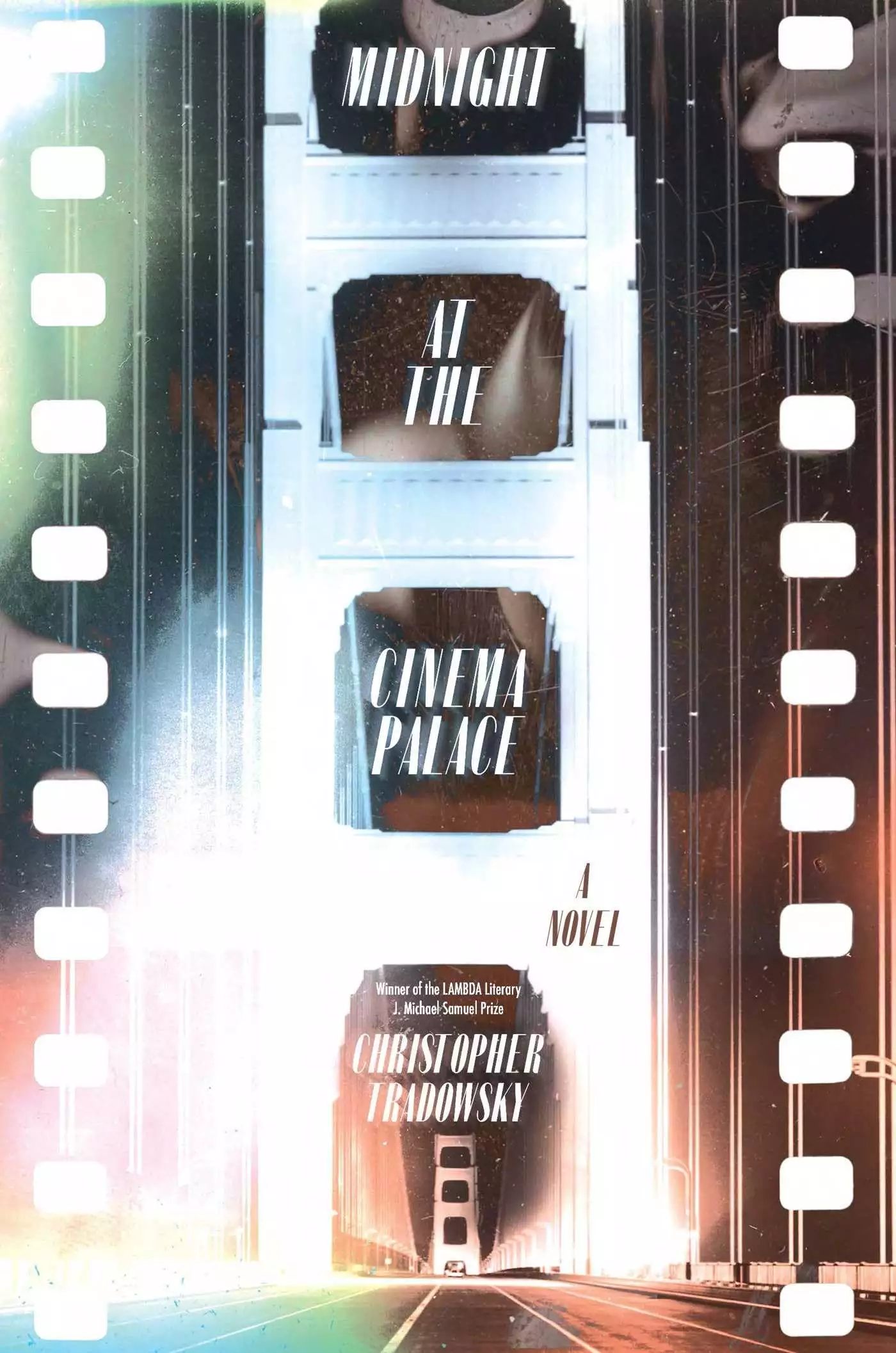
This tender, exuberant novel about a young man navigating coming of age in ’90s San Francisco is for readers of Garth Greenwell and André Aciman.
Walter Simmering is searching for love and purpose in a city he doesn’t realize is fading away—San Francisco in 1993, at the height of the AIDS epidemic and the dawn of the tech revolution. Out of college, out of the closet, and transplanted from the Midwest, Walter is irresistibly drawn from his shell when he meets Cary Menuhin and Sasha Stravinsky, a dynamic couple who live blithely beyond the boundaries of gender and sexuality. Witty and ultra-stylish, Cary and Sasha seem to have stepped straight out of a sultry film noir, captivating Walter through a shared obsession with cinema and Hollywood’s golden age.
As the three embark on adventures across the city, filled with joie de vivre, their lively friendship evolves in unexpected ways. When Walter befriends Lawrence, a filmmaker and former child actor living with HIV, they pursue a film project of their own, with hilarious and tragic results.
Midnight at the Cinema Palace is a vibrant and nostalgic exploration of young souls discovering themselves amidst the backdrop of a disappearing city. Christopher Tradowsky’s astonishing debut captures the essence of ’90s queer culture and the complex lives of friends seeking an aesthetically beautiful and fulfilling way of life.
Release date:
June 10, 2025
Publisher:
Simon & Schuster
Print pages:
384
* BingeBooks earns revenue from qualifying purchases as an Amazon Associate as well as from other retail partners.
Amarcord Amarcord IT WAS HIS FAVORITE RECURRING dream, always returning unprompted, always startling and delighting, leaving him a little wistful as he woke. As long as he lived in the city, every few months, as the seasons slipped by unnoticed, Walter would dream of snow falling over San Francisco.
There were many versions of the dream, but most did not feel especially cold. In most versions the snow was sparse, decorative, filmic snow with giant, waxy flakes, its silence the silence of a soundstage. From a bright overcast sky, fat flakes would fall evenly, equitably, over the Sunset, the Mission, the little saddle ridge where his apartment perched between the Haight and the Castro. Each neighborhood would surrender its character to the slow erasure of its details, its peculiarities, its grime and delights alike. He could see snowflakes catching in the Victorian traceries, settling upon gables, climbing stoops, and drifting along doorsteps, clogging the painted lathework of the Queen Annes. He dreamed of snow falling over the gardens of succulents and into their green crevices, glancing off the orange spikes of the birds-of-paradise, dusting the gargantuan thistles that were artichokes in full bloom, crowned by bristles of primordial purple.
Sometimes the snow whisked down among the cypresses like a train of heavy lace; sometimes it floated amid the date palms, as light as poplar spores. Or it spiraled atomically, like the tiny particles in the snow globe dropped from the hand of the dying Kane. When it fell along the Tenderloin alleys, delicately as if sifted there, even the dumpsters appeared quaint, Dickensian. In one intensely beautiful dream, the snow arrived as hoarfrost. Freezing fog trundling in from Ocean Beach deposited ice crystals on every branch and spire, frosting the deco towers, the green pagodas and granite lions of Chinatown. For an instant the city was etched in glass.
Rarely did Walter dream of formidable snowfall, a Midwestern storm like the ones he knew as a kid. But in one dream the snow piled so high it stopped traffic, icing the inclines and pulling buses from their wires, sleet freezing the rails of the cable cars. Sedans hunched under mounded banks. It was a vision of spontaneous jubilation as the city took a snow day. Walter—who in waking life was afraid of heights and never dreamed of flying—rode giddily on a ski lift over downtown as he took in the scene. There was a snowball battle in Union Square, and people sledding down the streets on serving trays; a luge race launched from Grace Cathedral, sledders rocketing down Sacramento Street toward the bay. The hideous brutalist Embarcadero fountain had frozen over; couples skated across it like holiday shoppers. Then the dream warped into a nightmare, as some wretched souls began to freeze midstep or drown in slush, while manic revelries raged all around them.
Walter didn’t particularly miss the winter, not in waking life—that is, his new California life—so he was puzzled at first by the dream’s snow-blind nostalgia. Only once was it clear to him, lucidly, in the dream itself, what had provoked it. He was walking through an ancient cloud forest in the botanical gardens, where massive tree ferns loomed amid soft veils of fog. It was so foggy he might have been in a cloud on a mountaintop for all he knew. Bright flakes began to tear from the fog and land in the moss that lined the path. Before him was a green pond, edged by a stone ledge, upon which a fat peacock waddled in a circle, seeking footing. As the peacock turned toward him fanning its enormous tail, which shimmered and waved its ultramarine eyes, Walter was certain he was dreaming and said, “You can’t fool me, bird, I know you,” as if the bird might answer and contradict him. It was none other than the peacock from Fellini’s Amarcord, caught on film in a stone square in a freak Italian snowstorm. He had seen the movie the evening before, and all night long Nino Rota’s score feverishly invaded his sleep. Walter awoke that morning wondering not the usual confusions provoked by the dream (What month was it? What season? On what planet had he landed, and who did he know here?), but more technically, more mysteriously: How on earth did Fellini get that shot?
We hope you are enjoying the book so far. To continue reading...

 Please log in to recommend or discuss...
