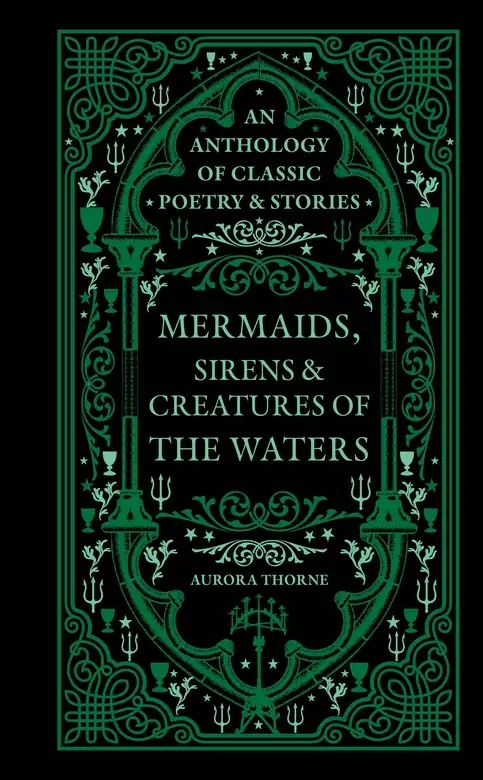
Step into the seductive world of Mermaids, Sirens & Creatures of the Waters, where the haunting melodies and treacherous allure of fates unknown come to life through classic poetry and stories.
This captivating collection immerses you in the watery depths of mermaids, enchantresses, and merrows, where weaving tales of deceptive beauty and the dangerous desires of otherworldly lovers are entwined in verses that glisten with irresistible temptation. Each poem and story is a siren's call, cast in words that evoke the enthralling perfume of lust and deadly passion.
Within these pages, you'll find timeless works such as Samuel Daniel's 'Ulysses and the Siren' and Alfred, Lord Tennyson's 'The Mermaid'. These poems, along with excerpts from William Shakespeare and The Hans Christian Andersen, blur the boundaries between reality and fantasy, plunging you into an enigmatic seascape where their enchanting songs beckon you under a macabre spell.
Mermaids, Sirens & Creatures of the Waters is a must-have for those entranced by the mystical, the magical, and the malevolent forces that dwell in the shadows of unseen waters.
Contents include: - 'The Sirens' - James Russell Lowell - 'Mermaid' - Walter De La Mare - 'The Mermaid' - W B Yeats - The Sea Lady - H G Wells - The Sea Fairies - L Frank Baum - The Odyssey - Homer
Release date:
September 10, 2026
Publisher:
Octopus
Print pages:
144
* BingeBooks earns revenue from qualifying purchases as an Amazon Associate as well as from other retail partners.
Few things have been more beautiful than my note book on the Deist Controversy as it fell downward through the waters of the Mediterranean. It dived, like a piece of black slate, but opened soon, disclosing leaves of pale green, which quivered into blue. Now it had vanished, now it was a piece of magical India rubber stretching out to infinity, now it was a book again, but bigger than the book of all knowledge. It grew more fantastic as it reached the bottom, where a puff of sand welcomed it and obscured it from view. But it reappeared, quite sane though a little tremulous, lying decently open on its back, while unseen fingers fidgeted among its leaves.
‘It is such a pity’ said my aunt, ‘that you will not finish your work in the Hotel. Then you would be free to enjoy yourself and this would never have happened.’
‘Nothing of it but will change into something rich and strange,’ warbled the chaplain, while his sister said ‘Why it’s gone into the water.’ As for the boatmen, one of them laughed, while the other, without a word of warning, stood up and began to take his clothes off.
‘Holy Moses!’ cried the Colonel. ‘Is the fellow mad?’
‘Yes, thank him dear,’ said my aunt: ‘that is to say tell him he is very kind, but perhaps another time.’
‘All the same I do want my book back,’ I complained. ‘It’s for my Fellowship Dissertation. There won’t be much left of it by another time.’
‘I have an idea,’ said some woman or other through her parasol. ‘Let us leave this child of nature to dive for the book while we go on to the other grotto. We can land him either on this rock or on the ledge inside, and he will be ready when we return.’
The idea seemed good; and I improved it by saying I would be left behind too, to lighten the boat. So the two of us were deposited outside the little grotto on a great sunlit rock that guarded the harmonies within. Let us call them blue, though they suggest rather the spirit of what is clean, cleanliness passed from the domestic to the sublime, the cleanliness of all the sea gathered together and radiating light. The Blue Grotto at Capri contains only more blue water, not bluer water. That colour and that spirit is the heritage of every cave in the Mediterranean into which the sun can shine and the sea flow.
As soon as the boat left I realised how imprudent I had been to trust myself on a sloping rock with an unknown Sicilian. With a jerk he became alive, seizing my arm and saying ‘Go to the end of the Grotto and I will show you something beautiful.’
He made me jump off the rock on to the ledge over a dazzling crack of sea, he drew me away from the light till I was standing on the tiny beach of sand which emerged like powdered turquoise at the further end. There he left me with his clothes, and returned swiftly to the summit of the entrance-rock. For a moment he stood naked in the brilliant sun, looking down at the spot where the book lay. Then he crossed himself, raised his hands above his head, and dived. If the book was wonderful, the man is past all description. His effect was that of a silver statue, alive beneath the sea, through whom life throbbed in blue and green. Something infinitely happy, infinitely wise – but it was impossible that it should emerge from the depths sunburnt and dripping, holding the note book on the Deist Controversy between its teeth.
A gratuity is generally expected by those who bathe. Whatever I offered, he was sure to want more, and I was disinclined for an argument in a place so beautiful and also so solitary. It was a relief that he should say in conversational tones ‘In a place like this one might see the Siren.’
I was delighted with him for thus falling into the key of his surroundings. We had been left together in a magic world, apart from all the commonplaces that are called reality, a world of blue whose floor was the sea and whose walls and roof of rock trembled with the sea’s reflections. Here, only the fantastic would be tolerable, and it was in that spirit that I echoed his words. ‘One might easily see the Siren.’
He watched me curiously while he dressed. I was parting the sticky leaves of the note book as I sat on the strip of sand.
‘Ah!’ he said at last. ‘You may have read the little book that was printed last year. Who would have thought that our Siren would have given the foreigners pleasure!’
(I read it afterwards. Its account is, not unnaturally, incomplete, in spite of there being a woodcut of the young person, and the words of her song.)
‘She comes out of this blue water, doesn’t she,’ I suggested ‘and sits on the rock at the entrance, combing her hair.’
I wanted to draw him out, for I was interested in his sudden gravity, and there was a suggestion of irony in his last remark that puzzled me.
‘Have you ever seen her?’
‘Often and often.’
‘I never.’
‘But you have heard her sing!’
He put on his coat and said impatiently, ‘How can she sing under the water? Who could? She sometimes tries, but nothing comes from her but great bubbles.’
‘She should climb on to the rock then.’
‘How can she?’ he cried again, quite angry. ‘The priests have blessed the air, so she cannot breathe it, and blessed the rocks, so that she cannot sit on them. But the sea no man can bless, because it is too big, and always changing. Therefore she lives in the sea.’
I was silent.
At this his face took a gentler expression. He looked at me as though something was on his mind, and going out to the entrance rock, gazed at the external blue. Then returning into our twilight he said ‘As a rule only good people see the Siren.’
I made no comment. There was a pause, and he continued. ‘That is a very strange thing, and the priests do not know how to account for it; for she of course is wicked. Not only those who fast and go to mass are in danger, but even those who are merely good in daily life. No one in the village had seen her for two generations. I am not surprised. We all cross ourselves before we enter the water, but it is unnecessary. Giuseppe, we thought, was safer than most. We loved him, and many of us he loved: but that is a different thing to being good.’
I asked who Giuseppe was.
‘That day – I was seventeen and my brother was twenty and a great deal stronger than I was and it was the year when the visitors, who have brought such prosperity and so many alterations into the village, first began to come. One English lady in particular, of very high birth, came, and has written a book about the place, and it was through her that the Improvement Syndicate was formed, which is about to connect the hotels with the station by means of a Funicular railway.’
‘Don’t tell me about that lady in here,’ I observed.
‘That day we took her and her friends to see the grottoes. As we rowed close under the cliffs I put out my hand, as one does, and caught a little crab, and having pulled off its claws. . .
We hope you are enjoying the book so far. To continue reading...

 Please log in to recommend or discuss...
