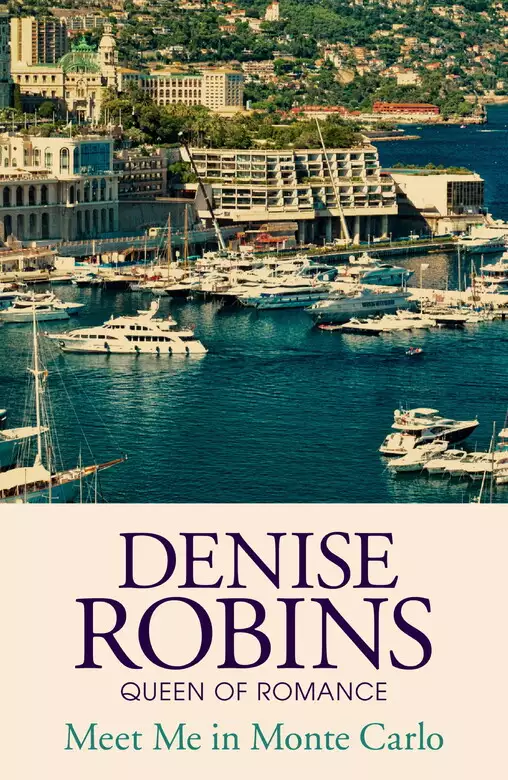
The boulevards of Paris, Cannes, Monte Carlo - perhaps in their glamour Sylvia could forget Johnny... forget that he no longer wanted to marry her. But Sylvia didn't know when she left London that she was about to be plunged into a ring of jewel thieves, that handsome, romantic Henri was a criminal mastermind, and that Johnny would turn up in Dijon with Lucille, who was very stunning and very French. At the centre of the intrigue were stolen emeralds worth half a million dollars. And when those emeralds surfaced in her handbag, Sylvia began the most dangerous adventure of her life - an adventure that would perish all her doubts about Johnny's love. A captivating love story from the 100-million-copy bestselling Queen of Romance, first published in 1954, and available now for the first time in eBook.
Release date:
July 24, 2014
Publisher:
Hodder & Stoughton
Print pages:
400
* BingeBooks earns revenue from qualifying purchases as an Amazon Associate as well as from other retail partners.
Until the time that Sylvia went to Monte Carlo with her Australian cousin, she had led a perfectly ordinary, simple life. How was she to dream that that life was to be so suddenly and dramatically altered? That Johnny, whom she loved, was to leave her, then reappear as a ‘mystery man’ working in with a gang of jewel thieves? How was she to foresee that her peaceful existence as she had always known it would be exchanged for a mad rush down the exotic Côte d’Azur in the company of one of the most dangerous and clever criminals in France? That she was to dine with him, dance with him, listen to him talk, not knowing that he was a ‘thief’ and even a ‘killer’? That she was to stroke the sleek coat of Setti, his Alsatian, thinking the dog a harmless pet and yet it, too, was trained to kill?
How could she foresee a day when she and Johnny would stand together before a shuttered villa behind Monte Carlo and hear the spatter of bullets breaking the silence of the drowsy golden afternoon, while the police tried to shoot their way through barred doors and sealed windows, and rout out the man with a price on his head?
None of these things seemed at all possible in the life of a girl like Sylvia Byrne, and yet they came to pass. And she was to live through those few staggering days of wildest excitement, drawn into playing a part in a strange, fast-moving drama of life, death – and of love.
No – none of this seemed possible to Sylvia when on a certain afternoon that first momentous telephone call came through to Broadcasting House and reached the office in which Sylvia worked.
She lifted the receiver and answered:
‘Mr Fitzclair’s secretary speaking …’
She supposed that she was about to have another of those boring conversations which droned on most of the day. It wasn’t all ‘fun and games’ being personal assistant to a producer at Broadcasting House. Of course it had its exciting moments. She loved the big, vital building with its great halls and labyrinth of corridors, its little rooms marked ‘Silence’, the warning lights, the thousands of people hurrying to and fro, and the whole stupendous daily offering to the world of Talks, Music and general entertainment. She felt quite proud and patriotic every time she walked down Langham Place, passed through those imposing doors and realized that she, Sylvia Byrne, had become a cog, if only a very little one, in the machinery that flashed those messages from one end of the world to the other. And she liked her chief, Mr Fitzclair, who was a clever young man and just a little teeny-weeny bit in love with her. Yesterday when she was taking a letter for him he had suddenly said:
‘You know, Sylvia, you’re just like the Tanagra figurine that stands on my grandmother’s mantelpiece. Such a diminutive little figure, and with that blonde hair curling to the nape of your neck like a baby’s and your big eyes – you’ve got “something” for me!’
She had laughed it off and managed to steer his thoughts back into the channels of work. She didn’t want to ‘have anything’ for Aubrey Fitzclair, neither did she mind whether she resembled his grandmother’s Tanagra figurine or not. She had got this job with a bit of influence and was glad to have it, but only with the intention of working furiously eight hours a day in order to take her mind off Johnny.
It didn’t seem much use thinking too frequently about Johnny. But she was quite hopelessly in love with him. It hurt being in love with a man who is thousands of miles away in Korea, and who might at any moment be wounded or taken prisoner by those awful Communist Chinese or … but she never allowed her thoughts to focus on the ultimate horror that might overtake Johnny and blot him out of existence. Neither would it be very easy to imagine Johnny being blotted out; the big, athletic fellow with his curly hair, his gay laughing face and those strong arms which could pick her up and carry her round the room as though she were a child. Six foot four was Johnny. Sylvia’s fair head barely reached his shoulder.
Oh, but she loved him! And he loved her, too. Without being officially engaged, they had an understanding that, when he got back from doing his National Service, he would find a suitable job and then they could get married and live happily ever afterwards.
There was no reason why it shouldn’t be so. They were both young and full of joie de vivre. Before Johnny had left England, Sylvia had been quite blissful. It had seemed to her that they were two lucky people. Everything lay in front of them.
Sylvia’s father was Principal Lecturer in Surgery at one of the biggest medical schools in London. She had an adored and adoring mother, and a beautiful home in Wimpole Street. Sylvia was working not because she needed the money but because she had an active mind and could not stay idle in the circumstances – while Johnny was away.
Johnny had been a medical student at Mr Byrne’s hospital at the same time as Sylvia’s cousin, Tom Byrne. Sylvia had gone to one of the dances there with Tom. But it was with Johnny that she danced most of the night. They had just tumbled into love with each other. He had said all the nice things that Aubrey Fitzclair said-and more. And she had thought that there wasn’t a man in the world to compare with him either for charm, looks or humour. And one must marry a man with a sense of humour – to that Sylvia had firmly made up her mind.
So Johnny Garland became the Chosen One for Sylvia, and the best thing of all was that her mother and father liked him. Daddy, in particular, said that young Garland was a sound fellow who ought to do well. As for Mummy – she had cherished the fond wish that lay in the heart of so many mothers that her darling would make a ‘brilliant match’. There would be nothing ‘brilliant’ about marriage with Johnny, but she liked him immensely.
He hadn’t a bean. He had lost his parents when he was a small boy – had no money coming to him; only a good education behind him and the small legacy from a fond aunt which had enabled him to take up medicine. Above all things, Johnny was a born doctor, and one of the first things Sylvia had admired was his finely made, sensitive fingers and his deep sympathy for suffering humanity which lay behind the façade of ‘fun’.
If Sylvia had had her way she would have married Johnny before the Army swallowed him up and he left with the R.A.M.C. for the menacing shadow of the Korean campaign. But that he would not hear of. He wasn’t the sort of young man to take advantage of the fact that Sylvia was the daughter of his chief; that he had a lot to gain by becoming Alec Byrne’s son-in-law. On the contrary, Johnny was proud and it was a pride, so Sylvia discovered, that could at times be uncomfortably obdurate. He wanted to make his way first and then get married, he said. She had tried not to argue on the subject. She, too, had her pride. And if Johnny did not want to marry her now – well, that was that. But it hadn’t been at all funny seeing him off, aware that she wasn’t even engaged to him.
‘You know that I love you and that I’ll love you till I die,’ he had said, when he had held and kissed her for the last time.
She had not been able to answer because she had been crying, her face burrowed into the curve of his arm. He had kept hugging her and repeating:
‘I do love you, Silver. You know that I do. Time will soon pass, and when I get back I’ll find a damn’ good hospital job and then put on a morning coat and silk hat, and approach your parents, carrying an expensive bouquet, and ask for your lily-white hand.’
He had laughed and she had laughed with him while the tears continued to drip forlornly down her small nose.
After he had gone she was not to be comforted. Her mother had been quite worried about her. And her father, who idolized her, openly declared that it was an infernal nuisance that little girls had to grow up and feel this way about big brutes of men.
Then Sylvia got her job at the B.B.C., set her teeth and put her heart into working as hard as she could. Every day she sent a letter to Johnny and he wrote back. Dear, comforting letters even if they were not particularly romantic. It wasn’t quite Johnny Garland’s line, writing poetic, amorous epistles. But he always ended with the only words that counted for Sylvia: ‘I love you.’
So the months dragged by and the Korean war went on and on and it was two years since she had seen Johnny. Now he was due home. Yet when his call came, Sylvia’s thoughts were not particularly focused on Johnny. Why should they be, on this bleak January morning when she was trying to get through Mr Fitzclair’s correspondence and having to keep breaking off in order to answer silly questions? What a nuisance budding script writers were, always wanting to know when their manuscripts were going to be read and if Mr Fitzclair had come to any decision.
‘Hullo. This is Mr Fitzclair’s secretary speaking,’ Sylvia said again, as she had heard only a muffled bleat from the other end of the wire. And then, then, came that deep, rather lazy and wholly charming voice which she hadn’t heard for two whole years.
‘Is that by any chance Miss Sylvia Byrne?’
Sylvia turned positively pale. She clutched so violently at the gilt choker round her neck that it broke and crashed on to her typewriter.
‘Johnny!’ she gasped.
‘Then it is you, Silver.’
She gulped. She tried to speak. No words came. She changed from white to wild rose. She heard a singing in her ears and felt a pounding of her heart. It was the most tremendously exciting episode of her whole life. Silver. His own particular name for her. He had given it to her on the very first night they had met at th. . .
We hope you are enjoying the book so far. To continue reading...

 Please log in to recommend or discuss...
