
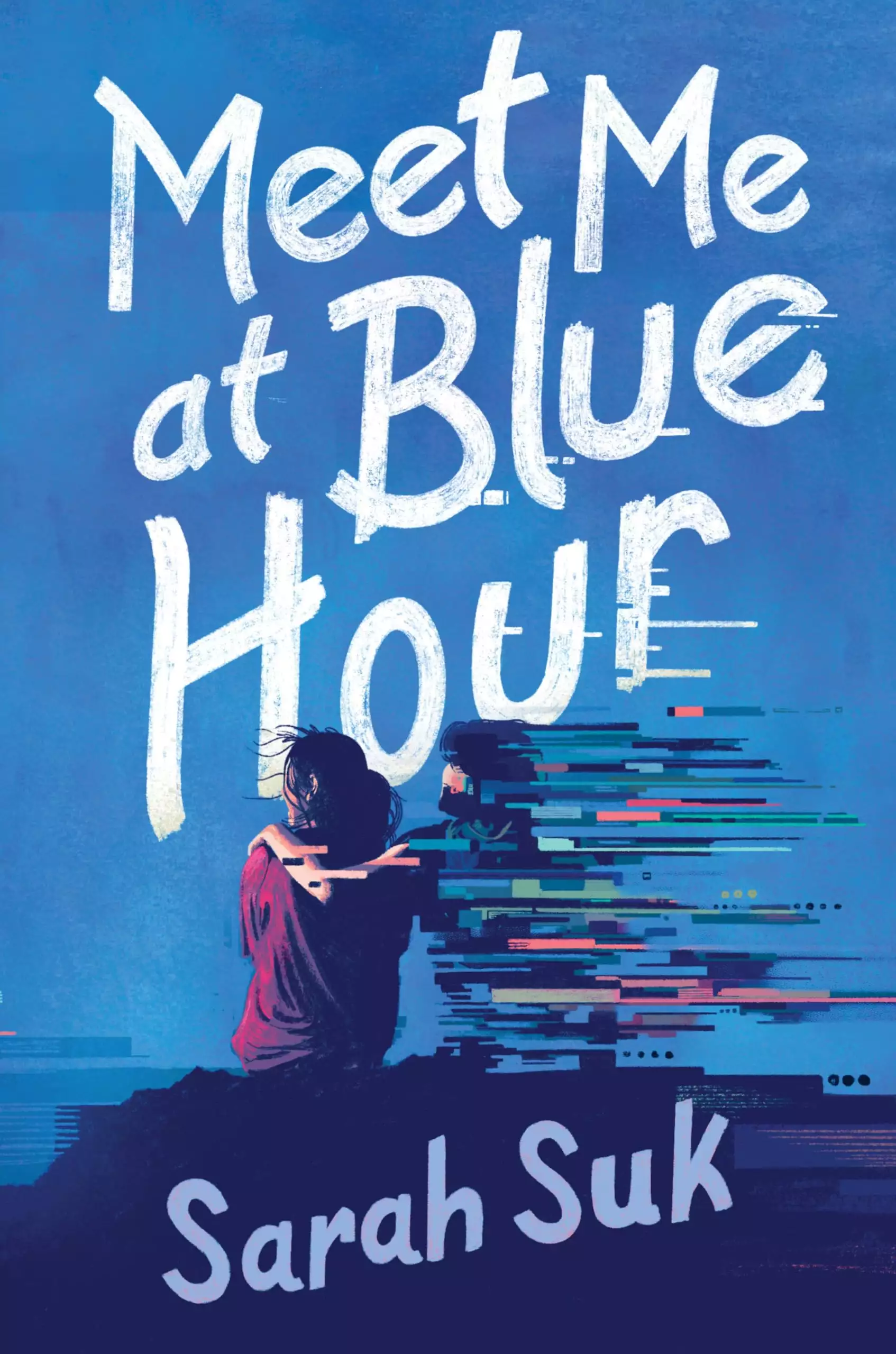
Meet Me at Blue Hour
- eBook
- Audiobook
- Hardcover
- Book info
- Sample
- Media
- Author updates
- Lists
Synopsis
Eternal Sunshine of the Spotless Mind meets Past Lives in this gripping, emotional story of two childhood friends navigating the fallout of one erasing their memory of the other, from acclaimed author Sarah Suk.
Seventeen-year-old Yena Bae is spending the summer in Busan, South Korea, working at her mom’s memory-erasing clinic. She feels lost and disconnected from people, something she’s felt ever since her best friend, Lucas, moved away four years ago without a word, leaving her in limbo.
Eighteen-year-old Lucas Pak is also in Busan for the summer, visiting his grandpa, who was recently diagnosed with Alzheimer’s disease. But he isn’t just here for a regular visit—he’s determined to get his beloved grandpa into the new study running at the clinic, a trial program seeking to restore lost memories.
When Yena runs into Lucas again, she’s shocked to see him and even more shocked to discover that he doesn’t remember a thing about her. He’s completely erased her from his memories, and she has no idea why.
As the two reconnect, they unravel the mystery and heartache of what happened between them all those years ago—and must now reckon with whether they can forge a new beginning together.
Release date: April 1, 2025
Publisher: HarperCollins
Print pages: 288
* BingeBooks earns revenue from qualifying purchases as an Amazon Associate as well as from other retail partners.
Reader buzz
 Please log in to recommend or discuss...
Author updates
Meet Me at Blue Hour
Sarah Suk
These are the sounds they used for forgetting: train whistles, suitcase wheels on cobblestone, raindrops pattering against an open umbrella. To me, it all seems awfully romantic, something I could replay a thousand times over—and I have. Of all the mixtapes I’ve listened to, this one is by far my favorite. But to Patient 1562 it was more than just sounds on a cassette tape. It was a memory they wanted to erase.
“I wonder what it was.” I pull my earphones out, draping the cord around my neck, and lean back against the wall from where I’m sitting on the floor, surrounded by cardboard boxes full of tapes. Danielle Flores, my supervisor, pokes her head out from behind a stack of boxes, a laptop perched precariously on top of them.
“What are you talking about?” she says, a strand of dark curly hair falling over her forehead. She blows it out of her eyes.
“Patient 1562.” I open the Walkman clipped to the waistband of my denim shorts, pull out the tape, tuck it back into its plastic case with a dreamy sigh. “I wonder what the memory they erased was. It sounds so beautiful, but it was probably a sad one if they wanted to forget.”
Danielle presses her fingers against her temples and lets out a slow, deep breath. “Yena, are you telling me that you’ve been listening to tapes this whole time instead of, oh, I don’t know, doing your actual job?”
“Um . . . I mean, not the whole time.”
It’s only been a week since I started my job at Sori of Us Clinic, or just Sori Clinic for short, as their new archive assistant—a title that is way fancier than the actual work itself—and I can’t say my supervisor has been too keen to have me on board. It’s not that I don’t have the makings to be Employee of the Month or anything, but how excited can I be to organize thousands of mixtapes when I can listen to them instead?
Before Danielle can unleash the fury of her ever-growing migraine on me, there’s a light knock on the door and Dr. Mira Bae steps in, holding a box of Dunkin’ Donuts. I quickly stumble to my feet, unclipping the Walkman and holding it behind my back, earphones bunched in one hand. Dr. Bae smiles at both of us, and then she sees the look on Danielle’s face.
“Just wanted to see how things are going in here,” she says. Her voice is cheerful, but she’s shooting daggers at me with her eyes.
“Hi, Dr. Bae. Things are going just fine,” Danielle says. Bless her soul. A stickler for the rules she may be, but a snitch she is not. “Are those donuts?”
She hurries over to take the box, receiving it with both hands. As the founder of the clinic and one of the top researchers in the field of memory erasure, Dr. Mira Bae has the deeply earned respect of everyone in the building and beyond. She is a genius, a boss, a trailblazer with the most perfectly manicured nails you’ve ever seen.
“Danielle, I hope my daughter isn’t giving you too hard a time,” she says.
Oh. And she’s also my mom.
Danielle laughs, waving a hand in the air. “No, no, not at all. She’s doing great.”
“So great,” I add. “The Memotery has never looked better.” Dr. Bae raises her eyebrows and I quickly correct myself. “The Archive,
, I mean. The Archive has never looked better.”
I think of this room in many names. Formally, it’s the Mixtape Archive, but to me, it’s the Library of Sounds, the Place for the Forgotten, or my personal favorite, the Memotery, a combination of the words memory and cemetery, the final place where one’s erased history goes to rest.
In the early days, the Memotery used to be one overflowing storage closet with rickety built-in shelves at the clinic and an impressive collection of cardboard boxes stuffed to the brim with cassette tapes stored in my mom’s Busan apartment, leaning against the refrigerator, occupying the guest bedroom, working overtime as both a TV stand and a coffee table in the living room. Even now, I’ll sometimes find the occasional tape strewn around the house, lost memories wedged between the couch cushions or tucked behind the toaster.
But eventually, as Sori Clinic’s reputation grew, so did their office space. This year, they finally got an upgrade with a new, shiny room dedicated to storing the tapes with new, shiny shelving and a new, shiny job title for the person in charge of organizing it all: the archivist. And the archive assistant.
The former was a part-time role they actively hired, and the latter was created just for me because Dr. Bae would not have her only daughter graduate from high school with no college plans or future aspirations, no ma’am. If I didn’t have any plans, my mom would make some for me and put me to work until I did, which was how I found myself packing my bags after graduation and flying across the ocean from Vancouver, Canada, to Busan, South Korea, to join her at her clinic for the summer.
“I hope I’m not overstepping, but is this really a two-person job?” Danielle said when I first began. “I can take care of organizing the Archive on my own.”
“I’m confident you can, Danielle, but think of how much quicker it’ll be with an assistant,” Dr. Bae said. “Besides, I’m hoping you’ll be a good influence on my daughter here. Yena, did you know Danielle is a writer? And she’s here from America, studying at Pusan National University for a year! I did an exchange just like that when I was in undergrad. Doesn’t that sound like fun? Maybe you’d want to do an exchange program one day?”
Subtlety. It’s not what Dr. Bae is famous for.
glance in my direction and the way she raises her voice when she asks Danielle how school is going that she wants me to listen, to be curious, to want what Danielle has: a field to study, a passion to pursue. Something. Anything.
Instead, I look up to the ceiling and picture trains on a rainy day, tuning out their voices. For a second, I’m not in this room full of empty shelves and cardboard boxes. I’m in someone else’s story, imagining things they’ll never remember again.
“Well, keep up the good work, Danielle,” Dr. Bae says as their conversation dwindles down. “Will you be joining the team dinner tonight?”
Danielle shakes her head. “Unfortunately, no. I have a big paper I have to get going on.”
Dr. Bae nods in understanding. “I won’t be able to make it myself. Still a lot to prepare for our clinic’s upcoming study. Yena, how about you?”
I blink, trying to catch up on what I missed. “Sorry, what?”
“The monthly staff dinner that Joanne organized. Are you going?”
“Oh. No.”
I don’t bother giving a reason. What is there to say? It’s not that I have other plans or work to catch up on. Team dinners just aren’t really my thing and it’s not like I know the other staff at the clinic that well anyway.
“All right,” Dr. Bae says after a beat of awkward silence. “I’ll see you at home tonight, Yena. Don’t wait up for me. I’ll be staying late at the office.”
I can count on one hand the number of times we’ve had a meal together since I arrived in Busan, and I wouldn’t even need all five fingers. By now, I’ve come to understand that staying late and going early to work is basically her daily routine.
“Yes, Dr. Bae,” I say, giving her a salute with my free hand, the other still holding the Walkman behind my back.
She leaves and Danielle opens the box of donuts, holding it out to me. “Sounds like your mom is still on your case about university,” she says.
“Even you can tell?” I take out a donut that’s in the shape of a bear’s head and look somberly at its face. “My god, what have her conversation skills come to.”
“Out of curiosity, what do you want to do?” Danielle asks. “Because you clearly don’t want to be working here.”
“I’m still young. Did you know what you wanted to do with your life when you were seventeen?”
“Yes. I wanted to write.”
“Well, you’re a bad example of the point I’m trying to make.” I shrug. “I don’t know yet. And maybe I’ll never know. Besides, does it even matter? Nothing lasts forever. Just because I have a dream today doesn’t mean it will mean anything tomorrow, so what’s the point of making all these plans?”
Danielle cocks her head to the side. “Interesting.”
“What?”
“Nothing. It just seems quite contrary to your mom’s philosophy of life,” she says. “She’s probably the most committed and passionate person I’ve ever met. Kind of ironic that her daughter is the opposite.”
She says it in a matter-of-fact way, as if simply making an observation, but something about her choice of words stings.
I push the feeling away, stuffing the bear donut into my mouth. I dust my hands off, swallow, give Danielle a toothy grin. “Shall we get back to organizing these tapes?”
“Get back to?” Danielle says with a pointed look.
“I can be a good worker when I want to be.”
And I am for the rest of my shift. I help Danielle organize all the mixtapes by patient number and then by year of erasure, pruning out all the tapes that are older than a decade by cross-checking them with the database of patient information on Danielle’s laptop. But even as I work, going through the movements of sorting through box after box, I can’t stop thinking about what she said.
The opposite of committed and passionate. It bothers me more than I want it to. Is that really me?
Funny. It didn’t used to be.
It starts with a sound.
embossed on their business cards. Sori is the Korean word for “sound,” and it alludes to the process of erasure itself. In order to forget something, a patient has to bring in a collection of sounds related to the memory they want to erase. Voice memos, songs, background recordings, anything. The more specific they are to the exact memory the better, but general sounds that trigger enough associations can do the job just as well. The process truly begins not when the patient is in the operating chair but when they start collecting sounds.
It also alludes to the new beginnings that erasure offers, which is what Sori Clinic is all about. Fresh starts and healing.
I can see the temptation in that.
The July afternoon heat is sticky and humid against my skin as I walk along the shore of Haeundae Beach, phone in one hand, the straps of my sandals dangling from the other. I stare at the phone screen as it rings, and a moment later, Dad’s familiar bearded face appears on the screen.
“Hi, Yena Bean! How are you?” he says. In the background, I can see the overflowing bookshelf in the living room of our Vancouver apartment, filled with potted plants and his collection of gardening books. Even through FaceTime, I can tell that all the plants look as shiny as ever, thriving under the care of his green thumb, though it looks like the sagging shelves could use some of that same TLC. I can also tell that there’s a woman’s cardigan I’ve never seen before hanging off the back of the couch in my field of vision. I don’t mention it.
“Or maybe a better question is, where are you?” he says. “Looks nice over there.”
“Hi, Dad. I’m at Haeundae.” I duck my head out of the frame so he can see the ocean behind me, panning the phone across the crowded beach to show all the people strolling along the sand, taking selfies, and sitting under beach umbrellas. It’s absolutely packed here today, but I don’t mind. “I like to come here after work sometimes.”
“Joketda,” he says wistfully. “Do you know what that means?”
“Please, that’s too easy. It means you’re super jealous of me, right?” I say with a teasing grin.
“Ohhh, sounds like your Korean’s getting pretty good there,” Dad says, looking impressed.
Having grown up with both parents speaking English to me, my Korean language abilities lie somewhere on the spectrum between basic and barely there, even with my brief stint going to Korean school on Saturdays as a kid. It’s not a problem at Sori Clinic, which operates on an entirely bilingual system (and an entirely English one between me and Danielle, though her Korean is admittedly much more impressive than mine), but outside of that, it’s probably a good idea for me to try to pick it up a bit more.
“So, what’s going on?” Dad asks. He tries to appear casual, but I can tell by the way he leans forward a little with his eyebrows knit together that he knows something is off. He’s pretty good at that. Though I guess the fact that I’m calling at all might have clued him in. We haven’t talked much since I came to Korea, save for the big updates like I’m alive and I made it in one piece. “Everything okay?”
“Dad, do I have commitment issues?” I ask.
He blinks at the screen and for a second, I think he’s frozen.
“Dad?”
“Sorry, I’m here. I was just wondering what you mean by that?”
“I mean, it’s nothing really. Just something my supervisor said to me,” I say. “Well, to be exact, she said I’m the opposite of committed, which obviously means commitment issues. And she also said I’m not passionate! Can you believe her? That’s so rude, right?”
Dad is silent. I frown and shake the phone, trying to reset him. “Hello?”
“I’m still here,” he says. After a pause, he adds, “I’m sure she didn’t mean anything negative by it, Yena. Perhaps she was just commenting on your free-spirited and laid-back nature.”
I narrow my eyes at him. “You agree.”
He sighs. “Well, Bean, you don’t exactly stick to anything or anyone for very long. At least not since Lucas moved away. You haven’t been the same since.”
And there it is. Even after all these years, hearing his name makes my stomach feel like it’s falling through my feet. I look away from the phone.
“I have no idea what you’re talking about,” I say.
It starts with a sound.
machine, the birthplace of our friendship. From the ages of eleven to fourteen, we were inseparable. He was my best friend and I was his, a truth sealed by pinkie promises, thumbs stamped together, a string of bike rides, bruised knees, film nights, secrets only he and I knew. It was the closest I’d ever been to being a mind reader, to having my mind read. That’s how well we knew each other.
And then one day, he disappeared without a word, and I realized I didn’t know him very well at all. The Lucas I knew would have answered my confused texts, would have picked up my calls, would have told me before leaving the province and vanishing from my life as if he were nothing but a magic trick. Now you see him, now you don’t.
I had to hear through the grapevine that he and his family had taken off to Alberta. Honestly, if I hadn’t heard that, I would have thought he was dead. How does someone go from being your best friend to completely ghosting you? I couldn’t wrap my mind around it and, nearly four years later, the thought still makes me gloomy as hell. I feel pathetic every time it crosses my mind. I should be over this by now.
“I don’t even really remember him,” I lie. “And I can stick to things. I just haven’t found the right thing or person that I click with yet. But I can definitely do it.”
“Well, I hope your time in Korea will help with that,” Dad says sincerely. He clears his throat. “So, how’s your mom doing these days?”
Talking to Dad about Mom and vice versa is probably my least favorite pastime, but I don’t want to think about Lucas anymore, so I let him change the subject. “She’s fine. Not the happiest with my life decisions, but otherwise thriving.”
“I bet she blames me for those life decisions, doesn’t she?” Dad says, scoffing.
“Please, Dad,” I say, rolling my eyes. What I don’t say is that she may have mentioned that very sentiment once or twice since I came to Korea. Maybe more. Who’s counting? Not me. “What did I tell you about putting me in the middle of your divorce and any resulting complicated feelings regarding it?”
“You said don’t do it.”
“Exactly.”
We chat a little longer on more neutral topics like how his gardening business is doing and whether Greg, the cat next door who likes to come over to our apartment for weeks at a time, will stop leaving dead mice on the balcony. After we say goodbye and hang up, I stand still, staring out at the water.
It’s possible that both Danielle and Dad aren’t completely wrong about me. For all the parties and school clubs I hopped around in high school, I never really made a friend who went deeper than a good time and an Instagram follow or had an interest that lasted longer than a week. It’s never bugged me before. I’ve never even thought about it—it just was what it was. But then, I’ve never heard it out loud like this before either.
“Which character would you be?” I remember asking Lucas on one of our film nights. We were huddled on the couch with a giant bowl of pretzels, doing a marathon of all three Lord of the Rings movies. Even more than watching the films themselves, I loved imagining myself in them, walking through the story as my own main character.
“I don’t know, but I know who you would be.” He pointed a pretzel at me and grinned. “Aragorn.”
My heart fluttered. Aragorn was my favorite character. “Because we both have amazing hair?”
“That. And because you’re the most loyal and dedicated person I know, and you’d take a sword for anyone.”
When Lucas left, did he take that Aragorn piece of me with him? I hate thinking that, the idea that he could have such an impact on me when I had so little on him. People who don’t care about you anymore shouldn’t still get to hold on to pieces of you.
I turn away from the water, the sun hot against the back of my neck as I trudge through the sand with new determination in my step. Maybe Dad thinks I haven’t been the same since Lucas, but I’ll show him how untrue that is, how over it I am. He and Danielle can both just wait and see.
In any new situation, it’s important to have a plan. That way, you can leave as little room for error as possible.
I look down at the Notes app on my phone where I wrote out my plan for arriving in Korea. It reads:
Fly into Incheon International Airport. Review Umma’s new menu for the restaurant while on the plane. Make notes to email her when I have Wi-Fi.
One-hour layover at the airport. Get a snack, stretch, brush teeth. Update Umma and Appa on how the travel is going. Send email.
Flight to Busan. Arrive at Gimhae International Airport at 6:00 p.m. Update Umma and Appa again. Samchon should be waiting at Arrivals to pick me up.
Of course, even with a plan as simple as this one, things can go wrong. Like your uncle forgetting to pick you up when he said he would.
“Ah, Lucas! Are you here already?” Samchon says, answering my call in Korean with a jovial, booming voice.
“Yes, I am. Are you?” I reply also in Korean, looking around. My palm is sweaty against the handle of my carry-on suitcase as I wheel it over to a bench away from the crowd. I haven’t seen my uncle in a long time and I’m not sure he would recognize me. The last time I visited Korea, I was probably half the height I am now. “I’m wearing a gray T-shirt.” In the time it takes me to say that sentence, five other guys in gray T-shirts walk by me. Very helpful.
“Yes, sorry. Almost there. I wanted to be waiting right at the gate holding a sign with your name on it, but your grandpa wanted a coffee,” Samchon chuckles.
“Wait. Harabeoji’s here?” I say. “I told him to wait for me at home!”
“And you think I’d listen to you?” a gravelly voice behind me says.
I whirl around to see the all-too-familiar face of my grandfather grinning at me, holding two cups of coffee in his hands. He gives me one, patting me on the back.
“Full of cream and sugar just the way you like it, you monster,” he says.
A wave of emotion wells up in my chest. Is it the fact that he remembers my coffee order? Or is it hearing his voice, so familiar, speaking in a mix of Korean and English like we always do when we talk to each other? I fold him into a hug. “I thought I told you not to come out,” I say, but I can’t help the smile that tugs at the corners of my lips.
“Yeah, yeah, I’m happy to see you too.” He takes a step back and examines me. “So this is what a high school graduate looks like. Thought it’d be more impressive, to be honest.”
“What are you talking about? I can’t believe this good-looking young man is my nephew!” Samchon says, appearing behind Harabeoji holding a paper sign that says LUCAS PAK on it.
“Oh, Samchon. You literally made a sign,” I say, cheeks warming in embarrassment.
“Of course I did. It’s your first time visiting me in Busan!” he says. “Honestly, I’m surprised your parents let you travel on your own. I know how cautious they can be when it comes to you. Least I can do is give you a proper welcome."
Speaking of, I quickly send them a text letting them know I’ve met up with Samchon before sticking my phone into my pocket.
Samchon seizes my suitcase and starts wheeling it across the airport. “Come on, the car’s this way! Your grandpa was really looking forward to seeing you, you know. He’s having a good day today too. Must be because he knew you were coming.”
Harabeoji takes a sip of his coffee and leisurely follows along. I hurry after them both.
It’s only been six months since I last saw him, but that’s the longest we’ve ever been apart. Before moving back to Korea to live with Samchon earlier this year, Harabeoji lived with me and my parents in Canada. He was there by my side ever since I was a kid. It’s been strange not having him in the house anymore. I watch his back moving ahead of me now, try to notice all the ways he’s changed since he left.
Maybe he’s gotten shorter.
Maybe his hair has gotten whiter.
Maybe his Alzheimer’s has gotten worse.
I shake the thought out of my head. No, I won’t worry about that. I’ve done enough worrying ever since he was officially diagnosed late last year. Besides, I didn’t come all the way to Korea to stress about how he might be getting worse.
I’m here to make sure he doesn’t.
We squeeze into Samchon’s car, Harabeoji in the front passenger seat and me in the back with the big LUCAS PAK sign. Harabeoji fiddles with the audio and starts playing the Beatles.
“Did you know, Lucas, your uncle was so surprised that I know how to use Bluetooth,” he says, sounding smug. “Weren’t you, Taehoon?”
“I was. Honestly, he’s better with technology than me,” Samchon says. “He said you taught him everything he knows, Lucas.”
“It’s nothing,” I say.
“It’s amazing is what it is,” Harabeoji says. “I was able to watch your graduation from all the way across the world because it was livestreamed. If that’s not the future, what is?”
Samchon snorts. “You should have seen him with his nose up to the computer screen. Had his phone out and everything to record the moment you walked across the stage.”
“I know. He sent it to me on KakaoTalk,” I say, laughing. “It’s a very zoomed-in video.”
If there was one thing that made Harabeoji hesitate about moving back to Korea, it was missing my graduation. He’s always been big on celebrating milestones and he really wanted to be at the ceremony. You only graduate from high school once, he said. But the way timing and logistics worked out, it made more sense for him to leave before then.
“That zoomed-in video is proof of your education,” Harabeoji says sternly. “There’s nothing more important than that. Turn up the music, Taehoon.”
Samchon does, and Harabeoji begins to sing along. I lean my head back on the headrest, the exhaustion from the travel day catching up to me. I don’t sleep well on planes, but there’s something about cars that always gets me dozing, like a child being rocked back and forth.
I close my eyes and let Harabeoji’s singing carry me off to sleep.
It’s 5:00 a.m. when I jolt awake with a gasp, sweating from the nightmare I’d been having. I’m lying on the couch in Samchon’s living room, tangled up in a blanket. It takes me a second to remember how I got here. I vaguely recall walking up to his apartment after grabbing dinner at a nearby soondubu restaurant, insisting that I’d sleep on the couch after Samchon repeatedly offered me his room. I’m pretty sure I knocked out immediately as soon as my head hit the pillow.
I sit up, unraveling the blanket from my legs. The nightmare is a recurring one. In it, I’m swimming in pitch-dark waters and then something wraps around my knees, my ankles, and pulls me down, down, down into the depths. Sometimes I manage to escape it, sometimes I don’t, but the feeling of fear and panic is always the same.
I try to shake the feeling off now and reach for my phone. The brightness from the screen makes me squint.
There are several messages and voice notes from my parents, including Umma’s reply to my email about the menu. I skip it for now, opening my web browser instead and searching up Busan Sori of Us Clinic.
section titled Memory Recovery Clinical Study, a page I’ve visited more times than I can count since I first found it. I don’t know if it’s habit or a need for reassurance, but I read through it again now, nearly mouthing the words along by heart.
Sori of Us Clinic (commonly referred to as Sori Clinic) specializes in erasing memories through sound, but what if we could also restore lost memories through the same method? That’s the question we are exploring in this clinical study.
We are looking for people diagnosed with memory loss including but not limited to dementia, Alzheimer’s, and short-term memory loss to participate in this study. To be eligible, participants must have a companion available to assist them in the gathering of old memories that participants may not be able to recall themselves.
The study will be held in Busan, South Korea, at our clinic’s office. Participants must be available to attend in person for a period of at least two months.
Update: Due to an overwhelming amount of interest, all slots in the study are currently full. If you’d like to hear about any openings in future studies, please join our online waitlist. Thank you very much for all your support. Here’s to the future of memories.
After Harabeoji was diagnosed with Alzheimer’s, he wanted to move back to Korea to spend as much time as he had left in the country where he grew up. I didn’t want him to go, couldn’t imagine a life where I didn’t see him every day, waking up under the same roof, but how could I say no? As devastated as I was, I wanted Harabeoji to be happy, and this was what would make him happy.
So arrangements were made for him to live with Samchon, who had just relocated from Seoul to Busan for a promotion. He had a bigger apartment, and the money to hire a caretaker to look after Harabeoji when he was at work. With my own parents busy running their restaurant, it made the most sense for everybody. But still, it felt like the end of something, the end of everything.
I spent hours, days, weeks researching everything I could about Alzheimer’s, reading about the different stages, looking for cures that didn’t exist. And then I discovered Sori Clinic and their recovery study, and for the first time since Harabeoji’s diagnosis, I felt a glimmer of hope.
The clinic was in Busan, where Harabeoji was. If this wasn’t fate, what was?
The study was already full when I found it, but that didn’t deter me. First, I signed up for the waitlist. Then I convinced my parents to let me visit Harabeoji for the summer as a graduation trip. The rest of my plan is this:
While I’m in Korea, I’ll visit Sori Clinic every day to try to get him off the waitlist and into the study. There are bound to be people who drop out and spots that open up, and when there are, I’ll be the first one there to claim that spot.
Over the summer, I’ll assist him in the study to recover his memories. Harabeoji doesn’t know what I’m up to yet, but if all goes according to plan, he will soon. And everything will be okay.
I get up from the couch and go into the kitchen, turning on the stove light. The clinic doesn’t open until 9:00 a.m. so until then, I calm my racing mind by washing some rice, rooting through Samchon’s fridge, and pulling out a block of tofu, green onions, soy sauce, busying my hands with making breakfast for three.
I’ll cook. I’ll eat. And then I’ll go to Sori Clinic to save my grandpa’s memories.
11 years old
Sure, I remember them. Those two kids dressed up in cosplay for the special Studio Ghibli screening at the theater, right?
I remember everyone. I’ve been here a long time.
She was dressed up as some character, all black robes and white face paint with purple lines down her cheeks, staring at me from the counter. Kind of creepy. But also, a little endearing, the way she was leaning forward, entranced, head bobbing slightly in time with the pop pop pop of my dance. It’s nice to have fans.
She looked around for her father, who was standing by the butter machine, chatting with a woman and laughing. I could see the dilemma on her face. She wanted to ask him for a bag of popcorn, but she didn’t want to interrupt him.
“Look, Lucas,” an older gentleman in line said to the boy at his side. “That girl is dressed up for the movie too. And you were worried you’d be the only one!”
The boy is wearing some kind of gray animal costume with whiskers drawn on his face and a black circle on his nose, which I can only assume was meant to be a nose on a nose. He looked shyly at the girl, who must have felt him staring because she turned to look at him too. She gasped, running up to him.
“I love your Totoro costume!” she exclaimed.
“I like your No Face costume too,” he said, partially hiding behind the older gentleman’s leg. He smiled.
She peered more closely at him. “You look kind of familiar. Do you go to Korean school on Saturdays? The one next to the noodle place?”
“Um, yeah, I do. Do you?”
“Yes! I think I’ve seen you during recess. I recognize your face. You probably wouldn’t recognize mine right now though.”
I guess you could say I was the soundtrack to their first conversation. Their voices blended with my own and the sound of sodas pouring, candy wrappers crinkling, footsteps shuffling forward in line. The older gentleman bought a bag of popcorn for the boy. The girl looked wistfully back at her father, still wrapped up in his own conversation.
“Wow, the popcorn is way bigger than I thought,” the boy said. He cleared his throat, glancing at the girl. “Do you want to sit next to us in the theater and share? I mean, you don’t have to. Just if you want to. And if Harabeoji’s okay with it.”
“I think that’s a great idea,” the older gentleman said.
“I love sharing!” the girl said enthusiastically. Her father had finally ended his chat and was looking for her. She waved at him from across the theater, hollering, “Dad! We’re going to sit next to my new friend!”
She bounded forward with the boy at her side, both still humming with excited conversation, their steps in time to my pop pop popping in a dance of their own. ...
We hope you are enjoying the book so far. To continue reading...
