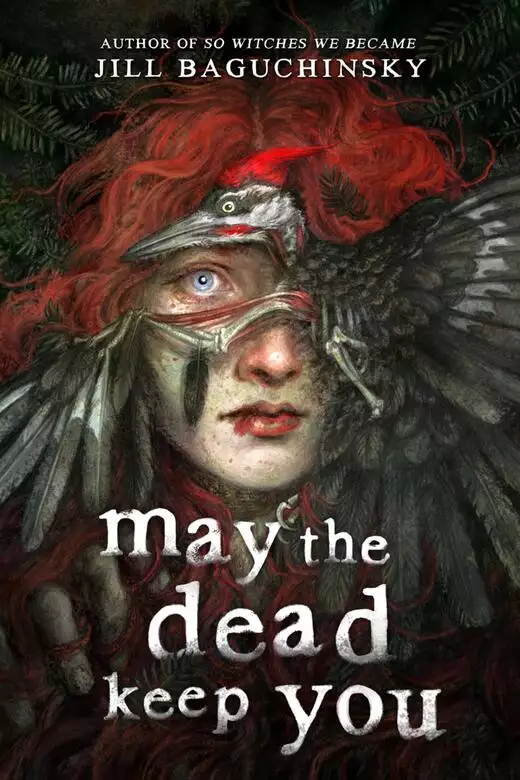
Perfect for fans of Don't Let the Forest In and Wuthering Heights, this gothic horror novel is about the pasts that haunt us and the stories we decide to make for ourselves.
There’s nowhere Catie East would rather be than the redwood forest that surrounds her family’s unusual historic home, the Heights.
She prefers being alone in the forest. People are…complicated. But when a scientist and his son move into the estate’s cottage, planning to study the woods around them, the boy catches Catie’s eye. And when a dead woodpecker miraculously comes back to life in his precious hands…he captures her heart.
Necromancy isn’t the only strange thing happening in the Heights.There’s an unfamiliar face in the mirror. Blood on the floors. Eyes in the wallpaper. And the men around her—including her once-sweet nature boy—are becoming something else. Something possessive and frightening. Something violent.
As the Heights’s dark history starts to come to light, Catie discovers that the home she loves is imbued with pain. And even though the pain isn’t her own, it will corrupt her and the people around her all the same—unless she can stop it.
A story about breaking cycles of abuse and overcoming generational trauma, May the Dead Keep You is an edge-of-your-seat read—equally horrifying, heart-wrenching, and hopeful.
Release date:
April 21, 2026
Publisher:
Little, Brown Books for Young Readers
Print pages:
384
* BingeBooks earns revenue from qualifying purchases as an Amazon Associate as well as from other retail partners.
I’m on my way to the graveyard the evening things start to go wrong.
Barefoot as usual, I jog along on my toes like a careful cat, slipping through feathers of sword ferns and gathers of heart-shaped sorrel. Redwood trunks rise around me like cathedral columns, their dizzyingly high branches forming vaulted arches overhead. The sun that peeked out earlier this afternoon wasn’t enough to burn off the thick tendrils of fog mingling amid the treetops before an evening cloud bank rolled in. That mist clings to branches and needles, condensing, dripping over a ground cover that rarely has a chance to dry. Dusk sighs and settles its way through the forest, shadowing my view of the path before me, but I don’t need much light to find my way, not to this solemn spot.
Ahead, a collection of small painted stones lies amid the roots of a hulking redwood, surrounding it like a fairy ring. The tree is a notable behemoth, even in a forest full of giants; its trunk is more than fourteen feet in diameter, marked by a yawning fire cavity at its base. There was a time—decades ago, probably—when this part of the forest burned. Fire gnawed and snapped away at the redwood’s trunk, charring through to its heartwood and smoldering inside for days or weeks. The tree still lives, just with a natural cave at its base.
I call that tree the Notch—the hollow is large enough for me to fit inside, but it’s little more than a notch in such an enormous trunk. I like to think that the Notch holds and keeps the memories I bring it, the tiny things that would otherwise rot and fade and disappear without ever being noticed. They deserve to be remembered.
Tonight I’m ferrying a mouse, little more than a baby, smaller than my pinky. I found it this afternoon; it lay in the yard near the tree line, already cool and stiff, the blood on its nut-brown fur mostly dry. I don’t know its story, but I can imagine—nature is often cruel, and death is common in the woods. I wrapped it in a scrap of fabric and nestled it in the tiniest box I could find, and now I dig a miniature grave in the rich, dark soil near the Notch and tuck the mouse inside to sleep. After smoothing the dirt back into place, I mark the resting spot with a painted stone from my pocket—light blue this time, with a small mouse silhouette stenciled in navy.
I do this whenever I find a dead animal on our property. My brother says it’s a waste of my time—I could just leave these things to the wilderness, let it claim them back—but does a life deserve less respect just because it’s small and brief?
My mother thinks I’ll catch a disease, touching dead things. But she also thinks I should wear shoes in the woods. She doesn’t understand how well I know this place, how certain I am that my forest won’t hurt me. I let her think that I keep my shoes on out here, just so she doesn’t worry. It’s not always convenient to listen to one’s mother.
I stand and brush the dirt from my hands. The scent of it is deep and lush, a comforting mismatch of decay and potential. I should head back, but first I close my eyes and tilt my face toward the looming treetops. I inhale deeply, filling my lungs with damp forest. There’s a metallic whisper of ozone in the air, and I wonder if it will rain tonight.
My eyes snap open when I hear the voice.
It’s soft, distant. Female, young but not a little girl. At first I assume it was a trick of the breeze, but then it comes again, pleading and too faint to understand.
I hesitate. This forest belongs to my family; it’s private property, clearly posted and remote. No one should be nearby except for the father and son who have arranged to rent our guest cottage, and they haven’t arrived yet. Still, we do get the occasional lost hiker or nosy trespasser. They tend to be harmless, but my fingers slip into my hoodie pocket anyway and wrap around the key chain canister of pepper spray my mother insists I carry in the forest. Just in case, I can almost hear her say. I swallow back my uncertainty and call out, “Hello?”
The voice is slightly clearer this time, although it still sounds far away. I still can’t quite make out what it says, but I almost think it cries please.
Something twists in my chest, and I take a few careful steps in what I think is the right direction. “Where are you? Do you need help?”
The only answer it gives is a fragile, plaintive whimper.
“What are you doing out here?” I keep walking, trying to follow the voice. It could be coming from almost anywhere, echoing weakly through the trees, muted and twisted by the fog. “If you could yell a little louder, it would help me find you!”
Instead, the voice grows quieter, settling into little more than a murmur. I think it says please again, but it’s impossible to tell for sure.
“I’m trying to help you!” I yell, locking my throat against the nervous wobble that tries to work its way into my voice. “I just don’t know where you are!”
Something tickles over my cheek—an insect, I assume. A moth searching for light in the deepening dusk. I reach up to brush it away, but it’s already gone.
The voice is gone, too.
“Hello?” I yell again, and then I go very still, listening. When I don’t get an answer, I keep walking, ignoring the unease that creeps up my spine. If someone’s lost out here, I can’t just leave them alone. It’s getting darker.
But they’ve stopped answering.
I keep walking, listening, hoping, until a far-off growl makes me pause. It’s gruff and mechanical—an engine, not an animal—and it’s accompanied by a faint squeal. Is that squeal what I’ve been hearing? As I pick my way through the shadowed woods, following both sounds now, I catch the distant wink of headlights through the trees on the narrow, twisting dirt road that leads to Cross Cottage. A U-Haul sputters uphill, passing the dusty crossroad that gives Cross Cottage its name. As the van gets closer, some component of its engine squeals again in protest, and I’m surer that the voice I’ve been chasing wasn’t a voice at all.
With a grimace, I watch the U-Haul rattle by. The botanist and his son have arrived.
As the van limps its way up to the cottage, I creep closer and crouch behind a fallen trunk to peek. The Solises will be our neighbors for the next six months while Dr. Solis completes his research for my mother’s company. I want to get a look at these newcomers in my woods.
The weather in Ellis Pass, California, is cool for late May, and I burrow deeper into my oversize sweatshirt, pulling its hood over my auburn hair as I spy on the U-Haul’s arrival. The overtaxed van sighs in relief when its engine finally shuts off, and the squeal fades to nothing. A small Subaru SUV follows behind, handling the incline far more efficiently and parking as the U-Haul’s door swings open.
The mustached man who exits the van looks to be about the same age as my mother—late forties or early fifties, probably, judging by the hints of silver that streak from his temples back through his otherwise dark brown hair. The boy who climbs out of the Subaru with a small animal carrier is undoubtedly his son—they have the same burnt-brown waves of hair, the same tan skin, the same dark eyes. The boy jogs to the porch and finds the key my mother hid under a flowerpot while the man opens the back of the U-Haul and piles moving boxes onto a handcart.
I’ve been hoping they wouldn’t actually show up. The idea of renters in the cottage is odd, unnerving. For years, Earnshaw Forest has belonged just to us—me, my mother, and my older brother, Leigh. It’s such a private place. Leigh has been crossing his fingers that this wouldn’t work out, too—the arrival of the botanist and his son marks the end of my brother’s carefree, rent-free lifestyle in Cross Cottage, at least for half a year. The last tenuous threads of his hope will snap when I get home and deliver the news. I smile a little at the thought of needling Leigh.
The boy reappears from inside the cottage and flips on the porch light on his way back to the van. So this is Hunter. You two used to be friends, my mother had said when she mentioned her plan for the cottage. She prodded my memory, telling me about the study on which she and Dr. Solis collaborated the year I turned five, well before her career went corporate. “You and Hunter spent the whole summer running around together like a couple of wild animals.” Back then we still lived down south, not far from the state’s desert region. It was a long time ago—I’ll be a senior at Ellis High this fall—and the boy at the van isn’t familiar.
Hunter Solis. He looks nice enough, I suppose, but he’s in my space and I have no reason to trust him. His presence clenches my shoulders and tightens the muscles in my core. He’s tall. Narrow. Bookish, maybe. I suppose that’s not something you can tell about a person just by looking, but the bulky box marked Books—Hunter that he hefts from the U-Haul helps confirm my suspicion. Ivy would say that he looks like a nerd—but Ivy thinks all boys are uninteresting nerds. I agree with her about most of them, though there are exceptions, now and then.
But I’m not sure I’m willing to make an exception for one who insists on being in my forest. His father’s work isn’t Hunter’s fault, but that doesn’t change the fact that he’s here.
I stare at the boy and dig through old recollections, searching for some hint of a childhood friend I don’t remember. He stacks a green shoebox on top of the box of books, and something comes to me—a glimpse of an arid yard, a prickly plant, a landscape of sprawling tan. Something… special, and then it’s gone. I can’t hold on to it.
Hunter carries the boxes into the cottage and comes back for more. He wears a well-worn flannel over a faded souvenir T-shirt—I think it says something about Canada, though I’m too far away to tell for sure—but he looks like the kind of boy who would be at home in a soft gray sweater, one that would match the misty gray of the deepening twilight around him. Beneath the stark slashes of his brows, his dark eyes look tired, and I wonder if it’s from all the fuss that goes along with moving, or if that’s just the natural, slightly sleepy shape of them. Maybe he always looks that way.
Dr. Solis returns, and he and Hunter set to work wrestling an enormous storage bin from the U-Haul. The botanist says something, and while I can’t hear his words, there’s a warning in his expression that Hunter doesn’t heed. One corner of the bin catches on something in the van, drags it out, and sends it toppling onto the dirt driveway. Hunter yelps in alarm and jumps down after it, crouching out of view. When he straightens, he’s cradling a taxidermy deer head, the sort made to hang on a wall as a trophy. The fall snapped it from its wooden plaque, and one ear dangles from a strip of loose fur.
People have different tastes, different ethics, and I suppose I can appreciate the value of hunting, even though I’d never do it myself. But I’ve never understood the urge to display dead things like decor. My stomach twists as I think of the mouse I just buried and its neighbors in my graveyard. The deer won’t know that sort of peace, not as it is now—decapitated, broken, staring through blind glass eyes. Hunter Solis looks absolutely crushed that it’s been damaged, reinforcing my dislike of the narrow, bookish, tired-eyed boy. Maybe we were briefly friends as children, but that was long ago.
Still, I can’t pull away—not yet. I keep watching as he fusses with the taxidermy, his long fingers fiddling with the hanging ear. He puzzles the pieces back together, muttering as he tests the cleanness of the tear, measures whether it can be glued. His father makes a comment and takes the head from him, then carries it toward the cottage as Hunter reluctantly ducks back into the van. He emerges with two more taxidermy creatures—a brown rabbit and something I believe is a small fox—and my annoyance flares again. I think of the animal carrier and cringe, wondering if it holds his next project.
I’m so caught up in the satisfaction of feeding my ire that at first I barely notice the prickling sensation on the back of my neck. The feeling sharpens, an almost physical tickle of warning and dread. I instinctively go very, very still, and I listen.
Behind me, something stirs in the underbrush. It’s a gentle rustle, a whisper of movement—a single step or a slight shifting of weight. It’s just an animal, I tell myself. Or it’s the wind. Nothing more.
But the sound that follows—the soft clearing of a throat, as if to summon my attention—is uniquely human, and it ices the pit of my stomach.
While I’ve been watching Hunter, someone’s been watching me.
Without moving my head, I shift my eyes hard to the side, forcing them farther and farther until they ache. It’s not enough, and finally I have to turn my head, just a little, slowly, slowly. I grind my teeth, locking them together against whatever sound of alarm and surprise would otherwise escape. Whoever’s there, I don’t want them to know that I know. Did the Solises bring someone with them? Surely I would have noticed a third person exit the van or the Subaru and head into the woods. As my pulse pounds in my ears, some disjointed little voice in the back of my brain complains that my forest is entirely too crowded tonight.
All I can see are shadows. I inch my head around a little more, and my breath catches with a quick, sharp gasp that wrenches my windpipe shut.
Someone stands there in the growing dark, maybe ten feet away, lurking between two wide trunks. I can’t make out many details, but I get the impression of a man. He’s tall and gaunt, and I think I catch the glint of glasses when he tilts his head. He’s smiling, but it’s a ghastly smile, almost a leer, that stretches wide and taut over his face. My throat tightens against a throttled scream, and I scuttle around, staying low, tensing. My shaking fingers fumble for the pepper spray again, grab it, lose it. With or without it, I’m ready to face the man, ready to fight.
He’s not there.
Still crouching, I search the woods with wide, wild eyes. Where the man stood, a tall sapling stretches from a clump of ferns, its branches lilting in the damp evening breeze.
A tree. Just a tree and the rustle of the wind. I gasp in a needed breath and stare for a moment longer, still unsure, but the tree remains a tree and my mood shifts from panicked to embarrassed. Still trembling, I press a hand to my chest, where my heart thrums against my rib cage like a mallet striking the keys of a xylophone.
A bird pipes up in the branches overhead, its rapid-fire cry shrilling through the drifting fog like half-mad laughter. My pulse is still rabbiting, and the unexpected noise ignites my overwrought system with a spark of fresh adrenaline. With a startled yelp, I leap to my feet, scrambling for safety like a mouse in the shadow of a swooping hawk. I press myself against a tree and peer up, leg muscles twitching and ready to flee.
Above me, a black-and-white woodpecker sits on a branch, its red-crested head thrown back as it trills again.
“Really?” I shake my head, about to launch into a few choice words for the bird.
Then I remember where I am and what I was doing before I started cowering from saplings and scowling at woodpeckers, and I slowly turn back toward the cottage and the glow of its porch light.
The narrow, bookish boy still stands near the U-Haul, rabbit under one arm, fox under the other. When our eyes meet, his brow furrows.
Heat blazes across my cheeks and all the way to the tips of my ears.
The boy opens his mouth.
Closes it.
Glances back toward the cottage and inhales as if he’s about to holler for his father.
I run.
Heedless of the scratch of fallen branches and rough underbrush against my bare feet, I sprint back past the Notch, through the graveyard, down the familiar path. I don’t know why I keep running; it’s not as if Hunter has any reason to chase me, but my brain and body have flashed straight to flight mode, and doing otherwise isn’t possible. I don’t stop until I reach the tall iron fence that separates our lawn from the forest, and then I only pause long enough to pound a code into the number pad mounted near the front gate. As soon as it opens, I zip inside and shove it shut behind me. I lean forward, catching my breath as I check the soles of my feet for injuries. There are none; my forest watched out for me, as it always does.
The house ahead—the Heights—is an eccentric giant. Half midcentury mansion, half medieval-castle keep, it’s a sprawling, squatting anachronism that shouldn’t be here in this overgrown place, surrounded on all sides by fence and forest. It curls in on itself, tensed like a lurking dragon, while its windows are wide and watchful, giving it the keen, hungry look of a beast on the hunt.
It shouldn’t exist, this odd, hulking ogre of a house. It doesn’t make sense here.
It’s perfect.
I’m home.
This, Patrick—this is where I want to live, a place like this. Not a hotel, of course, but a house in this style. Isn’t it wonderfully silly? Can you imagine? You’ll build it for me someday, I know you will. You’ll tell me I’m ridiculous but then you’ll build it anyway, and I know you think I’m joking, I can picture your face right now, that adorable little frown of yours. You’ll build me a ridiculous castle, and I’ll do it all up in the prettiest shades of red, just like this place, and we’ll live happily ever after.
I miss you so much, darling. I’m seeing so many wonderful things, but you’re all I can think about, and part of me regrets signing up for this program every single day. Why did I want to study abroad when everything I need is right there at home in California? Right there with you. I know it’s only a few more months, but it feels like forever until I’ll see you again. Don’t forget me, all right?
Love, Essie
P.S. I saw the most delightfully silly gargoyles in Paris last week. They look so ghoulish but they’re actually protectors, the guide said. I’d like my castle to have some of those, too.
The Heights is a pleasant ten-minute walk through the woods from Cross Cottage, provided you know where you’re going and the forest lets you get there. Embarrassed panic lets me cover the distance in half that time.
Still breathing hard, I cross the lawn and skip the Heights’ massive front doors and the enormous stone gargoyle that guards them, its face frozen in a bulldog snarl as it hunches on the landing of the sprawling front steps. Instead, I follow the path of flat gray stepping stones around the side of the house to the rear entrance. Once upon a time, when a renowned architect named Patrick Earnshaw bought up this entire patch of forest and built his family a ridiculously, charmingly bewildering house right in the middle of it, he intended the rear entrance to be for staff and deliveries. We use it as an easy way to bypass the cavernous great room on our way to the kitchen, which is where we usually gather when we’re downstairs. It’s where I know I’ll find my brother, Leigh, and our mother—her car is out front, so she’s home from work at a reasonable hour, which is a nice surprise.
Before going inside, I step into the pair of sneakers I’d stashed under the low hedge that meanders around most of the house. The hedge is as overgrown as the grass—shaggy and unkempt, with stray branches sticking out in all directions, and thick clumps of leaves like botanical bed head. Most of the basic landscaping chores around the Heights are Leigh’s responsibility, or at least they’re supposed to be; his unmatched procrastination skills make the untidy hedge a perfect place to hide the shoes Mom thinks I wear on my walks in the woods. She doesn’t understand how much more connected and grounded I feel with the dirt and the moss and the damp debris of the forest floor between my toes.
There’s another keypad at the rear entrance, this one for the Heights’ interior security system. The system and the high-tech fence are two of the few modern updates Mom insisted on after we moved in—when your home is remote and slightly infamous, safety can be a concern. As I type in the code, I remember the man I thought I saw in the forest—gaunt cheeks, a glint of glass. Although he turned out to be a harmless sapling, the beep of the system when I slip into the mudroom and lock the door behind me is reassuring.
The rich, heavy scent of a well-seasoned cream sauce greets me when I reach the kitchen, wrapping me in a familiar comfort that banishes the last threads of my unease. My mother stirs a pot at the stovetop while Leigh half-heartedly doles servings of salad into bowls. “There she is!” Mom says, glancing over her shoulder to smile at me. That smile dims a bit at the flush on my face, and brittle concern creeps into her tone. “Catie? Everything okay?”
I glue a smile of my own in place. “Of course! Just taking a walk.”
Her brows tilt slightly. “You were wearing shoes out there, right?”
“Of course,” I say again as I raise one leg like a dancer, showing off my sneaker.
“She’s lying,” Leigh says, chuckling. “She just put those on before she came in. I saw her on the cam.” He holds up his phone with the security camera app open.
Damn it. “Why were you checking the app?”
He grins. “They just released an update. There’s a new feature that sends a notification when one of the cameras detects a person.”
That’s going to make my walks a tiny bit more complicated. I roll my eyes at my brother. Leigh and I love each other. We really do. But sometimes he can be the most phenomenal pain in the ass.
Then again, so can I.
“Oh, Catie,” Mom says. “There are so many snakes out there!”
“I was careful.” We’ve had this discussion before, along with ones about swarming ants and sharp thorns and bacteria in the soil. “Besides, you know being barefoot’s in my blood.” My father always hated shoes, too.
“True,” Mom says. Her smile turns wistful and tight for a moment before she snaps back to the present and kisses my cheek. “I just worry sometimes, having a daughter who’s such a free spirit.”
Leigh gives a short snort of a laugh. “More like half-feral.”
“That’s not nice,” Mom says, but it’s also not wrong. Dad left when I was eleven. In the six years since, some of my memories of him have turned misty, almost dreamlike. But I remember the wildness in his work—his mixed-media canvases with three-dimensional sculptural elements poised to break free—and I like to think I inherited some of that spirit and talent along with his auburn hair and freckles. Leigh, meanwhile, got Mom’s sandy-blond hair and hazel eyes but not her mind for business.
“Just hear me out,” Leigh says to Mom, jumping back into a conversation they must have been having when I walked in. “All I’m saying is that with the right grow-light system—”
Mom dumps the contents of the pot into a strainer. “We’ll talk about it later, okay?” she says. “I know you’re excited, but there’s a lot to consider before jumping in.”
“I’m not jumping in,” Leigh says, plonking the salad bowls onto the kitchen table with a little too much force. “I’ve done my research.”
“Wait, is this the weed thing again?” I ask, smiling mock-sweetly at my older brother. “Leigh, smoking that stuff every day isn’t research.”
Leigh shoots me a quick scowl. “It’s market research. And it’s not every day.” Leigh is an entrepreneur—and by entrepreneur, I mean he’s spent the five years since he dropped out of college coming up with start-up ideas that never get off the ground, all funded mostly by our mother. His latest scheme is cultivating some amazing new cannabis strain and starting his own weed brand, since recreational usage is legal in California. I expect the endeavor to go about as well as his attempts to break into day trading or his forays into crypto.
“Speaking of weeds and grass,” Mom says, “Leigh, you’ve got some chores to catch up on tomorrow. You too, Catie. See to the dusting, okay?”
I nod. While the lawn and the hedge trimming are Leigh’s responsibilities, I’m tasked with several inside chores, like dusting. I don’t mind; you’d expect an older house full of oddities to collect piles of dust and grime and cobwebs, but whenever I check the furniture in the great room or the shelves in the library, my hand comes away clean. For some reason, this place doesn’t get dusty. But Mom thinks I do a good job of keeping up with things, and I’m not about to let her find out otherwise.
“So the Solises are here,” I announce as revenge for Leigh’s feral comment. “I, um, saw them moving in while I was on my walk.”
Leigh groans and slumps into a kitchen chair. “I still can’t believe you gave away my house,” he grumbles at Mom as she puts a bowl of fettuccine Alfredo on the table.
“I didn’t give it away,” Mom says as if they haven’t already had this conversation half a dozen times. “I rented it out, and for good reason. You know how important Dr. Solis’s research could be for Gimmerton Labs. If his tannic acid hypothesis holds up—”
“You’ll get a huge bonus,” Leigh interrupts dully.
“Gimmerton Labs will save a lot of lives,” Mom corrects.
“And make a lot of money,” I say. While I appreciate the privileges that come with having a mother who’s the CEO of one of the largest pharmaceutical companies in the country, I’m not exactly a cheerleader for the industry itself.
“That too,” Mom says, her tone taking on an edge of fatigue. “Keep your fingers crossed about Dr. Solis’s research, both of you. If he can make this work, it’ll be important for Gimmerton. It’ll be important for all of us.”
Her words make my mouth go dry. Despite its powerful reputation, Gimmerton has been struggling for a while. During Leigh’s day-trader phase, he kept harping on the company’s dropping stock price, and while I didn’t understand all the details around that (let’s be fair, neither did Leigh), I could see the effect the situation was—and still is—having on Mom.
If Mom loses her job, we’ll have to sell the Heights. It’s a somewhat-famous house in architectural circles. She gets offers on it sometimes, even though it’s not on the market. Good offers. Offers I know it’s hard for her to turn down when she’s worrying about her future at Gimmerton. Maybe we could manage by selling some of its oddities and treasures instead, at least for a while, but those things be. . .
We hope you are enjoying the book so far. To continue reading...

 Please log in to recommend or discuss...
